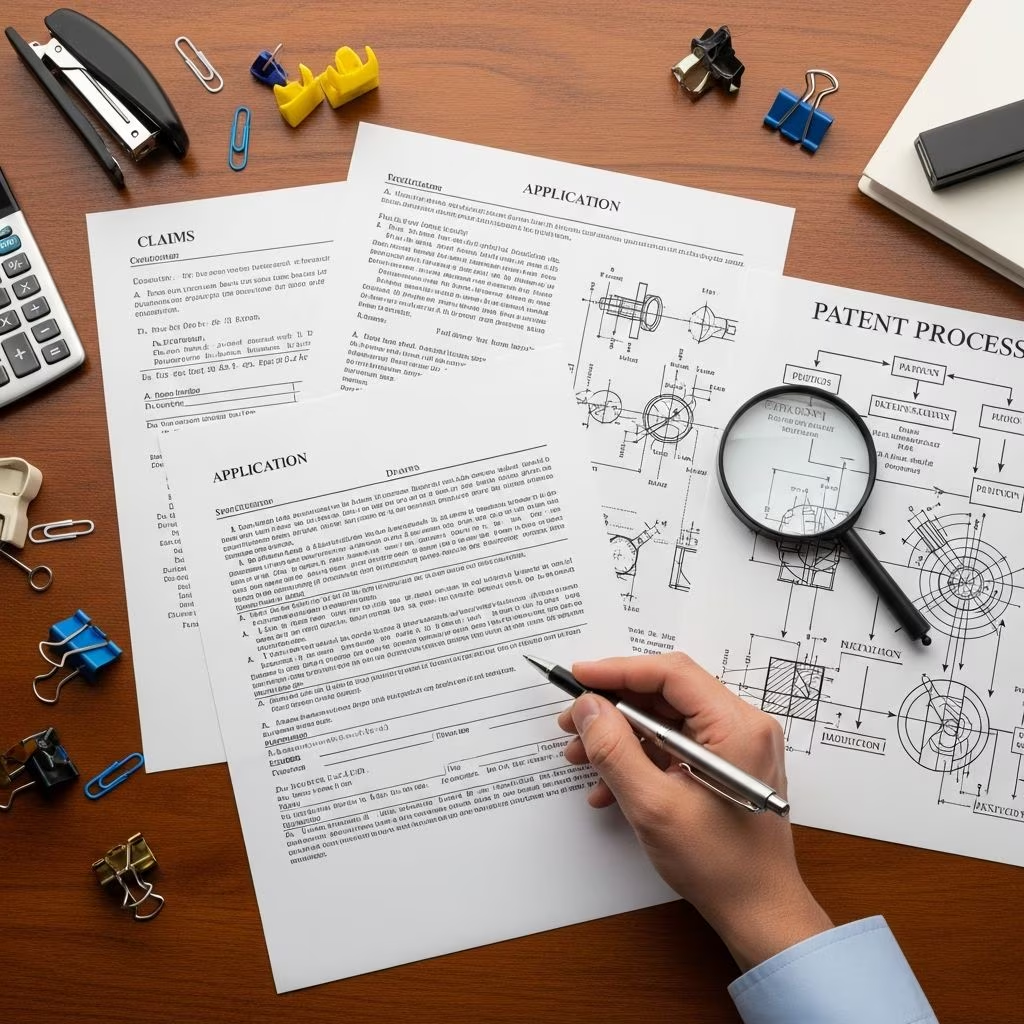
Securing a patent grants inventors exclusive rights to their creations for up to 20 years, preventing others from making, using, or selling the invention without permission. This process involves rigorous preparation, submission to the United States Patent and Trademark Office (USPTO), and examination, typically spanning 2-3 years. Understanding each phase ensures higher success rates and avoids costly errors.
Understanding Patent Types and Eligibility
Patents protect different innovations: **utility patents** cover new processes, machines, compositions, or improvements (20-year term); **design patents** safeguard ornamental designs (15 years); and **plant patents** protect asexually reproduced plants (20 years). To qualify, inventions must be novel, non-obvious, and useful—not abstract ideas, laws of nature, or natural phenomena.
Before investing time, evaluate commercial viability. Provisional applications offer a low-cost ‘patent pending’ status for 12 months ($800 USPTO fees), ideal for market testing. Skip patenting if the market is under $10 million or easily circumventable.
Conducting a Thorough Prior Art Search
A comprehensive prior art search is crucial to confirm novelty. Brainstorm terms describing your invention’s purpose, structure, and function, then use USPTO’s Patent Public Search Tool and Classification Text Search for Cooperative Patent Classifications (CPC). Review patents, applications, non-patent literature, and international databases like WIPO’s PatentScope.
- Identify similar inventions via CPC codes and definitions.
- Analyze 50-100 documents for overlapping features.
- Document findings to support claims during examination.
Professional searches by attorneys reveal hidden risks, preventing rejections.
Preparing Essential Patent Drawings
High-quality drawings are mandatory, showing every aspect clearly with numbered references matching the description. Use black ink on white paper, precise margins, and multiple views (e.g., exploded assemblies, flowcharts for processes). Simple inventions need 3-5 sheets; complex ones 10-15, costing $100-300 per sheet professionally.
| Patent Type | Drawing Requirements | Examples |
|---|---|---|
| Utility | Technical diagrams, schematics | Cross-sections, exploded views |
| Design | Photographs or line drawings | Multiple angles of ornamental features |
| Plant | Duplicate color photos/drawings | Botanical details, specimens |
Poor drawings lead to rejections; always reference numbers in text.
Drafting the Patent Specification
The specification forms the application’s core, enabling a skilled artisan to replicate the invention. Structure it sequentially:
- Title: Concise and descriptive.
- Background: Problem solved and prior art limitations.
- Summary: Invention’s essence and objectives.
- Detailed Description: Step-by-step making/using, with drawing references.
- Claims: Define protected scope—independent (broad) and dependent (narrow).
- Abstract: 150-word summary on separate page.
For plant patents, include Latin name, variety, and botanical description. Claims must align perfectly with the description to avoid indefiniteness rejections.
Assembling Application Components
Nonprovisional utility applications require:
- Transmittal and fee forms.
- Application data sheet.
- Specification, drawings, oath/declaration.
- Sequence listing if applicable.
Design applications omit claims but need spec and visuals; plant apps require duplicate drawings. File electronically via Patent Center to avoid surcharges—create a USPTO account 24-48 hours early. Fees start at $800 (provisional) to $1,820 (utility small entity).
Submitting to the USPTO and Initial Review
Upon submission, receive a filing receipt with number and date—your priority date. USPTO checks completeness; fix deficiencies within the deadline or risk abandonment. Complete apps assign to examiners.
Publication occurs 18 months post-filing (unless non-publication requested), alerting the public.
Navigating the Examination Process
Examiners assess patentability, issuing a First Office Action (allowance or rejections/objections). Common issues: prior art, claim breadth, enablement.
- Respond within 3-6 months: Amend claims, argue distinctions, submit evidence.
- Non-Final Rejection: Opportunity to traverse.
- Final Rejection: Appeal, continue (RCE, ~$1,500), or abandon.
Most apps face 2-3 office actions; attorney responses boost allowance rates to 70%. Process averages 24 months.
From Allowance to Issued Patent
Notice of Allowance triggers issue fees ($1,200 small entity). Pay within 3 months, submit post-issue docs. Patent issues ~3 months later, lasting 20 years from filing (maintenance fees at 3.5, 7.5, 11.5 years).
International Filing Strategies
For global protection, file PCT within 12 months of US priority, claiming 30-31 month runway before national phases. Selectively enter key markets (e.g., EU, China) to control costs—overseas attorneys required.
Common Pitfalls and Pro Tips
Avoid public disclosure pre-filing (destroys novelty outside 1-year grace period). Use NDAs for discussions. Budget $10,000-$20,000 total for attorney-assisted filing. Track deadlines via Patent Center.
| Pitfall | Consequence | Solution |
|---|---|---|
| Inadequate search | Late rejections | Professional prior art analysis |
| Poor drawings | Delays/rejections | Hire illustrators |
| Broad claims | Obviousness rejection | Layer independent/dependent claims |
Frequently Asked Questions (FAQs)
What is the cost to file a patent?
USPTO fees: $320 provisional, $1,820 utility (small entity). Attorney fees add $5,000-$15,000.
How long does patent approval take?
24-36 months on average, with 2-3 office actions.
Do I need a lawyer to file?
No, but recommended—pro se apps have <50% allowance vs. 70% with counsel.
Can I file internationally?
Yes, via PCT within 12 months for 150+ countries.
What if my app is rejected?
Respond to office actions; appeal to PTAB if final rejection.
References
- Applying for Patents — USPTO. 2025. https://www.uspto.gov/patents/basics/apply
- A Step-by-Step Guide to Filing a Patent — Stanzione & Associates, PLLC. 2024. https://www.stanzioneiplaw.com/a-step-by-step-guide-to-filing-a-patent/
- How to File a US Patent: Step-by-Step Guide — Daniel Law Offices, P.A. 2024. https://danielpatents.com/how-to-file-a-us-patent-step-by-step-guide/
- Patent Process Overview — USPTO. 2025. https://www.uspto.gov/patents/basics/patent-process-overview
- 7 Steps to Patent Protection — Cooper IP. 2024. https://cooperip.com/7-steps-to-patent-protection/