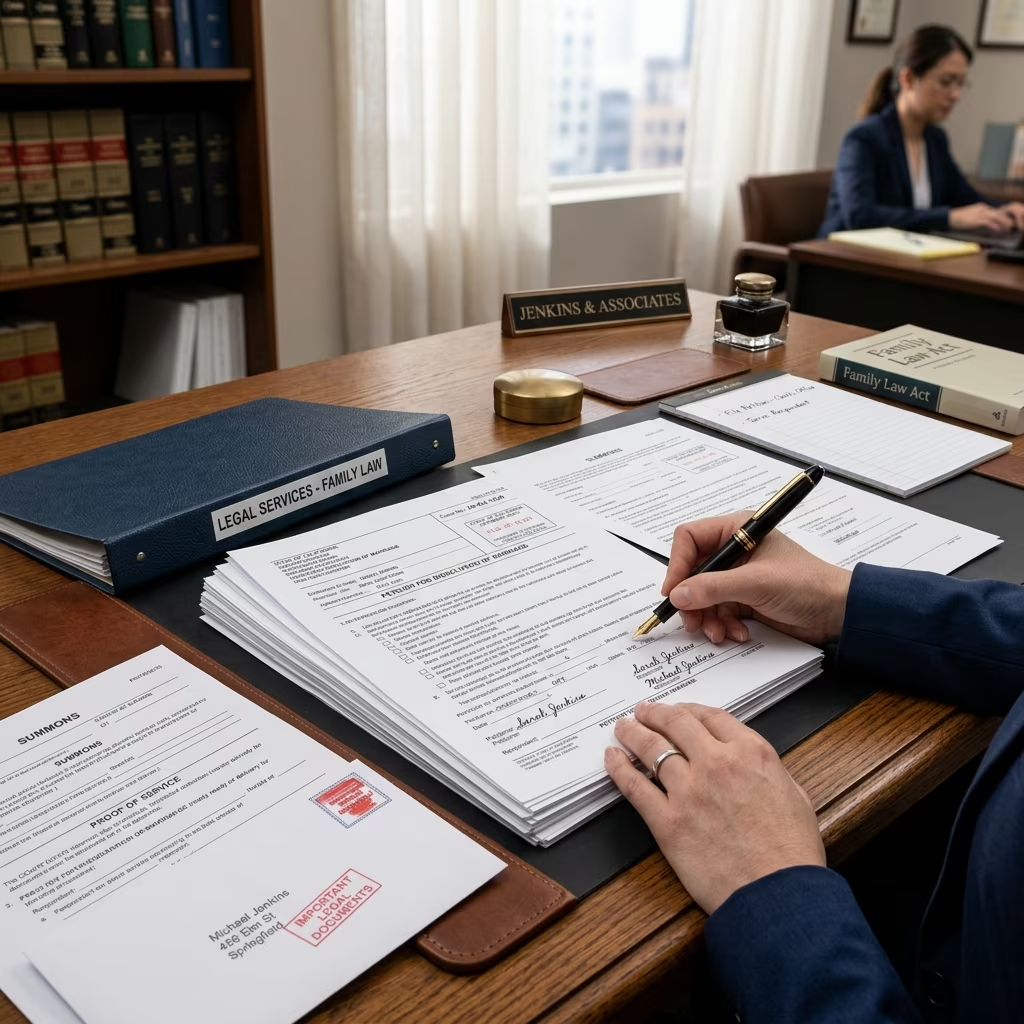
Launching a divorce case is more than telling the court you want to end your marriage. It involves formal paperwork, strict service of process rules, and specific deadlines that must be followed to protect both spouses’ legal rights. This guide walks you through the major steps: preparing and filing the petition, serving your spouse correctly, documenting service, and understanding how your spouse may respond.
Understanding What a Divorce Petition Does
The divorce petition (sometimes called a complaint or dissolution petition) is the document that officially starts the case with the court. It notifies the court and your spouse that you are seeking a divorce and usually sets out your requests regarding property, debts, support, and parenting issues.
| Feature | Typical Content |
|---|---|
| Parties | Names, addresses, and basic information about both spouses |
| Jurisdiction | Facts showing the court has power to hear the case, including residency |
| Grounds for divorce | No‑fault (e.g., irretrievable breakdown) or fault‑based reasons, depending on state law |
| Requests to the court | Proposed arrangements for property division, spousal support, child custody, and child support |
| Signature and verification | Petitioner’s signature, sometimes under oath or affirmation |
Before You File: Jurisdiction, Residency, and Grounds
Every state has its own rules about who can file for divorce and where the case must be started. Filing in the wrong court or before you meet residency requirements can delay your case or cause it to be dismissed.
Checking Residency Requirements
Most states require at least one spouse to have lived in the state for a minimum period before filing. For example, Texas generally requires a spouse to have lived in the state for at least six months and in the filing county for at least 90 days. Similar residency rules exist in many jurisdictions, though the exact time periods differ.
- Review your state’s residency rules on an official court or state law library website.
- Gather documents that show your residence, such as leases, utility bills, or identification.
- If you recently moved, consider whether waiting to file may be necessary to satisfy residency.
Choosing Grounds for Divorce
States recognize no‑fault grounds and sometimes fault‑based grounds.
- No‑fault grounds typically involve an irretrievable breakdown of the marriage or irreconcilable differences.
- Fault‑based grounds can include adultery, cruelty, desertion, or other misconduct, depending on local law.
No‑fault divorce is widely available and often simplifies the process because it focuses on the marriage’s breakdown rather than proving blame.
Preparing the Divorce Petition and Related Forms
Once you confirm you can file in your state, the next step is completing the required forms. Many court systems publish standardized divorce packets for self‑represented litigants.[10]
Common Documents in a Divorce Filing
- Petition or complaint for divorce – the primary document starting the case.
- Summons – gives formal notice of the lawsuit and deadlines to respond.
- Financial disclosures – statements listing income, expenses, property, and debts.
- Parenting forms – if you have minor children, forms addressing custody, visitation, and support.
Accuracy is critical. Incomplete or incorrect information can create delays or require amendments later on. When in doubt, consult a lawyer or review official self‑help resources from your state courts.[10]
Filing the Divorce Petition with the Court
Filing is the moment your divorce case officially begins. You present your completed forms to the clerk of the appropriate court, pay any required fee, and receive a case or index number.
Choosing the Correct Court
Your filing location usually depends on residency and where you or your spouse currently live. For instance, in Texas, you file in the district court of the county where either spouse has lived for at least 90 days, provided the state residency rules are met.
Filing Steps
- Make at least one copy of each form for your records.
- File the original petition and accompanying documents with the court clerk.
- Pay filing fees or request a fee waiver if you qualify based on income.
- Obtain file‑stamped copies and note your case number for future documents.
After filing, the case exists in the court system, but your spouse’s rights are not fully engaged until they are properly served.
Service of Process: Giving Legal Notice to Your Spouse
“Service of process” is the formal, legally recognized way of delivering court papers to the other party. Proper service ensures your spouse has a fair chance to respond and participate in the case.
Why Proper Service Matters
If service is not done correctly, the court may delay the case, refuse to enter certain orders, or even dismiss the petition. Service rules are designed to guarantee that your spouse receives notice through reliable methods.
Who Can Serve Divorce Papers?
In most states, the petitioner cannot serve the papers personally. Instead, a third party must act as the server.
- The server must typically be at least 18 years old and not a party to the case.
- Permitted servers often include professional process servers, sheriff’s deputies, or qualified adults such as friends or relatives who meet the criteria.
Common Methods of Serving Divorce Papers
Although specific procedures vary by state, several methods of service are widely used.
- Personal service – The server hands the papers directly to your spouse, or leaves them nearby after identifying the spouse and explaining what the documents are.
- Substituted service – If personal service is not possible, the court may allow delivery to a responsible adult at your spouse’s home or workplace plus mailing a copy.
- Service by mail – Papers may be mailed using a method that confirms receipt (for example, certified mail with return receipt), often accompanied by an acknowledgment form your spouse must sign.
- Service by publication – If your spouse cannot be located despite diligent efforts, a court may permit notice to be published in a newspaper as a last resort.
Courts frequently impose deadlines for completing service. Some jurisdictions require service within a fixed number of days after filing, and extensions may be granted only for good reason.
What Must Be Served on Your Spouse?
Your spouse must receive enough information to understand the case and respond appropriately.
- A copy of the filed petition or complaint for divorce.
- The summons, which includes basic case information and response deadlines.
- Any temporary court orders that apply at the start of the case.
- Blank response forms or instructions, as required by some court systems.
Check your local court’s rules or self‑help materials to ensure you serve every required document.[10]
Proof of Service: Documenting That Notice Was Given
After service is completed, the server usually must fill out a proof of service form (sometimes called an affidavit of service) describing how, when, and where the papers were delivered.
Information Typically Included
- Date and time the papers were served.
- Location of service.
- Method used (personal, mail, substituted, publication).
- Name of the person served and their relation to the case.
The server signs the document, often under penalty of perjury, and returns it to you. You then file the original proof of service with the court clerk and keep copies for your records.
After Service: How Your Spouse Can Respond
Once your spouse has been officially served, they generally have a set period to respond—commonly around 20 to 30 days, depending on the jurisdiction. Their response shapes how the case will move forward.
Types of Responses
- Agreement with the petition – If your spouse agrees with the requests, the case may move relatively quickly toward an uncontested divorce.
- Partial or full disagreement – Your spouse can file an answer contesting some or all of your proposals regarding property, support, or parenting.
- No response – If your spouse does not respond by the deadline, you may be able to ask the court for a default judgment, subject to local requirements.
Contesting the Divorce or Its Terms
When a spouse disagrees with the divorce itself or with specific terms, they can contest the case by filing an answer or other responsive pleading. Their filing may request different outcomes for division of assets, spousal support, custody, or child support.
In some locations, if a spouse is served initially with a summons with notice rather than a full complaint, they must file a notice of appearance and demand for complaint to ensure they receive detailed allegations and can present their own claims.
Special Situations with Service
Not every case fits neatly into standard service rules. Courts have procedures for handling unusual circumstances while still protecting fairness.
Unable to Locate Your Spouse
If you cannot find your spouse despite reasonable efforts, you may ask the court to allow alternative methods of service such as publication or substituted service. The court will typically require proof of diligent search before granting this relief.
Service Out of State or Internationally
Serving a spouse who lives in another state or another country can involve additional rules, including state‑specific statutes, federal law, or international conventions. In these situations, legal advice is often crucial to avoid procedural errors.
Practical Tips for Managing the Filing and Service Process
Divorce procedures can feel overwhelming, but some practical steps can make the process more manageable.
- Use official resources – Many state courts offer step‑by‑step self‑help guides for starting a divorce and serving papers successfully.[10]
- Stay organized – Keep a binder or digital folder with copies of all filings, proofs of service, and court notices.
- Track deadlines – Note time limits for serving the petition and for your spouse’s response to avoid delays.
- Consider legal counsel – Even if you start the case yourself, speaking with a family law attorney about strategy and local practice can be valuable.
Frequently Asked Questions (FAQs)
Do I have to serve the divorce papers myself?
No. In most states, you are not allowed to serve your own divorce papers. A neutral adult, such as a process server, sheriff’s deputy, or other qualified person, must serve them.
What happens if my spouse refuses to accept the papers?
Refusing to take the papers usually does not prevent service. For personal service, the server may leave the documents near your spouse after explaining what they are, and service can still be valid. Courts may also authorize alternative service methods when a spouse actively avoids service.
How long does my spouse have to respond?
Response deadlines vary by state, but a common timeframe is about 20 to 30 days from the date of service. Your summons or local rules should specify the exact deadline.
Can I get a divorce if my spouse does not respond?
Yes, in many jurisdictions you can request a default judgment if your spouse fails to respond by the deadline. You will still need to prove certain facts to the court, and the judge will review your proposed orders for fairness and compliance with state law.
Where can I find reliable information about my state’s rules?
The best sources are official court websites, state law libraries, and recognized legal aid organizations.[10] These resources provide up‑to‑date forms and instructions tailored to local procedures.
References
- What are the basic steps for filing for divorce? — WomensLaw.org. 2023-02-01. https://www.womenslaw.org/laws/de/divorce/basic-info/what-are-basic-steps-filing-divorce
- Serve your divorce papers — California Courts, Self Help Guide. 2024-05-01. https://selfhelp.courts.ca.gov/divorce/start-divorce/serve
- Serving & Answering a Legal Petition for Divorce — Justia. 2022-09-15. https://www.justia.com/family/divorce/the-divorce-process/serving-and-answering-a-divorce-petition/
- Serving the Divorce Papers On Your Spouse — LawHelp.org (D.C.). 2021-11-10. https://www.lawhelp.org/dc/resource/serving-the-divorce-papers-on-your-spouse
- Filing for Divorce – Guides at Texas State Law Library — Texas State Law Library. 2023-06-20. https://guides.sll.texas.gov/divorce/filing-for-divorce
- How to File For Divorce in New York — New York City Bar Association. 2020-03-01. https://www.nycbar.org/get-legal-help/article/family-law/ending-your-marriage/filing-a-divorce-action/
- Divorce Frequently Asked Questions (FAQs) — New York State Unified Court System. 2022-04-01. https://www.nycourts.gov/divorce-resources/divorce-frequently-asked-questions-faqs