
Spotting and Avoiding eJuror Jury Duty Email Scams
Learn how to recognize fake eJuror jury duty messages, protect your identity, and safely respond when you receive suspicious court-related communications.
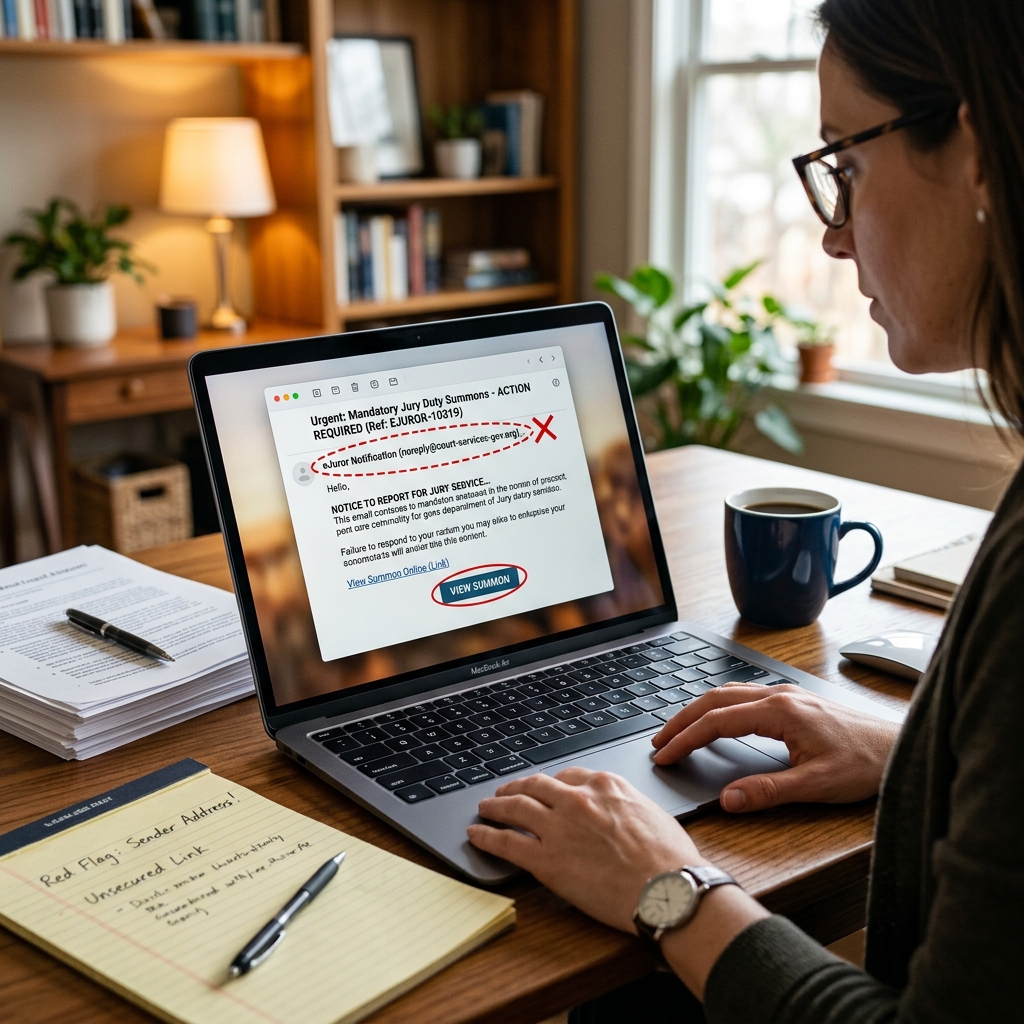
Across the United States, scammers are exploiting the civic duty of jury service by sending fraudulent emails and messages that appear to come from legitimate court systems or the eJuror online jury registration program. These scams are designed to trick you into revealing sensitive personal information or making fraudulent payments, often under the threat of fines or arrest. Understanding how these schemes work and how genuine court communications are handled is essential to protecting yourself from identity theft and financial loss.
What Is the eJuror Jury Duty Email Scam?
The eJuror jury duty email scam is a type of phishing scheme that impersonates federal courts or uses the name of the legitimate National eJuror Program to gain your trust. In many reported cases, recipients receive an email claiming they have been selected for jury service and are instructed to complete an attached form or click a link to provide personal data. The data requested often includes highly sensitive information that can be used for identity theft.
According to the Administrative Office of the U.S. Courts, these emails are not connected to the federal courts or to the official eJuror system. They are crafted to look official—with seals, case numbers, or formal language—but their purpose is to steal your information or infect your computer with malware.
Typical Features of the Scam
- Claims that you have been selected for federal jury duty or must update your juror information.
- Requests sensitive data such as Social Security number, driver’s license number, date of birth, or mother’s maiden name.
- Contains attachments (often PDF forms) or links that you are asked to open or return by email.
- May threaten fines, arrest warrants, or other penalties if you do not respond quickly.
- Uses the name “eJuror” or references to “federal court” to seem legitimate.
How Legitimate Jury Communications Really Work
To recognize a scam, it helps to know how real jury communications are typically handled. Federal courts and many state courts follow consistent practices designed to protect your privacy. These official procedures differ in important ways from what scammers do.
Official Contact Methods
Federal courts primarily contact prospective jurors through the U.S. mail, not through unsolicited email or phone calls. While some courts use online systems or limited phone or text messages to coordinate attendance, these contacts do not ask for highly confidential information via email or phone.
- Most initial jury summonses arrive by regular postal mail.
- Any online juror questionnaires are accessed through secure court websites, not through email attachments.
- Courts may confirm simple details (like scheduling) by phone, text, or email but will not demand Social Security numbers or payment.
Key Security Rules Used by Courts
Multiple federal and state judicial systems have issued public warnings to clarify what legitimate court staff will never do.
- Courts do not require sensitive personal data (such as full Social Security numbers) to be sent by email or over the phone.
- eJuror never asks that personal identification information be sent directly in an email response.
- Social Security numbers are not required when completing standard online jury forms for federal courts.
- Court officials will not ask for immediate payment—especially via wire transfer, prepaid cards, cash apps, or cryptocurrency—to avoid arrest for missing jury duty.
Comparison: Real Jury Contact vs. Scam Messages
| Aspect | Legitimate Court Communication | Jury Duty Scam |
|---|---|---|
| Initial contact method | Usually postal mail with official summons or questionnaire. | Unsolicited email, text, or phone call claiming urgent action is needed. |
| Request for sensitive data | Limited information through secure forms; full SSN normally not emailed or phoned. | Demands SSN, driver’s license, bank details, or mother’s maiden name via email or phone. |
| Threats and pressure | Information on legal obligations, but no demand for immediate payment in calls or emails. | Threats of arrest, large fines, or warrants if you do not comply immediately. |
| Payment requests | Courts do not ask for fine payment via phone, email, or money-transfer apps. | Requests payment by wire transfer, prepaid cards, or cash apps to “avoid arrest.” |
| Use of eJuror name | Official eJuror used through secure court portals; never by demanding info in reply email. | Emails pretending to be eJuror with attached forms or links requesting data. |
Red Flags: How to Recognize a Fake eJuror Jury Email
Scam communications often share common warning signs. If you spot any of the following features, treat the email, call, or text as suspicious and do not respond until you have verified it with an official court contact.
Common Warning Signs
- Urgent threats of arrest, contempt of court, or heavy fines if you do not respond immediately.
- Requests to provide or confirm sensitive details such as:
- Social Security number
- Driver’s license or passport number
- Bank account or credit card information
- Taxpayer or medical ID numbers
- Mother’s maiden name or other identity-verifying data
- Direction to open an attached form or click a link to “confirm your jury status.”
- Pressure to pay a fine immediately using wire transfers, prepaid cards, or money-transfer apps.
- Messages from unfamiliar email domains or phone numbers that do not match official court contact details.
- Grammar errors, unusual formatting, or inconsistencies in the court name or location.
Technical Clues in Emails
In addition to the content of the message, pay attention to technical clues that can reveal a scam:
- Sender email address that does not use an official court or government domain (for example, random free webmail accounts).
- Links that do not go to a recognized court website when you hover over them.
- Attached files you were not expecting, particularly with generic names like “JurorForm.pdf” or “NoticeToAppear.doc.”
Risks: What Happens If You Respond to the Scam?
Responding to a fake eJuror email or a fraudulent jury duty call can have serious consequences. The biggest dangers are identity theft, financial fraud, and computer compromise.
Identity Theft and Financial Fraud
By collecting data such as your Social Security number, date of birth, and other identifiers, scammers can open accounts in your name, file fraudulent tax returns, or attempt to access existing financial accounts. Even partial information can be combined with publicly available data to build a full profile for misuse.
In some cases, scam communications also directly request payment for supposed jury-related fines or fees. Once paid, these funds are typically impossible to recover.
Malware and System Infection
Several court alerts note that opening suspicious email attachments or clicking links in fake court notices can install malware or viruses on your computer. This malicious software may log keystrokes, steal saved passwords, or lock your files and demand ransom. Deleting suspicious messages without opening attachments or links is a critical protective step.
Immediate Steps to Take If You’re Targeted
If you receive a suspicious jury-related communication or realize that you may have already responded to a scam, act quickly. Fast action can reduce the damage and help authorities respond to emerging fraud patterns.
If You Receive a Suspicious Email, Call, or Text
- Do not reply directly to the message, and do not provide any personal information.
- Do not click on links or open attachments from unknown or suspicious senders.
- Use an independent source (such as the official federal or state court website) to find contact information for the Clerk of Court or local jury office.
- Call the court directly and ask staff to verify whether the communication is legitimate.
- If in doubt, delete the suspicious email after you have reported it.
If You Already Shared Personal Information
When you realize that you have given sensitive data to a scammer, do not panic, but take concrete steps to protect yourself.
- Contact your bank and credit card companies to alert them to the potential fraud and monitor for unusual activity.
- Check your credit reports regularly and consider placing a fraud alert or credit freeze, where appropriate.
- Report the incident to the Federal Trade Commission (FTC), which tracks scams and provides guidance for identity theft victims.
- Notify the Clerk of Court’s office at your nearest U.S. District Court or relevant state court, so they can record and publicize the scam.
- If malware may have been installed, run security scans on your devices and consult trusted IT support.
How to Verify a Jury Duty Notice Safely
Not every unexpected court-related communication is a scam, but it is wise to verify before acting. To check whether a summons or message is genuine, use independent contact information and take your time.
Verification Checklist
- Find the official website for your federal district court or state court (using your own browser search, not links in the message).
- Locate the phone number or email for the jury administrator or Clerk of Court listed on that site.
- Call the office and provide only the basic details necessary to check your status—such as your name and any reference number on a mailed summons.
- Ask whether the court uses the eJuror program and, if so, confirm how you are supposed to access it (usually via a secure site and not through emailed attachments).
- If the message you received conflicts with the court’s explanation, treat it as a scam and follow the protective steps described above.
Protecting Yourself and Your Community
Jury duty is a core part of the justice system, and courts depend on citizens to respond honestly to legitimate summonses. At the same time, it is a crime for anyone to impersonate court officials for fraudulent purposes. By staying informed, you can help protect not only yourself but also friends, family, and colleagues who might be targeted.
Practical Prevention Tips
- Discuss jury duty scams with family members, especially those who may be less familiar with online fraud techniques.
- Encourage everyone to verify any court-related messages through official channels rather than responding directly.
- Keep software and antivirus tools updated to reduce the risk of malware infection from malicious attachments.
- Use strong, unique passwords and two-factor authentication for email and financial accounts to limit the impact of data exposure.
- Regularly review guidance from official court websites and agencies like the FTC on new scam trends.
Frequently Asked Questions (FAQs)
1. Is eJuror itself a scam?
No. The National eJuror Program is a legitimate online system used by many U.S. court districts to manage jury service. The problem arises when scammers falsely use the eJuror name in emails or calls that are not connected to the courts.
2. Can a real court ever email me about jury duty?
Some courts use email or text messages to supplement mailed notices or to provide logistical information. However, genuine communications will not ask for Social Security numbers, credit card information, or other highly sensitive data via email or phone. When in doubt, contact the court directly.
3. What should I do if I get a phone call saying I missed jury duty and must pay a fine?
Hang up and verify the situation using the official phone number of your local court. Multiple court systems have emphasized that they do not call citizens to collect fines for missing jury duty and do not demand payment through money-transfer apps or prepaid cards.
4. Who should I report a jury duty scam to?
You should notify the Clerk of Court’s office for your federal district or local court, as well as report the scam to the Federal Trade Commission. These reports help courts and regulators track fraud patterns and issue public warnings.
5. If I ignored a suspicious email, could I miss real jury duty?
Legitimate jury summonses are typically sent by postal mail. Ignoring a single suspicious email is unlikely to cause you to miss a real summons. If you are concerned, you can check directly with your local court using official contact information to confirm your jury status.
References
- Juror Scams — United States Courts. 2024-01-10. https://www.uscourts.gov/court-programs/jury-service/juror-scams
- Jury Scam Warnings — U.S. District Court, Eastern District of New York. 2012-07-16. https://www.nyed.uscourts.gov/jury-scam-warnings
- Jury Duty Phishing Scams — Global Learning Systems. 2023-03-01. https://globallearningsystems.com/jury-duty-phishing-scams/
- RECENT JUROR EMAIL SCAM SEEKS PERSONAL IDENTIFICATION — U.S. District Court, Northern District of West Virginia. 2014-03-21. https://www.wvnd.uscourts.gov/warning-recent-juror-email-scam-seeks-personal-identification
- Public Alert: Beware of “Court” Scams — Maryland Courts. 2014-08-15. http://www.mdcourts.gov/media/news/2014/pr20140815
- Protect Yourself Against Jury Duty Scams — New Jersey Courts. 2022-06-30. https://www.njcourts.gov/jurors/protect-yourself-against-jury-duty-scams
Similar Articles








Read full bio of medha deb


