
Guide to South Dakota Wage and Hour Rules
Understand minimum wage, overtime, paychecks, and worker protections under South Dakota wage and hour laws.
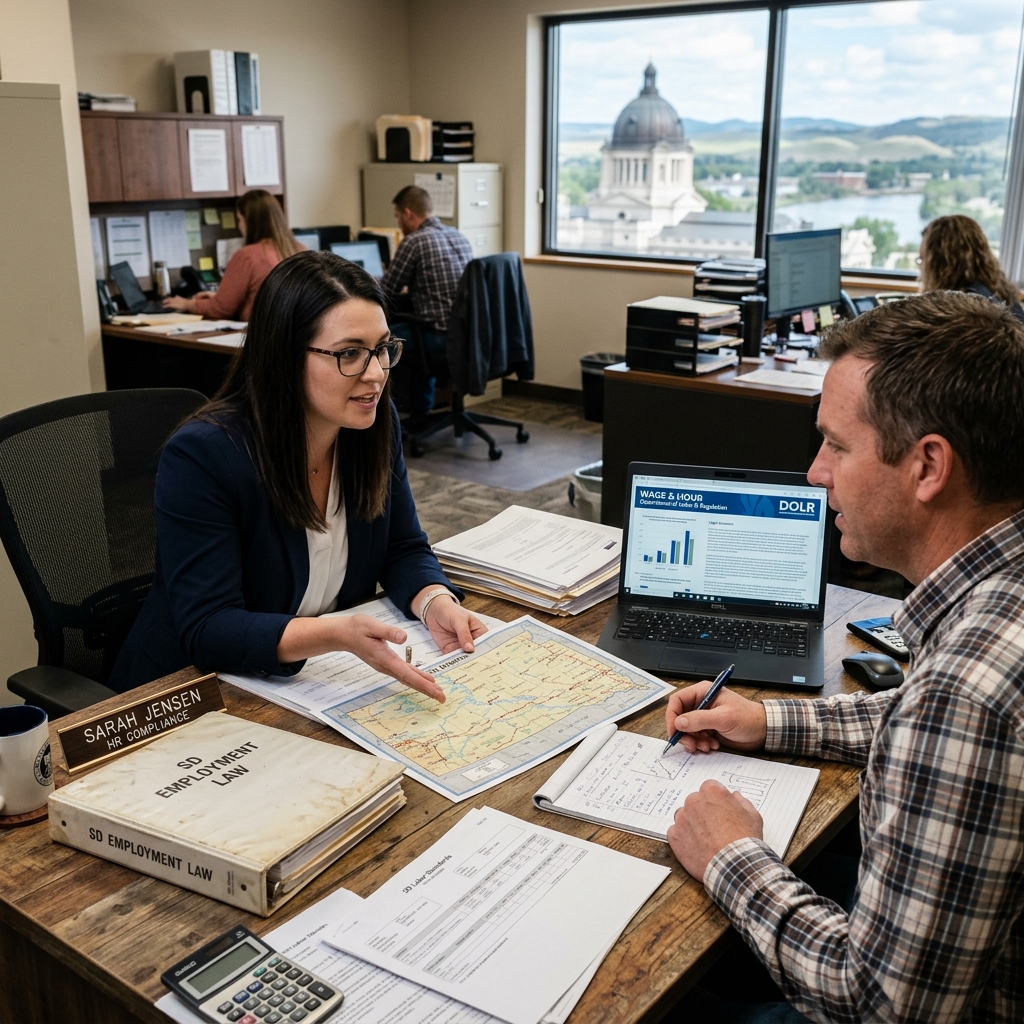
South Dakota wage and hour law combines state-specific rules with federal protections, setting standards for how workers are paid, when they must be paid, and what rights they have when pay is incorrect or late. Understanding these rules is essential for employers who want to stay compliant and for employees who want to make sure they receive all wages they are owed.
This guide explains the key wage and hour topics in South Dakota, including minimum wage, tipped pay, overtime, youth employment limits, paydays, final paychecks, and what to do when a wage dispute arises. It is designed for general information and does not replace legal advice.
Overview: How Wage and Hour Law Works in South Dakota
South Dakota relies on a mix of state statutes and federal law to regulate workplaces. State rules are found primarily in South Dakota Codified Law Title 60, along with related administrative regulations. Federal law, especially the Fair Labor Standards Act (FLSA), fills in gaps where the state has not created its own detailed requirements.
- State law sets the minimum wage and basic rules for pay frequency, final pay, and child labor.
- Federal law governs overtime pay, recordkeeping, and many protections for non‑exempt workers.
- Employers must follow whichever law gives workers the greater protection when state and federal rules differ.
Because South Dakota does not have comprehensive overtime statutes, employers rely heavily on federal standards to determine when additional pay is owed for long workweeks.
Minimum Wage in South Dakota
South Dakota sets a statewide minimum wage that is higher than the federal minimum and adjusts it regularly based on inflation. As of January 1, 2026, the state minimum wage is:
| Type of employee | Minimum wage (per hour) | Notes |
|---|---|---|
| Non‑tipped employees | $11.85 | Statewide minimum effective January 1, 2026. |
| Tipped employees | $5.925 | Tip credit allowed up to 50% of the regular minimum, but total pay including tips must reach at least $11.85 per hour. |
Employers are prohibited from paying below the state minimum wage for covered workers, even if the federal minimum wage would allow a lower amount. Some categories of employees may be exempt under state or federal law, such as certain executive, administrative, or professional workers, agricultural employees, and outside salespersons.
Tip Credit and Tipped Employees
Businesses that employ tipped workers—such as servers or bartenders—may take a tip credit, meaning part of the employee’s income comes from customer tips rather than the employer’s direct wage.
- Employers must pay at least the reduced cash wage to tipped employees (currently $5.925 per hour).
- When tips are added, the employee’s total hourly earnings must be at least the regular minimum wage (currently $11.85 per hour).
- If tips are insufficient to reach the full minimum wage, the employer must make up the difference.
Employers should keep careful records of hours and total compensation for tipped staff to demonstrate compliance with both state and federal rules.
Overtime Pay: Federal Standards Apply
South Dakota does not have its own detailed overtime statute that specifies when overtime must be paid. As a result, employers generally follow the Fair Labor Standards Act (FLSA) for overtime obligations.
Under federal law applicable in South Dakota:
- Non‑exempt employees must receive 1.5 times their regular rate of pay for every hour worked over 40 in a workweek.
- The workweek is a fixed, regularly recurring period of 168 hours—seven consecutive 24‑hour periods.
- Overtime is calculated by week, not by day, unless another agreement or law specifies otherwise.
Many white‑collar employees may be exempt from overtime under FLSA if they meet specific duties and salary tests. Common exempt categories include executive, administrative, and professional employees, along with some computer and outside sales employees.
Paydays, Pay Methods, and Final Paychecks
South Dakota law controls when wages must be paid and allows employers some flexibility in the method of payment, as long as workers receive their full wages owed.
Regular Paydays and Payment Methods
- Employers must pay wages at least once each calendar month or on regular, agreed-upon paydays designated in advance.
- Wages must be paid in cash, check, or by direct deposit, provided legal conditions for electronic pay are met.
- Employers should clearly communicate the payroll schedule to new employees in writing or through policy documents.
Pay frequency and method can also be influenced by federal rules and any contractual agreements between the employer and employee.
Final Paychecks After Separation
State law governs the timing of final wage payments when an employee leaves a job by resignation or termination.
- Employees who leave employment must receive all wages due by the next regular payday.
- Payment may be made as soon thereafter as the employee returns any employer property in their possession, if applicable.
- Employers should include all earned wages, overtime, and any agreed‑upon commissions or bonuses that have become due under company policy.
Disputes about whether certain compensation was earned or when it is payable can lead to complaints or claims with the South Dakota Department of Labor and Regulation.
Breaks, Meal Periods, and Rest Time
South Dakota does not generally require employers to provide meal or rest breaks for adult workers under state law. However, federal regulations and industry norms may still encourage reasonable break policies.
- For adults, breaks are typically a matter of employer policy or collective bargaining agreements rather than statutory law.
- Short breaks of 5 to 20 minutes, if offered, are usually counted as paid time under federal guidance.
There are special rules for minor employees. For example, youth between certain ages must receive a 30‑minute rest period if they work long continuous shifts. Employers with younger workers should review both state child labor rules and federal youth employment regulations.
Youth Employment and Hours Limits
South Dakota places specific restrictions on child labor to protect the health, safety, and education of minors. These rules focus on both the types of work minors may perform and the number of hours they can work.
Prohibited and Restricted Work for Minors
- Minors under age 16 generally may not work in any occupation considered dangerous to life, health, or morals.
- No child may be exploited by an employer in any manner, including being required to work in unsafe or harmful conditions.
- Hazardous tasks and certain industrial jobs are typically off limits for younger workers under both state and federal law.
Hour Limits for Younger Workers
South Dakota law sets specific limits on the amount of time minors can work, especially during the school year.
| Age group | Maximum hours and timing |
|---|---|
| Under 16 (school days) | No more than 4 hours on a school day; no more than 20 hours in a school week. |
| Under 16 (non‑school days) | No more than 8 hours on a non‑school day; no more than 40 hours in a non‑school week. |
| Under 16 (late hours) | Generally may not work after 10:00 p.m. on a night preceding a school day. |
Employers must also comply with federal child labor rules, which can be stricter in certain industries such as agriculture, manufacturing, and entertainment.
Equal Pay and Non‑Discrimination in Wages
South Dakota includes specific pay equity provisions that prohibit wage discrimination based on sex. In addition, broader anti‑discrimination rules apply to compensation and other employment terms.
- Employers may not pay employees of one sex less than employees of the opposite sex for comparable work requiring similar skill, effort, and responsibility, excluding physical strength.
- State law also makes it an unfair practice to discriminate in hiring, promotion, compensation, layoff, or other conditions of employment based on protected characteristics such as race, sex, religion, disability, or national origin.
These state rules operate alongside federal equal pay and anti‑discrimination laws, such as Title VII of the Civil Rights Act and the Equal Pay Act, giving employees multiple avenues to challenge discriminatory wage practices.
Resolving Wage Disputes in South Dakota
Workers who believe they have not been paid properly—whether due to unpaid wages, underpayment of minimum wage, or overtime issues—can pursue a wage claim with the South Dakota Department of Labor and Regulation.
Filing a Wage Complaint
- Employees may file a Claim of Unpaid Wages using the form provided by the Department of Labor and Regulation.
- Claims can involve issues such as unpaid regular wages, failure to pay at least the minimum wage, or missing overtime compensation.
- The Department reviews the claim, may investigate, and can take enforcement action if violations are found.
If the Department determines the employer has violated wage laws, it may assist in recovering unpaid wages. In particularly serious cases, if the employer’s failure to pay was oppressive, fraudulent, or malicious, courts may award additional damages beyond the unpaid amount.
Documentation Employees Should Keep
To support a wage claim, employees should maintain records whenever possible. Helpful documentation includes:
- Personal notes of hours worked and schedule changes
- Copies of pay stubs and time sheets
- Written employment agreements or offer letters
- Emails or messages discussing pay rates, bonuses, or overtime approval
Strong records can make it easier for the Department or a court to determine what wages were owed and whether the employer complied with the law.
Practical Compliance Tips for Employers
Employers in South Dakota can reduce the risk of wage and hour violations through clear policies and consistent practices.
- Review pay rates annually to ensure they meet or exceed the latest state minimum wage.
- Confirm employee classifications as exempt or non‑exempt for overtime purposes under FLSA.
- Maintain accurate records of hours worked, tips received, deductions taken, and pay dates.
- Train managers on child labor limitations and scheduling rules for minors.
- Monitor pay equity across job categories to avoid sex‑based or other discriminatory wage practices.
Regular consultation of official state guidance and federal resources can help ensure that payroll practices stay current with changing laws and inflation‑based adjustments.
Frequently Asked Questions (FAQs)
1. What is the current minimum wage in South Dakota?
For non‑tipped employees, the minimum wage in South Dakota is $11.85 per hour, effective January 1, 2026. Tipped employees may be paid a cash wage of $5.925 per hour, as long as tips are sufficient to bring their total hourly earnings up to at least $11.85.
2. Does South Dakota have its own overtime law?
South Dakota does not have a comprehensive overtime statute specifying overtime rates or thresholds. Employers therefore apply federal FLSA rules, which require non‑exempt employees to receive 1.5 times their regular rate for hours worked over 40 in a workweek.
3. Are employers required to offer meal or rest breaks?
State law in South Dakota does not generally mandate meal or rest breaks for adult employees. Some employers still provide breaks as a matter of policy or to comply with industry standards. Special rules may apply to minors and to certain safety‑sensitive positions.
4. How often must employees be paid?
Employers must pay wages at least once each calendar month or according to regular paydays agreed upon in advance. Many employers choose weekly or bi‑weekly schedules, but monthly pay can be lawful as long as workers are informed and paid all wages due.
5. When should a final paycheck be issued in South Dakota?
When an employee resigns or is terminated, South Dakota law requires that they receive their final paycheck by the next regular payday, or shortly thereafter if they must first return employer property. All earned wages, including overtime, should be included.
6. How can an employee file a wage complaint?
Employees who believe they were not paid correctly can file a Claim of Unpaid Wages with the South Dakota Department of Labor and Regulation. The Department reviews the claim and may help recover unpaid wages if violations are confirmed.
7. Are there special wage protections for minors?
Yes. South Dakota restricts the types of work minors may perform and limits their hours based on age and whether school is in session. Employers must ensure that young workers are not scheduled for excessive hours or placed in dangerous jobs.
References
- Employment Laws – Minimum Wage — South Dakota Department of Labor and Regulation. 2026-01-01. https://dlr.sd.gov/employment_laws/minimum_wage.aspx
- Employment Laws – Wage and Hour Issues — South Dakota Department of Labor and Regulation. 2024-06-01. https://dlr.sd.gov/employment_laws/wage_hour_issues.aspx
- South Dakota Employment and Labor Laws — Paylocity. 2025-02-10. https://www.paylocity.com/resources/tax-compliance/state-laws/south-dakota/
- Quick and Easy Guide to Labor & Employment Law: South Dakota — Baker Donelson. 2025-01-20. https://www.bakerdonelson.com/easy-guide-south-dakota
- South Dakota Employment Law Overview — Brightmine. 2025-03-01. https://www.brightmine.com/us/resources/hr-compliance/south-dakota-employment-law/
Similar Articles








Read full bio of Sneha Tete




