
Solitary Confinement: Hidden Cells, Lasting Harm
Exploring how extreme isolation in prisons functions, why it persists, and the human, legal, and public‑safety costs it creates.
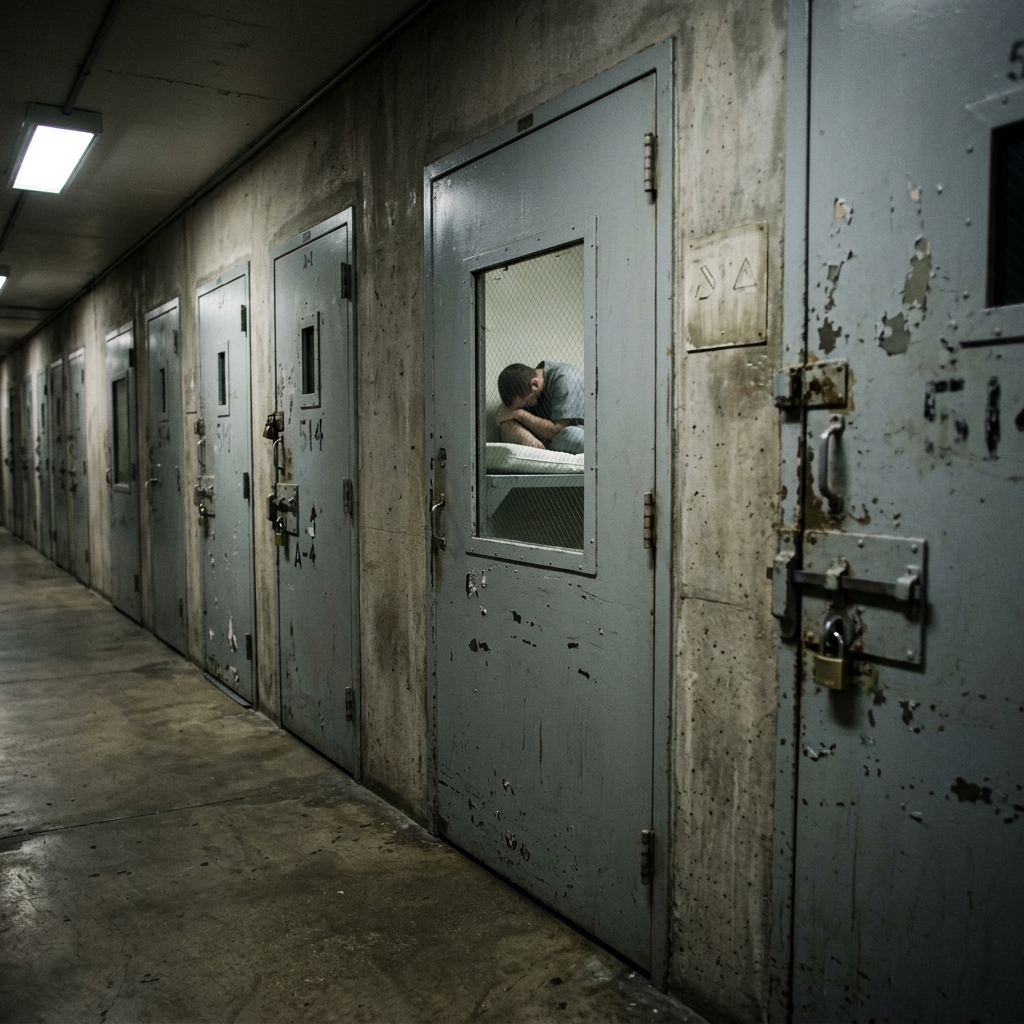
Across prisons, jails, immigration and youth detention facilities, solitary confinement subjects tens of thousands of people to extreme isolation for 22 to 24 hours a day with little or no meaningful human contact. This practice, often justified as a tool for order and safety, has been increasingly condemned as cruel, ineffective, and in many circumstances a form of torture under international law.
Understanding Solitary Confinement
There is no single legal definition of solitary confinement, but experts and international bodies converge on several core elements.
- Physical isolation: People are locked alone in small cells, usually about the size of a parking space, for 22–24 hours per day.
- Minimal human contact: Interaction with others is rare and often occurs through doors, bars, or food slots rather than face-to-face, “meaningful” contact.
- Severely restricted activity: Work, education, rehabilitative programs, and recreation are sharply limited or absent, with some facilities offering only one hour of solitary exercise in a bare cage.
- Extended duration: While some stays last days, many stretch to months, years, or even decades, raising serious human rights concerns.
Internationally, the United Nations Standard Minimum Rules for the Treatment of Prisoners (the Mandela Rules) define solitary confinement as confinement for 22 hours or more a day without meaningful human contact and call anything longer than 15 days prolonged solitary confinement, which should be prohibited.
Who Ends Up in Isolation and Why?
Many people assume solitary confinement is reserved for the “worst of the worst.” In reality, research shows that isolation is used for a wide range of reasons, many of them minor or administrative.
Common Pathways to Solitary Confinement
- Disciplinary infractions:
- Serious incidents such as fights or attacks.
- Minor misbehavior, including talking back to staff or possessing banned items like cigarettes.
- Management of vulnerable groups:
- People needing protection from others, such as those targeted by gangs or at risk of sexual violence.
- Individuals with mental health conditions whose symptoms are misinterpreted as rule-breaking.
- Security and classification decisions:
- Placement based on risk assessments and gang affiliations, sometimes without specific recent misconduct.
- Use of isolation as a catch-all response when facilities lack appropriate mental health or protective units.
One national analysis found that about 20% of people in state and federal prisons experienced some form of restrictive housing over a 12-month period, underscoring how routine this practice has become.
| Reason for Isolation | Typical Examples | Key Concern |
|---|---|---|
| Disciplinary punishment | Fighting, possession of contraband, disobeying orders | Overuse for low-level, nonviolent misbehavior |
| Administrative segregation | Perceived gang involvement or security threat | Placement without clear end date or meaningful review |
| Protective custody | Threats to safety from others in general population | Safety achieved via isolation instead of safer alternatives |
| Response to mental health symptoms | Self-harm, disruptive behavior linked to illness | Isolation worsens conditions it purports to manage[10] |
Scale of the Practice
Despite decades of criticism, solitary confinement remains widespread in the United States. Official data and research suggest that:
- In the summer of 2019, an estimated 62,000 people in US prisons — about 4.4% of the prison population — were held in solitary confinement.
- Earlier estimates, including Bureau of Justice Statistics data, put the number of people in solitary confinement at more than 80,000 across US prisons.
- Most prisons and many jails have designated units designed for isolation, and many others have individual cells used for solitary purposes.
These figures do not fully capture the use of isolation in immigration detention or youth facilities, where records can be less transparent and oversight more limited.
Psychological and Emotional Harm
Research consistently shows that solitary confinement is profoundly damaging to mental health. People subject to prolonged isolation face a wide range of symptoms and long-term consequences.[10]
Immediate and Short-Term Effects
- Distorted perception: Visual and auditory hallucinations, hypersensitivity to noise and touch.
- Sleep and mood disruption: Insomnia, persistent anxiety, depression, and intense irritability.[10]
- Emotional volatility: Uncontrollable feelings of rage, fear, and despair that make it harder to follow rules or cope with stress.[10]
- Disorientation: Confusion about time and place, difficulty concentrating, and cognitive slowing.[10]
Long-Term and Post-Release Consequences
- Post-traumatic stress: Many people exhibit signs of PTSD after extended solitary confinement, including nightmares, flashbacks, and hypervigilance.[10]
- Increased suicide risk: Studies have found dramatically elevated rates of suicide among people in solitary compared with those in general population units; one report in California identified a 33-fold higher risk.
- Persistent social difficulties: Isolation erodes social skills and trust, contributing to relationship problems, unemployment, and community instability after release.[10]
These impacts are particularly severe for children and people with pre-existing mental health conditions, leading the UN Special Rapporteur on Torture to call for an absolute ban on solitary confinement for juveniles and people with mental disabilities.
Physical Health Risks
Solitary confinement harms the body as well as the mind. People in isolation often lose access to adequate medical care and exercise, worsening existing conditions and creating new ones.
- Limited movement contributes to muscle atrophy, cardiovascular problems, and chronic pain.
- Restricted health care can mean delayed diagnosis and treatment of serious medical issues.
- Stress-related illnesses such as headaches, gastrointestinal problems, and high blood pressure frequently develop or worsen in isolation.
- Heightened vulnerability to self-harm and medical emergencies goes hand in hand with low visibility and insufficient monitoring.
A growing body of research highlights that extended isolation fundamentally alters how the body processes stress and stimuli, leading to long-lasting health problems even after confinement ends.
Does Solitary Confinement Make Prisons Safer?
Corrections officials often argue that solitary confinement is necessary to control violence and protect staff and imprisoned people. However, empirical evidence shows little support for these claims and, in some cases, points in the opposite direction.
Evidence of Ineffectiveness
- No clear reduction in violence: Studies have not found consistent links between high use of solitary confinement and safer facilities.
- Increased assaults: In Texas, a period of expanded use of solitary confinement was followed by a reported 104% increase in assaults by incarcerated people, which officials themselves attributed to frequent isolation.
- Higher recidivism: People released directly from solitary confinement into the community have higher rates of reoffending, undermining public safety.
Isolation tends to intensify anger, fear, and social dysfunction, all of which can fuel further violence inside facilities and in the community after release.
Solitary Confinement and Torture
International human rights law provides a framework for assessing when severe isolation crosses the line into torture or cruel, inhuman, or degrading treatment. Under the UN Convention Against Torture, torture includes any state-sanctioned act inflicting severe physical or mental pain for purposes such as punishment, coercion, or discrimination.
Experts and bodies such as the UN Special Rapporteur on Torture have concluded that:
- Prolonged solitary confinement — typically defined as more than 15 days of 22+ hours of isolation per day — can itself amount to torture or ill-treatment.
- The risk is especially high when isolation is indefinite, with no clear end date or meaningful review.
- Children and people with mental disabilities should never be subjected to solitary confinement.
Because solitary confinement often happens behind closed doors with limited oversight, it also increases the risk that other forms of abuse and ill-treatment will go unnoticed.
Legal Standards and Calls for Reform
International and domestic standards have increasingly moved toward strict limits on solitary confinement and, in some cases, its abolition.
International Norms
- The Mandela Rules call for an absolute prohibition of prolonged solitary confinement (beyond 15 days) and specify that any use of solitary must be exceptional, last resort, and subject to independent review.
- The UN Special Rapporteur on Torture has recommended banning prolonged or indefinite solitary confinement as punishment and ending its use in pretrial detention, for juveniles, and for people with mental disabilities.
Domestic Developments
- Several US states have enacted laws limiting the length and conditions of solitary confinement, especially for youth and people with serious mental illness.
- Colorado announced that it had effectively eliminated long-term solitary confinement and aligned its practices with the Mandela Rules, replacing prolonged isolation with step-down programs and mental health units.
- Advocates, including national coalitions, have proposed federal blueprints for ending solitary confinement through reporting requirements, independent oversight, and strict limitations on when isolation can be used.
Despite these advances, the number of people held in solitary confinement in federal systems has not consistently declined, illustrating the gap between policy commitments and on-the-ground practice.
Alternatives to Isolation
Research suggests that ending reliance on solitary confinement is not only a human rights imperative but also practical from a safety and management perspective.
Key Features of Humane Alternatives
- Short, definite time limits: Any separation should be brief, clearly defined, and communicated in advance, with regular opportunities to earn return to less restrictive environments.
- Step-down programs: Graduated housing and programming that help people transition from higher-security settings back to the general population, emphasizing skill-building and trust.
- Specialized mental health units: Treatment-focused environments with robust clinical services instead of isolation cells for people with mental illnesses.
- Violence-prevention strategies: Investments in de-escalation training, conflict resolution, and dynamic security — staff presence and relationships — rather than reactive punishment.
Where implemented comprehensively, these measures have been associated with reduced institutional violence, better mental health outcomes, and smoother reentry to the community.
Frequently Asked Questions (FAQs)
1. Is solitary confinement always illegal?
No. Many legal systems still permit some use of solitary confinement, especially short-term disciplinary segregation. However, international standards state that prolonged or indefinite solitary confinement can amount to torture or cruel, inhuman, or degrading treatment, and should be prohibited.
2. How long does someone have to be in isolation before it is considered prolonged?
The Mandela Rules define prolonged solitary confinement as more than 15 consecutive days with 22 hours or more of isolation per day, and call for an absolute ban on such practices.
3. Are children ever placed in solitary confinement?
Yes, youth have been placed in solitary confinement in various systems, despite the heightened risks. International experts recommend a complete ban on solitary confinement for anyone under 18 because of severe developmental and psychological harm.
4. Does solitary confinement affect people after they leave prison?
Yes. Many people experience lasting mental and physical health problems, including PTSD, anxiety, depression, and difficulty forming relationships, which can contribute to unemployment, instability, and higher recidivism rates.[10]
5. What can be done to reduce or end solitary confinement?
Effective strategies include setting strict legal limits, improving oversight and transparency, expanding mental health services, investing in step-down and rehabilitative programs, and adopting evidence-based violence prevention approaches that do not rely on isolation.
References
- Solitary confinement — Penal Reform International. 2022-06-01. https://www.penalreform.org/issues/prison-conditions/key-facts/solitary-confinement/
- The Use of Prolonged Solitary Confinement in the United States — Center for Constitutional Rights. 2014-10-01. https://ccrjustice.org/files/CCR_CAT%20Submission_SolitaryConfinement.pdf
- Solitary Confinement in US Prisons — Urban Institute. 2022-08-01. https://www.urban.org/sites/default/files/2022-08/Solitary%20Confinement%20in%20the%20US.pdf
- Solitary Confinement in the United States: The Facts — Solitary Watch. 2020-05-01. https://solitarywatch.org/facts/faq/
- Solitary Confinement Facts — American Friends Service Committee. 2018-03-01. https://afsc.org/solitary-confinement-facts
- Why Are People Sent to Solitary Confinement? — Vera Institute of Justice. 2019-06-01. https://www.vera.org/publications/why-are-people-sent-to-solitary-confinement
- The body in isolation: The physical health impacts of incarceration in solitary confinement — Cloud DH et al., Journal of General Internal Medicine. 2021-01-01. https://pmc.ncbi.nlm.nih.gov/articles/PMC7546459/
Similar Articles








Read full bio of Sneha Tete




