
Social Media Evidence: Practical Steps To Prove An Alibi Now
How posts, photos, and metadata can support an alibi, and what courts require before admitting them.
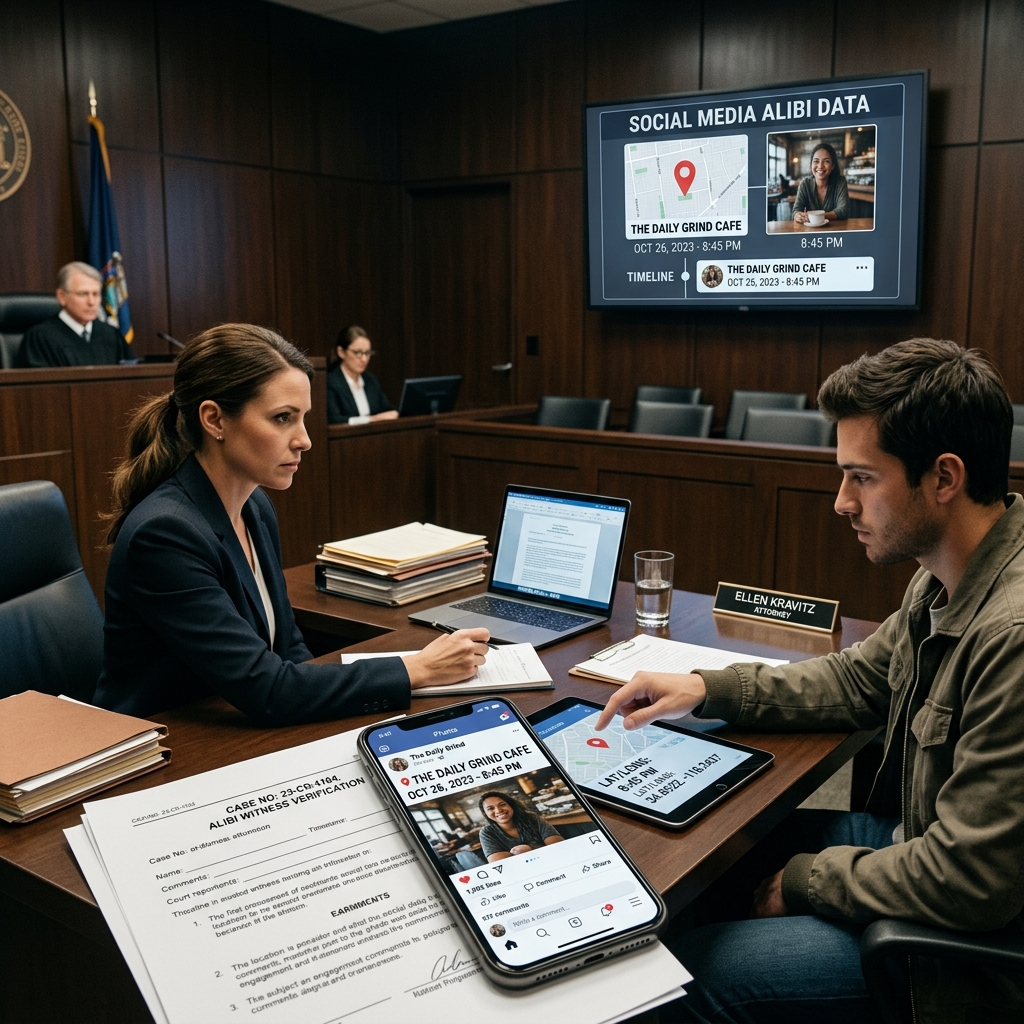
Social media can do more than tell a personal story; it can also help establish where someone was, when they were there, and what they were doing. In a criminal case, that information may support an alibi, challenge the prosecution’s timeline, or cast doubt on witness testimony. But a post, photo, or message is only useful in court if it can be tied to the person who supposedly created it and shown to be relevant to the disputed facts.
That is why social media evidence sits at the intersection of technology and evidence law. It may be persuasive, but it is not automatically admissible. Courts look closely at authenticity, relevance, and reliability before allowing jurors to consider it. The rules matter just as much for defense teams using social media to prove innocence as they do for prosecutors using it to prove guilt.
Why Social Media Can Matter in an Alibi Defense
Alibi evidence is designed to show that a defendant could not have committed the alleged offense because they were somewhere else at the relevant time. Social media can support that claim in several ways. A timestamped post may show a person at a restaurant, at work, on vacation, or with other people far from the crime scene. A check-in, story, photo, or direct message can add context that helps reconstruct a timeline.
In criminal cases, social media evidence often includes posts, photos, videos, comments, messages, and location-related information. Because these materials can capture ordinary moments in real time, they may reveal details that are not available from traditional witnesses. Public posts may be especially useful because they are easier to preserve and collect, while private content often requires formal legal process.
Common Types of Social Media Evidence
Different kinds of online content can play different roles in an alibi case. Some forms are direct proof of presence, while others help support a broader timeline.
- Posts and captions that mention where a person was or what they were doing.
- Photos and videos that visually place someone in a specific location.
- Time stamps that help anchor an event to a particular date and time.
- Location check-ins or geotagged content that may suggest where the user was when the content was uploaded.
- Comments and replies that add context or clarify the timing of an event.
- Messages that show conversations before, during, or after the alleged incident.
- Metadata that may help confirm when a file was created, modified, or shared.
When assembled carefully, these materials can create a timeline that lines up with the defense theory. That timeline may not prove innocence by itself, but it can be powerful when it contradicts the prosecution’s version of events.
What Courts Look For Before Admitting It
Courts do not admit social media evidence simply because it exists. The party offering the evidence must clear foundational hurdles first. Based on evidence-law principles applied by courts and legal guidance sources, the most important questions are whether the material is authentic, relevant, and reliable enough to be considered by a judge or jury.
| Issue | What the court wants to know | Why it matters |
|---|---|---|
| Authentication | Is the post or account really tied to the person claimed? | Prevents fabricated or misattributed evidence |
| Relevance | Does it help prove or disprove a fact in dispute? | Limits evidence to what actually matters |
| Reliability | Is the content trustworthy and not misleading? | Protects against distorted interpretations |
| Prejudice | Would its impact unfairly outweigh its value? | Prevents jurors from being swayed by emotion alone |
Authentication is often the first obstacle. A lawyer must show that the evidence is what it claims to be, and not something created by another person using the account, edited after the fact, or taken out of context. If the evidence cannot be tied convincingly to the alleged author, its value drops sharply.
How Attorneys Build the Foundation
To use social media in court, a lawyer may rely on screenshots, account records, witness testimony, platform data, or other surrounding proof. A common strategy is to combine multiple pieces of evidence rather than depending on a single post. For example, a geotagged photo, a text exchange, and a witness statement may together create a stronger picture than any one item alone.
Some authenticating methods include testimony from someone who recognizes the account, evidence that the post contains details only the person would likely know, or platform records that connect the account to the user. In practice, the more layers of verification, the better. Courts are often cautious because online content can be copied, altered, or falsely attributed with relative ease.
Defense lawyers also have to think about preservation. Once relevant content is discovered, it should be saved in a form that preserves the original context, including visible date and time information when possible. If the content is important to a case, a clean record of how it was obtained can help protect it from later challenges.
When Social Media Helps the Defense and When It Hurts
Social media can support the defense, but it can also create problems. Posts that seem harmless to the person who wrote them may still be used by prosecutors to challenge a claimed alibi. A photo showing someone at a party may help place them away from a crime scene, but a later comment, tag, or direct message might create confusion about timing. The same digital trail that helps one argument can weaken another.
That is why context matters. A single image without metadata may not prove much. A post that appears to show a person somewhere else may have been uploaded hours later. A message may reflect where someone planned to go rather than where they actually were. Courts and attorneys alike must be careful not to confuse online activity with verified physical presence.
Public social media can also open the door to impeachment. If a defendant claims they were never near a location, but their account shows repeated check-ins or photos there, opposing counsel may argue that the account undermines their story. This is one reason criminal defense lawyers often advise clients to stop posting once a case begins and to avoid deleting content without legal guidance.
Privacy, Access, and Legal Limits
Access to social media content is not unlimited. Public posts are often easier to obtain, but private messages, hidden photos, and restricted account information usually require legal process such as a subpoena, warrant, or court order. Social media companies are not generally required to hand over private content to defense teams simply because the content might be useful.
This creates a practical imbalance. Prosecutors may have broader access to certain records through government channels, while defense teams may need to use discovery tools, witness cooperation, or independent investigation to obtain comparable information. As a result, defense counsel often has to move quickly before a user changes privacy settings or removes content.
Courts also protect against unnecessary invasions of privacy. If a request is too broad, speculative, or disconnected from the issues in the case, it may be limited or denied. The key question is whether the requested material is reasonably likely to lead to admissible evidence and whether the scope is proportional to the needs of the case.
Practical Uses in a Criminal Case
In real cases, social media can support an alibi in several practical ways. It may show that the accused was attending an event, interacting with friends, or posting from a different place at the relevant time. It can also reveal patterns that help explain movement over a longer period, such as repeated check-ins, travel photos, or location-based posts.
Defense investigators may review a broad time window around the alleged offense, not just the exact date. That approach can reveal earlier or later posts that place the person away from the scene or show a routine that supports their explanation. Comments from friends and family may also help, especially if they mention the person’s location or activities.
At trial, social media evidence may be introduced alongside testimony from witnesses who saw the defendant at another location. When both digital and human evidence point in the same direction, the alibi can become more persuasive. But if the evidence is incomplete or poorly documented, opposing counsel may argue that it is unreliable or misleading.
Best Practices for Handling Social Media Evidence
Because digital evidence can disappear quickly, careful handling is essential. The following practices help strengthen an alibi-based presentation:
- Preserve the original content as soon as it is found.
- Record the date, time, and source of each item collected.
- Save surrounding context, including comments and replies.
- Document how screenshots or downloads were created.
- Confirm whether the post was public, private, or shared with a limited audience.
- Compare the social media timeline with phone records, receipts, witness statements, or surveillance footage.
These steps help create a defensible record and reduce the risk that the evidence will be challenged as incomplete or altered. The goal is not only to find helpful content, but also to show the court that the content was collected responsibly.
Frequently Asked Questions
Can a Facebook post prove an alibi? It can help support an alibi, but a post by itself may not be enough unless it is authenticated and tied to the relevant time and place.
Do screenshots count as evidence? Yes, but they usually need supporting proof. Courts often want more than a screenshot to be sure the content is genuine and unaltered.
Can private messages be used in court? Sometimes, but access to private content usually depends on lawful process and the rules governing discovery and privacy.
Why is metadata important? Metadata can help show when a file was created or shared, which may strengthen the timeline behind an alibi.
Can social media hurt a defense? Yes. Inconsistent posts, tags, and comments may undermine an alibi or create impeachment material for the other side.
Why Digital Evidence Needs Careful Legal Review
Social media is appealing because it is immediate, familiar, and often full of details that seem to tell a story. But courts do not treat digital content as automatically truthful. The legal system asks whether the evidence is authentic, relevant, and fair to use. Those safeguards matter because online material can be incomplete, edited, or misread.
For a defense team, the best use of social media is usually part of a larger evidentiary strategy. A strong alibi may combine online posts with receipts, travel records, surveillance footage, witness testimony, or device data. When those pieces align, they can create a clear picture of where someone was and when.
References
- Using Social Media to Gather Evidence in a Criminal Case — Criminal Attorney Columbus. n.d. https://www.criminalattorneycolumbus.com/using-social-media-to-gather-evidence-in-a-criminal-case/
- Social Media Evidence at Trial — Maryland People’s Law Library. n.d. https://www.peoples-law.org/social-media-evidence-trial
- Social Media as Criminal Evidence: New Possibilities, Problems — American Sociological Association. n.d. https://www.asanet.org/footnotes-article/social-media-criminal-evidence-new-possibilities-problems/
- How to Use Social Media as Digital Evidence in a Court Case — Kelley Kronenberg. n.d. https://www.kelleykronenberg.com/how-to-use-social-media-as-digital-evidence-in-a-court-case/
- Don’t let the defense misuse social media to depict your client — Plaintiff Magazine. n.d. https://plaintiffmagazine.com/recent-issues/item/don-t-let-the-defense-misuse-social-media-to-depict-your-client
- Social Media Use Might Hurt Your Defense — William Hodge Law. n.d. https://williamhodgelaw.com/your-social-media-use-might-hurt-your-criminal-defense/
Similar Articles








Read full bio of medha deb


