
Smart Shredding: A Practical Guide to What to Keep and What to Destroy
Learn which documents to save, which to shred, and how to protect your identity while clearing paper clutter at home.
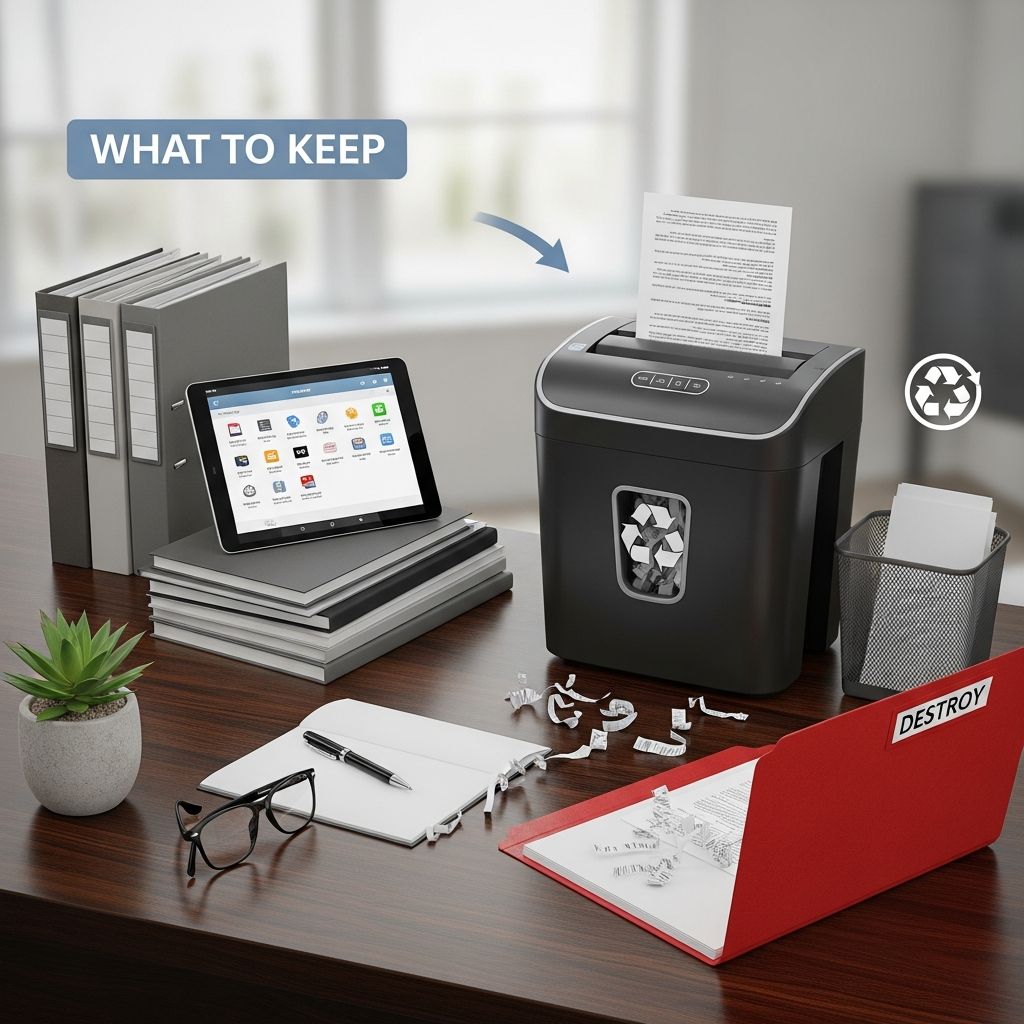
Paper piles can quietly expose you to fraud. Old bills, medical papers, loan offers, and bank statements may look harmless, but many contain details that identity thieves can use. Shredding is one of the simplest ways to block that risk while also keeping your home organized and your records under control.
This guide walks you through what to shred, what to save, how long to keep common documents, and how to set up a simple shredding routine that protects your privacy and your peace of mind.
Why Shredding Matters for Your Safety
Identity theft often starts with basic information: your name, address, account numbers, or Social Security number. Criminals can sometimes recover this data from trash or recycling if documents are thrown away intact.
Shredding documents before disposal helps:
- Prevent identity theft by making personal details unreadable.
- Reduce financial fraud tied to stolen account and card numbers.
- Protect medical and insurance data that could be misused for fraudulent claims.
- Limit what strangers know about you from discarded mail, receipts, and records.
- Control clutter so only meaningful, needed records take up space.
Key Principle: When in Doubt, Shred
A simple rule can guide most decisions: if a document includes personal, financial, or account information that you would not share with a stranger, it is safer to shred rather than toss it whole.
That said, some papers need to be kept for legal, tax, or practical reasons. The sections below distinguish what to shred quickly from what to retain for a set period or indefinitely.
Record Retention Basics: How Long Should You Keep It?
Different documents have different lifespans. Tax agencies, banks, and consumer organizations often recommend keeping some records for years to resolve disputes, prove payments, or support tax filings.
The table below summarizes typical retention ideas for household records. These are general guidelines, not legal advice; confirm with a tax professional or attorney for your specific situation.
| Type of Document | Suggested Retention Period | When to Shred |
|---|---|---|
| Utility bills, phone bills, routine service bills | Keep until payment is confirmed on your account or card statement | After you verify payment and no disputes remain |
| Bank and credit card statements | 1 year, unless needed longer for tax or legal reasons | After the retention window or when statements are available securely online |
| Pay stubs | Keep until you reconcile with your annual wage statement or tax documents | After confirming accuracy against your year-end statement |
| Tax returns and supporting documents | Generally 3 6 years, depending on local rules and your situation | After the recommended limitation period ends |
| Loan agreements, mortgage documents | For the life of the loan plus a period afterward | After payoff and once you no longer need proof of terms or payment |
| Property records, deeds, major home improvement receipts | As long as you own the property, and sometimes longer | After sale and once no legal or tax issues remain |
| Insurance policies (auto, home, health, life) | For the active policy term; claims info as advised by your insurer | After policy expiration and resolution of any claims |
| Medical and benefit statements | Until you match them with bills and insurer payments | After verification, unless needed for future reference |
What You Should Almost Always Shred
The following categories nearly always belong in the shredder instead of the trash:
- Documents with full account numbers: bank, credit card, investment, or loan numbers.
- Anything with your Social Security number or similar national ID.
- Documents with dates of birth matched with names or addresses.
- Pre-approved credit and loan offers that someone could misuse to open accounts.
- Old checks and check carbons (except those needed for proof of payment).
- Expired credit and debit cards once you cut or shred the card itself.
- Prescription labels or medical summaries with identifiable information.
- Travel itineraries or boarding passes that contain loyalty numbers or barcodes.
Destroying this information sharply lowers your exposure if someone rummages through trash or recycling.
What You Generally Keep Longer
Some records are more valuable intact than the small risk they pose when stored securely. Consider keeping:
- Tax returns and key backup documents, following revenue-agency retention guidance.
- Records of major purchases, repairs, and warranties for big-ticket items.
- Home ownership and vehicle documents, including title, deed, and major work receipts.
- Legal documents such as marriage certificates, divorce decrees, adoption papers, wills, and powers of attorney.
- Benefit and retirement plan records that prove contributions, eligibility, or coverage details.
Store these in a locked drawer, safe, or other secure location that is away from prying eyes and reasonably protected from fire and water damage.
Choosing a Shredding Method: Home vs. Professional
You can either shred at home with your own equipment or use a professional shredding service. Each approach has trade-offs in cost, convenience, and security level.
Types of Home Paper Shredders
Home shredders come in several cutting styles, each with different security levels.
- Strip-cut: Slices paper into long vertical strips. Generally not recommended for sensitive data because strips can sometimes be reconstructed.
- Cross-cut: Cuts both vertically and horizontally into small pieces. Provides better security for everyday confidential documents and is widely recommended for home use.
- Micro-cut / high-security: Reduces paper into tiny particles, making reconstruction virtually impossible. Commonly used for highly sensitive information and top-secret or medical records in professional settings.
For most households, a reliable cross-cut or micro-cut shredder offers a good balance of cost and protection.
Professional Shredding Services
Professional shredding companies use industrial equipment and may offer:
- On-site shredding, where a mobile truck destroys documents at your location while you watch.
- Off-site shredding, where sealed containers are collected and shredded at a secure facility, often with certificates of destruction.
- Ongoing bin service, useful for home offices or small businesses that create steady volumes of confidential paper.
Look for providers that emphasize secure handling, restricted access, and routine recycling of shredded material.
Building a Simple Shredding System at Home
You do not need elaborate tools to be safer with paper. A straightforward, repeatable process is far more important than occasional big cleanups.
Step 1: Set Up a “To Shred” Container
Place a small bin or box near where you open mail or handle paperwork. Label it clearly as “To Shred.” Only put in items you are confident you no longer need in whole form.
Step 2: Sort as You Go
Instead of letting everything pile up, quickly decide as you handle each piece of paper:
- Trash or recycling (no personal details) — e.g., envelopes without labels, flyers.
- To shred — anything with names, addresses, account details, or personal identifiers.
- To keep — important records needing longer retention.
Step 3: Schedule Regular Shredding Time
Consistency beats intensity. Consider:
- Running your shredder once a week or every two weeks.
- Doing a slightly longer session at the end of each month or quarter.
- Adding an annual deep review of files to clear out expired documents.
Regular shredding keeps piles small and reduces the chance you will toss sensitive papers in a hurry.
Step 4: Include Digital Information
Digital records pose similar risks. When disposing of devices or media, simply deleting files is often not enough. Consider:
- Using reputable data-wiping tools before donating or recycling computers or drives.
- Physically destroying old hard drives, USB drives, or discs if they held especially sensitive data.
- Clearing printers, copiers, and scanners that store documents on internal memory before disposal.
Common Mistakes to Avoid
Small errors can undo good habits. Watch out for these pitfalls:
- Throwing away envelopes with labels intact: tear or shred labels that show your name, address, or account barcodes.
- Leaving “To Shred” piles visible: keep shredding containers out of public view, especially in shared buildings.
- Ignoring junk mail: many marketing pieces contain partial account details or reference numbers that are best shredded.
- Mixing important and disposable papers: avoid stacking vital records with routine bills where they may get shredded by accident.
- Overloading the shredder: follow capacity guidelines to prevent jams and prolong equipment life.
Eco-Friendly Ways to Handle Shredded Paper
Protecting your identity does not have to conflict with environmental responsibility. Many shredding programs incorporate recycling.
- Check your local recycling rules to see if shredded paper is accepted and how it must be bagged.
- Use shredded paper as packing material for shipping non-fragile items.
- Add non-glossy shredded paper to compost as a carbon-rich component, in moderation.
- Choose professional services that recycle shredded output wherever possible.
FAQs: Everyday Questions About Shredding
Q: Do I need to shred every single piece of mail?
No. Focus on anything that includes names, addresses, account or customer numbers, barcodes linked to your identity, or other personal details. Generic flyers and blank envelopes usually do not need shredding.
Q: Is tearing documents by hand good enough?
Hand tearing may slow down casual snooping, but determined thieves can still reconstruct torn documents. Cross-cut or micro-cut shredding makes reconstruction far more difficult and is better for sensitive information.
Q: Are digital statements safer than paper?
Digital delivery removes the risk of paper statements in the trash, but it introduces online security concerns. Use strong passwords, enable multi-factor authentication where possible, and securely delete files or wipe devices before disposal.
Q: Should I keep old credit cards after they expire?
No. Once a card is replaced or expired, cut it through the number and chip or shred it, then dispose of the pieces in separate trash loads if possible.
Q: How do I know if my shredder is secure enough?
If you regularly handle bank records, health information, or anything especially sensitive, choose at least a cross-cut shredder and consider micro-cut for added security. Review the product’s security rating and choose models designed for confidential documents.
Q: What about documents for my small home business?
Business records may be subject to additional legal and industry requirements, including privacy and data-protection rules. In many cases, professional shredding services and a formal retention schedule are recommended to stay compliant.
References
- Document Shredding Tips & Best Practices 2026 — Futuramo Blog. 2024-01-15. https://futuramo.com/blog/document-shredding-tips-best-practices-2026/
- Tips for Safely Getting Rid of Paper Documents — U.S. Chamber of Commerce CO. 2022-07-12. https://www.uschamber.com/co/start/strategy/safely-get-rid-of-documents
- Document Destruction Best Practices — Complete Controller. 2023-03-28. https://www.completecontroller.com/playing-it-safe-best-practices-for-document-destruction/
- What To Shred: A Guide For Every Industry — CI Information Management. 2024-04-01. https://ci-infomanagement.com/wp-content/uploads/2024/04/What-To-Shred-A-Guide-For-Every-Industry.pdf
- Decluttering Your Office: When & What to Shred — SecureShred. 2023-09-05. https://secureshred.org/decluttering-your-office-when-what-to-shred/
Similar Articles








Read full bio of medha deb


