Smart Note-Taking for Lawyers: From Shorthand to Digital Mastery
Discover how modern shorthand, structure, and digital tools turn legal note-taking into a powerful strategic advantage.
For legal professionals, notes are not just personal reminders; they are working tools that shape arguments, strategy, and memory of complex events. Effective note-taking can determine how well you examine a witness, draft a motion, or recall a crucial off-the-record remark days or months later.
This guide explains how to modernize your approach to note-taking with practical techniques that blend shorthand, structure, and technology while staying grounded in how lawyers actually work.
Why Note-Taking Is a Strategic Legal Skill
Lawyers operate in information-dense environments: hearings, client meetings, depositions, negotiations, and continuing legal education sessions. In each context, you must capture what matters without losing track of what is happening in real time.
Strong note-taking supports key legal tasks:
- Case strategy: Tracking themes, admissions, and contradictions as they emerge.
- Memory and recall: Reinforcing understanding of rules, facts, and timelines.
- Collaboration: Sharing clear notes with colleagues, experts, and support staff.
- Risk management: Documenting advice, instructions, and client decisions.
Research in education and psychology consistently finds that note-taking, especially when active and structured, improves comprehension and long-term retention compared with passive listening alone.
Handwriting vs. Typing: Choosing the Right Mode
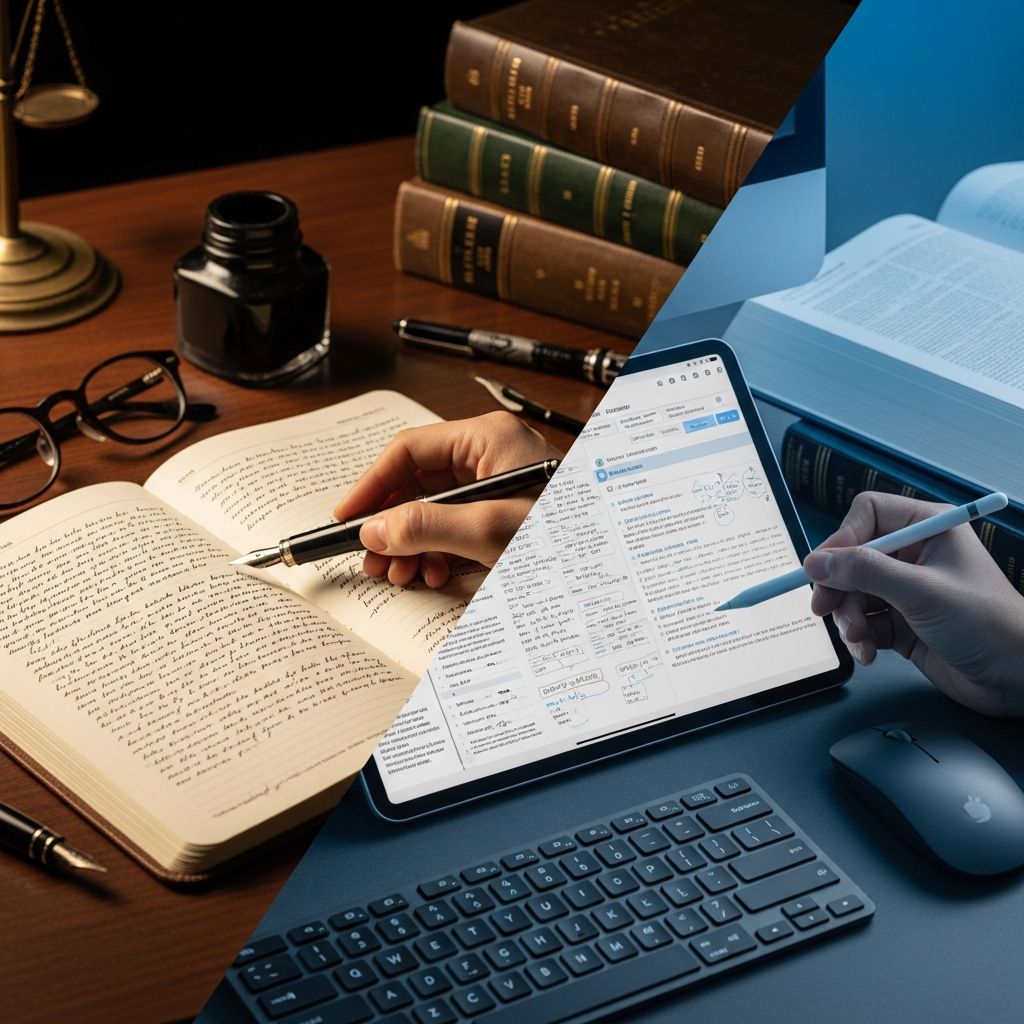
Legal professionals can type rapidly, but speed is not the only metric that matters. Handwritten notes and typed notes have different strengths, and the optimal approach often combines both.
| Method | Key Advantages | Best Uses in Legal Practice |
|---|---|---|
| Handwriting | Encourages summarizing, deeper processing, and better conceptual understanding; often associated with improved retention. | Court hearings, client interviews, witness prep, and any situation where devices may distract or be frowned upon. |
| Typing | Faster capture of verbatim language, easy search, copy-paste, and integration with documents and research tools. | Research memos, transactional negotiations on video calls, drafting sessions, and collaborative meetings. |
| Hybrid (digital pen/tablet) | Handwriting feel with digital backup, tagging, and search for converted text. | Long trials, complex arbitrations, conferences, and travel where you need both flexibility and security. |
Rather than choosing one method forever, decide by setting:
- Use handwriting when insight, judgment, and discretion are paramount.
- Use typing when you must record dense information quickly and will search it later.
- Use a hybrid when you want the cognitive benefits of handwriting plus the reliability of digital storage.
Building a Personal Shorthand for Legal Work
Traditional stenographic shorthand is a specialized profession, but every lawyer can benefit from a personalized system of abbreviations and symbols. The aim is not perfect transcription; it is fast, accurate capture of what matters most.
Principles of Practical Legal Shorthand
- Consistency over complexity: A simple, repeatable system beats an intricate one you forget under pressure.
- Meaningful abbreviations: Shorten recurring legal terms (“mt” for motion, “K” for contract, “π”/”Δ” for parties).
- Visual markers: Use arrows, stars, boxes, and underlines to show relationships and priority rather than writing extra words.
- Separation of voices: Reserve distinct marks for judge, client, opposing counsel, and witnesses to avoid confusion later.
Ideas for a Simple Symbol Set
You can design your own legend and keep it taped inside a notebook cover. For example:
- Actions: ▶ = to do, ★ = high priority, ◎ = follow-up research
- Evidence: E# = exhibit number, D = document, T = testimony
- Argument structure: C = claim, R = rule, A = application, Ct = counterargument
- People: J = judge, OC = opposing counsel, Cx = cross-examination question
Over time, your shorthand becomes a professional asset, letting you capture testimony, negotiations, and instructions without losing eye contact or momentum.
Structuring Notes for Fast Review
Raw notes are only useful if you can interpret and locate information later. Effective legal note-taking emphasizes organization at the moment of writing, not just after the fact.
Segment by Purpose, Not Chronology Alone
Rather than letting notes run as a continuous stream, segment them around how you will use them later:
- Facts and timelines
- Legal issues and rules
- Client goals and constraints
- To-dos and follow-ups
- Questions for later research or clarification
Even quick visual cues (indents, short headings, lines across the page) make later review faster and more reliable.
Use Visual Layouts to Show Relationships
Linear notes can obscure how rules, facts, and arguments connect. Visual techniques are particularly valuable in law, where relationships and hierarchies matter.
- Indenting and bullets: Show elements, sub-elements, and exceptions of rules.
- Arrows: Connect facts to issues, or promises to conditions and breaches.
- Columns: Contrast competing narratives (plaintiff vs. defendant) or offer vs. counteroffer.
Listening Like a Lawyer: Capture the Right Details
Active listening is the foundation of good note-taking, particularly in adversarial settings like court or negotiations.
Train yourself to focus on:
- Elements of claims and defenses: Note which elements are conceded, disputed, or unsupported.
- Admissions and inconsistencies: Mark potential impeachment points immediately.
- Judicial cues: Capture the court’s concerns, hypotheticals, and tentative rulings.
- Client priorities: Listen for implicit goals (reputation, speed, confidentiality) as much as explicit requests.
In practice, this means you should often listen first and write second: let a witness finish a full thought, then summarize the core idea rather than trying to record every word.
Digital Tools that Support Legal Note-Taking
Modern note-taking tools can significantly improve organization, searchability, and collaboration if you use them intentionally.
Core Features Lawyers Should Look For
- Cross-device sync: Access notes from courtroom, office, and home without emailing yourself.
- Tagging and folders: Group notes by client, matter number, jurisdiction, or issue.
- Search and filters: Find mentions of a statute, client name, or issue in seconds.
- Templates: Standardize intake, meeting, and hearing notes across the team.
- Encryption and access controls: Protect confidentiality and comply with professional obligations.
Using Tags and Labels Effectively
Consistent tags make years of notes usable. For each matter, decide on a simple taxonomy and stick with it:
- Client or matter code (e.g., “ACME-2025-01”)
- Stage (“research”, “hearing”, “settlement-discussion”)
- Topic (“jurisdiction”, “damages”, “expert-witness”)
When you later prepare a brief or motion, a quick search for the matter code plus “damages” can surface every note relevant to that issue.
Review, Synthesis, and Turning Notes into Strategy
Research on learning shows that reviewing and reorganizing notes soon after an event consolidates memory and improves understanding. For lawyers, this review step is where raw notes become strategy.
The 24-Hour Review Habit
Make it a professional standard to process important notes within one business day:
- Clarify shorthand while the context is fresh.
- Add missing dates, names, and case citations.
- Extract a short summary at the top or bottom of the page.
- Convert symbols (▶, ◎, ★) into calendar tasks, research tickets, or emails.
This small investment prevents misunderstandings later and makes your notes reliable enough to share with others.
From Notes to Work Product
When you later draft a brief or prepare for trial, use your notes intentionally:
- Outline arguments based on the issues and themes you flagged.
- Check facts against documents and transcripts; mark discrepancies.
- Build timelines from dated entries to clarify causation and notice.
- Prepare examinations by extracting admissions and weak points from earlier testimony.
Common Note-Taking Pitfalls in Legal Practice
Even experienced attorneys fall into habits that undermine the value of their notes. Watch for these frequent mistakes:
- Trying to be a court reporter: Attempting verbatim transcription instead of capturing meaning and legal significance.
- Disorganized pages: Mixing issues, to-dos, and personal reminders in a way that is impossible to parse later.
- Overreliance on memory: Assuming you will “remember the important parts” after a long day of hearings or negotiations.
- Lack of backup: Keeping the only copy in a single notebook or on a single device.
- Ignoring security: Using unsecured apps or devices without proper access controls for confidential material.
Adapting Your Note-Taking to Different Legal Contexts
The same basic skills apply across settings, but your emphasis should shift depending on the environment.
Court Hearings and Trials
- Focus on judicial rulings, evidentiary rulings, and key factual findings.
- Use visual cues to track elements of claims and whether each has supporting or missing proof.
- Mark impeachment opportunities and places where testimony diverges from prior statements.
Depositions and Witness Interviews
- Record not just answers but demeanor, hesitations, and changes in tone, which may not appear in transcripts.
- Tag sections by topic or exhibit so you can quickly navigate during later examinations.
- Highlight follow-up questions and additional documents to request.
Client Meetings and Intake
- Separate facts reported from client impressions or fears.
- Record advice given and decisions made for later risk management.
- Note any deadlines or constraints (e.g., business deals, regulatory filings).
Research and Drafting
- Summarize cases in a consistent format (facts, issue, rule, reasoning, holding).
- Use digital tags so that future matters can reuse this research efficiently.
- Link notes directly to draft sections where the material will appear.
Frequently Asked Questions (FAQs)
Q: Do I really need my own shorthand if I am not a stenographer?
Yes. You do not need formal stenographic training, but a small set of consistent abbreviations and symbols will significantly speed up your handwritten notes and reduce cognitive load during fast-moving proceedings.
Q: Is handwriting always better than typing for legal notes?
Studies show handwriting can improve understanding and retention because it forces you to summarize, but typing is superior for speed and search. For most lawyers, a combination works best: handwriting in court and client meetings, typing for research and drafting contexts.
Q: How can I make my notes secure when using cloud tools?
Choose providers with strong encryption, enable multi-factor authentication, restrict access to work accounts and devices, and follow your jurisdiction’s guidance on cloud use for client data. When in doubt, consult ethics opinions from your bar association.
Q: How often should I review and clean up my notes?
Important notes from hearings, key meetings, or depositions should be reviewed within 24 hours. Less critical material can be processed weekly, but a regular review schedule is essential so your notes stay accurate, searchable, and reliable.
Q: Which note-taking apps are best for lawyers?
Many bar associations recommend general productivity tools such as OneNote, Evernote, or similar apps, combined with secure document systems. The best choice depends on device preferences, firm policies, and required security features.
References
- Effective Court Note-Taking: A Strategic Legal Skill — Royal Literary Fund Resources. 2023-11-27. https://rlresources.com/2023/11/27/effective-court-note-taking-a-strategic-legal-skill/
- Modern Note-Taking — North Carolina Bar Association. 2024-03-25. https://www.ncbar.org/2024/03/25/modern-note-taking/
- Law School Outlines and Note-Taking Tips — Barbri. 2023-08-01. https://www.barbri.com/resources/law-school-outlines-and-note-taking-tips
- Note-Taking Advice for Law Students — Listen Like a Lawyer. 2018-07-22. https://listenlikealawyer.com/2018/07/22/note-taking-advice-for-law-students/
- 5 Legal Notetaking Apps That Will Actually Make Your Life Better — Write.law. 2022-09-15. https://write.law/blog/legal-notetaking-tips-that-will-actually-make-your-life-better
Similar Articles







Read full bio of Sneha Tete