
Smart Guide to the Home Office Tax Deduction
Understand when your home workspace qualifies, how to calculate the deduction, and the practical steps to claim it without IRS headaches.
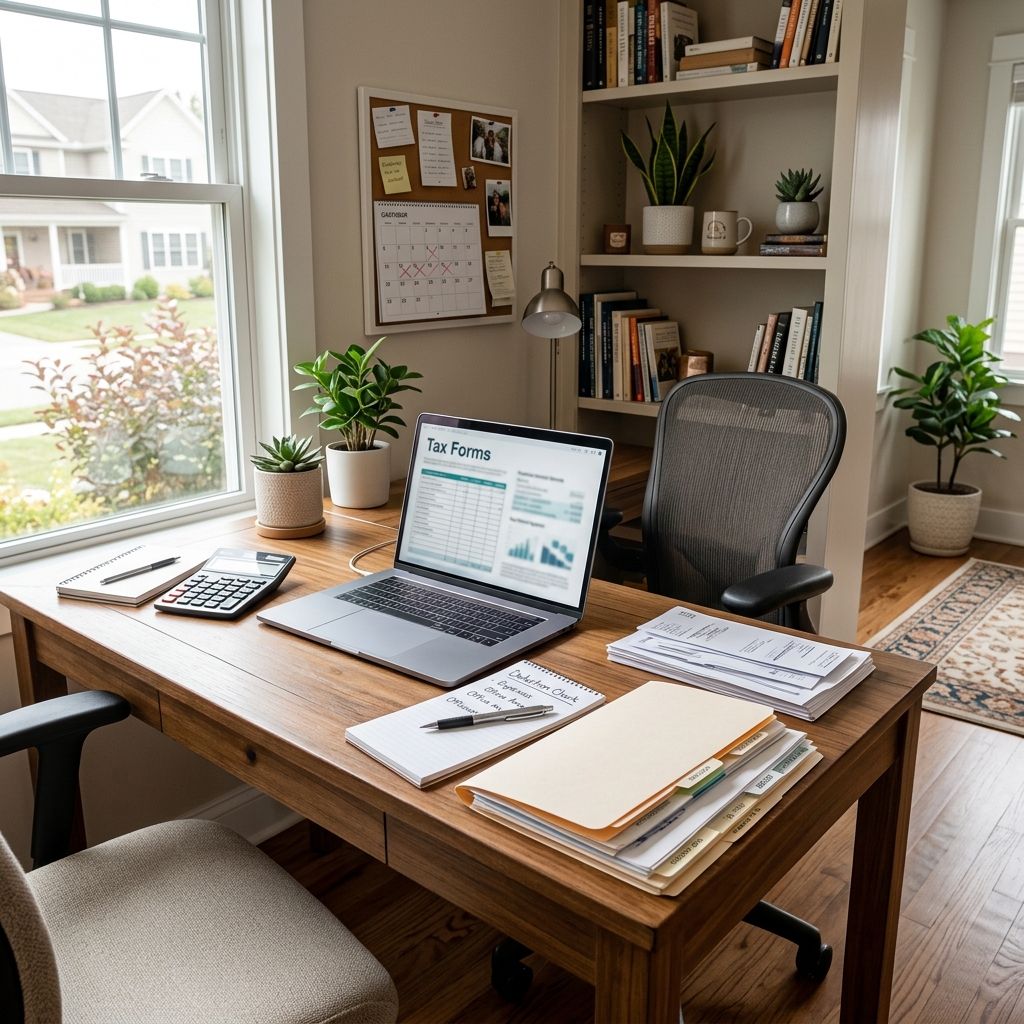
The home office tax deduction can be a valuable money‑saving tool for freelancers, gig workers, and small business owners who run their businesses from home. When used correctly, it allows you to deduct a portion of expenses like rent, mortgage interest, utilities, insurance, and repairs that relate to the business use of your home. Misunderstand the rules, however, and you risk losing the deduction or attracting IRS attention.
This guide explains the key requirements, how to calculate the deduction under both IRS methods, and how to claim it step by step. It also addresses common myths, mistakes, and practical scenarios so you can decide whether the home office deduction is right for you.
1. What the Home Office Deduction Actually Is
The home office deduction allows qualifying taxpayers to write off expenses tied to the business use of a portion of their home. In simple terms, you are telling the IRS: “Part of my home is effectively my business premises, so I’m deducting the costs of that space.”
You may claim this deduction whether you:
- Own your home (house, condo, etc.)
- Rent a home or apartment
- Live in other dwellings such as mobile homes or houseboats, as long as it is your residence and meets the business‑use rules
The deduction is typically taken on Schedule C for sole proprietors and single‑member LLCs, and is supported by Form 8829, Expenses for Business Use of Your Home when you use the regular method.
2. Who Can Claim the Home Office Deduction (and Who Cannot)
Before thinking about square footage or expense categories, you must confirm whether you are eligible at all. The home office deduction is not available to everyone who works from home.
2.1 Eligible taxpayers
According to IRS guidance, the deduction primarily applies to individuals who use part of their home for a trade or business and report income as self‑employed. Common examples include:
- Sole proprietors filing Schedule C
- Independent contractors and consultants
- Freelancers (writers, designers, developers, etc.)
- Gig economy workers running a qualified business activity
- Owners of home‑based businesses such as online stores or professional services
2.2 Taxpayers who generally cannot claim it
Under current rules, most W‑2 employees cannot claim the home office deduction, even if their employer requires them to work remotely. This is a common source of confusion. Unless you also have a separate self‑employed business that qualifies, your employee home workspace does not produce a home office deduction.
| Situation | Typically Eligible? | Notes |
|---|---|---|
| Sole proprietor with a dedicated home office | Yes | Must meet exclusive and regular use tests. |
| Independent contractor working from home | Yes | Home must be principal place of business or client meeting location. |
| Remote W‑2 employee with employer‑provided laptop | No | Employee home office expenses not deductible under current rules. |
| Home daycare operator | Often yes | Special rules apply for shared business/personal use. |
3. Core IRS Tests: Exclusive Use and Principal Place of Business
Being self‑employed is not enough by itself. The IRS also requires that the space and the way you use it meet specific tests. These rules are set out in IRS Topic No. 509, Business Use of Home.
3.1 Exclusive and regular use
To deduct expenses for business use of your home, you must use a clearly identifiable part of your home exclusively and on a regular basis for your business. “Exclusive” is strict: the IRS expects no personal use of that area.
For example:
- A spare bedroom used only as your office for client calls, recordkeeping, and work projects generally qualifies.
- A kitchen table where you work during the day and your family eats at night does not qualify because the space is also used for personal activities.
Occasional or incidental business use (such as checking work email from the couch) does not meet the standard. The space should be clearly dedicated to business.
3.2 Principal place of business or client meeting location
The area must also be one of the following:
- Your principal place of business for your trade or business, where you perform key administrative or management activities such as billing, scheduling, and recordkeeping; or
- A place where you regularly meet with clients or customers in the normal course of business; or
- A separate structure (such as a detached studio or garage) used in connection with your trade or business.
Your home office does not have to be the only place you work, but you must be able to show that it is the main hub for your business operations, especially for administrative tasks.
4. What Expenses You Can Include
Once you establish eligibility, the next step is understanding which costs can be included in the deduction. The IRS divides home office expenses into two main categories: direct and indirect expenses.
4.1 Direct expenses
Direct expenses are costs that relate only to the business area. These are fully deductible (subject to business‑income limits) because they benefit only the home office, not the rest of the home.
Examples include:
- Painting or repairing the walls of your home office
- Installing built‑in shelving in the office space
- Office‑specific flooring or lighting
4.2 Indirect expenses
Indirect expenses are costs required to maintain and operate the entire home and are allocated between personal and business use based on the percentage of the home used for business. Only the business portion of these expenses is deductible.
Common indirect expenses include:
- Rent or a portion of mortgage interest
- Real estate taxes
- Homeowners or renters insurance
- Utilities such as electricity, gas, and water
- General repairs and maintenance
- Depreciation of the home (if you own it)
5. Two Ways to Calculate the Deduction
The IRS offers two methods to calculate the home office deduction: the regular method and the simplified method. Each has advantages and trade‑offs, and you may choose the one that works best for your situation in a given year.
5.1 Regular method
Under the regular method, you determine the business percentage of your home and apply that percentage to eligible indirect expenses. You then add any direct expenses to arrive at the total deduction.
The business percentage is typically calculated as:
- Square footage approach:
Business percentage = (Home office square footage / Total home square footage) × 100 - Room‑based approach:
If rooms are roughly equal in size, Business percentage = (Number of rooms used for business / Total number of rooms) × 100
Example: If your home office occupies 300 square feet in a 2,000‑square‑foot home, the office represents 15% of the home. You may be eligible to deduct 15% of qualifying indirect expenses, plus 100% of direct expenses.
When you use the regular method, you generally complete Form 8829 to compute the allowed deduction and then transfer the result to Schedule C.
5.2 Simplified method
The IRS introduced the simplified method to make calculations easier for qualifying small business owners. Instead of tracking actual home expenses and calculating a business percentage, you simply multiply the square footage of your home office by a prescribed rate.
Key features of the simplified method include:
- A rate of $5 per square foot of qualified business space
- A maximum of 300 square feet eligible
- A maximum total deduction of $1,500 per year under this method
- No separate depreciation calculation for the home
Example: A 200‑square‑foot office used exclusively for business can generate a simplified deduction of 200 × $5 = $1,000.
5.3 Comparing the two methods
| Feature | Regular Method | Simplified Method |
|---|---|---|
| Record‑keeping | Requires tracking actual home expenses and allocating business percentage. | Minimal; primarily needs office square footage. |
| Depreciation of the home | Allowed; may increase deduction but affects basis when you sell. | Not claimed; simpler but potentially smaller deduction. |
| Maximum square footage | No fixed limit, but must be reasonable and used exclusively for business. | Limited to 300 square feet. |
| Maximum deduction | Varies based on expenses and business income. | Capped at $1,500 (300 × $5). |
| Best for | Homeowners or renters with high eligible expenses and good records. | Those who prefer simplicity or have smaller home office costs. |
6. Step‑by‑Step: How to Claim the Home Office Deduction
For sole proprietors and similar self‑employed individuals, claiming the home office deduction generally involves your Schedule C and, if using the regular method, Form 8829.
6.1 Preparation
Before you start filling out forms, gather the following:
- Total square footage of your home and your home office
- Records of rent, mortgage interest, insurance, utilities, repairs, and real estate taxes
- Any direct expenses limited to the home office space
- Business income and other Schedule C expense records
6.2 Using the regular method
- Calculate business percentage: Use square footage or room‑based calculation to determine the percentage of your home used for business.
- Complete Form 8829: Enter relevant expenses and apply the business percentage to indirect costs. The form guides you through limits related to business income.
- Transfer the final deduction: The allowable deduction from Form 8829 flows onto your Schedule C as part of your business expenses.
6.3 Using the simplified method
- Measure your office space: Confirm the square footage of the area used exclusively for business (up to 300 square feet).
- Multiply by $5: Compute the deduction (square footage × $5).
- Enter on Schedule C: Report the simplified amount directly as a home office expense in the appropriate business expense category.
7. Practical Tips, Common Errors, and Record‑Keeping
Because the home office deduction has specific requirements, it has historically been perceived as a red‑flag area for audits. While the rules are clearer today, careful documentation still matters.
7.1 Practical tips for staying compliant
- Clearly define the space: Use furniture or visual boundaries to mark where your office begins and ends. Avoid mixed personal use.
- Maintain written records: Keep notes or sketches showing the layout and measurements of your office area.
- Save supporting documents: Store receipts and statements for rent, utilities, insurance, and repair costs in a secure folder.
- Review annually: Re‑check eligibility each year if your work arrangement or office layout changes.
7.2 Common mistakes that can cost you
- Counting shared spaces: Claiming areas that double as living or family space, such as living rooms or kitchens.
- Overstating square footage: Including hallways or closets not used for business in your office measurement.
- Ignoring the principal‑place‑of‑business test: Claiming a home office even though most work and management activities occur elsewhere.
- Skipping documentation: Failing to keep proof of expenses and office measurements can make defending your deduction difficult.
8. FAQs About the Home Office Tax Deduction
8.1 Does my home office have to be a separate room?
No. The IRS does not require a separate room; a portion of a room can qualify as long as that area is used exclusively and regularly for business. However, using a separate room often makes it easier to demonstrate exclusive use.
8.2 Can I take the home office deduction if I work from home as an employee?
Generally, no. Remote employees who receive a W‑2 from their employer typically cannot claim unreimbursed home office expenses under current federal rules, even if they work from home full time.
8.3 Can renters claim the home office deduction?
Yes. Renters who meet the exclusive‑use and principal‑place‑of‑business tests and report self‑employment income may deduct an appropriate portion of their rent and other eligible expenses.
8.4 Does using the simplified method affect future depreciation?
Under the simplified method, you do not claim depreciation for the home related to the office space. This can simplify future tax calculations because there is no accumulated depreciation to recapture, but it may produce a smaller deduction compared with the regular method for some taxpayers.
8.5 What if I run a daycare in my home?
Home daycare providers have special rules because the same areas are used for both business and personal activities. The IRS allows an allocation based on the proportion of time the space is used for daycare during the year. In these situations, it is wise to review IRS guidance or consult a tax professional.
8.6 Can I switch between the regular and simplified methods?
Yes. You may generally choose either method for a given tax year as long as you meet the underlying eligibility criteria. Many taxpayers compare potential deductions under each method and pick the one that is more favorable and practical for their record‑keeping style.
9. When the Home Office Deduction Is Worth the Effort
The home office deduction is not mandatory; some eligible taxpayers choose not to claim it. Yet when properly applied, it can significantly reduce taxable income and reflect the reality that part of your home functions as business space.
The deduction is often especially valuable if:
- You have substantial rent, mortgage interest, or utility costs.
- Your business relies heavily on a dedicated workspace, such as design studios or consulting offices.
- You maintain accurate records and prefer to optimize tax savings.
If your home office is small and your expenses are modest, the simplified method may provide a quick, low‑effort deduction. For those with larger or more expensive homes, the regular method may be worth the additional calculations.
References
- Topic No. 509, Business Use of Home — Internal Revenue Service. 2024-03-12. https://www.irs.gov/taxtopics/tc509
- How small business owners can deduct their home office from their taxes — Internal Revenue Service. 2022-02-15. https://www.irs.gov/newsroom/how-small-business-owners-can-deduct-their-home-office-from-their-taxes
- Home Office Tax Deduction: Rules, Who Qualifies — NerdWallet. 2023-12-19. https://www.nerdwallet.com/taxes/learn/home-office-tax-deduction
- Home Office Deduction: Who can take it, who can’t — H&R Block. 2023-02-10. https://www.hrblock.com/tax-center/filing/adjustments-and-deductions/home-office-deduction/
- Home-Based Business Tax Deductions Guide — U.S. Chamber of Commerce CO. 2023-05-04. https://www.uschamber.com/co/run/finance/home-based-business-tax-deductions
- The Home Office Deduction — TurboTax, Intuit. 2023-01-30. https://turbotax.intuit.com/tax-tips/small-business-taxes/the-home-office-deduction/L1RZyYxzv
- The Home Office Deduction: A Comprehensive Guide — TaxAct Blog. 2023-02-01. https://blog.taxact.com/guide-to-home-office-deduction/
Similar Articles








Read full bio of Sneha Tete




