The size of a criminal jury may sound like a technical detail, but it raises fundamental questions about how the Constitution protects the right to a fair trial. The Supreme Court’s decision to review the use of six-member juries in criminal cases puts this issue at the center of modern constitutional criminal procedure.
Why Jury Size Matters in Criminal Justice
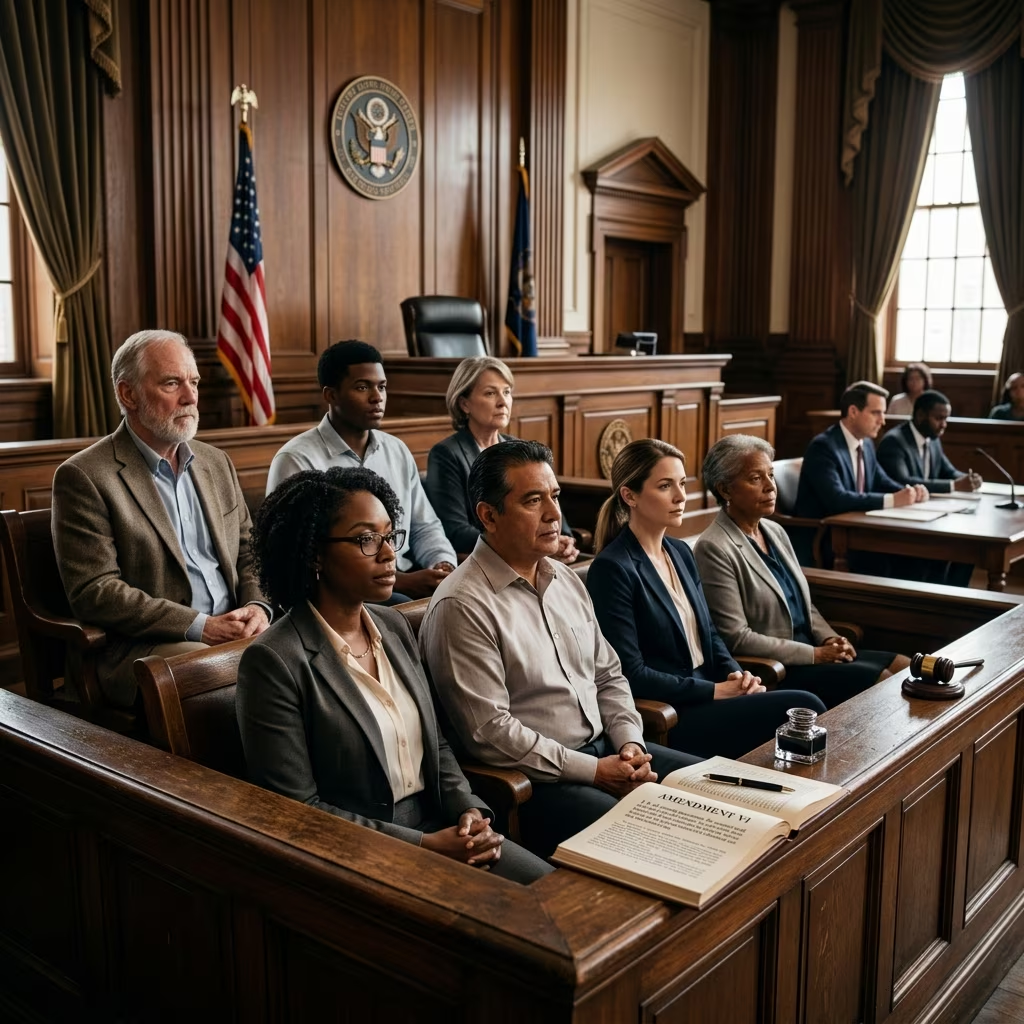
The Sixth Amendment guarantees criminal defendants the right to trial by an “impartial jury,” but the text does not specify how many people must sit on that jury. This silence has left courts to decide whether a jury of six satisfies the same constitutional values as the more traditional twelve-person body.
Jury size affects several core aspects of the criminal process:
- Representativeness: Larger juries are more likely to reflect the diversity of the community and avoid excluding minority viewpoints.
- Deliberation quality: Twelve people bring more perspectives to the table, which can enrich discussion and reduce the risk of domination by a single strong personality.
- Reliability of verdicts: A greater number of jurors can lower the chance of error or arbitrary outcomes because more individuals must independently be convinced beyond a reasonable doubt.
- Public confidence: Traditional twelve-person juries have deep roots in Anglo-American legal culture, which can enhance public trust in verdicts.
States that use six-person juries argue that they are sufficiently representative and efficient, while critics claim they weaken the structural protections the jury was designed to provide.
Historical Roots of the Twelve-Person Jury
To understand today’s debate, it helps to look at where the jury came from. The criminal jury, as adopted in the United States, traces back to the English common-law tradition, where the standard was a twelve-person jury delivering a unanimous verdict.
When countries such as the United States and Argentina constitutionalized jury trials in the nineteenth century, they effectively imported that model: twelve lay citizens who deliberate and return a unanimous decision on guilt or innocence. This historical baseline is critical because many courts interpret constitutional references to “jury” as incorporating the core features of the institution known at the time of adoption.
In some jurisdictions, constitutional or statutory texts explicitly or implicitly assume twelve people. For example, comparative research on juries notes that the traditional jury number is twelve because it is thought to better ensure representativeness and safety against arbitrary decisions. Although the U.S. federal Constitution does not write the number twelve into its text, this tradition informs how judges and scholars read the Sixth Amendment.
Modern Divergence: States That Use Six-Member Juries
Despite tradition, several states have experimented with smaller juries in criminal cases, particularly for non-capital or less serious felonies. Florida is a prominent example, allowing six-person juries in many criminal prosecutions.
State legislatures and courts offer a range of justifications for six-member juries:
- Administrative efficiency: Smaller juries are easier and cheaper to summon and manage, reducing burdens on courts and citizens.
- Speed of trials: With fewer people, voir dire (jury selection), deliberations, and logistics can move faster.
- Allocation of resources: Some systems reserve twelve-person juries for the gravest offenses, such as homicide or crimes carrying very long sentences, while allowing smaller panels for other cases.
Yet this divergence raises the question: can states alter the size of the jury without undermining the constitutional meaning of the right to trial by jury? The Supreme Court’s review seeks to clarify that answer.
Key Constitutional Questions Raised by Six-Person Juries
The current controversy revolves around how the Sixth Amendment should be interpreted in light of both historical practice and modern needs. Several interlocking questions are at stake:
1. Does the Sixth Amendment require twelve jurors?
One view is that when the framers wrote “jury,” they referred to the existing model: twelve laypersons deciding guilt unanimously. Under this approach, reducing the number to six would change the core of the institution and thus violate the Sixth Amendment.
Another view, more flexible, is that the Constitution protects functional equivalence rather than a fixed number. If a six-person jury can provide a fair cross-section of the community and adequately safeguard against wrongful convictions, it might satisfy the Sixth Amendment even if it departs from historical practice.
2. How does jury size relate to unanimity?
Jury size intersects with the separate but related doctrine of unanimity. In recent years, the Supreme Court has reaffirmed that the Sixth Amendment requires unanimous verdicts in state criminal trials for serious offenses. If unanimity is mandatory, some scholars argue that shrinking the jury makes the unanimity requirement less protective, because a single holdout among six jurors may face more pressure than one among twelve.
In jurisdictions that historically adopted the Anglo-Saxon jury model, the package typically included twelve members plus unanimity, suggesting that both features together contribute to the robustness of jury deliberation and minority protection.
3. Is the representativeness of the jury compromised?
A major constitutional concern is whether a smaller jury can still reflect a fair cross-section of the community. Comparative analyses of jury systems emphasize that twelve-person juries are more likely to capture diverse social experiences and viewpoints.
With only six seats, statistically speaking, it becomes more likely that certain demographic or social groups will be underrepresented or not represented at all, particularly in communities with significant diversity. Courts must decide whether this increased risk crosses the line into constitutional infirmity.
Comparative Perspectives on Jury Size and Composition
Looking beyond Florida and the Supreme Court, other jurisdictions have confronted similar questions about jury size and its constitutional significance.
Illinois and the rejection of six-member juries
The Supreme Court of Illinois issued a notable decision declaring six-member juries unconstitutional under its own legal framework. The court concluded that only a twelve-person jury adequately guarantees both community representation and the quality of deliberation.
In reaching this conclusion, the Illinois court emphasized two key points:
- Community representativeness: Twelve jurors better ensure that verdicts reflect a broad spectrum of social perspectives.
- Protection against domination: Larger juries reduce the probability that one strong-willed juror can overpower the views of others, which can happen more easily in smaller groups.
Although Illinois’s decision rests on its own constitution, its reasoning is highly relevant to ongoing debates in the United States about whether six-person panels can meet Sixth Amendment standards.
Jury design in other legal systems
Comparative law shows that many systems formalize the jury’s size to protect fairness. For instance, in some Latin American reforms and in Argentina’s implementation of jury trials, statutes or constitutional interpretations favor twelve-person bodies for serious crimes. These systems typically treat jury size as integral to ensuring that lay participation meaningfully reflects the community.
Similarly, discussions in jurisdictions like Spain highlight that citizen participation in criminal justice through the jury is framed as both a right and duty, and legal rules carefully regulate the jury’s composition, including number, to preserve impartiality and independence.
Policy Arguments For and Against Six-Member Juries
Beyond constitutional interpretation, the debate involves practical policy considerations. Supporters and critics of six-member juries offer competing arguments that courts must assess alongside doctrinal analysis.
| Feature | Twelve-Person Jury | Six-Person Jury |
|---|---|---|
| Community representation | Higher likelihood of diverse viewpoints and demographics. | Greater risk of underrepresentation or homogeneity. |
| Deliberation dynamics | More perspectives; reduces influence of a single dominant juror. | Smaller group may be more vulnerable to peer pressure and dominance. |
| Administrative cost | More expensive and logistically complex. | Cheaper and easier to manage. |
| Speed of trials | Potentially slower selection and deliberations. | Typically faster proceedings. |
| Historical consistency | Aligned with Anglo-American jury traditions. | Departures from traditional model raise constitutional questions. |
Arguments in favor of six-member juries
- Cost and efficiency: Courts face heavy dockets, and smaller juries can help process cases without compromising basic fairness.
- Flexibility for lesser offenses: States can reserve twelve-person juries for the most serious charges while employing six-person panels where the stakes are lower.
- No explicit numerical requirement: The Sixth Amendment mentions “jury” but not a specific number, leaving room, proponents argue, for reasonable variations as long as other protections remain intact.
Arguments against six-member juries
- Reduced representativeness: Smaller panels increase the risk that important community segments are left out, particularly in diverse jurisdictions.
- Weaker deliberation safeguards: With fewer jurors, it may be easier for a single assertive voice to dominate deliberations or for groupthink to set in, threatening the independence of juror judgment.
- Deviation from historical meaning: Critics contend that the framers understood the criminal jury as a twelve-person institution, so shrinking the jury alters the core of the Sixth Amendment right.
Implications of Supreme Court Review for States and Defendants
The Supreme Court’s decision to take up the constitutionality of six-member criminal juries carries significant consequences.
If six-member juries are upheld
A ruling that six-person juries comply with the Sixth Amendment would:
- Validate states like Florida that already rely on smaller juries for many criminal trials.
- Encourage other states to consider adopting similar practices as a way to manage caseloads and resources.
- Signal that the Court is willing to interpret the Sixth Amendment’s “jury” requirement more flexibly, focused on functional fairness rather than strict historical replication.
If six-member juries are struck down
Conversely, a holding that six-member juries violate the Sixth Amendment would:
- Force states using six-person panels to transition to twelve-member juries in affected criminal cases.
- Potentially open the door to challenges of past convictions obtained through six-person juries, depending on how the Court addresses retroactivity.
- Reaffirm the centrality of historical practice—twelve jurors and unanimity—as defining features of the constitutional jury right.
Either way, the decision will reshape how courts and legislatures think about the structural design of criminal juries and the minimum conditions for a constitutionally adequate trial.
Frequently Asked Questions About Six-Member Criminal Juries
Does the Constitution explicitly require twelve jurors?
No. The U.S. Constitution’s Sixth Amendment guarantees the right to an “impartial jury” but does not specify a number. Courts and scholars infer the significance of twelve largely from historical practice and the Anglo-American jury tradition.
Why have twelve-person juries been the norm?
Twelve-person juries emerged in English common law and became deeply embedded in the conception of what a “jury” is. Comparative constitutional studies highlight that this number is considered ideal for ensuring representativeness and safe, well-deliberated verdicts.
Are six-member juries used in all criminal cases in states like Florida?
No. States typically differentiate based on offense severity. Florida, for example, uses six-member juries in many criminal cases, but may employ larger panels or other procedures in the most serious matters, reflecting a policy choice about when full traditional juries are necessary.
How do other countries handle jury size?
Approaches vary. Some systems, such as those influenced by Anglo-Saxon tradition in Latin America, tend to adopt twelve-person juries for serious crimes, often alongside a requirement of unanimity. Other jurisdictions experiment with mixed tribunals or different numbers, but typically regulate size carefully to protect impartiality and community participation.
Is unanimity related to the question of jury size?
Yes. Although unanimity and size are distinct issues, they interact. Modern constitutional debates emphasize that unanimity strengthens protections for minority viewpoints within the jury, and shrinking the jury may change how that protection functions in practice.
Looking Ahead: The Future of Jury Design
The Supreme Court’s examination of six-person criminal juries forces courts, lawmakers, and the public to revisit what the jury is meant to accomplish. Is the jury primarily a tool for efficient fact-finding, or is it a structural safeguard grounded in historical form? How much flexibility can states exercise before they erode the meaning of the Sixth Amendment?
Whatever the outcome, the case highlights that details like jury size—often invisible to the general public—can have profound effects on how justice is administered. Debates in Illinois, Latin America, and Europe show that many systems treat size, composition, and deliberation rules as inseparable from the constitutional promise of a fair criminal trial. In this conversation, six-person juries are more than an efficiency measure; they are a test of how far the law can depart from tradition while still honoring the rights of defendants and the expectations of a democratic society.
References
- Estados Unidos: El jurado de 6 miembros es inconstitucional — Instituto de Estudios Comparados en Ciencias Penales y Sociales (INECIP). 2014-03-21. https://inecip.org/noticias/estados-unidos-el-jurado-de-6-miembros-es-inconstitucional/
- El Juicio por jurados como garantía constitucional — Pensamiento Penal. 2018-07-01. https://www.pensamientopenal.com.ar/system/files/2018/07/doctrina46716.pdf
- La inconstitucionalidad de los veredictos no unánimes en los juicios por jurados — Revista de la Facultad de Derecho (Universidad de la República). 2024-01-01. http://www.scielo.edu.uy/scielo.php?script=sci_arttext&pid=S2393-61932024000101204
- JUICIOS POR JURADOS — Honorable Cámara de Diputados de la Nación (Argentina). 2010-01-01. https://www3.hcdn.gob.ar/dependencias/secparl/dgral_info_parlamentaria/dip/estudios-investigaciones/estudios-investigaciones-historicas/juicios-por-jurados.pdf
- EL JURADO — Revista de Estudios Jurídicos (Universidad de La Rioja). 1997-01-01. https://dialnet.unirioja.es/descarga/articulo/78652.pdf
- Corte Suprema decidirá si Florida puede usar jurados de seis personas en casos penales — WFLA News Channel 8. 2024-01-22. https://www.wfla.com/tampa-hoy/nacional/corte-suprema-decidira-si-florida-puede-usar-jurados-de-seis-personas-en-casos-penales/