
Simple vs. Precomputed Interest on Auto Loans
Understand how simple and precomputed interest change your car payments, total costs, and savings when you pay off early.
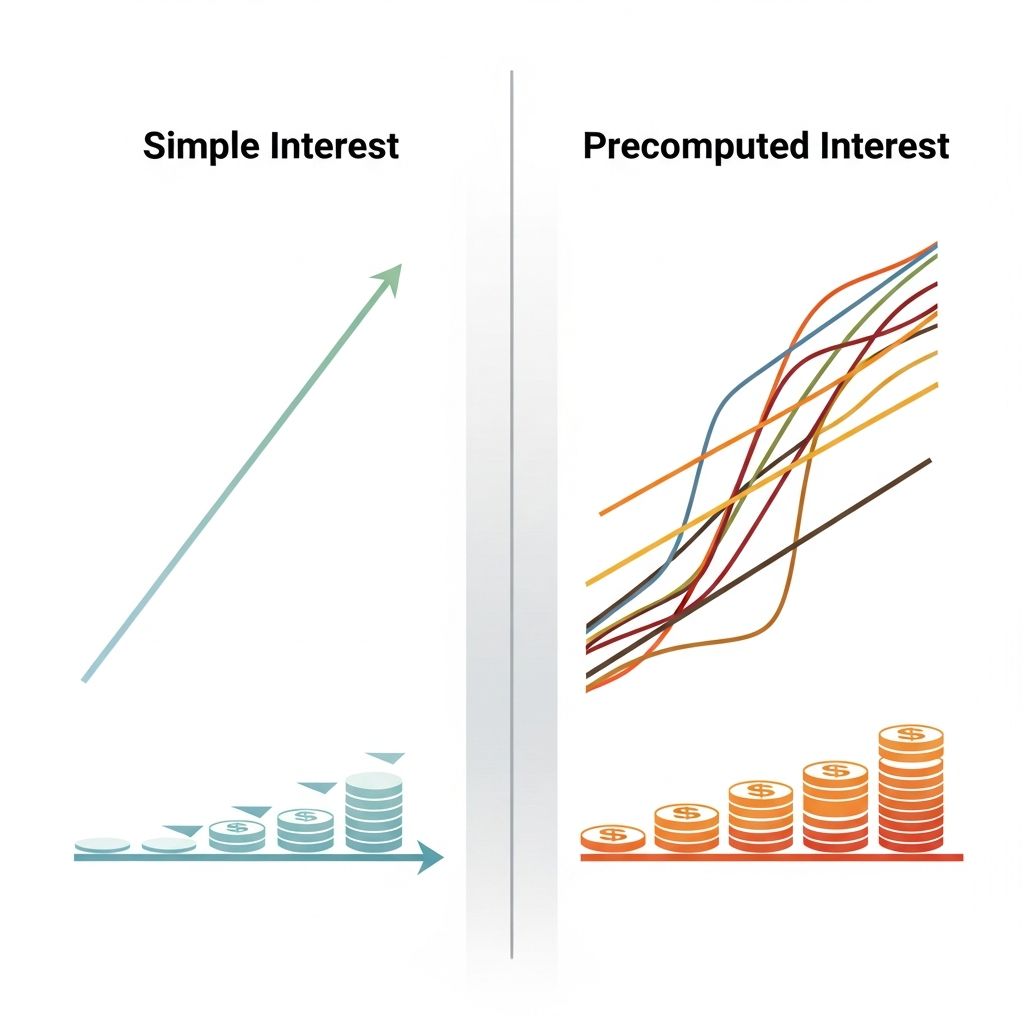
When you finance a car, the way a lender calculates interest can change how much you pay, how flexible your payments are, and how much you save if you pay off the loan early. Most auto loans use simple interest, but some contracts still use precomputed interest, which can be more expensive if you plan to pay ahead or refinance early.
Understanding these two methods before you sign can help you compare offers accurately, avoid costlier terms, and choose the type of loan that fits your budget and repayment plans.
Core Idea: What Is Auto Loan Interest?
Interest is the price you pay to borrow money to buy a vehicle. Each payment you make is typically split between:
- Principal – the amount you borrowed to buy the car
- Interest – the finance charge the lender earns for providing the loan
For auto loans, lenders usually calculate interest in one of two ways:
- Simple interest – interest is recalculated on the remaining balance as you go
- Precomputed interest – total interest is calculated upfront and built into a fixed payment schedule
How Simple Interest Auto Loans Work
With a simple interest auto loan, interest is based on what you still owe at each point in time, not on the original amount for the entire term.
Key characteristics of simple interest loans
- Interest is calculated on the outstanding principal for each period (often daily or monthly).
- Payment allocation changes over time: early payments are heavier on interest and lighter on principal; later payments reverse that pattern.
- Paying early or making extra payments usually reduces total interest, because the balance shrinks faster and future interest is based on a lower amount.
- Most mainstream bank, credit union, and captive auto lender loans are structured this way.
How monthly interest is determined
Lenders commonly start with an annual interest rate and convert it into a periodic rate. In a simplified monthly example:
- Annual interest rate: 6%
- Approximate monthly rate: 6% ÷ 12 = 0.5%
- If your remaining principal is $20,000, that month’s interest is about $100 (0.5% of $20,000)
Your fixed monthly payment then covers that interest plus some amount of principal. As the principal declines, the interest portion of each payment gets smaller and the principal portion gets larger, producing the familiar amortization schedule.
Why simple interest rewards early payoff
Because interest is recalculated on what you still owe, making additional payments toward principal reduces future interest charges:
- If you pay more than the minimum, the extra typically goes to principal (as long as your lender applies it correctly).
- Since future interest is based on a smaller principal, the total interest you pay over the life of the loan drops.
- This flexibility makes simple interest loans attractive if you expect bonuses, tax refunds, or other extra cash you might use to pay down your car loan.
How Precomputed Interest Auto Loans Work
With a precomputed interest loan, the lender calculates the entire amount of interest you are expected to pay for the full term at the outset.
Key characteristics of precomputed interest loans
- Interest is calculated upfront using the original loan amount, rate, and term.
- The lender adds that interest to the principal to create a single “amount financed” figure.
- This total is then divided into equal monthly payments for the length of the loan.
- Each payment has a fixed interest portion built in; the schedule does not automatically adjust when you pay ahead.
- Extra or early payments may not significantly reduce total interest, because the loan was designed to collect nearly all of the interest regardless of early payoff.
Why precomputed interest can limit savings
In a precomputed structure, the lender assumes you will keep the loan for the entire term and assigns the interest across all payments from the beginning. If you decide to:
- Pay off the loan early
- Refinance before the end of the term
- Make large additional principal payments
the formula or contract rules may still require you to pay most of the original interest, even though you shortened the time you used the loan. That makes precomputed interest loans less friendly to early payoff compared to simple interest loans.
Side-by-Side Comparison: Simple vs. Precomputed Interest
| Feature | Simple Interest Auto Loan | Precomputed Interest Auto Loan |
|---|---|---|
| How interest is calculated | On the remaining balance each period | On the original balance for the full term, upfront |
| Payment structure | Payment is fixed, but interest vs. principal portion changes over time | Payment and interest allocation are set in advance and rarely adjust |
| Effect of extra payments | Usually reduces principal faster and cuts total interest significantly | May provide only limited savings; much of interest is already built in |
| Best for borrowers who… | Want flexibility to pay off early, refinance, or pay extra when possible | Expect to keep the loan for the full term and value predictable costs |
| Common availability | Most bank, credit union, and dealer loans use simple interest | Less common; sometimes seen in certain retail installment contracts |
How to Tell Which Type of Interest Your Auto Loan Uses
The loan type is not always highlighted in big print, so you may need to look closely at the paperwork and ask questions before signing.
Where to look in your documents
- Loan agreement or retail installment contract: Look for wording such as “simple interest,” “actuarial method,” or “precomputed interest.”
- Truth in Lending disclosures (often included with auto financing in the United States): These show the annual percentage rate (APR), amount financed, finance charge, and total of payments, which can give hints about how interest is handled.
- Amortization schedule or payment schedule, if provided: A schedule that clearly shows declining interest portions over time is typical of a simple interest loan.
Questions to ask the lender or dealer
- “Is this a simple interest or precomputed interest auto loan?”
- “If I pay extra on my loan, will all of my extra payment go toward principal?”
- “If I pay the loan off early, how will you calculate the payoff amount?”
- “Is there any prepayment penalty or additional fee if I repay early?”
Get answers in writing whenever possible so you can compare loans accurately and avoid surprises later.
How Interest Type Affects Your Financial Strategy
The same car, loan amount, and APR can lead to different outcomes depending on whether the interest is simple or precomputed. Here are practical ways the interest method affects your plans.
1. Paying off your car loan early
- Simple interest: Paying off early typically saves interest because you stop future interest from accruing on the remaining balance.
- Precomputed interest: Early payoff may reduce some interest, but often not proportionally to how much you cut off the term. Some contracts embed nearly all interest upfront.
If early payoff is a high priority, a simple interest loan generally provides more benefit.
2. Making extra payments occasionally
- Simple interest: Extra payments made correctly toward principal reduce future interest charges, even if they are irregular.
- Precomputed interest: Extra payments may move your payoff date slightly earlier but often do not reduce the total interest by as much.
When you make extra payments on a simple interest loan, clearly designate them as additional principal payments so they are not treated as early payments toward a future due date.
3. Refinancing to a better rate
- Simple interest: Refinancing to a lower rate can reduce your monthly payment and total interest, especially if done earlier in the term.
- Precomputed interest: Because much of the interest is fixed, the benefits of refinancing may be smaller than expected. You may have already paid a significant portion of the interest in earlier payments.
Other Factors That Matter Besides Interest Type
The structure of interest is important, but it is only one part of the cost of an auto loan. When comparing offers, also pay close attention to:
- Annual percentage rate (APR) – reflects the interest rate plus many finance charges, helping you compare the true cost of different loans.
- Loan term length – longer terms lower monthly payments but often increase total interest paid.
- Loan amount – borrowing more for taxes, fees, or add-ons increases both principal and interest.
- Fees and add-ons – optional products like service contracts or credit insurance may be financed into the loan, raising the amount on which interest is charged.
- Your credit profile – borrowers with higher credit scores usually qualify for lower interest rates, which can significantly reduce total costs over the life of the loan.
Practical Checklist Before You Sign an Auto Loan
Use this quick checklist to evaluate any car loan contract:
- Confirm whether the loan uses simple interest or precomputed interest.
- Review the APR, loan term, and total of payments on the disclosures.
- Ask how extra payments are applied and whether you can target them to principal.
- Check for any prepayment penalties or payoff fees.
- Compare offers from multiple lenders, including banks, credit unions, and online lenders, before relying on dealer-arranged financing.
- Use an online auto loan calculator to estimate your monthly payment and total interest under different rates and terms.
Frequently Asked Questions (FAQs)
Is simple interest always better than precomputed interest?
Simple interest is usually more favorable, especially if you plan to pay extra or pay off the loan early, because interest is based on the declining balance. However, you should still compare APRs, fees, and terms; a simple interest loan with a much higher rate may still cost more overall than a lower-rate precomputed loan.
How can I confirm if my auto loan is simple interest after signing?
Review your contract and your lender’s online account tools to see how payments are allocated between principal and interest. If the interest portion of your payment declines over time in your statements or amortization schedule, that is a strong sign the loan uses simple interest.
Do precomputed interest loans charge interest on interest?
Precomputed loans do not typically add new interest on outstanding unpaid interest the way some compounding loans do, but they do calculate the expected entire interest amount in advance and spread it across all payments. This structure is why early repayment often leads to less savings than with a simple interest loan.
Will paying biweekly instead of monthly help on a simple interest auto loan?
Paying more frequently can reduce total interest because principal declines sooner, particularly if your loan calculates interest daily and you effectively make the equivalent of an extra payment each year. Confirm with your lender that there are no processing fees or restrictions on biweekly payments.
What if my dealer will not specify the interest method?
If a dealer or finance office cannot clearly explain whether the loan is simple or precomputed, or will not provide written confirmation, you may want to walk away and seek financing from a bank or credit union that can provide transparent terms.
References
- How to Calculate Auto Loan Interest — Experian. 2025-02-20. https://www.experian.com/blogs/ask-experian/how-to-calculate-auto-loan-interest/
- How Does Interest on a Car Loan Work? — Intuit Credit Karma. 2023-09-12. https://www.creditkarma.com/auto/i/car-loans-interest
- How Does Interest Work on a Car Loan? — Navy Federal Credit Union. 2023-05-10. https://www.navyfederal.org/makingcents/auto/how-does-interest-work-on-car-loan.html
- How Do Car Loans Work? — Bank of America. 2024-03-18. https://www.bankofamerica.com/auto-loans/how-car-loans-work/
Similar Articles








Read full bio of Sneha Tete




