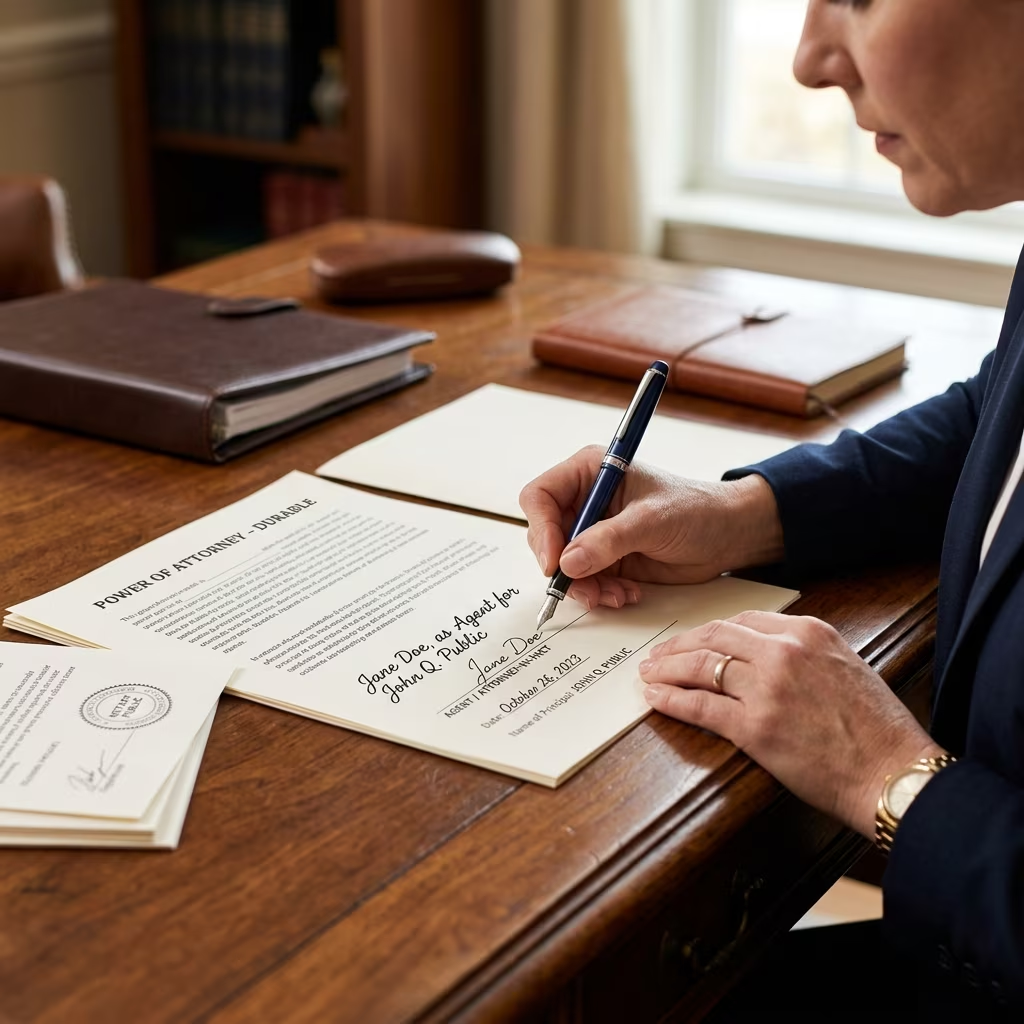
Acting under a Power of Attorney (POA) gives you authority to sign documents on behalf of another person, known as the principal. To avoid confusion, rejection of documents, or personal liability, you must sign in a way that clearly shows you are acting as an agent, not in your own personal capacity.
This guide explains how to prepare for signing, the correct signature formats, how to handle different types of documents, and common mistakes to avoid. It is for general information only and is not a substitute for legal advice. Requirements vary by state and by institution, so when in doubt, consult a lawyer or the organization requesting the signature.
Understanding Your Role as a Power of Attorney Agent
A Power of Attorney is a legal document that authorizes one or more people to act as the principal’s agent. The agent, often called an attorney-in-fact, may be permitted to make financial, legal, or medical decisions, depending on what the POA document specifies.
- Principal: The person who grants authority in the POA.
- Agent / Attorney-in-fact: The person authorized to act for the principal.
- Scope of authority: The specific actions and decisions the POA allows you to make; these are defined in the POA document itself.
When you sign for the principal, you are not simply helping them; you are legally binding them to agreements. That is why your signature must always show both:
- Who is actually entering the transaction (the principal), and
- Who is signing and in what capacity (you, as agent).
Key Principles for Signing as Power of Attorney
Across states and institutions, one consistent rule appears: you must make it obvious that you are signing on behalf of the principal and in an agency capacity, not as yourself personally.
Core Components of a Valid POA Signature
Most professionals recommend that a signature as POA include the following elements:
- Principal’s full legal name
- A connector word such as “by” or “as” to link the principal and the agent
- Your personal signature
- Your role or capacity, such as “Agent”, “Attorney-in-Fact”, or “POA”
Using all four elements reduces the risk that someone may argue you signed for yourself rather than for the principal.
Common Signature Formats
Here are widely accepted signature formats when you sign under a Power of Attorney:
| Format | Example | When to Use |
|---|---|---|
| Principal’s Name, by Agent’s Signature, Title | “John Smith, by Jane Doe, Attorney-in-Fact” | General contracts, checks, real estate documents; emphasizes principal as the contracting party. |
| Agent’s Name, Agent Title for Principal | “Jane Doe, attorney-in-fact for John Smith” | Alternative format often accepted by institutions and real estate professionals. |
| Short identifier after signature | “John Smith, by Jane Doe, POA” | Simpler notation that still indicates agency status and avoids personal liability. |
Preparation Before You Sign
Proper signing starts before you put pen to paper or use an electronic signature. These steps help ensure your authority will be recognized and your documents accepted.
1. Review the Power of Attorney Document
Before signing anything, read the POA carefully:
- Confirm the principal’s name and your name are correct.
- Check that the POA is currently valid (for example, some POAs only become effective upon incapacity, or may have termination dates).
- Verify the scope of authority: does it explicitly allow you to sign checks, contracts, real estate forms, or medical authorizations as needed?
2. Carry Documentation of Your Authority
Many banks, medical providers, and title companies will want to see proof of your authority. Best practice is to bring:
- A original POA document or a certified copy.
- A government-issued photo ID to verify your identity.
In some states, such as Hawaii, Idaho, and Montana, notaries are required to verify an agent’s authority when a document is notarized. Having the POA ready can avoid delays.
3. Confirm Any Special Signature Requirements
Institutions sometimes require a specific signature format on their own forms. To prevent rejection:
- Call ahead or ask in writing how they want POA signatures to appear.
- Follow any stated format exactly (for example, some bank forms may have a dedicated “POA” signature line).
- If you are unsure, ask a lawyer or the institution to confirm that your intended format is acceptable.
How to Sign Different Types of Documents
While the basic principles stay the same, certain documents involve extra considerations when you sign as POA.
Signing Contracts and Agreements
For contracts (such as service agreements, leases, or purchase contracts), clarity is critical because these documents create legal obligations for the principal.
Recommended approach:
- Print or write the principal’s full legal name on the signature line.
- Add the word “by”.
- Sign your own legal signature.
- Add your title or capacity, such as “Attorney-in-Fact” or “Agent”.
Example: “John A. Smith, by Jane B. Doe, Attorney-in-Fact”
If the contract requires initials on each page, some practitioners recommend using both sets of initials, such as “JS by JD, POA”, so it remains clear throughout the document that you are acting under POA authority.
Signing Checks and Financial Documents
Many POA agents use their authority to manage bank accounts, pay bills, or endorse checks for deposit. Before doing so:
- Confirm the POA grants you authority over banking and financial transactions.
- Check whether the bank requires its own POA form or has special signature instructions.
Typical check endorsement format:
- Signature line: “John Smith, by Jane Doe, Agent”
- Or: “John Smith, by Jane Doe, Attorney-in-Fact”
Never sign only your own name on a check if you are using POA authority. Doing so can indicate you are personally taking responsibility for the funds or acting without authority.
Signing Real Estate Documents
Real estate transactions often require strict compliance with signature and recording rules. Title companies, real estate brokers, and county recorders may have their own expectations.
Commonly recommended format for real estate agreements:
- “Charles Jones, by Ann Jones, under POA” – principal named first, followed by “by,” agent’s name, and a POA reference.
An alternative format that is also recognized by many professionals is:
- “Ann Jones, attorney-in-fact for Charles Jones”
For deeds or other documents that must be recorded, the office may require an original or certified copy of the POA to be presented. Check local requirements before closing.
Documents Requiring Notarization
When a document signed under POA must be notarized, the notary typically verifies your identity as the signer and may also need to verify your authority, depending on the state.
- In Hawaii, Idaho, and Montana, notaries must confirm that you have representative authority, often by seeing the POA or relying on personal knowledge.
- In states like California and North Carolina, notaries do not have a statutory duty to verify your POA authority, but best practice is still to present the document.
For the notary’s records, you will sign with your POA format (e.g., “John Smith, by Jane Doe, Attorney-in-Fact”), but the journal will usually include your own name as the signer and a note that you signed as attorney-in-fact.
What You Should Never Do When Signing as POA
Certain mistakes can create serious problems, including personal liability or accusations of forgery. Professionals consistently warn against the following:
- Never sign only the principal’s name – this can look like you are forging their signature, because it does not indicate your role as agent.
- Never sign only your own name – this suggests you are acting in your personal capacity, which could make you personally liable for the contract or debt.
- Do not omit your title or status – always add “Agent”, “Attorney-in-Fact”, or “POA” so third parties know you are acting under a Power of Attorney.
- Do not exceed the scope of the POA – if the document does not clearly grant authority for a particular transaction, consult an attorney before signing.
Practical Tips to Reduce Risk
In addition to using proper signature formats, the following practices can help protect you and the principal.
- Keep detailed records: Maintain copies of all documents you sign, along with dates and reasons for each transaction.
- Communicate with the principal: When possible, keep the principal informed about major decisions and signatures, especially financial and real estate commitments.
- Consult professionals for complex matters: For large financial transactions, real estate deals, or disputes, seek advice from an attorney or qualified advisor.
- Respect fiduciary duties: As an agent, you generally have a duty to act in the principal’s best interests, avoid conflicts of interest, and follow their known wishes.
Frequently Asked Questions
1. Do I always have to write “by” when signing as POA?
Using “by” between the principal’s name and your name is one of the clearest ways to show that you are signing as an agent, and it is widely recommended by legal professionals. Some formats instead put your name first followed by “attorney-in-fact for” the principal, which is also generally acceptable. The key is clarity, not the specific word.
2. Can I use an electronic signature as a Power of Attorney agent?
In many situations, electronic signatures are treated similarly to handwritten signatures, and you can sign as POA using a digital format. However, electronic signature rules and POA recognition vary by state and by institution. Always confirm with the bank, title company, or organization whether electronic signatures are acceptable for the specific document.
3. Does a notary need to see the principal when I sign as POA?
Generally, no. When you sign a document as an attorney-in-fact and it is notarized, the notary interacts only with you as the signer and verifies your identity. In some states, the notary may also need to verify your authority by reviewing the POA or relying on personal knowledge. The principal does not typically need to be present.
4. What if the institution rejects my POA signature?
Institutions may reject signatures for several reasons: they may require their own POA forms, have stricter internal policies, or question the validity of the POA. First, ask for a clear explanation of the reason for rejection. You can then:
- Offer to provide an original or certified copy of the POA.
- Adjust your signature format to meet their requirements.
- Consult an attorney if the institution continues to refuse a valid POA.
5. Can I be personally liable for contracts I sign as POA?
If you sign correctly, clearly indicating that you are acting as agent and within the scope of your authority, the obligations generally fall on the principal, not on you personally. However, if you sign only your own name, exceed your authority, or engage in misconduct, you may face personal liability or other legal consequences. Using clear POA signature formats and staying within the POA’s limits greatly reduces this risk.
6. Is there one “official” way to sign under Power of Attorney?
No single format is legally mandated in every situation. Legal and professional sources emphasize that the main requirement is clarity: the signature must show who the principal is, who is signing, and that the signer is acting under a Power of Attorney. The formats given in this guide are widely accepted best practices, but you should still follow any specific instructions from the institution involved.
References
- Power of Attorney — American Bar Association. 2023-06-01. https://www.americanbar.org/groups/real_property_trust_estate/resources/estate-planning/power-of-attorney/
- How Should An Agent Sign Documents Under A Power Of Attorney In Florida? — AWS Law. 2022-04-15. https://awslaw.org/how-should-an-agent-sign-documents-under-a-power-of-attorney-in-florida/
- How should a power of attorney be signed? — NC REALTORS®. 2018-09-10. https://www.ncrealtors.org/question/how-should-a-power-of-attorney-be-signed/
- How to sign documents as a business, estate or acting under a power of attorney — Pennsylvania Association of Realtors. 2021-07-26. https://www.parealtors.org/blog/how-to-sign-documents-as-a-business-estate-or-acting-under-a-power-of-attorney/
- How to sign as power of attorney (POA) — Adobe Inc. 2023-03-01. https://www.adobe.com/acrobat/hub/how-to-sign-as-power-of-attorney.html
- How to notarize for a signer who has power of attorney — National Notary Association. 2015-09-23. https://www.nationalnotary.org/notary-bulletin/blog/2015/09/how-to-handle-notarization-attorney-in-fact
- How to Sign as Power of Attorney for Your Elderly Parent — AgingCare. 2022-02-10. https://www.agingcare.com/articles/how-to-sign-as-power-of-attorney-for-your-elderly-parent-443408.htm