
Should Workers’ Comp Cover Medical Marijuana?
A clear look at how workers' compensation laws handle medical marijuana claims.
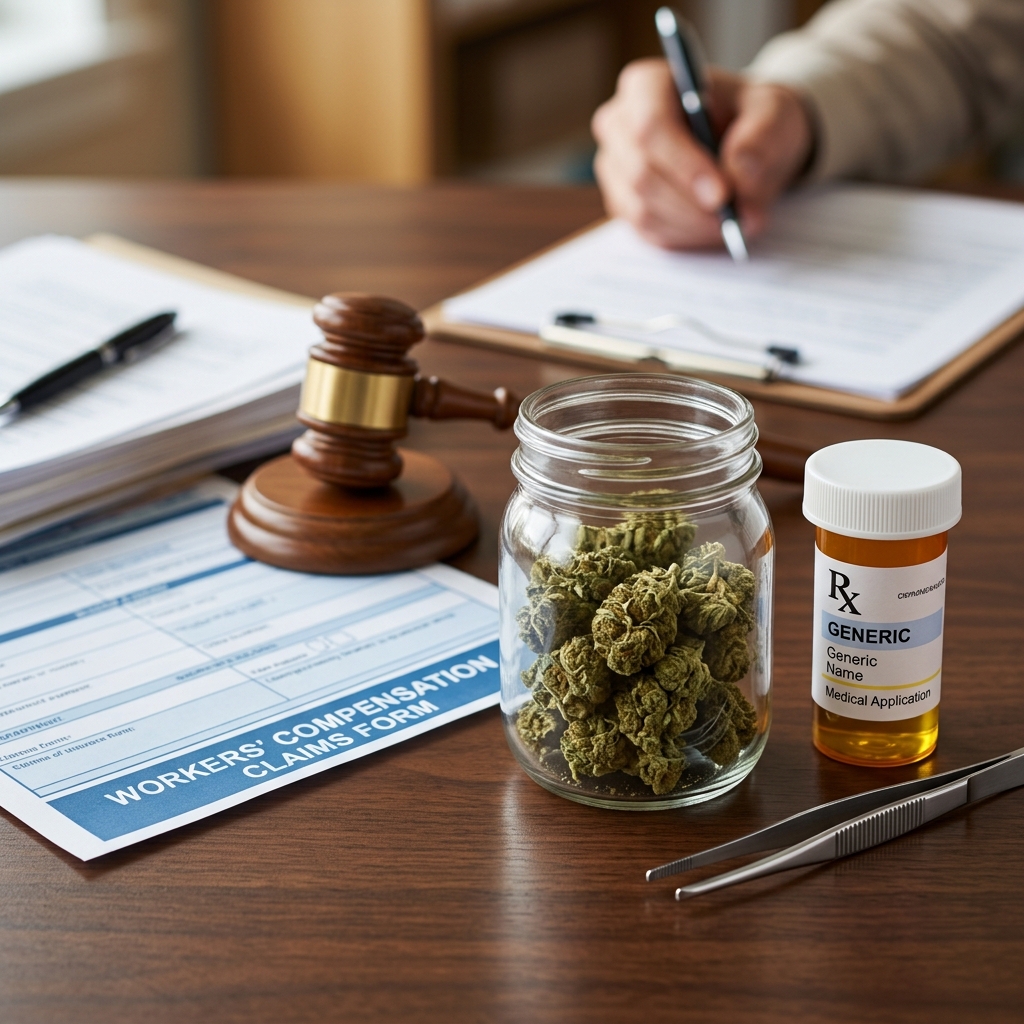
Whether workers’ compensation should pay for medical marijuana is one of the most uneven questions in workplace injury law. In some states, injured workers may recover the cost of cannabis when a doctor recommends it for a job-related condition. In others, insurers are expressly barred from paying for it, or the law remains silent even though medical marijuana is legal for other purposes.
The practical answer is that there is no nationwide rule. Workers’ compensation systems are state-based, and states have taken very different approaches to cannabis reimbursement, often influenced by whether the drug is treated as an approved medical therapy, whether it remains illegal under federal law, and whether state treatment guidelines allow it as a reasonable option after a workplace injury.
Why This Issue Is So Complicated
Workers’ compensation is designed to cover medical care that is reasonable and necessary for a work-related injury. That principle sounds straightforward, but medical marijuana sits at the intersection of health care, insurance, and drug policy. Cannabis may be legal for medical use in a state, yet still face limits because it is not approved by the U.S. Food and Drug Administration and remains a federally controlled substance.
This creates tension for insurers and employers. If a treating physician believes medical marijuana is the best or only workable option for pain, muscle spasticity, anxiety, or another qualifying condition, the injured worker may argue that the treatment should be paid for like any other prescribed therapy. Insurers often respond that reimbursement is not required, especially where state law does not clearly compel payment.
How States Tend to Treat Medical Marijuana in Workers’ Compensation
State approaches generally fall into three broad categories. Some states explicitly allow reimbursement in at least certain circumstances. Others expressly prohibit reimbursement. A third group legalizes medical marijuana but does not clearly say whether workers’ compensation must pay for it.
| State approach | Typical result for injured workers |
|---|---|
| Expressly allowed | Payment or reimbursement may be available if the claim meets state requirements and the treatment is properly authorized. |
| Expressly prohibited | Workers’ compensation insurers are not required to cover medical marijuana, even if it is recommended by a doctor. |
| Unclear or unresolved | Coverage may depend on litigation, administrative rulings, or how broadly a state interprets medical necessity. |
Federal and state policy research has found that only a small number of jurisdictions explicitly require workers’ compensation reimbursement for medical cannabis, while several expressly reject it and many do not impose a reimbursement duty at all. That uneven landscape is the main reason workers and employers often receive very different answers depending on where the injury occurred.
When Reimbursement May Be Possible
In states that recognize medical marijuana as a compensable treatment, the injured worker usually must still satisfy ordinary workers’ compensation rules. The injury must be job-related, the treatment must be tied to that injury, and a licensed provider must support the medical need for the cannabis use.
In some jurisdictions, reimbursement may be available through litigation, administrative review, or a claim that the cannabis is part of the overall medical treatment plan rather than a separate lifestyle choice. New York’s workers’ compensation board, for example, has opened the door to reimbursement in certain cases when medical marijuana is authorized and the relevant treatment guidelines are followed.
Pennsylvania has also been the subject of significant discussion because its medical marijuana framework and workers’ compensation rules leave room for arguments about medical necessity and reimbursement in the context of a work injury. Even there, however, the law is not simply automatic; workers still have to prove why the cannabis is reasonably required for recovery.
Where Coverage Is Usually Denied
Many states take the opposite view and refuse to make insurers pay for cannabis-related treatment. In those states, the fact that marijuana is medically authorized does not mean workers’ compensation must reimburse the cost.
Ohio is a useful example of a state that permits medical marijuana for qualifying conditions but still does not require workers’ compensation to cover it. State guidance and legal commentary indicate that the workers’ compensation system there continues to follow the federal view that marijuana is not an approved medicine for reimbursement purposes.
Other states reach similar outcomes by statute, regulation, or court decision. For injured workers, that means a prescription or certification alone may not be enough. A doctor can recommend cannabis, but the insurance carrier may still deny payment if the state has drawn a line against reimbursement.
What Injured Workers Should Understand Before Asking for Coverage
If a worker wants medical marijuana included in a workers’ compensation claim, the first question is not whether cannabis is legal in the state. The real questions are whether state law allows reimbursement, whether the treatment is tied to the injury, and whether the recommendation follows the state’s medical marijuana rules.
- Confirm that the injury is clearly work-related.
- Ask whether the state workers’ compensation system has a rule or case that addresses medical marijuana.
- Make sure the treating provider is authorized to recommend or certify the treatment.
- Keep records showing the diagnosis, treatment plan, receipts, and any reimbursement request.
- Check whether the claim must go through a utilization review or other approval process.
Documentation matters because cannabis claims often turn on proof. Insurers are more likely to challenge reimbursement when the medical file is thin, the treatment plan is vague, or the worker cannot show that marijuana was recommended for the compensable injury rather than for an unrelated condition.
How Federal Law Shapes the Debate
Even when state law is favorable, federal law continues to influence the conversation. Marijuana remains illegal under federal controlled-substances law, and that status is one reason insurers often resist paying for it. Because workers’ compensation insurance is also tied to regulated insurance systems, carriers tend to rely on federal illegality as one reason to deny reimbursement.
This does not always end the inquiry. State workers’ compensation systems can, and sometimes do, order payment despite federal concerns. But federal law remains a major background factor, especially in states that have not clearly said whether cannabis must be reimbursed.
Benefits and Concerns on Both Sides
Supporters of coverage argue that workers should not have to absorb the cost of a treatment that their doctor believes is medically necessary for a compensable injury. They also point out that medical marijuana may be an alternative to opioids or other stronger medications in certain cases.
Critics respond that workers’ compensation should not be forced to pay for a treatment that remains federally prohibited and inconsistently regulated. They also note that allowing reimbursement can create administrative problems, pricing questions, and disputes over how to verify ongoing need.
Both views have some force. The policy question is not simply whether cannabis helps some patients. It is whether a state workers’ compensation system should treat it as a reimbursable part of medical care, and under what safeguards.
Common Questions About Medical Marijuana and Workers’ Comp
Does a medical marijuana card guarantee coverage?
No. A card or certification may show that the worker is authorized to use cannabis under state medical marijuana law, but workers’ compensation reimbursement depends on the rules in the state where the claim is filed.
Can an employer refuse to pay even if the doctor recommends cannabis?
Yes, in many states. A doctor’s recommendation may support the claim, but it does not automatically override a statute, regulation, or appellate ruling that excludes reimbursement.
Is marijuana treated like other prescription drugs?
Not usually. Even in states that permit medical cannabis, it is often treated differently from conventional prescription medication because of federal status, special certification rules, and state-specific limits on how it may be dispensed.
What if the worker used marijuana before the injury?
That is a separate issue from reimbursement. Prior cannabis use can affect a claim in some states if the employer argues impairment contributed to the accident, but that depends on the particular law governing the claim and the facts of the case.
Is reimbursement ever paid directly to the worker?
Yes. In some systems, payment may go to the claimant after the worker pays out of pocket, while in others payment may be made to the dispensary if the state procedures allow it.
Practical Takeaways for Workers and Employers
For workers, the main lesson is to treat a medical marijuana request like any other contested medical expense: get a clear recommendation, keep complete records, and verify the local workers’ compensation rule before assuming payment will be approved. For employers and insurers, the key is to review the state framework carefully rather than relying on a generic national answer.
Because state law varies so widely, two workers with nearly identical injuries can end up with very different outcomes. One may receive reimbursement after proving medical necessity, while another may be denied because the state has chosen not to require payment for cannabis treatment.
That variation is likely to continue. Until more states clarify the issue, medical marijuana will remain one of the most contested categories of treatment in workers’ compensation law.
References
- How Legal Marijuana Will Affect Workers’ Comp Cases in PA — Robinson Law. n.d. https://robinsonlwyr.com/how-legal-marijuana-will-affect-workers-comp-cases-in-pa/
- Medical marijuana – Workers’ compensation state-by-state rules — Optum/Workers’ Compensation and Auto Injury Bulletin. 2025. https://preview-workcompauto.optum.com/content/dam/noindex-resources/owca/insights/ppra/medical-marijuana-state-by-state-rules-2025.pdf
- WCI Coverage of Cannabis Costs for Work-related Health Conditions — CDC/NIOSH. 2021-05-13. https://www.cdc.gov/niosh/bulletin/2021/wci-cannabis.html
- Medical marijuana and workers’ compensation in Florida — All Injuries Law. n.d. https://www.all-injuries.com/blog/medical-marijuana-and-workers-compensation-in-florida/
- Issue Brief: Medical Marijuana and Workers’ Compensation — American Academy of Actuaries. 2023-04-26. https://actuary.org/wp-content/uploads/2023/04/IB.MMJ_.4.26.23.pdf
- How Medical Marijuana Impacts Workers’ Comp Cases in PA — Krasno Law. n.d. https://www.krasnolaw.com/blog/how-medical-marijuana-impacts-workers-comp-cases-in-pa
- Medical Marijuana and Ohio Workers’ Compensation — Monast Law. n.d. https://www.monastlaw.com/library/medical-marijuana-and-ohio-workers-compensation.cfm
- Medical Marijuana – Workers’ Compensation Board — New York State Workers’ Compensation Board. n.d. https://www.wcb.ny.gov/content/main/TheBoard/medical-marijuana.pdf
Similar Articles








Read full bio of Sneha Tete




