
Should Your Minnesota Custody Agreement Be Signed by a Judge?
Understand why turning a private parenting plan into a court-approved custody order can affect enforceability, flexibility, and long-term stability.
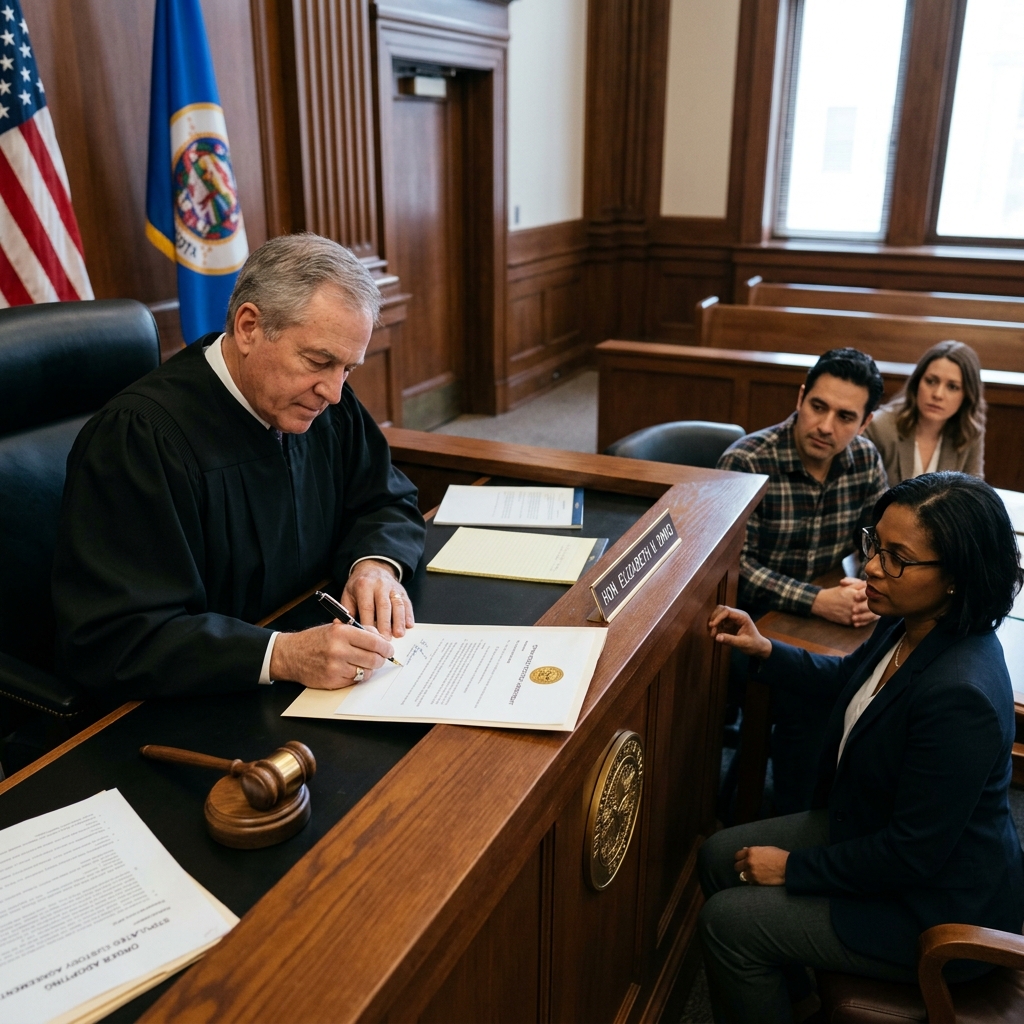
Parents in Minnesota frequently resolve child custody and parenting time through informal agreements rather than courtroom battles. The critical question is whether that agreement should be submitted to a judge so that it becomes an official court order. Understanding the legal consequences of a judge’s signature can help you choose the right path for your family.
Private Agreements vs. Court Orders: What Is the Real Difference?
A custody or parenting plan can exist in two very different forms:
- Private agreement: An arrangement created and followed by the parents without a judge’s approval.
- Court order: A written agreement or judicial decision signed by a judge that has the force of law.
In Minnesota, the only way for someone to officially have custody of a child, whether temporary or permanent, is through a court order. Without that order, you may have practical arrangements, but you lack the formal legal structure that courts and agencies rely upon.
How Minnesota Law Defines Custody and Parenting Time
Before deciding whether to seek a judge’s signature, it is important to understand the basic legal concepts used in Minnesota:
- Legal custody: The right to make major decisions about a child’s upbringing, such as education, medical care, and religious instruction.
- Physical custody: Where and with whom the child lives on a regular basis, including day-to-day care.
- Parenting time (visitation): The schedule describing when each parent spends time with the child.
In Minnesota, parents can agree on their own custody arrangements and ask the courts to approve them. If the judge approves, the agreement can be incorporated into a final custody order that defines legal and physical custody and outlines parenting time.
When a Judge’s Signature Becomes Essential
A judge’s signature is not just a formality; it marks the moment an arrangement becomes enforceable by law. There are several scenarios where having a formal custody order is especially important:
- Unmarried parents: In Minnesota, when parents were not married at the time of the child’s birth, the mother has sole custody until a court issues a custody order, even if both parents signed a Recognition of Parentage. A judge’s order is necessary to establish the father’s legal custody and parenting time.
- High conflict or frequent disagreements: If disagreements over schedules, decision-making, or relocations are common, a court order provides a clear, enforceable baseline.
- Safety concerns: When domestic abuse, substance use, or other serious risks affect the child, courts can issue specific conditions or limitations on parenting time.
- Out-of-state moves: Schools, courts, and agencies in other states rely on formal orders to recognize custody and parenting time under interstate custody laws.
- Access to records and services: Medical providers, schools, and government agencies often require proof of legal custody before sharing information or allowing major decisions.
In all of these situations, a judge’s signature transforms a private understanding into a legal order that can be enforced if disputes arise.
Benefits of Having Your Agreement Approved by a Judge
Turning an informal plan into a court order offers several advantages. Parents often choose court approval for the following reasons:
- Clear enforceability: If one parent refuses to follow the schedule or relocates without discussion, the other parent can ask the court to enforce the order.
- Legal recognition of parental rights: A signed order clarifies each parent’s rights and responsibilities concerning decision-making and time with the child.
- Stability and predictability: Children benefit from consistent routines and expectations. A court-approved plan codifies these routines.
- Integrated child support and related issues: Custody orders often address child support, health insurance, and tax-related questions, providing a complete framework.
- Basis for future modifications: Minnesota law ties custody modifications to a prior decree or order. Having that baseline makes later changes more straightforward.
By submitting your agreement to the court, you maintain some control over the terms while gaining the structure and protections of the legal system.
Potential Drawbacks of Seeking Court Approval
Despite the advantages, there are reasons some parents hesitate to involve the court. Common concerns include:
- Reduced flexibility: Once an agreement becomes a court order, significant changes typically require a formal modification process. Parents cannot casually disregard the schedule when circumstances change.
- Cost and time: Filing fees, attorney’s fees, and the time needed to attend hearings can be burdensome, particularly if the case becomes contested.
- Loss of privacy: Court records may be publicly accessible, and private family matters might be documented in filings.
- Risk of judicial changes: In contested cases, a judge might modify the parents’ proposed agreement if it is not in the child’s best interests, resulting in an order different from what either parent wanted.
Parents who currently cooperate well and prefer informal flexibility may weigh these drawbacks against the benefits of an enforceable order.
How Judges Decide Whether to Approve a Custody Agreement
Judges in Minnesota do not approve custody agreements automatically. They must ensure that the proposed arrangement is in the child’s best interests, a legal standard defined in Minnesota Statutes § 518.17.
| Factor | What the Court Examines |
|---|---|
| Child’s needs | Each parent’s ability to meet the child’s physical, emotional, cultural, and spiritual needs. |
| Special needs | Medical, mental health, developmental, or educational needs and how each parent supports them. |
| Domestic abuse | History of abuse, its impact on the child, and its implications for safe contact and parenting time. |
| Caregiving history | Who has been the primary caretaker and how each parent has handled parenting responsibilities. |
| Stability | How the plan affects the child’s home, school, and community connections. |
| Relationships | Impact on relationships with parents, siblings, and other important people. |
| Ability to cooperate | Parents’ willingness and capacity to communicate, share information, and reduce conflict. |
If the agreement satisfies these factors and does not endanger the child, a judge is more likely to approve it and sign it as a final order.
The Process of Turning an Agreement into a Court Order
While details vary depending on the family’s situation, the general steps in Minnesota are similar:
- Draft a detailed parenting plan: Parents (with or without attorneys) create a written agreement addressing custody, parenting time, holidays, transportation, and decision-making.
- File the necessary court forms: Parents submit a petition and related documents to the appropriate Minnesota court, usually in the county where the child lives.
- Attend any required hearings: The court may schedule a hearing to review the agreement, ask questions, and ensure both parties understand the terms.
- Judicial review of the agreement: The judge evaluates the plan using the best-interests factors, especially if there are concerns about safety or fairness.
- Issuance of the custody order: If approved, the judge signs the order, making it legally binding and enforceable.
For unmarried parents who have filed a Joint Petition to establish custody, parenting time, and child support, this process allows them to convert their mutual expectations into a clear legal framework.
Modifying a Court-Approved Custody Agreement
Life circumstances change. Parents move, children grow older, and new needs arise. Minnesota law allows modifications of custody and parenting time orders, but not for minor or temporary disagreements. Typically, a substantial change must justify the modification.
Common grounds for modifying a custody order include:
- Endangerment: The current environment endangers the child’s physical or emotional health or significantly impairs their development.
- Integration into the requesting parent’s home: The child has become integrated into one parent’s family with the other parent’s consent.
- Written agreement to change custody: Both parents sign a new written agreement supporting the modification.
- Persistent interference with parenting time: One parent repeatedly and willfully denies or obstructs court-ordered parenting time.
Minnesota statutes often impose waiting periods before modifications can be requested, except in emergencies involving immediate danger to the child. These rules highlight why initial court approval must be taken seriously: once it is in place, changing the order is possible but structured and sometimes limited.
Factors to Consider Before Asking a Judge to Sign Your Agreement
Deciding whether to seek judicial approval requires balancing legal safeguards against flexibility and cost. Parents might consider the following questions:
- Is there a history of conflict, last-minute cancellations, or unilateral decisions by either parent?
- Do you foresee future disagreements about schooling, medical decisions, or relocation?
- Are there concerns about safety, abuse, or substance use that should be clearly addressed in a court order?
- Will the child’s school, medical providers, or other institutions need formal documentation of custody and decision-making authority?
- How likely are major changes in residence, employment, or family structure that might require a clear legal framework?
For some families, the answer is straightforward: court approval offers necessary stability and protection. For others, informal cooperation may work well for a time, with court involvement considered later if problems develop.
Practical Tips for Creating a Judge-Ready Parenting Plan
Parents who decide to seek a judge’s signature can improve the chances of swift approval by drafting a thorough, child-centered plan. Consider the following practical tips:
- Be specific: Define weekdays, weekends, holidays, and summer schedules clearly to avoid ambiguity.
- Address transportation and exchanges: Specify where and how the child will transition between households.
- Include decision-making procedures: Outline how you will make major educational and medical decisions, and how disputes will be handled.
- Plan for communication: Describe how parents will share information about school, health, and activities.
- Consider the child’s age and needs: Build a schedule that aligns with the child’s developmental stage, schooling, and emotional needs.
- Think ahead to modifications: Include provisions for revisiting the schedule as the child grows, while acknowledging that formal changes may require court approval.
A well-crafted parenting plan that prioritizes the child’s best interests stands a better chance of being approved by a judge and serving the family effectively over time.
Frequently Asked Questions (FAQs)
Do we need a judge’s signature if we already get along well?
If both parents consistently cooperate and respect each other’s rights, a private agreement may work in the short term. However, only a court order definitively establishes legal custody and parenting time in Minnesota. Without an order, future disputes can be harder to resolve and enforcement options are limited.
Can our parenting plan become a court order even if we created it ourselves?
Yes. Parents can negotiate and draft their own custody and parenting arrangements, and then submit them to the court for approval. If a judge finds the agreement to be in the child’s best interests, it can be signed and entered as a formal order.
What happens if the judge disagrees with our proposed agreement?
If the judge concludes that parts of the agreement are not in the child’s best interests—because of safety concerns, instability, or other factors—the court can modify the terms or deny approval. The judge may instead issue an order that better protects the child.
Is a court order required for parenting time if one parent has sole custody?
Yes. In Minnesota, the court can establish parenting time even when one parent has sole custody. A signed order provides a clear schedule for the noncustodial parent’s time with the child and can be enforced if conflicts arise.
How does a child’s preference affect whether a judge will approve our agreement?
Minnesota law treats the child’s reasonable preference as one of several best-interests factors, particularly when the child is mature enough to express a considered view. The preference alone does not control the outcome, but judges may give more weight to the views of older children, especially teenagers.
Summary: When Signing Makes Sense
Seeking a judge’s signature on a custody agreement in Minnesota is ultimately about balancing flexibility against legal protection. A court-approved order offers enforceability, clarity, and long-term stability—critical benefits in cases of conflict, safety concerns, or significant life changes. At the same time, judicial involvement introduces formal procedures, potential costs, and a degree of rigidity. Parents should evaluate their current relationship, the child’s needs, and the likelihood of future disputes to determine whether converting a private agreement into a court order is the right step for their family.
References
- Minnesota Custody — WomensLaw.org. 2024-01-10. https://www.womenslaw.org/laws/mn/custody/all
- Child Custody & Parenting Time FAQs — Minnesota Judicial Branch. 2023-06-01. https://mncourts.gov/help-topics/child-custody/faqs
- How Minnesota Courts Decide Child Custody: The 12 Best-Interests Factors Explained — Lommen Abdo. 2023-03-15. https://lommen.com/how-minnesota-courts-decide-child-custody-the-12-best-interests-factors-explained/
- Minnesota Child Custody: Child’s Preference & Age — Birkholz Law. 2025-01-20. https://birkholzlaw.com/at-what-age-can-a-child-choose-their-custody-arrangement-in-minnesota/
- Parenting Time (Visitation) and Parenting Plans — LawHelp Minnesota. 2022-11-05. https://www.lawhelpmn.org/self-help-library/fact-sheet/parenting-time-visitation-and-parenting-plans
- Understanding the Different Types of Child Custody Arrangements in Minnesota — Thomason Law Office. 2025-06-10. https://www.tolawoffice.com/blog/2025/06/understanding-the-different-types-of-child-custody-arrangements-in-minnesota/
- Custody Modification Lawyer Minneapolis — H&L Law Firm. 2024-09-01. https://hllawfirm.com/custody-modification-lawyer-minneapolis/
Similar Articles








Read full bio of medha deb


