
Should Judges Weigh Social Media at Sentencing?
How online posts can influence sentencing decisions, judicial ethics, and fairness in court.
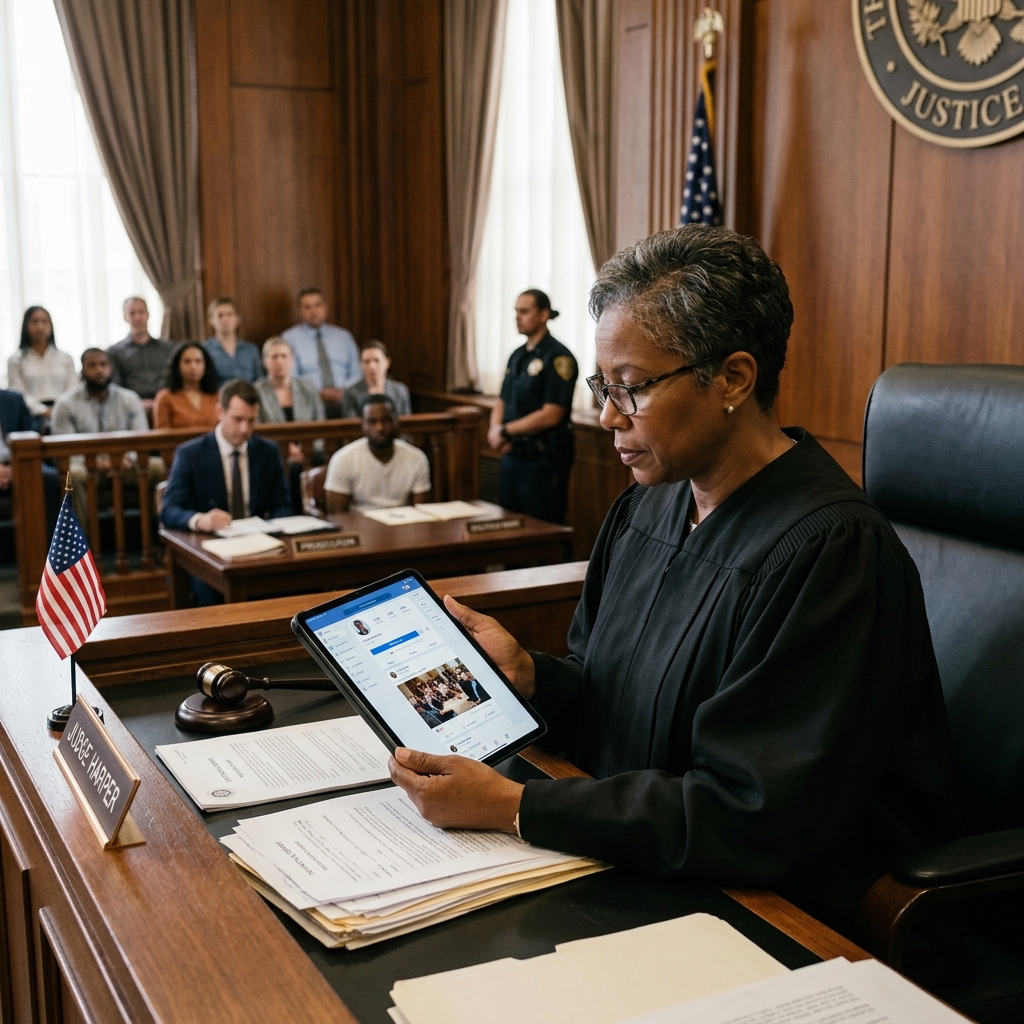
Social media has become part of everyday life, and that means it can also become part of the criminal justice record. Posts, comments, photos, and even “likes” may be reviewed by prosecutors, defense attorneys, probation officers, and sometimes judges when a defendant appears in court. The real question is not whether social media exists in a case, but how much weight it should carry when a judge decides punishment.
Judges generally have broad discretion at sentencing, but that discretion is not unlimited. Online posts may be relevant if they help show motive, remorse, intent, rehabilitation, or ongoing danger. At the same time, courts must avoid punishing people merely for unpopular speech, protected opinions, or misunderstood online behavior. The challenge is balancing the search for truth with constitutional fairness.
Why Social Media Now Matters in Sentencing
In the past, sentencing often relied on the conviction itself, the defendant’s criminal history, victim impact statements, and probation reports. Today, digital conduct can be just as visible as conduct in the physical world. A Facebook post can reveal threats, bragging, gang affiliation, drug use, or contempt for the law. It can also reveal something less dramatic but still important: whether a defendant accepts responsibility or continues to deny obvious wrongdoing.
That is why social media evidence has become attractive to courts. It can provide a time-stamped record of the defendant’s words and behavior close to the offense or even after arrest. But visibility does not automatically equal reliability. A post may be sarcastic, copied from someone else, written for an audience, or posted by another person using the defendant’s account. Those uncertainties matter because sentencing decisions are supposed to rest on accurate information.
What Judges May Consider
Courts can usually consider a wide range of information at sentencing, especially when it bears on the defendant’s character, future risk, or acceptance of responsibility. In many jurisdictions, sentencing rules allow judges to look beyond the strict trial record and evaluate broader background information.
- Threats or violent statements that suggest danger to the public.
- Admissions that connect the defendant to the offense or related conduct.
- Evidence of remorse or lack of remorse after arrest or conviction.
- Conduct showing aggravation, such as celebrating the offense or mocking victims.
- Patterns of behavior that suggest repeated misconduct rather than a one-time event.
These uses are not limited to Facebook alone. The same logic can apply to Instagram, TikTok, X, Snapchat, messaging apps, or public forums. The platform matters less than the content and its connection to a lawful sentencing factor.
When Online Speech Becomes Problematic
The hardest cases arise when the judge relies on speech that is offensive but not clearly tied to criminal conduct. A defendant may post crude jokes, political rants, or disturbing opinions that reflect poor judgment without proving a specific sentencing factor. If the court gives those posts too much weight, the sentence can start to look like punishment for attitude rather than conduct.
This is where constitutional concerns enter the picture. The First Amendment protects a wide range of expression, including speech that is rude, controversial, or deeply unpopular. A sentencing court therefore must distinguish between evidence that illuminates the offense and evidence that simply reveals unpopular views. That distinction is especially important when the speech is not criminal, not threatening, and not directly related to the underlying case.
Authenticity and Context Are Critical
Not every screenshot tells the full story. Before a judge should rely on a social media post, the court should ask whether the post is authentic, complete, and fairly interpreted. A cropped image may remove surrounding comments that change the meaning. A deleted post may be difficult to verify. A meme may look like a confession when it is really a joke or repost from another account.
Courts also need to know who actually made the post. Shared passwords, hacked accounts, parody accounts, and reposted content can all create uncertainty. If the defense challenges authorship or meaning, the judge should not treat the post as a settled fact without support. Reliable evidence, not guesswork, should drive sentencing.
| Question | Why it matters at sentencing |
|---|---|
| Who created the post? | Authorship affects whether the content can be attributed to the defendant. |
| What was the context? | Context can change whether a post appears threatening, joking, or political. |
| Is the post complete? | Partial screenshots can distort meaning and lead to unfair inferences. |
| Does it relate to the offense? | Relevance is the key question for using the post to justify punishment. |
Judicial Discretion Has Limits
Sentencing is not a free-form exercise. Even where judges have wide latitude, they must ground their decisions in permissible factors. Punishment generally should reflect the seriousness of the offense, the defendant’s history, deterrence, protection of the public, rehabilitation, and respect for the law. A social media post can help illuminate those factors, but it cannot replace them.
There is also a fairness concern if a judge focuses too heavily on a defendant’s online image. Social media often exaggerates personality. People post to impress, to vent, to perform for friends, or to hide vulnerability behind sarcasm. Treating every dramatic post as a literal confession can produce distorted results. The law requires more restraint than a casual internet reader might use.
Defense and Prosecution Arguments
Both sides can make strong arguments about whether a post should matter.
- Prosecution arguments: The posts show intent, lack of remorse, danger, or a pattern of conduct relevant to sentencing.
- Defense arguments: The posts are exaggerated, taken out of context, protected speech, or unrelated to the offense.
- Shared concern: The court should not rely on misleading snippets or unclear attribution.
In practice, the strongest cases are usually the ones where the post directly confirms a material fact. A message boasting about the offense, threatening a witness, or expressing intent to reoffend is much more persuasive than a vague rant about politics, religion, or society in general.
Privacy, Public Access, and the Myth of “Private” Posts
Many defendants assume that a private account, closed profile, or limited audience means their posts are invisible to the court. That assumption is risky. Anything shared with others can be preserved, forwarded, captured, or subpoenaed. A post that was intended for friends may still become part of the record if it is lawfully obtained and properly authenticated.
Still, the existence of access does not end the analysis. A judge should not assume that every available post is fair game. The key issue is whether the content is legally relevant and whether its use respects evidentiary rules and constitutional protections. Private speech does not lose all protection simply because technology makes it easier to retrieve.
Best Practices for Courts
Courts can reduce error by treating social media evidence with the same caution they would apply to any other disputed digital exhibit.
- Require a clear showing that the account or post belongs to the defendant.
- Examine the full context, not just isolated screenshots.
- Ask how the post connects to a recognized sentencing factor.
- Avoid relying on political, cultural, or personal opinions unless they have direct legal relevance.
- Separate offensive expression from proof of criminal risk or culpability.
These practices do not stop judges from considering meaningful evidence. They simply make sure the evidence is used carefully. That is especially important in cases involving young defendants, impulsive online speech, or viral content that may be embarrassing but not truly probative.
How Lawyers Should Handle Social Media at Sentencing
Lawyers on both sides should anticipate that online behavior may surface before sentencing. Prosecutors may gather public posts that demonstrate danger or continuing hostility. Defense counsel may use the same material to show remorse, cooperation, treatment progress, or a record of ordinary life that undercuts a harsh sentence.
A careful lawyer will not just dump screenshots into the record. The lawyer should explain why the posts matter, how they were obtained, and what they actually prove. If the post is ambiguous, counsel should be ready to explain the alternate interpretation. If the post is inflammatory, counsel should be prepared to argue that shock value is not the same as sentencing relevance.
Frequently Asked Questions
Can a judge look at Facebook posts when deciding sentence?
Yes, if the posts are relevant, authentic, and used for a lawful sentencing purpose. The court should not rely on them simply because they are controversial or embarrassing.
Can a sentence be increased because of protected speech?
Not just because the speech is unpopular. Punishment should not be based on viewpoint alone. The speech must have a legitimate connection to sentencing factors such as threat, remorse, intent, or risk.
What if the post was deleted?
Deletion does not automatically make a post unusable. If the content can be reliably preserved and authenticated, it may still be considered. The court will still need to assess accuracy and context.
Do private posts stay private in court?
No. Private settings do not guarantee legal secrecy. A post may still be discovered and used if it is lawfully obtained and relevant.
What is the main danger in using social media at sentencing?
The main danger is overreading the post. Judges must avoid treating online exaggeration, sarcasm, or political expression as proof of criminal character without careful analysis.
The Bigger Lesson
Social media has changed how courts see defendants, but it has not changed the core rules of justice. Sentencing should be individualized, accurate, and based on legally relevant facts. Online posts can help reveal those facts, yet they can also mislead if stripped of context or treated as a shortcut to character judgment.
The fairest approach is neither to ignore social media nor to overvalue it. A judge should consider a Facebook post only when it genuinely helps answer a sentencing question the law cares about. In that sense, social media is like any other evidence: useful when verified, dangerous when misunderstood, and never a substitute for careful judicial reasoning.
References
- Ethics & Social Media: What Judges Need to Know — National Center for State Courts. 2024. https://www.ncsc.org/resources-courts/ethics-social-media-what-judges-need-know
- Social Media and Judicial Ethics Update — National Association of Women Judges. 2024. https://www.nawj.org/uploads/files/annual_conference/2024-annual-conference/sat1030a-socialmediaandjudicialethicsupdate.pdf
- Social Media and the Judiciary — New York State Advisory Committee on Judicial Ethics. 2024. https://cjc.ny.gov/Policy.Statements/Social_Media.html
- Judges on Social Media — Oklahoma Bar Association. 2023. https://www.okbar.org/barjournal/august-2023/judges-on-social-media/
- Judges’ Use of Social Networking Sites — University of North Carolina School of Government. 2015. https://www.sog.unc.edu/sites/www.sog.unc.edu/files/Judges%20social%20media%20July15.pdf
Similar Articles








Read full bio of Sneha Tete




