
Selling Study Drugs: Legal Risks of Adderall and Ritalin
How casually sharing or selling Adderall, Ritalin and other study drugs can lead to serious felony charges, jail time and long-term consequences.
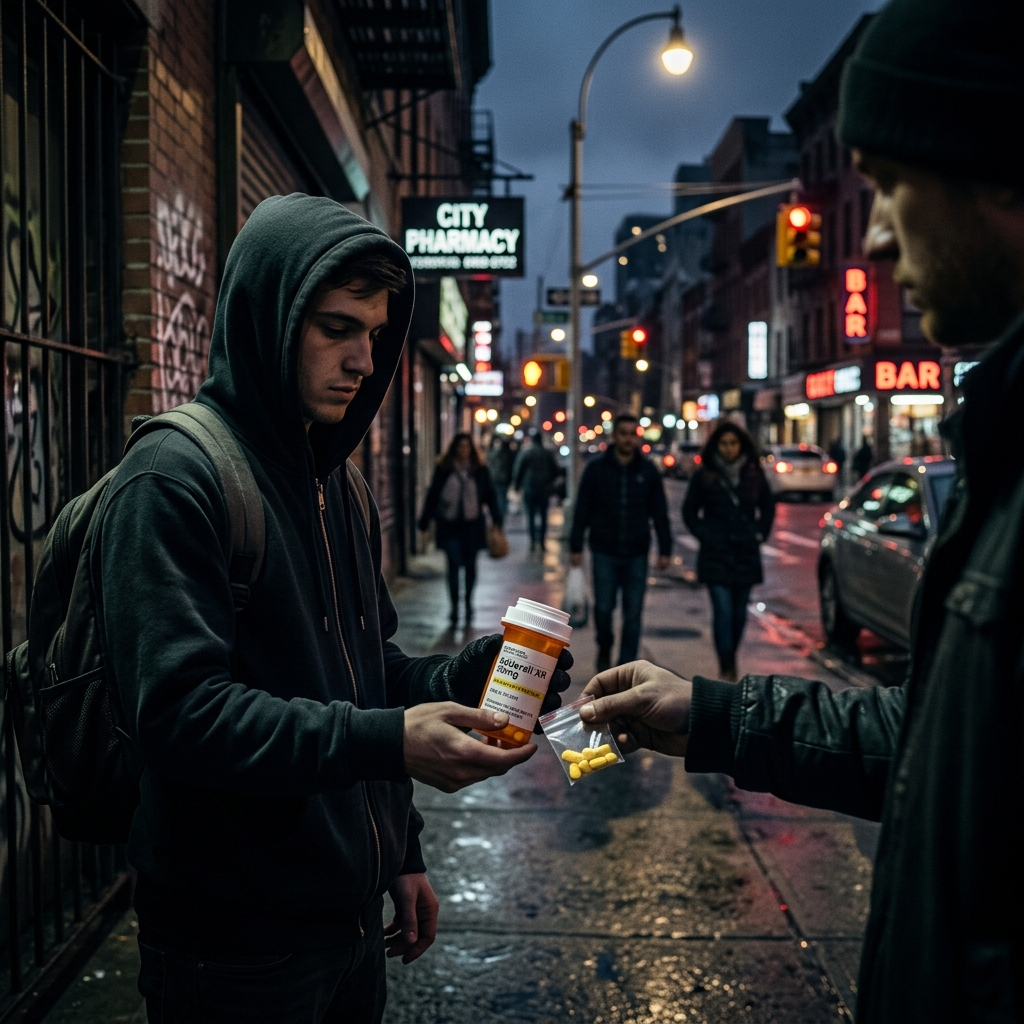
Adderall, Ritalin, Vyvanse and similar prescription stimulants are often called “study drugs” because some students use them to stay awake, focus longer, or cram for exams. When people share or sell these medications without proper authorization, they often assume the consequences will be minor. In reality, U.S. law typically treats the unauthorized sale or distribution of prescription stimulants the same way as dealing other controlled substances like cocaine or methamphetamine, exposing individuals to severe criminal penalties.
Understanding Study Drugs and Their Legal Status
Although many people think of study drugs as routine medications for attention-deficit/hyperactivity disorder (ADHD), the law focuses on their chemical properties and potential for abuse rather than how commonly they are prescribed.
- Common study drugs include Adderall (mixed amphetamine salts), Ritalin (methylphenidate), Vyvanse (lisdexamfetamine), Concerta and other stimulant formulations.
- These medications are generally classified as Schedule II controlled substances under the federal Controlled Substances Act because they carry a high risk of abuse and dependence but have accepted medical uses.
- Schedule II status places them in the same regulatory category as drugs like cocaine, methamphetamine and certain opioids.
Because of this classification, criminal laws at both the state and federal levels treat unauthorized distribution of prescription stimulants as serious drug offenses, even when the conduct involves a few pills exchanged among classmates.
Possession vs. Distribution: A Critical Legal Distinction
The law draws a clear line between possession of a controlled substance and distribution (selling, giving away, or trading it). The consequences for crossing that line are often dramatic.
| Type of conduct | Typical legal treatment | Potential penalties (examples) |
|---|---|---|
| Possession with valid prescription | Generally lawful if used as prescribed. | No criminal penalty, but misuse can still have medical and civil consequences. |
| Possession without valid prescription | Often charged as misdemeanor or lower-level felony depending on jurisdiction and amount. | Up to about 1 year in jail and fines around $1,000 in some states; possible probation and treatment requirements. |
| Possession with intent to sell | Frequently charged as felony drug offense. | Multi-year prison sentences and higher fines; penalties increase with quantity. |
| Selling, sharing, or giving away pills | Treated as distribution or criminal sale of a controlled substance, even without money changing hands. | Felony charges with potential sentences ranging from several months to many years in prison, plus substantial fines. |
Many people are surprised to learn that casually giving a friend an Adderall pill can be legally indistinguishable from “dealing” a controlled substance. In some jurisdictions, sharing even a single stimulant pill can justify felony charges.
How Federal Law Treats Selling Study Drugs
At the federal level, the Controlled Substances Act makes it illegal to distribute or dispense a Schedule II drug without proper authorization and without a prescription issued for a legitimate medical purpose.
- If someone sells or attempts to sell amphetamine-based drugs like Adderall without authorization, they can be charged with federal distribution offenses.
- Federal sentencing guidelines allow for penalties ranging from 5 to 20 years in prison for certain amphetamine distribution convictions, along with fines that can reach millions of dollars, depending on quantity and other factors.
- Federal law imposes enhanced penalties when distribution occurs near schools or colleges. In such cases, both the maximum prison term and maximum fine may be doubled, with potential sentences of up to 40 years and fines up to millions of dollars.
Federal prosecution is more likely when the conduct involves larger quantities, organized distribution or sales occurring on or near educational institutions. However, even small-scale activity can attract attention if it is part of a broader investigation or occurs in sensitive locations.
State-Level Consequences: Examples from Around the U.S.
Most criminal enforcement for study drugs happens at the state level. Although exact penalties vary from state to state, several jurisdictions illustrate how seriously the law treats these offenses.
Example: California
In California, it is illegal to possess Adderall without a valid prescription under the Health and Safety Code.
- Simple possession without a prescription is typically a misdemeanor, with potential penalties of up to one year in county jail and fines that can reach at least $1,000.
- Possession for sale of Adderall is a felony, with potential sentences of two, three or four years in state prison.
- Selling or transporting Adderall is also a felony, potentially punishable by three, four or five years in state prison.
Some reports from California indicate that selling Schedule II substances can lead to sentences approaching ten years and fines around $10,000, especially in cases involving more serious trafficking charges.
Example: New York
New York law similarly treats prescription stimulants as controlled substances.
- Unlawful possession of a small number of stimulants for personal use may be charged as a misdemeanor.
- Possession of one gram or more of a stimulant with intent to sell can result in felony charges and potential sentences of one to nine years in prison.
- Selling any amount of a prescription stimulant, even a single pill, can lead to felony charges such as fifth-degree criminal sale of a controlled substance.
These provisions demonstrate that once law enforcement believes there is intent to distribute, the legal consequences escalate sharply even at relatively low quantities.
Example: Ohio
In Ohio, distribution of controlled substances is governed by the state’s criminal code.
- Under Ohio law, selling or sharing prescription amphetamines without authorization can lead to felony distribution charges.
- Penalties for state-level distribution of amphetamines can range from six months to ten years in prison, depending on the amount involved.
- Federal prosecution for amphetamine distribution can carry sentences of five to twenty years and fines from $250,000 to $5 million.
Ohio law explicitly notes that even giving away Adderall without payment counts as illegal distribution. This reinforces the idea that the law focuses on unauthorized transfer, not necessarily profit.
Collateral Consequences: Beyond Jail and Fines
A criminal conviction for selling or distributing study drugs does more than expose someone to possible incarceration and fines. It can alter the trajectory of their education, career and finances for years.
Impact on Federal Student Aid
One of the most significant collateral consequences for students is the potential loss of federal student financial aid.
- Under federal rules, individuals convicted of certain drug offenses may lose eligibility for federal grants, loans and work-study programs for a period of time.
- Even accepting a plea deal for a lower-level drug offense, such as possession, can jeopardize access to federal student aid.
- Without financial aid, students may be forced to leave school, take on more debt from private lenders, or significantly delay their education.
This means that a single decision to sell or share study drugs can lead not only to criminal sanctions but also to major educational setbacks.
Permanent Criminal Record
Felony drug convictions can create a long-lasting criminal record that affects many aspects of life.
- Background checks for jobs, internships or professional licensing may reveal distribution or trafficking charges.
- Some employers are particularly cautious about hiring individuals with drug-related convictions, especially for positions involving safety, security, or access to vulnerable populations.
- Depending on the jurisdiction, certain felonies may limit eligibility for public benefits, housing programs, or voting rights.
Although some states provide avenues for record sealing or expungement under specific conditions, these processes can be complex and are not guaranteed.
Driver’s License and Civil Penalties
Drug convictions can also trigger additional civil penalties.
- In some states, unlawful possession or distribution of controlled substances can lead to driver’s license suspension, even if the offense did not involve a vehicle.
- Court orders may include mandatory drug education, counseling, probation supervision and community service.
- Defendants often face court costs, fees and restitution obligations, adding financial burdens beyond statutory fines.
Students and Young Adults: Why This Risk Is Especially High
Study drugs are closely associated with academic environments, making students and young adults particularly vulnerable to both misuse and legal exposure.
- Campus culture may normalize using stimulants to manage demanding workloads, leading some students to believe that “everyone does it” and that it must be low risk.
- Peers with legitimate prescriptions may feel pressured to share or sell pills during exam periods.
- Law enforcement and campus security sometimes target distribution near schools and colleges, and federal law imposes enhanced penalties for such conduct.
In some documented cases, college students have faced multiple felony counts for selling their prescribed Adderall, with mandatory minimum sentences that could total more than a decade of imprisonment if fully imposed.
When “Helping a Friend” Becomes Drug Trafficking
Many people who share study drugs do not see themselves as “drug dealers.” They may view their actions as doing a favor or recouping part of their prescription costs. Nonetheless, legally the behavior often fits the definition of trafficking or criminal sale.
Key points to understand:
- Intent to distribute is often inferred from circumstances such as multiple pills packaged separately, text messages arranging exchanges, or cash payments.
- Even if no money changes hands, giving away a controlled substance can be charged as distribution.
- Repeat or organized exchanges, even involving small quantities, can attract more serious charges.
Someone with a legitimate prescription may believe they are simply “sharing” their medication. From a legal standpoint, however, they are distributing a controlled substance without medical authorization, which is precisely what drug laws seek to prevent.
Protecting Yourself: Practical Risk-Reduction Strategies
While only an attorney can provide legal advice for specific circumstances, several general principles can help reduce the risk of serious legal consequences related to study drugs.
- Never share or sell your prescription medication. Even one pill can be enough to justify criminal charges.
- Keep medications secure. Store stimulants in a safe location to prevent theft or unauthorized use by roommates or visitors.
- Follow your prescriber’s instructions. Misuse or overuse can lead not only to medical risks but also increased scrutiny.
- Decline offers to buy or sell others’ pills. Agreeing to participate in exchanges, even casually, can expose you to distribution allegations.
- Seek help if you feel pressured. Many schools have counseling, health services and legal clinics that can provide guidance.
For anyone already facing investigation or charges, consulting a qualified criminal defense attorney in their jurisdiction is essential. Drug laws are complex, and possible outcomes depend on local statutes, the facts of the case and prior history.
Frequently Asked Questions About Study Drugs and the Law
Is it illegal to take someone else’s Adderall or Ritalin without a prescription?
Yes. Possessing Adderall, Ritalin or similar stimulants without a valid prescription generally violates state and federal controlled substances laws. In many states, this is charged as a misdemeanor, punishable by up to about a year in jail and fines, though penalties vary by location.
Can I be arrested for giving away my prescription pills for free?
Yes. The law does not require a profit motive for a distribution charge. Giving prescription amphetamines to another person without authorization can be treated as illegal distribution or criminal sale, even if you do not accept payment.
Do small quantities of study drugs still lead to felony charges?
They can. In some jurisdictions, selling even one Adderall pill can justify a felony charge. Possession of larger amounts with intent to sell often leads to more serious felony counts with longer potential sentences.
What if I plead guilty to a lesser charge to avoid jail?
Plea agreements can reduce exposure to incarceration, but they still result in a criminal conviction. For students, any drug conviction—including simple possession—can jeopardize eligibility for federal student financial aid, leading to significant educational consequences.
Does using study drugs for academic performance change how the law treats them?
No. The law cares about authorization and compliance with prescription requirements, not the user’s intent to study or improve grades. Using study drugs without a prescription or sharing them with others remains illegal regardless of academic motives.
References
- Legal Consequences of Selling “Study Drugs” Like Adderall and Ritalin — FindLaw Editorial Team. 2023-09-01. https://www.findlaw.com/legalblogs/criminal-defense/legal-consequences-of-selling-study-drugs-like-adderall-and-ritalin/
- Distribution of Amphetamines — LHA (Cincinnati Criminal Attorney). 2022-05-10. https://www.cincinnaticriminalattorney.com/drug-offenses/distribution-of-amphetamines/
- Criminal Sale and Unlawful Possession of Prescription Stimulants — Crotty Saland PC. 2021-11-18. https://www.new-york-lawyers.org/practice-areas/drug-and-narcotics-crimes/unlawful-possession-and-criminal-sale-of-prescription-drugs/criminal-sale-and-unlawful-possession-of-prescription-stimulants/
- Adderall Drug Crimes — Wallin & Klarich. 2023-03-07. https://www.wklaw.com/practice-areas/adderall-drug-crimes/
- What Happens When You Get Caught with Adderall? — The Recovery Village Editorial Team. 2022-08-15. https://www.therecoveryvillage.com/adderall-addiction/what-happens-getting-caught/
- Possession of Adderall Without a Prescription — Eisner Gorin LLP. 2023-04-02. https://www.egattorneys.com/adderall-without-prescription
- ADD Medication Diversion: I Sold My ADHD Prescription and Got Caught — ADDitude Magazine. 2021-06-10. https://www.additudemag.com/medication-diversion-adhd-prescription/
Similar Articles








Read full bio of medha deb




