
Selling Business Assets in Chapter 11 Bankruptcy
Understand how asset sales work in Chapter 11, from court approval and Section 363 sales to protecting creditor rights and maximizing value.
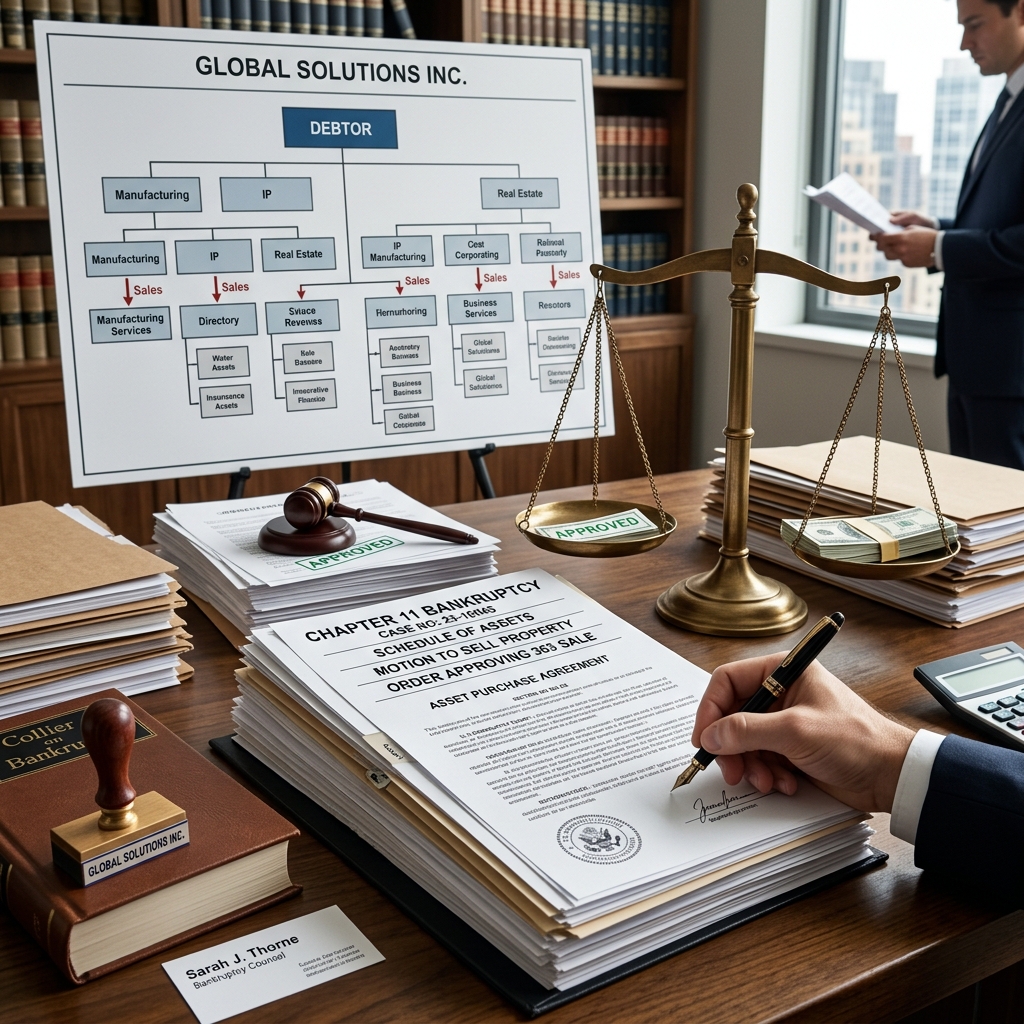
Filing for Chapter 11 bankruptcy does not mean a business must shut down immediately. Instead, Chapter 11 is designed to allow a debtor to reorganize, preserve value, and, when appropriate, sell assets strategically to pay creditors and support a turnaround. Understanding when and how you can sell assets is essential for owners, creditors, and potential buyers.
This guide explains the major options for selling assets in Chapter 11, the legal rules that control those sales, and practical issues that arise in real-world cases. While the concepts apply nationally under the U.S. Bankruptcy Code, there is occasional emphasis on how they work for businesses operating in states like California, which are governed by federal bankruptcy law but may also interact with state law remedies.
1. How Chapter 11 Changes a Company’s Power to Sell Assets
When a business files a Chapter 11 petition, a new legal entity called the bankruptcy estate is created. The debtor, usually acting as a debtor in possession (DIP), manages this estate and has powers similar to those of a trustee. However, its ability to transfer or sell property becomes subject to specific rules and court oversight.
1.1 The automatic stay and its impact
Immediately upon filing, the automatic stay generally stops most collection activities, repossessions, and foreclosures, giving the debtor breathing room to assess operations and formulate a plan. This pause is one reason asset sales in Chapter 11 can be carried out in a more orderly way than in a rushed foreclosure or forced liquidation.
- Creditors cannot seize or sell collateral without court permission.
- Pre-bankruptcy lawsuits are usually halted.
- Any attempt to obtain estate property is restricted unless the bankruptcy court authorizes it.
1.2 Ordinary course vs. non-ordinary course sales
The Bankruptcy Code draws a key distinction between ordinary course and non-ordinary course transactions:
| Type of Transaction | Example | Court Approval Required? |
|---|---|---|
| Ordinary course of business | Retailer selling inventory to customers at usual prices | No, debtor can continue business normally |
| Outside the ordinary course | Sale of a manufacturing plant, brand portfolio, or entire business line | Yes, motion and court approval required |
For anything beyond routine operations, a Chapter 11 debtor must seek court permission, usually by filing a motion describing the assets, the proposed buyer, the sale price, and why the transaction is in the best interest of the estate and its creditors.
2. Core Legal Standards for Asset Sales
Bankruptcy judges do not simply rubber-stamp asset sale requests. They apply legal standards designed to ensure that sales are fair, transparent, and consistent with the debtor’s fiduciary duties.
2.1 Business purpose and sound judgment
Courts generally evaluate whether the sale reflects a sound business purpose and exercise of management’s business judgment. While approaches vary by jurisdiction, many courts look at factors such as:
- Whether the assets are losing value or costly to maintain.
- Whether the sale price represents the best obtainable offer under the circumstances.
- Whether the sale fosters a successful reorganization or maximizes recovery in a liquidation scenario.
- Whether stakeholders received adequate notice and opportunity to object.
The debtor in possession owes a duty to act for the benefit of the estate and its creditors, not only its equity owners. Any proposed sale must be consistent with this fiduciary obligation.
2.2 Protecting creditor interests
Creditors have the right to object to asset sales and to argue that a deal undervalues assets or unfairly favors one party over another. Courts focus heavily on creditor protection by requiring:
- Notice of the sale motion to all creditors and parties in interest, typically at least 21 days before a Section 363 sale hearing, unless shortened for good cause.
- Opportunity to bid in many cases (often via an auction process) so that the market can test the proposed price.
- Allocation of sale proceeds consistent with lien priorities and Bankruptcy Code distribution rules.
2.3 Sales involving collateral and secured lenders
Many business assets are subject to liens in favor of banks or other secured lenders. Section 363 of the Bankruptcy Code allows sales “free and clear” of interests, but only if certain conditions are met, such as providing adequate protection to the secured creditor or paying the lien from the sale proceeds. In practice:
- Secured creditors often must be paid from sale proceeds up to the value of their collateral.
- Lien rights may attach to the sale proceeds instead of the asset itself.
- A secured lender may object if the sale price does not cover at least the value of its collateral interests.
3. Two Primary Paths: Section 363 Sale vs. Plan Sale
In modern Chapter 11 practice, asset sales typically occur through one of two main structures: a Section 363 sale or a sale implemented under a confirmed Chapter 11 plan.
3.1 Section 363 sales: selling outside a plan
A Section 363 sale refers to a sale of estate property outside the ordinary course of business, approved under Section 363 of the Bankruptcy Code. These sales are often used early in the case, especially when the debtor needs to quickly monetize assets or sell a going-concern business to preserve value.
Key features of Section 363 sales include:
- Free and clear of interests: Assets can be sold free and clear of liens, claims, and other interests, with those interests attaching to the proceeds.
- Speed: The sale can be completed without waiting for a full plan confirmation process, which can take many months.
- Buyer protections: Buyers often receive strong protections against later challenges or successor liability (subject to exceptions, such as certain environmental or pension-related liabilities).
- Flexible bidding: Debtors commonly use auction procedures and a stalking-horse bidder to set a price floor.
Court approval depends on demonstrating that the sale is in the best interest of the estate and that the process has been fair and transparent.
3.2 Sales under a Chapter 11 plan
Alternatively, a debtor may propose an asset sale as part of a broader plan of reorganization or liquidation. The plan, along with a disclosure statement, is circulated to creditors and equity holders and must be confirmed by the court.
Plan-based sales typically:
- Occur later in the case, after the debtor has negotiated with major stakeholders.
- Provide a global resolution of claims, treatment of creditors, and disposal of assets.
- Offer creditors a vote on the plan, giving them direct influence over whether the sale will proceed.
For some businesses, particularly those with complex capital structures and multiple creditor classes, a plan sale can provide a more comprehensive and predictable framework than a standalone 363 sale.
3.3 Comparing Section 363 sales and plan sales
| Feature | Section 363 Sale | Plan-Based Sale |
|---|---|---|
| Timing | Often early in the case | After plan negotiation and disclosure |
| Creditor vote | No direct vote; can object | Creditors vote on the plan |
| Scope | Some or all assets, stand‑alone transaction | Integrated into comprehensive restructuring or liquidation |
| Speed | Generally faster | Generally slower |
| Buyer protections | High (free and clear, sale order protections) | High, but through plan confirmation and discharge |
4. The Sale Process in Practice
While every case is different, many Chapter 11 asset sales follow a fairly recognizable sequence. Understanding this can help owners and creditors anticipate what will happen and when.
4.1 Preparing for the sale
Preparation typically includes:
- Identifying assets that are core to the business versus those that are candidates for sale.
- Obtaining valuations or appraisals to estimate market value.
- Consulting with key creditor constituencies, such as secured lenders and major unsecured creditors, about strategy.
- Engaging investment bankers, brokers, or other professionals to market the assets when appropriate.
The goal is to structure the sale in a way that maximizes value and is defensible in court.
4.2 Sale motion and notice to creditors
For a substantial asset sale, the debtor usually files one or more motions:
- A motion seeking approval of bidding procedures, including deadlines, deposit requirements, and the use of a stalking-horse bidder.
- A motion seeking final approval of the sale itself, often scheduled after a competitive auction if higher bids emerge.
Notice of the sale and hearing must be given to all creditors and other parties in interest, usually at least 21 days before the sale hearing, though courts can modify this timeframe for good cause.
4.3 Auctions, stalking-horse bids, and bid protections
In many Chapter 11 cases, the debtor uses a stalking-horse bidder—an initial buyer that agrees to purchase assets on specified terms, subject to higher or better offers. The stalking-horse deal sets a floor price and may include protections such as breakup fees or expense reimbursement if the bidder is outbid.
If competing bidders emerge, the court-approved auction procedures govern how the auction is conducted. This competitive process helps demonstrate that the price obtained is the highest and best reasonably available, supporting court approval and creditor acceptance.
4.4 Approval hearing and sale order
At the sale hearing, the court evaluates:
- The fairness of the process, including marketing efforts and auction results.
- Whether the sale reflects sound business judgment.
- Any objections raised by creditors, equity holders, or other parties.
- The terms of the proposed sale order, including “free and clear” findings and protections for the buyer.
If approved, the court enters a sale order. The transaction then closes in accordance with that order, and the estate receives the sale proceeds for distribution under the Code’s priority scheme.
5. Special Considerations for Buyers and Creditors
Chapter 11 asset sales affect not only the debtor but also prospective buyers and the creditor body. Both groups should understand how their rights and risks differ in bankruptcy compared with ordinary commercial deals.
5.1 Advantages for buyers
From a buyer’s perspective, acquiring assets out of Chapter 11 can be attractive because:
- Assets are often sold free and clear of liens and many claims, reducing legacy liability risk.
- Court approval and a detailed sale order offer added certainty about ownership and the finality of the transaction.
- Buyers may be able to “cherry pick” desired contracts and leases, leaving behind unfavorable obligations, subject to court and counterparty protections.
However, buyers must also be prepared for a highly regulated process, strict deadlines, and the need to satisfy court-imposed requirements (such as demonstrating adequate assurance of future performance on assigned contracts).
5.2 Protections and strategies for creditors
Creditors should monitor asset sale proposals closely. Strategies often include:
- Reviewing the sale motion and supporting declarations to evaluate the fairness of the price and process.
- Objecting if the sale appears to undervalue collateral, improperly favors insiders, or bypasses creditor protections.
- Participating in the auction, either directly or via credit bidding if they hold secured claims.
- Ensuring that the sale order preserves their priority rights in the proceeds.
For secured creditors, the option to “credit bid”—bid using the amount of their debt rather than cash—can be particularly important in protecting against an undervalued sale.
6. Asset Sales, Reorganization, and Alternatives
Asset sales are not stand-alone events; they fit into the broader strategy of whether a business is attempting to reorganize and continue operating or to liquidate in an orderly fashion.
6.1 Going-concern vs. piecemeal sales
Debtors and stakeholders must consider whether to sell the business as a going concern (i.e., as an operating entity) or to sell discrete assets separately. Going-concern sales often yield higher value because they preserve customer relationships, employees, and brand goodwill. However, they may require more time, financing, and cooperation among lenders and key counterparties.
Piecemeal sales can make sense when:
- Certain business lines are profitable while others are not.
- Unique assets (such as intellectual property or real estate) have specialized buyers.
- Market conditions or regulatory constraints limit the ability to sell the company intact.
6.2 Small businesses and streamlined Chapter 11
Small and mid-sized businesses frequently rely on Chapter 11 to sell assets while preserving jobs and value. The U.S. courts recognize that small business Chapter 11 cases may need streamlined procedures, though the basic requirement of court approval for non-ordinary course asset sales remains the same.
Even in smaller cases, courts expect sufficient marketing, notice, and transparency to ensure that sales are fair and maximize value for creditors.
6.3 Non-bankruptcy alternatives
Before or instead of Chapter 11, some businesses explore out-of-court workouts or state-law liquidation mechanisms. For example, the U.S. Courts’ overview of bankruptcy highlights that Chapter 11 is only one of several potential paths for distressed businesses, and parties sometimes negotiate restructurings or asset transfers without court supervision.
However, these alternatives generally do not provide the same automatic stay protections, centralized forum, or court-approved “free and clear” sale features that a Chapter 11 process offers. As a result, Chapter 11 remains a primary tool for complex asset sales in distressed situations.
7. Practical Tips for Business Owners Considering Asset Sales in Chapter 11
Owners and managers who are contemplating Chapter 11 should work closely with experienced legal and financial professionals. Some practical considerations include:
- Plan ahead: Engage advisors early, before liquidity runs out. This increases the chance of a well-marketed sale rather than a fire sale.
- Keep accurate financial records: The U.S. Courts emphasize that Chapter 11 debtors must file schedules of assets and liabilities, income and expenses, contracts, and financial affairs. Accurate information is essential for credible sale processes.
- Communicate with key stakeholders: Early collaboration with secured lenders and major vendors can reduce objections and delays.
- Consider both 363 and plan routes: Evaluate whether a fast 363 sale, a later plan sale, or a combination (such as a 363 sale followed by a liquidating plan) best serves the business and creditors.
- Respect fiduciary duties: Remember that once in Chapter 11, the primary duty is to the estate and its creditors, not to insiders or equity owners.
8. Frequently Asked Questions (FAQ)
Can a company continue to operate while selling assets in Chapter 11?
Yes. In many cases, the debtor continues operating as a debtor in possession, using, selling, or leasing property in the ordinary course without court approval, while seeking permission for major asset sales outside the ordinary course.
Do all asset sales in Chapter 11 require a public auction?
No. The Bankruptcy Code does not mandate an auction in every case, but competitive bidding is common because it helps demonstrate that the best available price has been achieved and protects the sale order from later challenge. Courts may approve private sales when justified by circumstances.
What happens to contracts and leases in an asset sale?
Subject to court approval and applicable protections, a debtor can usually assume and assign contracts and leases to a buyer if defaults are cured and the buyer provides adequate assurance of future performance. Buyers often focus on selecting which agreements they want to assume as part of the transaction.
How are sale proceeds distributed among creditors?
Sale proceeds are distributed according to the Bankruptcy Code’s priority system. Secured creditors are typically paid from the value of their collateral first, followed by priority unsecured claims (such as certain tax or wage claims), then general unsecured creditors, and, only if all claims are paid in full, equity interests.
Can an owner buy the company’s own assets out of Chapter 11?
Sometimes, yes, but insider transactions receive heightened scrutiny. The court will closely examine whether the process is fair, competitive, and in the estate’s best interest, and whether any insider advantage has been mitigated through robust marketing and open bidding.
Is Chapter 11 always better than Chapter 7 for selling assets?
Not always. Chapter 11 offers more flexibility and the ability to sell a business as a going concern, but it is more complex and expensive. In some situations, a straightforward Chapter 7 liquidation may be more appropriate. The decision depends on the company’s size, asset mix, creditor structure, and prospects for reorganization.
References
- Chapter 11 – Bankruptcy Basics — United States Courts. 2024-01-01. https://www.uscourts.gov/court-programs/bankruptcy/bankruptcy-basics/chapter-11-bankruptcy-basics
- Bankruptcy Asset Sales: A Primer — Troutman Pepper. 2023-06-01. https://www.troutman.com/insights/bankruptcy-asset-sales-a-primer/
- Benefits of Asset Sales During Chapter 11 — BankruptcyPower.com. 2022-05-15. https://www.bankruptcypower.com/blog/benefits-of-asset-sales-during-chapter-11/
- #TBT: Asset sales in bankruptcy — Norton Rose Fulbright. 2016-05-01. https://www.projectfinance.law/blog/tbt-asset-sales-in-bankruptcy
- Come Sale Away: Flexible Sale Mechanisms Available in Chapter 11 — American Bar Association, Business Law Today. 2025-04-01. https://www.americanbar.org/groups/business_law/resources/business-law-today/2025-april/flexible-sale-mechanisms-available-chapter-11/
Similar Articles








Read full bio of medha deb




