
Self-Employed or Business Owner: Key Differences
Understand the legal, tax, and operational distinctions between self-employment and business ownership to make informed decisions for growth.
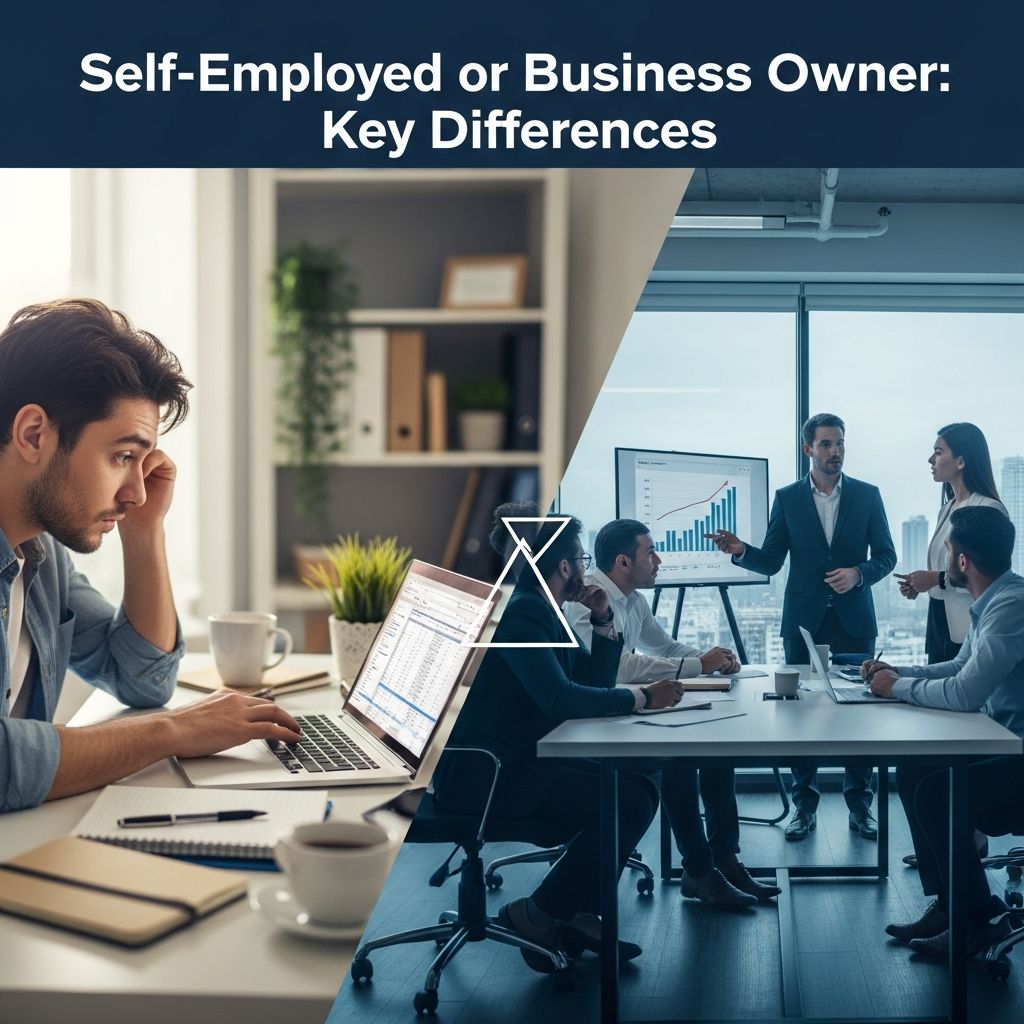
Distinguishing between self-employment and business ownership is crucial for anyone working independently, as it impacts taxes, liability, and growth potential. Self-employed people often operate solo with minimal formalities, while business owners build structured entities that support teams and expansion.
Defining Self-Employment
Self-employment refers to individuals who earn income directly from their own efforts without traditional employment. This includes freelancers, consultants, and gig workers who handle all aspects of their work alone. They typically use their personal Social Security number for operations and report everything on individual tax returns.
Common examples include graphic designers offering services per project, writers contracting with clients, or ride-share drivers. These workers enjoy flexibility in hours and client choice but bear full responsibility for income generation and expenses.
- Operate without employees or partners.
- No separate business entity required.
- Income treated as personal earnings.
Characteristics of Business Ownership
Business owners manage entities beyond personal services, often hiring staff, selling branded products, or scaling operations. They form legal structures like LLCs or corporations to separate business from personal affairs, enabling growth and protection.
For instance, a consultant evolving into an agency with junior staff becomes a business owner. This shift introduces formal registrations, payroll management, and distinct tax filings.
- Involves employees or contractors.
- Legal entity formation for liability shield.
- Focus on profitability and expansion.
Legal Structures: From Sole Proprietor to Formal Entities
Self-employed individuals default to sole proprietorships, where no legal separation exists between owner and business. This simplicity means personal assets are at risk in lawsuits or debts.
Business owners opt for structures offering protection:
| Structure | Liability Protection | Tax Filing | Best For |
|---|---|---|---|
| Sole Proprietorship | None | Personal return (Schedule C) | Solo operators |
| LLC | Yes | Pass-through to personal | Small teams, flexibility |
| S Corporation | Yes | Separate return; salary + distributions | Tax savings on growth |
| C Corporation | Yes | Corporate return (Form 1120) | Large-scale operations |
LLCs provide a balance of protection and simplicity, passing income to owners’ personal taxes unless electing corporate status.
Tax Implications: Filing and Payments
Taxes highlight the starkest differences. Self-employed file Schedule C with Form 1040, deducting business expenses from gross income. They pay self-employment tax (15.3% for Social Security and Medicare) on net earnings over $400, plus quarterly estimates.
Business owners’ taxes vary by entity:
- LLCs: Pass-through taxation; no self-employment tax on all profits if structured properly.
- S Corps: Owners take reasonable salary (payroll taxes apply), with distributions tax-free for self-employment.
- C Corps: Double taxation—corporate rate plus dividends—but more deductions available.
Owners with employees handle payroll taxes via Form 941, W-2s, and unemployment insurance, adding compliance burdens.
Liability and Risk Management
Sole proprietors face unlimited personal liability; business debts or lawsuits can seize homes or savings. Forming an LLC creates a barrier, shielding personal assets unless personal guarantees are signed.
Business owners mitigate risks through insurance, contracts, and entity choice. Transitioning from self-employment often starts here, as growing expenses or hires demand protection.
Operational and Growth Considerations
Self-employed focus on service delivery; scaling means more hours but no delegation without employees. Business owners invest in systems, marketing, and teams for scalability.
Key transition triggers:
- Hiring first employee or contractor.
- Revenue exceeding personal capacity.
- Need for branding or contracts under a business name (DBA).
Registration isn’t always required for self-employed, but DBAs aid professionalism without full entity formation.
Benefits and Administrative Burdens
Self-employed enjoy direct profit retention and simplicity but miss employee benefits like group health plans. They fund retirement via SEP-IRAs or solo 401(k)s.
Business owners access advanced deductions (e.g., corporate retirement plans) and can offer benefits to attract talent, though paperwork increases.
When to Transition from Self-Employed to Business Owner
Consider evolving if liability concerns grow, taxes burden profits, or growth stalls. Start with a single-member LLC for minimal change—taxed as sole prop but protected.
Consult professionals for entity choice, as S Corps suit higher earners saving on self-employment taxes.
Frequently Asked Questions
Are all self-employed people considered business owners?
Technically yes, but IRS distinguishes by structure: self-employed lack formal entities or employees, while owners do.
What tax structure saves the most for growing operations?
S Corporations often reduce self-employment taxes via salary/distribution split; LLCs offer flexibility. Depends on revenue and goals.
Do self-employed need to register a business name?
Not federally, but state DBAs help for banking/branding without full LLC formation.
How does hiring employees change my status?
It shifts you to business owner, requiring payroll taxes, W-2s, and insurance compliance.
Can sole proprietors form an LLC easily?
Yes, single-member LLCs maintain pass-through taxes while adding liability protection.
Planning Your Path Forward
Evaluate your setup annually: solo flexibility suits startups, but structures unlock growth. Tools like EINs and state filings ease transitions.
(Word count: 1678)
References
- Self-Employed vs. Business Owner: Tax Differences — SmartAsset. 2023-10-15. https://smartasset.com/taxes/self-employed-vs-business-owner
- Self-Employed vs Business Owner: What’s the Difference? — The Muse. 2024-05-20. https://www.themuse.com/advice/self-employed-vs-business-owner
- Small Business Owner vs. Self-Employed: What’s the Difference? — TaxAct Blog. 2024-02-12. https://blog.taxact.com/small-business-owner-vs-self-employed-whats-the-difference/
- Sole Proprietorship vs. LLC: Which Structure Should You Choose? — U.S. Chamber of Commerce. 2024-08-05. https://www.uschamber.com/co/start/strategy/sole-proprietorship-vs-llc
- Difference between sole proprietorship and self-employed — Skuad. 2023-11-10. https://www.skuad.io/blog/difference-between-sole-proprietorship-and-self-employed
- Independent contractor (self-employed) or employee? — IRS.gov. 2025-01-15. https://www.irs.gov/businesses/small-businesses-self-employed/independent-contractor-self-employed-or-employee
- Choose a business structure — U.S. Small Business Administration. 2025-03-01. https://www.sba.gov/business-guide/launch-your-business/choose-business-structure
Similar Articles








Read full bio of Sneha Tete


