
Secret Home Surveillance and the Fourth Amendment
How undercover home video, long‑term camera monitoring, and evolving technology collide with the Fourth Amendment’s privacy protections.
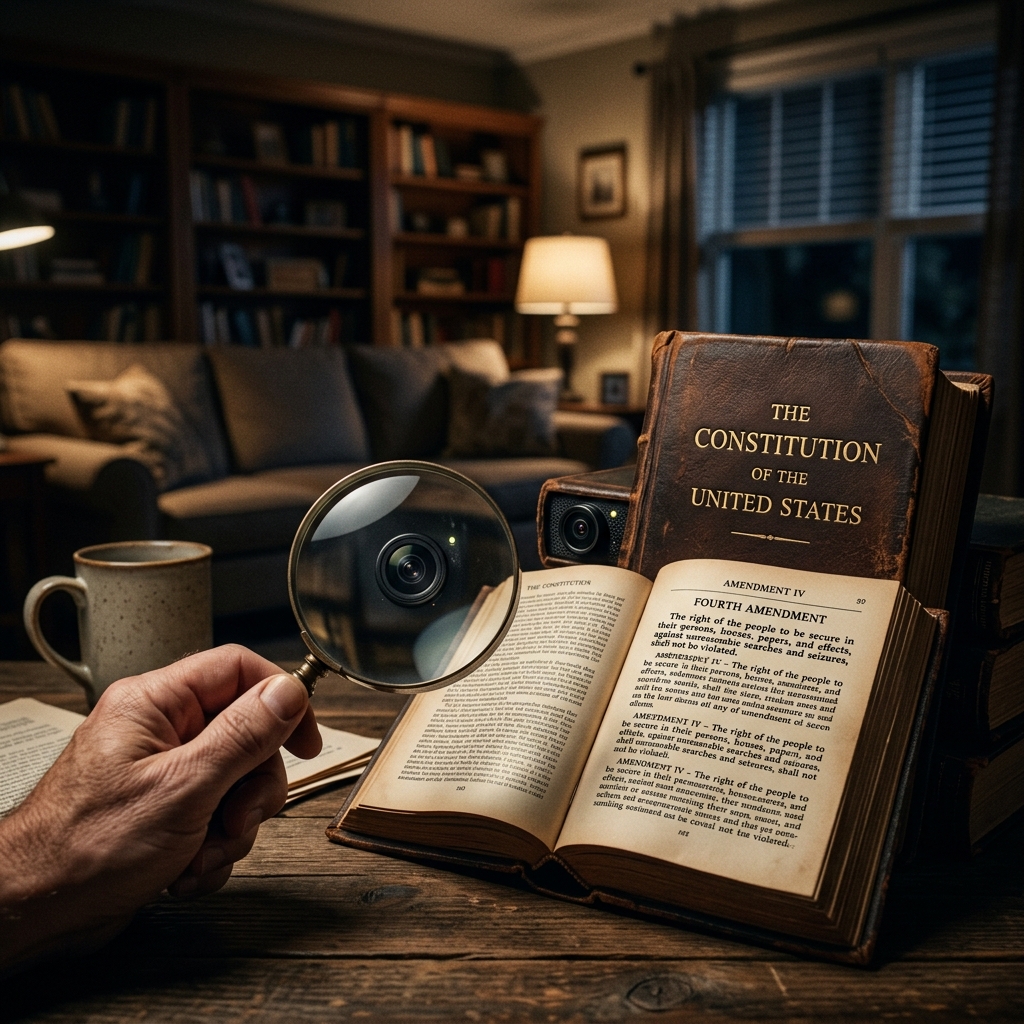
The spread of inexpensive cameras and sophisticated surveillance tools has transformed criminal investigations. At the same time, it has raised difficult questions about how the Fourth Amendment protects people inside and around their homes when law enforcement secretly records them. Courts must decide when video surveillance is a constitutionally permissible investigative technique and when it becomes an unreasonable search that requires a warrant.
This article uses recent federal case law about undercover agents and long-term camera monitoring as a springboard to explain how the Fourth Amendment applies to secret home surveillance video. It focuses on the concepts of consent, reasonable expectation of privacy, and the growing tension between traditional doctrine and modern technology.
Fourth Amendment Basics: Search, Seizure, and Privacy
The Fourth Amendment to the United States Constitution protects individuals against unreasonable searches and seizures of their persons, houses, papers, and effects. It generally requires police to obtain a warrant supported by probable cause before intruding on areas where a person has a reasonable expectation of privacy.
Two core ideas drive most modern Fourth Amendment analysis:
- Subjective expectation of privacy – Has the person actually tried to keep something private, for example by closing doors, using curtains, or shielding activities from view?
- Objective reasonableness – Does society recognize that expectation as reasonable, especially in the home and its immediate surroundings?
When both elements are satisfied, government intrusion typically counts as a “search,” which means officers usually need a warrant unless a recognized exception applies.
Undercover Agents and Hidden Cameras Inside the Home
One recurring scenario involves an undercover officer entering a suspect’s home with a hidden camera after being invited inside. Courts have long held that when a person voluntarily invites a government agent into their home, they assume the risk that the agent will later testify to what he or she observed. In many cases, courts extend this reasoning to allow the agent to record the encounter without a warrant.
The logic rests on a line of cases beginning with the Supreme Court’s decision in Hoffa v. United States, which held that the Fourth Amendment does not protect information that a suspect voluntarily discloses to a government informant or undercover agent. Once a person chooses to expose their conduct or statements to an invited guest who turns out to be a government agent, there is generally no reasonable expectation of privacy in that information.
Key principles in undercover home recording
- If an undercover agent is invited into the home, the agent may observe and later describe what took place, including illegal transactions.
- Courts typically treat hidden audio or video recording by the agent as permissible, so long as the interaction itself is consensual and limited in time.
- The constitutional analysis focuses on what the suspect voluntarily exposed to the agent, not on the presence of a recording device.
In this context, secret video is often viewed as a more accurate method of preserving what the agent could lawfully perceive, rather than as a separate intrusion. As a result, brief, consent-based recordings inside a home by an invited undercover officer ordinarily do not require a warrant.
Consent, Misunderstanding, and the Limits of Invitation
Even when a person appears to invite law enforcement into a private space, consent has limits. Courts have recognized that consent can be defective if the person is fundamentally mistaken about the nature or extent of the invasion. For example, in a case involving access to email accounts, the Ninth Circuit explained that consent to what appears to be a minor intrusion does not automatically authorize a qualitatively different, deeper intrusion when the person is misled about what will occur.
Applied to secret home surveillance, this means there may be situations where a resident’s apparent consent is not truly voluntary or informed. Relevant factors include:
- Whether officers disguised their purpose or identity in a way that undermines meaningful consent.
- Whether the person believed the interaction would be brief and limited, not recorded or saved for later analysis.
- Whether the surveillance was extended beyond the scope of the invited encounter, such as leaving hidden cameras running after the agent departs.
Courts draw particularly sharp distinctions between short, in-person undercover interactions and extended, remote camera monitoring. While a suspect usually assumes the risk of being observed by an invited agent during a specific meeting, they may not assume the risk of continuous video surveillance by concealed equipment installed in or around their home.
Curtilage and Outdoor Home Surveillance
Fourth Amendment protection is strongest inside the home, but it also extends to the area immediately surrounding the home, known as the curtilage. The Supreme Court has recognized that this area deserves special protection because it is closely associated with the privacy of domestic life. However, courts are divided about how this protection applies to video cameras that target yards, driveways, and porches.
Some courts have upheld long-term video surveillance directed at portions of a yard that can be partially seen from public vantage points, relying on traditional doctrines that individuals have less privacy in areas visible to passersby. Others argue that prolonged, targeted monitoring is far more intrusive than an occasional glance from the street and therefore implicates the Fourth Amendment.
Illustrative tension in outdoor surveillance
| View type | Traditional view | Modern surveillance concern |
|---|---|---|
| Brief observation from the sidewalk | No search: anyone can momentarily see the yard from public space. | Limited impact on privacy due to short duration and lack of recording. |
| Hidden camera aimed at yard for months | Some courts: still no search if area is partially visible. | Other courts and advocates: continuous monitoring reveals patterns and intimate details, transforming the intrusion into a search. |
This debate illustrates how older case law about what can be seen from public places struggles to account for modern surveillance capabilities that can record every movement for weeks or months.
Long-Term Video Monitoring of Homes
Long-term, covert video surveillance of a home is one of the most controversial issues in contemporary Fourth Amendment law. Some federal appellate courts have held that extended use of pole cameras aimed at a residence does not constitute a search, particularly when the camera records only what could theoretically be seen from a public vantage point. Other courts, scholars, and civil liberties organizations contend that such monitoring is qualitatively different from ordinary observation and must be treated as a search requiring a warrant.
Arguments that long-term surveillance is NOT a search
- Anything visible from public land is fair game; cameras simply record what officers could see if they stood at that vantage point.
- Individuals have a reduced expectation of privacy in driveways, front yards, and similar spaces that are regularly exposed to the public.
- Existing precedent about aerial observation and brief visual surveillance suggests that technology which improves observation, but remains within lawful vantage points, does not automatically trigger Fourth Amendment protection.
Arguments that long-term surveillance IS a search
- Continuous monitoring over weeks or months allows law enforcement to reconstruct intimate details of a person’s life, including routines, visitors, religious practice, and medical visits.
- Courts increasingly recognize that prolonged monitoring raises privacy concerns even when each individual observation is made from a lawful vantage point, as seen in the Supreme Court’s treatment of cell-site location data.
- Advocates argue that prolonged, targeted camera surveillance of a home and its curtilage crosses the threshold of a search and therefore requires a warrant supported by probable cause.
Legal briefs filed by organizations like the ACLU and the Brennan Center emphasize that cumulative surveillance is much more revealing than isolated views and therefore must be treated differently under the Fourth Amendment.
Technology, Aggregation, and the Supreme Court’s Modern Signals
The Supreme Court has started to grapple with how modern surveillance technologies, which collect vast quantities of data, fit into the Fourth Amendment framework. In Carpenter v. United States, the Court held that law enforcement must obtain a warrant to access historical cell-site location information, even though that data reflected movements in public spaces. The ruling underscored that long-term, aggregated records can reveal so much about a person’s life that accessing them constitutes a search.
Although Carpenter involved phone location records rather than video surveillance, its reasoning has influenced arguments about prolonged home monitoring. Key takeaways include:
- Prolonged surveillance that enables the government to reconstruct a detailed portrait of a person’s life can implicate the Fourth Amendment, even when each individual observation might seem harmless.
- The Court is increasingly attentive to how technology enables mass or persistent surveillance that was impossible when older precedents were decided.
- Future cases about home video monitoring are likely to draw on Carpenter to evaluate whether long-term recording of a residence is a search.
As surveillance capabilities advance—through high-resolution cameras, facial recognition, and easy cloud storage—courts are being asked to reconsider whether traditional doctrines about visibility from public places adequately protect constitutional privacy rights.
Practical Implications for Homeowners and Residents
Given the current state of the law, people concerned about secret home surveillance should understand a few practical points. While exact rules vary by jurisdiction, several general themes emerge from recent cases and commentary.
What residents should keep in mind
- Inviting strangers inside – When someone is invited into a home, there is a risk they could be a government agent documenting what occurs. The Fourth Amendment often provides limited protection for information voluntarily disclosed to invited guests.
- Outdoor visibility – Activities taking place in areas visible from public streets or alleys may receive less privacy protection, especially if courts treat them as open to casual observation.
- Duration matters – Brief, in-person observation is usually viewed differently from weeks or months of continuous recording. Long-term surveillance raises stronger privacy concerns and is more likely to be challenged as a search.
- Jurisdictional differences – Lower courts are divided about whether prolonged camera monitoring of a home is constitutional without a warrant. Outcomes often depend on the specific circuit’s precedent.
- Challenging surveillance – Defendants facing charges based on video surveillance can sometimes move to suppress evidence by arguing the surveillance was an unlawful search, particularly when it was prolonged or targeted at private areas.
Homeowners may also choose to use physical measures such as fences, privacy screens, or curtains to signal a stronger expectation of privacy, though these steps are not absolute guarantees against surveillance.
Policy Debates and the Future of Home Surveillance Law
Legal scholars and public interest organizations continue to debate how far the Fourth Amendment should reach into the domain of secret home surveillance. Some argue that any prolonged, covert monitoring of a residence should require a warrant because the home has always occupied a unique position in constitutional law. Others caution that law enforcement needs effective tools to investigate serious crimes and that requiring warrants in all surveillance scenarios could impede investigations.
Current policy discussions focus on several key concerns:
- Risk of a surveillance state – Commentators warn that unchecked use of cameras and other monitoring technologies could gradually erode the privacy traditionally associated with the home, turning neighborhoods into zones of constant observation.
- Need for clear rules – Courts are divided, and many people do not know how far police can go without a warrant. Advocates call for clearer legislative or judicial standards to govern long-term residential surveillance.
- Technical safeguards – Some propose limiting retention of surveillance footage or requiring higher-level approvals before deploying long-term cameras aimed at homes.
As more cases reach appellate courts, and potentially the Supreme Court, the law governing secret home surveillance is likely to evolve. Many observers expect future rulings to build on modern privacy decisions and to give greater weight to the cumulative impact of long-term monitoring.
Frequently Asked Questions
Does the Fourth Amendment always protect me inside my home?
The home receives the strongest Fourth Amendment protection, and police typically need a warrant to enter without consent. However, if you invite an undercover agent inside, courts generally hold that you assume the risk that the agent will observe and later testify about what took place.
Can police secretly record me inside my home without a warrant?
When an undercover agent is voluntarily invited into a home, many courts permit the agent to make secret audio or video recordings of the encounter without a warrant, viewing the recording as an accurate record of what the agent could lawfully see and hear. Covert installation of cameras without consent or extended monitoring may receive different treatment and is more likely to be challenged.
Is long-term camera surveillance of my yard or driveway a search?
Courts are divided. Some appellate courts have approved long-term warrantless pole camera surveillance of areas visible from public vantage points. Other courts and civil liberties advocates argue that prolonged monitoring of a home and its curtilage is a search and requires a warrant, especially when it reveals detailed patterns of life.
What factors influence whether surveillance requires a warrant?
Key factors include whether the surveillance targets the home or curtilage, the duration and continuity of monitoring, the vantage point used, and how much sensitive information the surveillance can reveal about a person’s private life.
How is modern technology changing Fourth Amendment analysis?
Technologies like pole cameras, cell-site location tracking, and automated data collection allow long-term, detailed monitoring that was not possible when older cases were decided. Recent Supreme Court decisions indicate growing concern about the privacy impact of aggregated, long-term data, influencing arguments that extended video surveillance of homes should be treated as a search requiring a warrant.
References
- Secret Home Surveillance Video Doesn’t Violate Fourth Amendment — FindLaw. 2017-09-14. https://www.findlaw.com/legalblogs/ninth-circuit/secret-home-surveillance-video-doesnt-violate-fourth-amendment/
- Williamson v. United States Brief: Ten Months of Warrantless Video Surveillance Violates the Fourth Amendment — Cato Institute. 2023-08-14. https://www.cato.org/blog/williamson-v-united-states-brief-ten-months-warrantless-video-surveillance-violates-fourth
- United States v. Hay — American Civil Liberties Union. 2022-05-05. https://www.aclu.org/cases/united-states-v-hay
- Police Use of Pole Cameras and the Fourth Amendment — FBI Law Enforcement Bulletin. 2019-08-01. https://leb.fbi.gov/articles/featured-articles/police-use-of-pole-cameras-and-the-fourth-amendment
- How 4th Amendment Rights Protect Us from Becoming a Spy State — Pacific Legal Foundation. 2021-07-12. https://pacificlegal.org/how-the-fourth-amendment-can-protect-us-from-becoming-a-surveillance-state/
- Fourth Amendment — Electronic Privacy Information Center (EPIC). 2023-03-01. https://epic.org/issues/privacy-laws/fourth-amendment/
- Brennan Center Brief Says Police Must Get Warrant for Long-Term Covert Home Surveillance — Brennan Center for Justice. 2021-03-18. https://www.brennancenter.org/our-work/analysis-opinion/brennan-center-brief-says-police-must-get-warrant-long-term-covert-home
Similar Articles








Read full bio of medha deb




