Introduction
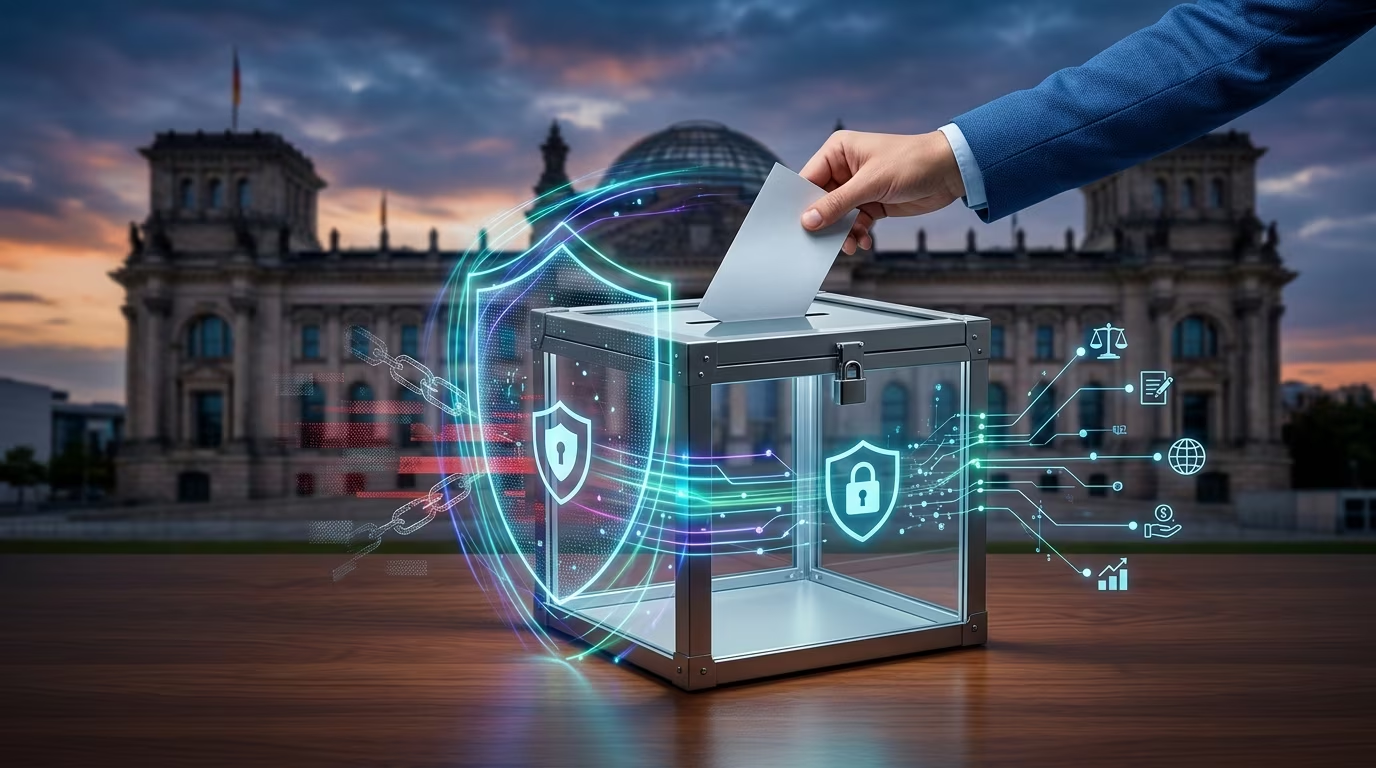
The cornerstone of any functioning democracy is the fundamental right to vote, a civic duty that empowers citizens to shape their government, hold leaders accountable, and direct the trajectory of public policy. However, in recent years, the landscape of electoral participation in the United States has faced unprecedented and multifaceted challenges. The aftermath of highly contested political races has left an indelible mark on the nation’s democratic infrastructure. While vigorous debate and intense political rivalry are healthy components of political life, the proliferation of unfounded allegations regarding widespread electoral fraud has ushered in a troubling era of systemic vulnerabilities. These persistent, baseless narratives not only undermine the public’s inherent trust in their institutions but also serve as a direct catalyst for a sweeping wave of state-level policy changes that threaten to disenfranchise millions of eligible voters. Examining the complex nature of these threats—from the enactment of restrictive voting laws and the dismantling of crucial electoral safeguards to the targeted harassment of election workers—reveals a coordinated strain on the American democratic process. Recognizing the full scope of these challenges is absolutely essential for developing robust, proactive defenses to protect the ballot box, ensure equitable access, and guarantee that every eligible voice is heard without fear of obstruction or intimidation.
The Resurgence of Restrictive Voting Legislation
In direct response to fabricated claims of widespread voter fraud, numerous state legislatures across the country have introduced and successfully passed sweeping legislative packages aimed at overhauling the voting process. Proponents of these bills often argue that these stringent measures are entirely necessary to restore faith in the electoral system and prevent hypothetical irregularities that threaten the sanctity of the vote. However, civil rights advocates, legal scholars, and nonpartisan election watchdogs fiercely contest this narrative, warning that these laws disproportionately target specific demographics, creating unnecessary and discriminatory hurdles for marginalized groups.
These coordinated legislative efforts frequently focus on tightening voter identification requirements, severely limiting access to mail-in voting, and restricting the availability of early voting periods. For example, some states have drastically reduced the number of ballot drop boxes available in densely populated urban areas, or they have imposed severe criminal penalties on individuals, community groups, and non-profit organizations attempting to assist voters with obtaining or submitting their absentee ballots. The cumulative effect of these overlapping policies is the creation of a labyrinthine electoral process that disproportionately disadvantages low-income earners, elderly populations, voters with disabilities, and minority communities. These demographics often rely heavily on flexible voting options due to inflexible work schedules, childcare responsibilities, or a systemic lack of reliable transportation.
The long-term implications of these restrictions extend far beyond the immediate logistical challenges faced by individual voters; they represent a fundamental, philosophical shift in the relationship between the state and the electorate. When access to the polls is systematically curtailed through bureaucratic red tape and punitive regulations, the resulting electorate inherently fails to accurately reflect the broader population’s true will. This systemic exclusion thereby dilutes the core principles of representative democracy, transforming the fundamental right to vote into an exclusive privilege reserved for those with the time, resources, and institutional knowledge to navigate the newly erected barriers.
The Ripple Effects of Election Misinformation
The widespread and deliberate dissemination of misinformation regarding election integrity represents one of the most potent, corrosive threats to modern democratic societies. Fueled by high-profile political figures, amplified by partisan media networks, and hyper-accelerated through largely unregulated digital media ecosystems, unfounded allegations of rigged elections and widespread fraud have deeply penetrated the American public consciousness. This relentless barrage of falsehoods has a profound and clearly measurable impact on voter confidence across the political spectrum.
When citizens are repeatedly and loudly told that the electoral system is irreparably flawed, corrupt, or explicitly rigged against them, a pervasive sense of apathy, cynicism, and institutional distrust inevitably takes root. Voters may begin to seriously question the value and efficacy of their democratic participation, leading to significantly depressed voter turnout and a broader withdrawal from civic engagement. Furthermore, this toxic environment of pervasive distrust provides a highly fertile breeding ground for extreme partisan polarization, as individuals increasingly retreat into ideologically isolated informational silos that merely validate and reinforce their preexisting suspicions and fears.
The persistence of these election-denial narratives also creates a highly dangerous, self-perpetuating feedback loop. Elected officials, responding to the genuine concerns of a misinformed constituency, may feel politically emboldened or obligated to push for even more restrictive voting laws. They often explicitly cite the very lack of public confidence that their own reckless rhetoric helped to generate as justification for overhauling election laws. Breaking this vicious cycle requires a massive, concerted effort on multiple fronts to promote digital media literacy, legally and politically hold purveyors of misinformation accountable, and significantly elevate transparent, accessible, and fact-based communication from trusted, nonpartisan election administration officials.
The Growing Crisis of Poll Worker Shortages and Safety
Behind the complex mechanics and logistical orchestration of every election are hundreds of thousands of dedicated poll workers and local election officials who tirelessly ensure the process runs smoothly, efficiently, and securely. Historically, this essential role has been widely viewed as an honorable, respected civic duty, most often fulfilled by patriotic retirees, civic-minded community volunteers, and local government employees. However, the highly hostile, polarized climate fostered by relentless election misinformation has radically transformed these once-mundane administrative positions into targets of intense, often dangerous scrutiny and escalating harassment.
According to recent comprehensive data released by the U.S. Election Assistance Commission (EAC), jurisdictions across the entire country have reported significant, widespread difficulties in recruiting and retaining adequate numbers of qualified poll workers. The 2024 Election Administration and Voting Survey (EAVS) explicitly highlighted that 48 percent of all jurisdictions struggled substantially with poll worker recruitment, characterizing the process as incredibly challenging. This critical administrative shortfall can directly lead to disastrous consequences on Election Day, including the forced consolidation or closure of polling places, exponentially longer wait times for voters, and an increased likelihood of honest administrative errors caused by understaffed, overworked teams.
The growing reluctance of ordinary citizens to serve in these roles is frequently and directly linked to a well-documented surge in threats, doxing, and physical intimidation directed at election staff. Workers have consistently reported facing highly aggressive verbal confrontations from partisan observers, targeted online harassment campaigns, and even explicit death threats directed at themselves and their families merely for performing their sworn, nonpartisan duties. This alarming, escalating trend not only profoundly jeopardizes the physical safety and psychological well-being of these dedicated individuals, but it also severely threatens to rapidly hollow out the vast institutional knowledge and technical experience absolutely essential for conducting fair, accurate, and secure elections. When highly experienced personnel are driven away from their crucial posts by a legitimate fear for their safety, the overall operational integrity and resilience of the nation’s election infrastructure are severely compromised.
Partisan Interference and the Threat of Election Subversion
Perhaps the most alarming and systemically dangerous development in the current, hyper-polarized electoral landscape is the increasingly coordinated, legislative effort to introduce aggressive partisan influence directly into the fundamental mechanics of election administration and result certification. Traditionally, the complex processes of tabulating ballots, resolving minor discrepancies, and officially certifying election results have been strictly treated as technical, nonpartisan administrative functions, independently overseen by dedicated civil servants and bipartisan election boards. However, a highly concerning new wave of state-level legislation explicitly seeks to abruptly shift this ultimate administrative authority directly into the hands of highly partisan political bodies, such as state legislatures.
In several key battleground states, lawmakers have aggressively pursued and sometimes enacted sweeping measures that would formally grant state legislatures the unprecedented power to directly intervene in local election disputes, summarily overrule the technical decisions of local election boards, or severely penalize, fine, or even criminally prosecute nonpartisan election officials for relatively minor, unintentional administrative infractions. This deliberate shift toward direct partisan control introduces a massive, structural vulnerability into the democratic system, raising the very real specter of election subversion—the terrifying possibility that legitimate, mathematically verifiable electoral outcomes could be entirely overturned or discarded by political actors who are simply dissatisfied with the democratic results.
This brazen legislative encroachment on the traditional independence and operational autonomy of local election administration critically undermines the foundational, unwritten guarantee that American elections are decisively decided by the voters at the ballot box, not by the partisan politicians already in power. The looming threat of legislative election subversion strikes precisely at the very heart of the democratic compact, rapidly eroding the long-standing tradition of the peaceful transfer of power that has historically been the defining hallmark and global standard of the American political system. Vigorously protecting the strict autonomy and operational independence of nonpartisan election officials from undue political interference is absolutely paramount.
Strengthening the Foundation: Legal and Civic Countermeasures
In the direct face of these rapidly mounting, multifaceted challenges to democratic integrity, a robust, unyielding defense of universal voting rights requires a comprehensive, multi-pronged approach encompassing aggressive legal action, sustained legislative advocacy, and widespread, organized grassroots mobilization. The federal and state judicial systems remain a critical, front-line battleground for actively challenging and dismantling discriminatory, restrictive election laws. Organizations such as the American Civil Liberties Union (ACLU) and numerous other dedicated civil rights groups continue to spearhead complex, high-stakes litigation aimed at permanently striking down restrictive measures that explicitly violate the core tenets of the Voting Rights Act of 1965 and the Equal Protection Clause of the U.S. Constitution. Through highly targeted, strategically designed legal challenges, these vital advocates actively seek to dismantle newly erected bureaucratic barriers to the ballot box and secure equitable access.
Beyond the formal confines of the courtroom, sustained, highly organized civic engagement is absolutely vital for proactively safeguarding the health of the democracy. Local community organizations, voting rights coalitions, and non-profit advocacy groups play an indispensable, on-the-ground role in thoroughly educating voters about their fundamental rights, guiding them through the complexities of navigating entirely new, often confusing voting requirements, and organizing massive, highly effective community voter registration drives. By empowering individual citizens with the necessary knowledge, logistical support, and actionable resources, these crucial grassroots initiatives directly help mitigate and overcome the intentionally disenfranchising effects of restrictive state legislation.
Furthermore, effectively protecting the physical electoral process requires an unwavering societal commitment to vigorously supporting, adequately funding, and physically defending the thousands of dedicated individuals who actually administer it. This comprehensive support must include aggressively advocating for significantly increased, sustainable federal and state funding for chronically under-resourced local election authorities, implementing robust, enforceable physical and cybersecurity measures to thoroughly protect vulnerable poll workers from partisan harassment, and launching widespread public awareness campaigns.
Frequently Asked Questions
- What is the exact impact of restrictive voting laws on overall voter turnout?
Restrictive voting laws, such as demanding strict, hard-to-acquire forms of photo identification, significantly reducing access to convenient mail-in voting, and severely curtailing early voting periods, can drastically depress overall voter turnout. This negative impact is particularly severe among low-income individuals, minority communities, college students, and the elderly. These demographic groups inherently face much greater logistical and financial hurdles in acquiring specific, government-mandated forms of ID, or they simply lack the flexible employment schedules necessary to physically vote in person during highly restricted, inconvenient polling hours.
- How does widespread misinformation specifically affect the democratic process?
Rampant misinformation regarding election integrity fundamentally erodes public trust in the entire voting process. When large segments of the population genuinely believe that their votes will not be accurately counted or that the system is systemically rigged, it directly leads to widespread voter apathy and a sharp decrease in civic participation. Furthermore, these widespread, demonstrably false narratives are frequently weaponized by political actors to justify the rapid implementation of highly restrictive voting policies that further disenfranchise eligible voters under the guise of election security.
- Why is there currently a massive shortage of poll workers across the United States?
The severe shortage of poll workers is currently driven by a complex combination of multiple factors, primarily an aging traditional volunteer base and an increasingly toxic, highly hostile political environment. According to the U.S. Election Assistance Commission, nearly half of all jurisdictions report severe difficulties in recruitment. Many highly experienced, long-term election workers have publicly cited relentless verbal harassment, organized intimidation, and genuine, credible safety concerns—all stemming directly from unfounded, partisan allegations of electoral fraud—as their primary reasons for resigning from their essential administrative posts.
- What exactly is election subversion in the modern political context?
Election subversion refers to calculated, often legally sanctioned attempts by highly partisan political actors or hyper-partisan legislative bodies to explicitly manipulate, illegitimately interfere with, or entirely overturn the legitimate, mathematically verifiable results of a democratic election. This dangerous phenomenon can occur through new state legislative efforts to legally seize direct control of local election administration, the deliberate refusal of partisan boards to certify valid, audited election results, or the targeted harassment and legal intimidation of nonpartisan election officials to improperly influence the execution of their sworn duties.
- How can everyday citizens actively help protect voting rights and democracy?
Citizens can proactively protect voting rights by remaining highly informed about proposed changes to local and national election laws, actively participating in grassroots political advocacy, and financially or voluntarily supporting legal organizations that consistently litigate against voter suppression tactics. Additionally, volunteering to serve as a local poll worker, actively assisting neighbors and community members with the voter registration process, and vigorously, factually combating election misinformation within their own social networks and local communities are absolutely crucial, impactful steps in defending the long-term integrity of the democratic process.
Conclusion: Charting a Resilient Path Forward for Electoral Integrity
The enduring resilience of the American democratic experiment is currently being subjected to severe, unprecedented tests by a highly complex, coordinated array of threats that explicitly seek to restrict equitable access to the ballot box and systematically undermine public confidence in the overall electoral system. From the insidious, hyper-accelerated spread of digital misinformation to the deliberate enactment of highly partisan state legislation designed to improperly manipulate the mechanics of election administration, the challenges facing the republic are both deeply systemic and historically rooted. However, the fundamental, shared national commitment to a government of the people, by the people, for the people firmly remains a powerful, unifying counterforce against these antidemocratic trends. By remaining highly vigilant, actively supporting and protecting the thousands of dedicated individuals who tirelessly run our elections, and aggressively, legally challenging discriminatory electoral practices at every turn, modern society can successfully fortify the cracking foundations of its democratic institutions. The defense of universal voting rights is definitively not a passive endeavor; it rigorously demands continuous civic engagement, an unwavering, nonpartisan dedication to objective truth, and a unified, collective resolve to ensure that the fundamental right to vote remains freely accessible, highly secure, and fiercely protected for all eligible citizens, both today and for all generations to come.
References
- The EAC Calls on Americans to Become Poll Workers Ahead of 2026 Midterms — U.S. Election Assistance Commission. 2026-01-27. https://www.eac.gov/news
- Election Administration and Voting Survey (EAVS) Comprehensive Report — U.S. Election Assistance Commission. 2025-06-30. https://www.eac.gov/research-and-data/studies-and-reports
- Voting Rights Project Litigation Overview — American Civil Liberties Union. 2026-01-15. https://www.aclu.org/issues/voting-rights
- History of Federal Voting Rights Laws — U.S. Department of Justice. 2024-05-15. https://www.justice.gov/crt/history-federal-voting-rights-laws