
Robotic Canines in Policing: Innovation or Threat?
Exploring the rise of robot dogs in law enforcement: life-saving tools or steps toward dystopian surveillance?
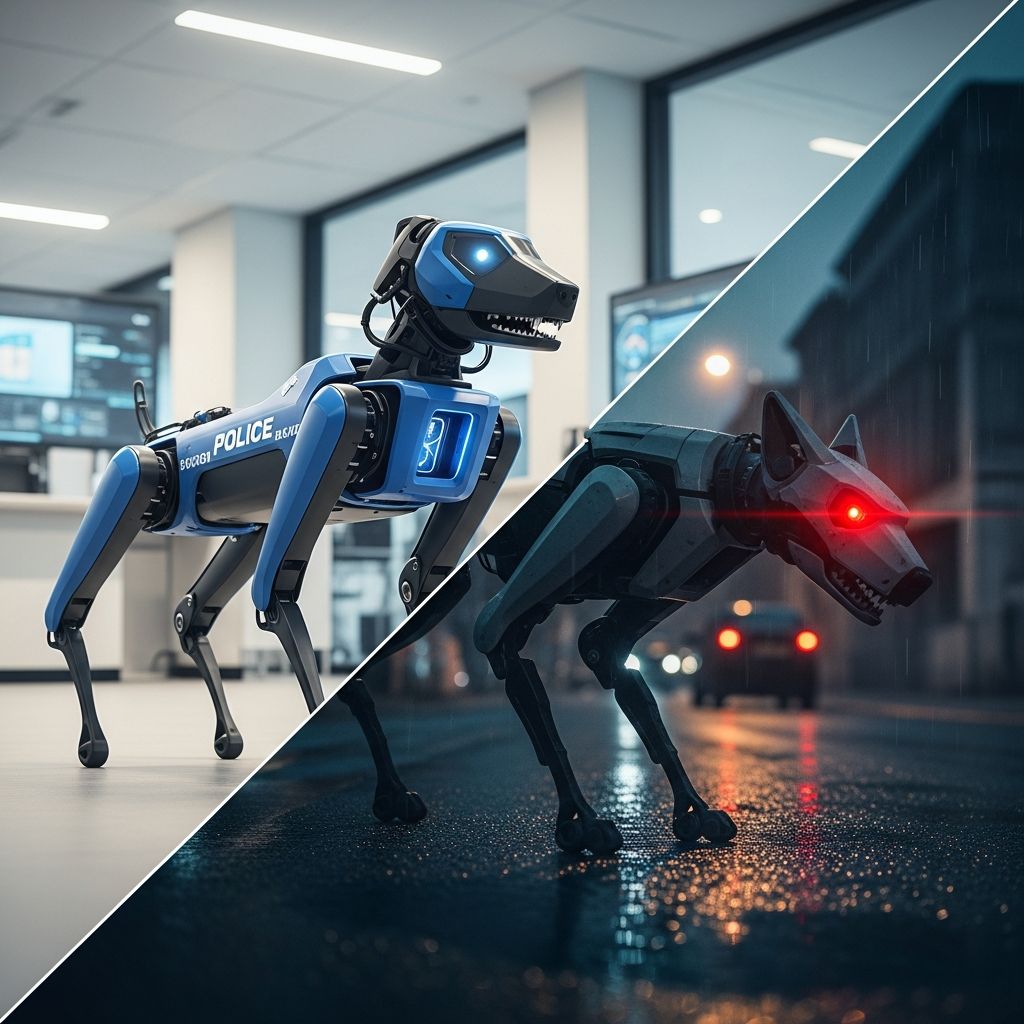
Mechanical quadrupeds, often dubbed robot dogs, are reshaping the landscape of law enforcement. These agile machines, capable of navigating treacherous environments and equipped with sophisticated sensors, offer officers unprecedented situational awareness without endangering human lives. From armed standoffs to hazardous material incidents, their deployment marks a pivotal shift in public safety strategies.
Technological Foundations of Police Robot Dogs
At the core of this revolution is advanced robotics engineering. Devices like Boston Dynamics’ Spot, a 75-pound unit resembling a German Shepherd, integrate multiple cameras for real-time video feeds, AI-driven object detection for weapons and individuals, and thermal imaging for low-visibility conditions. Operators control these units via tablet interfaces akin to gaming controllers, receiving live streams and 3D mapping data to assess threats remotely.
Unlike wheeled or tracked predecessors used by bomb squads since the 1980s, four-legged designs provide superior mobility. They climb stairs, traverse uneven terrain, and maintain balance on slippery surfaces, thanks to ongoing software updates. Globally, approximately 2,000 Spot units operate, with surging interest from law enforcement in the US, Canada, UK, Netherlands, and Italy.
- Key Features: AI weapon detection (handguns, knives, bats), loudspeaker for remote communication, gas leak sensors, and autonomous navigation.
- Autonomy Levels: Capable of self-maintenance checks and predefined patrols, always under human oversight.
- Durability: Withstands indoor and outdoor rigors, including chemical or biological hazards.
Real-World Deployments and Trials
In the United States, over 60 bomb squads and SWAT teams employ Spot for high-stakes operations. U.S. Immigration and Customs Enforcement (ICE) invested roughly $78,000 in a similar model from Icor Technology for perimeter security and inspections. These robots enter buildings during armed sieges or hostage scenarios, relaying critical intelligence that informs tactical decisions.
Across the Atlantic, Nottinghamshire Police in the UK initiated rigorous trials in 2025, funded by the Office of the Chief Scientific Adviser. Over 12 weeks, the robot undergoes scenarios like building searches, hostage negotiations, and responses to chemical agents. Superintendent Louise Clarke emphasized its potential to ‘enhance officer and public safety’ by gathering intelligence without risking lives. Successful outcomes could lead to nationwide rollout by 2026.
| Region | Key Users | Primary Applications | Status |
|---|---|---|---|
| USA/Canada | 60+ SWAT/Bomb Squads, ICE | Standoffs, Hazmat, Perimeter Security | Active Deployment |
| UK | Nottinghamshire Police | Sieges, Hostage Situations, Recon | 2025-2026 Trials |
| Europe | Dutch MoD, Italian Police | Defense, National Security Ops | Operational |
Enhancing Officer Safety and Operational Efficiency
Proponents highlight risk reduction as paramount. Traditionally, officers or K-9 units face immediate peril in volatile environments. Robot dogs provide a ‘force multiplier,’ enabling reconnaissance in confined spaces where drones falter. Thermal cameras spot hidden suspects, while 3D scans map layouts, preventing ambushes.
In chemical or biological incidents, these machines detect contaminants without human exposure. Nottinghamshire’s trials underscore this: ‘We can gather vital intelligence about a volatile situation without putting lives at risk,’ noted Superintendent Clarke. Moreover, remote loudspeakers facilitate de-escalation, potentially averting violence.
Professor Robin Murphy of Texas A&M University notes the evolutionary leap: four legs grant dexterity unattainable by wheeled bots, broadening usability indoors and on rough terrain.
Ethical and Privacy Challenges
Despite benefits, concerns mount. Civil liberties advocates fear escalation of police militarization. Equipping robots with weapon detection raises questions: could they integrate non-lethal tools like tasers? Ryan Calo, a robotics expert, warns against unchecked expansion: ‘No one wants a robotic police state,’ advocating predefined, transparent policies.
Privacy issues loom large. Constant surveillance via cameras and sensors could infringe on bystanders’ rights, especially in residential areas. Without robust oversight, data collection might enable unwarranted profiling. Public trust hinges on accountability—will footage be stored indefinitely? Who accesses it?
- Militarization Risk: Blurs lines between community policing and tactical response.
- Accountability Gap: Human operators decide, but machines execute—liability in errors?
- Equity Concerns: Deployment in minority neighborhoods could exacerbate biases.
Legal Frameworks and Regulatory Needs
Current laws lag behind technology. In the US, Fourth Amendment protections against unreasonable searches apply, but robot-gathered evidence admissibility remains untested. UK trials feed recommendations to the Home Office, potentially shaping national guidelines.
Experts like Brendan Schulman of Boston Dynamics call for ‘clear boundaries.’ Policies must specify deployment criteria, data retention limits, and independent audits. Internationally, the Dutch Ministry of Defense’s use signals a need for harmonized standards to prevent abuse.
Future Prospects and Technological Evolution
By 2026, wider adoption seems likely, with enhancements in object manipulation and AI autonomy. Integration with AR glasses for officers or swarm robotics could amplify capabilities. However, balanced governance is crucial—leveraging innovation while safeguarding rights.
Boston Dynamics continues refining Spot: improved slip resistance, better grasping. Imagine hybrid units with real K-9 teams, where robots handle entry and dogs provide olfactory detection.
Frequently Asked Questions (FAQs)
What are police robot dogs primarily used for?
They excel in high-risk reconnaissance, such as armed standoffs, hostage rescues, hazmat incidents, and building searches, providing real-time data to officers.
How much do these robots cost?
Models like Spot start at around $100,000, with custom variants like ICE’s costing $78,000.
Are robot dogs fully autonomous?
No, they operate under human control via remote interfaces, though capable of basic autonomous tasks like navigation and patrols.
What are the main criticisms of police robot dogs?
Concerns include privacy invasion, potential weaponization, and fears of over-militarization without proper oversight.
When might robot dogs become standard in policing?
UK trials suggest possible frontline service by 2026 if successful; US adoption is already underway.
Balancing Innovation with Civil Liberties
Robot dogs epitomize policing’s dual-edged sword: profound safety gains juxtaposed against societal risks. Transparent policies, community input, and ethical guidelines will determine if they become trusted allies or symbols of overreach. As trials progress, stakeholders must prioritize human oversight to harness benefits responsibly.
References
- Police Oracle: The robot dog being tested in-force which could enter service by 2026 — Police Oracle. 2025. https://www.policeoracle.com/video/see-the-robot-dog-being-tested-in-force-which-could-enter-service-by-2026/
- YouTube: Police test robot dog for potential UK rollout — YouTube (Mark 1333). 2025-08-22. https://www.youtube.com/watch?v=sGxHc3LOldU
- Governing: Police ‘Robot Dogs’ Raise Concerns as More Departments Adopt Them — Governing.com. Recent (post-2023). https://www.governing.com/resilience/police-robot-dogs-raise-concerns-as-more-departments-adopt-them
Similar Articles








Read full bio of Sneha Tete


