
Robocalls, Government Debt and the First Amendment
How a Supreme Court ruling reshaped robocall rules, government debt collection, and free‑speech protections under the Telephone Consumer Protection Act.
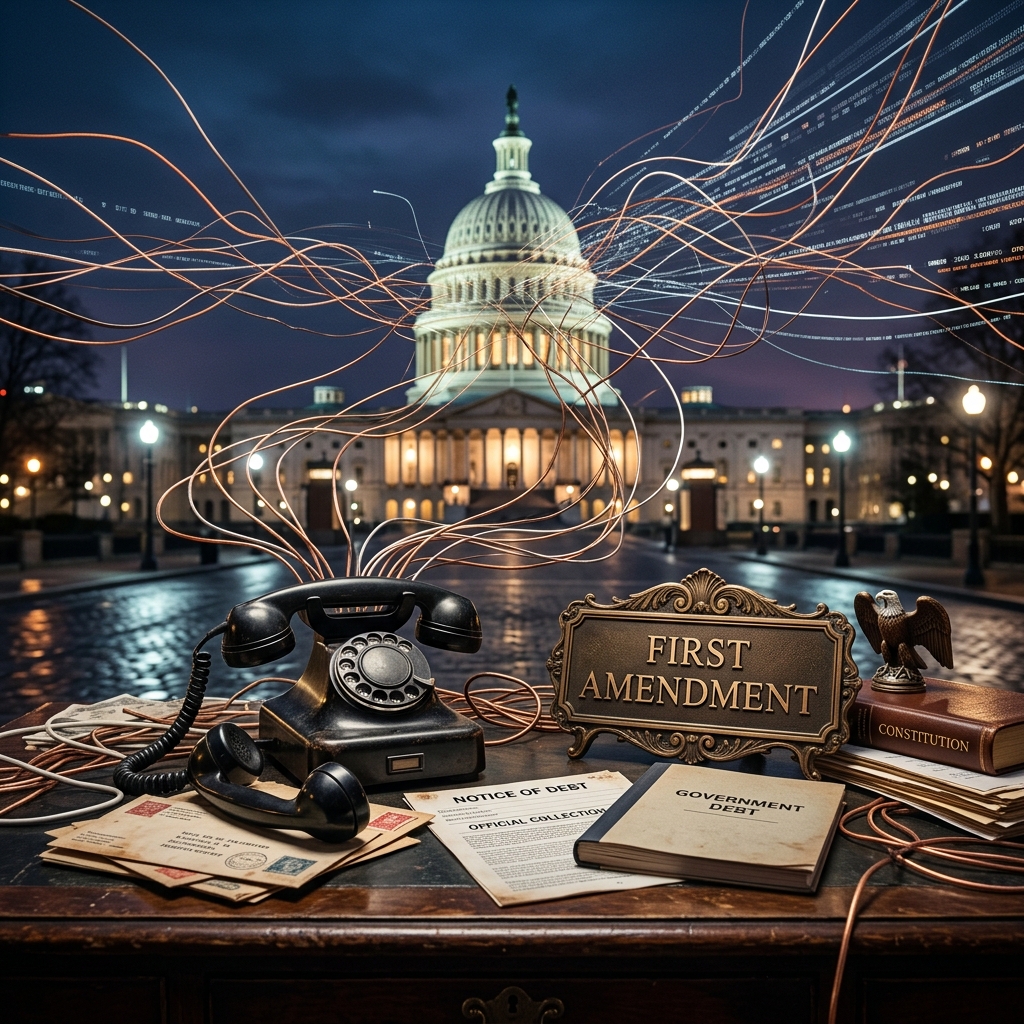
Automated calls and text messages, commonly known as robocalls, have become a persistent annoyance for many consumers. At the center of the legal framework governing these calls is the Telephone Consumer Protection Act (TCPA), a federal statute designed to curb unwanted automated communications to mobile and landline phones. In a significant decision, the U.S. Supreme Court struck down a special exemption that allowed robocalls to collect certain government-backed debts, reshaping both consumer protections and First Amendment doctrine in the process.
This article explains what the TCPA does, why Congress created an exemption for government debt collection, how the Supreme Court evaluated that exemption under the First Amendment, and what the ruling means for consumers, debt collectors, and future regulation of robocalls.
Understanding the Telephone Consumer Protection Act
Congress enacted the TCPA in 1991 in response to growing complaints about unsolicited telemarketing and automated calls. The statute focuses on limiting the use of automatic dialing systems and prerecorded voices, particularly when contacting mobile phones, where the called party often pays for the call.
Under the TCPA, the key restrictions include:
- Limits on calls made using an automatic telephone dialing system (autodialer) to cell phones without prior consent.
- Prohibitions on using prerecorded or artificial voice messages for certain calls without prior express consent.
- Enhanced protections for residential lines against telemarketing calls.
- Private rights of action that allow individuals to seek statutory damages, often between $500 and $1,500 per violating call or text.
From the outset, the TCPA carved out limited exceptions, such as calls made for emergencies or calls to recipients who have expressly consented to being contacted. These exemptions were designed to allow socially valuable communications to continue, while still protecting consumers from intrusive marketing and debt collection practices.
The 2015 Government-Debt Robocall Exemption
In 2015, Congress amended the TCPA through the Bipartisan Budget Act. The amendment created a new exemption: robocalls made to collect debts owed to or guaranteed by the federal government were permitted even if the recipient had not consented.
Examples of debts covered by this exemption included:
- Federal student loans guaranteed or held by the U.S. Department of Education.
- Residential mortgages backed by federal entities.
- Other government-guaranteed or government-held debts, such as certain Small Business Administration obligations.
Practically, the exemption meant that a call saying “please pay your government-backed loan” could be made using an autodialer or prerecorded voice to a cell phone without prior consent, while a similar automated call about a purely private debt or a political campaign remained prohibited.
This preferential treatment sparked constitutional concerns. Political organizations and other callers argued that the government was granting more leeway to speech related to its own financial interests than to other types of speech, including political fundraising or advocacy.
The Supreme Court Case: Barr v. American Association of Political Consultants
The controversy over the government-debt exemption culminated in the case Barr v. American Association of Political Consultants, Inc., decided by the U.S. Supreme Court on July 6, 2020.
Political organizations challenged the TCPA’s robocall ban as unconstitutional, pointing to the 2015 exemption for government debt collection as evidence that the law was content-based—that is, it treated different speech differently depending on what the caller was talking about.
The Court’s task involved two major questions:
- Does the government-debt exemption create a content-based distinction under the First Amendment?
- If the exemption is unconstitutional, should the Court invalidate the entire robocall restriction or simply remove the flawed exemption?
First Amendment Analysis: Content-Based Regulation and Strict Scrutiny
Under First Amendment doctrine, laws that regulate speech based on its content are generally subject to strict scrutiny, the most demanding standard of judicial review. A law is content-based if it distinguishes favored or disfavored speech based on the topic, idea, or message expressed.
The Supreme Court majority concluded that the 2015 exemption was indeed content-based. The legality of a robocall turned on whether it was “made solely to collect a debt owed to or guaranteed by the United States.” In other words, a caller discussing government debt enjoyed an exception that did not apply to callers discussing politics, charitable contributions, or private financial matters.
Because the exemption favored certain speech—government debt collection—over other lawful speech, the Court applied strict scrutiny. Under this standard, the government must demonstrate that the law serves a compelling interest and is narrowly tailored to achieve that interest with minimal restriction of protected speech.
Although collecting government-backed debts is an important policy objective, the Court held that the exemption was not narrowly tailored to the stated interests and impermissibly discriminated based on content. As a result, the exemption violated the First Amendment.
Severability: Striking the Exemption, Preserving the Ban
Having found the exemption unconstitutional, the Supreme Court then turned to the issue of severability: whether the invalid provision could be removed while leaving the rest of the statute intact.
On this question, a larger majority of the Court agreed that the proper remedy was to sever the government-debt exemption from the TCPA, rather than striking down the entire robocall restriction. This approach restored the statute to its pre-2015 structure.
Key aspects of the decision on severability include:
- The core robocall ban remains valid and enforceable.
- The special treatment for government debt collection calls is removed.
- Robocalls to collect government-backed debts are now subject to the same rules as other robocalls.
The effect is to strengthen consumer protections: people with government-backed debts, such as federal student loans, now enjoy the same TCPA safeguards against unwanted robocalls as other consumers.
Practical Impact on Consumers and Debt Collectors
For everyday consumers, the ruling has several significant implications:
- Restored protections: Robocalls about government-backed debts no longer have special permission. Consumers can rely on the TCPA to challenge unwanted automated calls and texts related to those debts.
- Uniform rules: Debt collectors, whether pursuing private or government-backed obligations, must follow the same TCPA requirements, including obtaining prior consent where required.
- Potential liability: Organizations that continued to use autodialers or prerecorded messages for government debt collection may face TCPA claims for calls made within the statute of limitations, typically four years.
For debt collectors and government contractors, compliance responsibilities are more demanding. They must ensure that automated communications to mobile phones meet TCPA standards, including obtaining the called party’s consent and honoring requests to stop or limit communications.
Consumer Remedies Under the TCPA
The TCPA allows individuals to bring private lawsuits seeking statutory damages. Typical remedies include:
- Up to $500 per violating call or text.
- Up to $1,500 per call or text if the violation is found to be willful or knowing.
These remedies are designed to deter companies from placing large volumes of unwanted automated calls. By making each call potentially costly, Congress sought to influence caller behavior and promote respect for consumer privacy.
Robocalls, Free Speech and Regulation: A Balancing Act
The Supreme Court’s decision highlights a recurring tension in modern communications law: how to balance consumer privacy and nuisance concerns with First Amendment protection for speech, including political advocacy and commercial information.
From a policy perspective, the ruling sends several signals:
- Congress can regulate the manner of calling—such as banning certain automated technologies—if the rules are neutral with respect to the content of the speech.
- Creating exceptions that favor one type of speech over another, particularly when tied to government interests, risks strict scrutiny and invalidation.
- When a problem arises from an added exception, courts may choose to remove that exception rather than dismantle longstanding consumer protections.
For political organizations and advocacy groups, the outcome is mixed. The Court rejected arguments that the entire robocall ban must fall, but it agreed that content-based distinctions raise constitutional concerns. Future legislative changes to the TCPA will likely be evaluated with this precedent in mind.
Key Differences Before and After the Ruling
| Aspect | Before 2015 Amendment | After 2015 Amendment | After Supreme Court Ruling |
|---|---|---|---|
| Robocalls to collect government-backed debt | Generally prohibited without consent under TCPA | Exempted from TCPA restrictions for certain cell phone calls | No longer exempt; subject to full TCPA rules |
| Robocalls for political or charitable purposes | Restricted by TCPA unless consent or another exception applies | Still restricted; no new exemption | Still restricted; rules unchanged |
| First Amendment status of robocall ban | Not directly challenged at Supreme Court | Government-debt exemption raised content-based concerns | Core ban upheld; exemption struck as unconstitutional |
| Consumer protection against government-debt robocalls | Strong protections under TCPA | Weakened by exemption for federal debt collection | Protections restored and aligned with other robocalls |
Compliance Considerations for Organizations
Entities that place automated calls or send automated texts must take stock of their practices in light of the ruling and the continuing requirements of the TCPA.
Important compliance steps include:
- Reviewing call campaigns that rely on autodialers or prerecorded messages to ensure that appropriate consent has been obtained.
- Updating policies and scripts for calls relating to government-backed debts, treating them the same as other debt-related communications under the TCPA.
- Monitoring developments in TCPA case law, as courts continue to interpret terms like “automatic telephone dialing system” and the reach of the statute.
- Implementing procedures for honoring opt-out requests and do-not-call preferences.
Regulators, including the Federal Communications Commission and the Federal Trade Commission, frequently address unlawful robocall practices, such as deceptive debt collection schemes. Robust compliance not only reduces the risk of private lawsuits but also helps organizations avoid enforcement actions.
Frequently Asked Questions (FAQs)
Are robocalls to collect federal student loans still allowed?
No. After the Supreme Court’s decision, automated calls to collect federal student loans must comply with the same TCPA requirements as other robocalls. Callers generally need prior consent to use autodialed or prerecorded calls to cell phones.
Did the Supreme Court strike down the entire robocall ban?
No. The Court invalidated only the 2015 government-debt exemption. The core restrictions on robocalls to cell phones remain in place and continue to protect consumers.
Why was the government-debt exemption considered unconstitutional?
The exemption was unconstitutional because it favored one type of speech—collecting government-backed debts—over other speech, such as political advocacy, based on content. That content-based distinction triggered strict scrutiny and failed to meet First Amendment standards.
Can consumers sue over unwanted robocalls about government-backed debt?
Yes. With the exemption removed, robocalls related to government-backed debt are subject to the general TCPA rules. Consumers may bring actions seeking statutory damages for calls that violate the statute.
Does the ruling affect emergency alerts or consent-based calls?
No. Emergency communications and calls made with the recipient’s prior consent remain generally permissible. The ruling focuses specifically on the government-debt exemption, not on longstanding exceptions for emergencies or consent.
References
- U.S. Supreme Court Strikes Down Exception for Government Debt Robocall Ban Under First Amendment — UC Berkeley Center for Consumer Law & Economic Justice. 2020-07-06. https://consumerlaw.berkeley.edu/news/us-supreme-court-strikes-down-exception-government-debt-robocall-ban-under-first-amendment
- Supreme Court Rules on Robocallers — National Consumer Law Center Digital Library. 2020-07-06. https://library.nclc.org/article/supreme-court-rules-robocallers
- Supreme Court Nixes Robocall Exception for Federal Loans — Courthouse News Service. 2020-07-06. https://www.courthousenews.com/supreme-court-nixes-robocall-exception-for-federal-loans/
- Supreme Court Strikes Down Government-debt Exception to TCPA Ban on Autodialed and Prerecorded Calls to Cell Phones — Davis Wright Tremaine LLP. 2020-07-07. https://www.dwt.com/insights/2020/07/tcpa-government-debt-exception-ruling
- Government Debt Collection Exception to Robo Call Ban Invalidated — Constitutional Law Reporter. 2020-09-14. https://constitutionallawreporter.com/2020/09/14/government-debt-collection-exception-to-robo-call-ban/
- TCPA Class Action Lawsuits: Stop Harassing Robocalls and Texts — Class Law Group. 2023-01-01 (approx.). https://www.classlawgroup.com/telephone-consumer-protection-act-lawsuit
- Banned Debt Collectors — Federal Trade Commission Legal Library. 2020-01-01 (approx.). https://www.ftc.gov/legal-library/browse/cases-proceedings/banned-debt-collectors
Similar Articles








Read full bio of medha deb


