
Rhode Island Rental Agreements and Tenant Rights
Understand Rhode Island leases, deposits, notices, and eviction rules so landlords and renters can navigate rental housing with confidence.
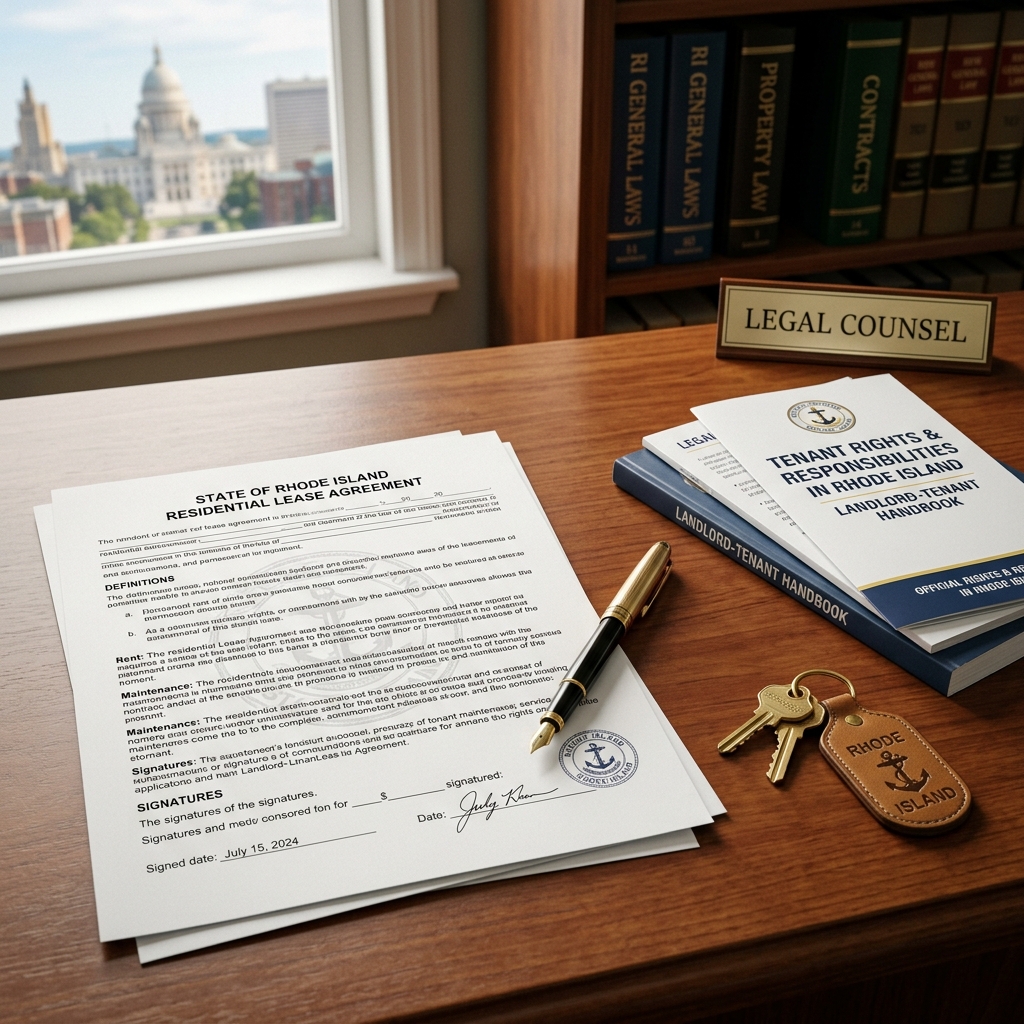
Rhode Island has a detailed legal framework that governs how landlords and tenants create, manage, and end residential rental agreements. These rules affect everything from how leases must be written to how much a landlord can charge as a security deposit and what happens if rent is not paid on time. Understanding this framework before you sign a lease can prevent costly disputes later.
This guide explains key features of Rhode Island lease and rental agreement law, focusing on everyday issues that renters and property owners encounter. It is for informational purposes and does not replace advice from a licensed attorney.
Legal Foundations of Rhode Island Rental Agreements
Most residential rental relationships in Rhode Island are governed by the Residential Landlord and Tenant Act, found in Title 34, Chapter 18 of the Rhode Island General Laws. This statute defines basic rights and responsibilities for both sides and sets minimum standards that cannot be waived in a lease.
- Scope of the law: The Act generally applies to residential units such as apartments, houses, and mobile home lots. Certain arrangements, like transient occupancy in hotels or some institutional housing, may be excluded.
- Mandatory provisions: Landlords must comply with housing codes and cannot contract around core protections like habitability, fair procedures for eviction, and limits on security deposits.
- Interaction with local and federal rules: State law operates alongside local ordinances and federal laws, including fair housing and lead-based paint regulations.
Anyone renting or managing housing in Rhode Island should treat the Residential Landlord and Tenant Act as the starting point for understanding rental obligations.
Types of Rental Arrangements in Rhode Island
Rhode Island law allows several common structures for residential tenancies, each with different rules on renewal and termination.
Fixed-Term Leases
A fixed-term lease usually runs for a set period, commonly six months or one year.
- Duration: The lease specifies a start and end date. The tenancy usually ends automatically at expiration unless the parties agree to renew.
- Rent stability: The agreed rent typically cannot be changed during the term unless the lease itself allows and applicable law is followed.
- Written requirement: For leases longer than one year, Rhode Island generally requires a written agreement to be enforceable.
Periodic (Month-to-Month or Week-to-Week) Tenancies
Periodic tenancies continue automatically at the end of each rental period until either the landlord or tenant ends the agreement with proper notice.
- Common structure: Month-to-month tenancies are widely used for flexibility. Week-to-week arrangements are less common but recognized.
- Notice to terminate: Rhode Island law generally requires at least 30 days’ written notice to end a month-to-month tenancy and at least 10 days’ notice for a week-to-week tenancy.
- Rent changes: In periodic tenancies, landlords may raise rent prospectively if they provide legally sufficient advance written notice and do not violate discrimination or retaliation rules.
Written vs. Oral Agreements
| Feature | Written Agreement | Oral Agreement |
|---|---|---|
| Proof of terms | Easier to prove; terms are recorded in the document. | Harder to prove; disputes often rely on witness testimony or conduct. |
| Lease longer than one year | Generally required to be in writing to be enforceable in court. | May not be enforceable beyond certain limits. |
| Flexibility | Less flexible; early termination may involve penalties or negotiation. | More flexible but can be legally uncertain. |
| Recommended practice | Strongly recommended for clarity and risk management. | Acceptable for short-term arrangements but riskier. |
While oral agreements are legally recognized, Rhode Island guidance from housing authorities emphasizes written leases to reduce misunderstandings.
Essential Terms in Rhode Island Rental Agreements
Regardless of structure, most Rhode Island leases include similar core provisions. Many of these mirror expectations in the Residential Landlord and Tenant Act.
- Parties and premises: Names of all adult tenants and the landlord or property manager, plus a clear description of the rental unit.
- Rent and due date: The amount of rent, where and how it must be paid, and the due date. Unless agreed otherwise, rent is customarily due on the first day of each month at the dwelling unit.
- Security deposit: The deposit amount and conditions for withholding or refund. Rhode Island law caps deposits at one month’s rent for most residential tenancies.
- Utilities and services: Which utilities (such as heat, water, electricity) and services (like trash collection) are included in rent and which the tenant must arrange.
- Repair and maintenance duties: Allocation of responsibility for ordinary repairs, major systems, and routine upkeep like lawn care or snow removal, consistent with legal minimums.
- Rules and restrictions: Occupancy limits, pet policies, smoking rules, parking arrangements, and similar house rules.
- Entry procedures: How and when the landlord may enter the unit, typically requiring advance notice except in emergencies.
- Grounds for termination and eviction: Reference to legal grounds such as nonpayment of rent, serious lease violations, or illegal activity, with notice procedures informed by Rhode Island statutes.
Even when a lease is silent, statutory rules will fill many gaps. For example, landlord duties to maintain habitable housing apply whether or not they are spelled out in the contract.
Security Deposits: Limits, Handling, and Refunds
Security deposits are a major source of conflict between landlords and tenants. Rhode Island law imposes specific limits and timelines to protect both sides.
Deposit Amount and Purpose
- Maximum amount: Landlords may not require a security deposit greater than one month’s rent for a residential tenancy.
- Separate from rent: A deposit is meant to secure performance of the tenant’s obligations and cover damage or unpaid rent, not to serve as advance payment of regular monthly rent.
- No disguised extra deposits: Landlords generally cannot circumvent the cap by labeling additional required payments as “last month’s rent” or similar if they function as a deposit.
Return of Security Deposits
- Deadline to return: After the tenancy ends and possession is delivered, landlords must return the deposit within 20 days, subject to lawful deductions.
- Itemized statement: If any portion is withheld, the landlord must provide a written, itemized list of damages or unpaid rent that justified the deduction.
- Consequences of non-compliance: Failure to provide the statement and refund on time can lead to forfeiture of the right to keep any part of the deposit and may expose the landlord to additional legal remedies, such as court orders requiring return of the full amount.
Tenants are advised to document the unit’s condition at move-in and move-out through photographs and inspection checklists, which can be crucial evidence in any dispute.
Rent, Late Payment, and Increases
Rhode Island does not impose statewide rent control, but it sets procedural safeguards around how rent is charged, increased, and collected.
Rent Due Date and Grace Concepts
- Default due date: If the lease does not specify otherwise, rent is ordinarily due on the first day of the month.
- Demand notice timing: Landlords generally may not issue a formal demand notice for unpaid rent until at least 15 days after the due date.
- Informal grace period: This 15-day threshold functions like an effective grace period before the landlord begins the quick eviction process available for nonpayment cases.
Rent Increases
- No statewide rent cap: Rhode Island law does not set a maximum percentage or amount for rent increases for most private units.
- Advance written notice: For periodic tenancies, landlords must provide written notice of a rent increase sufficiently in advance of the date the higher rent will apply, typically matching or exceeding the notice period required to terminate the tenancy (for example, 30 days for month-to-month).
- Non-discriminatory application: Rent increases may not be used to target tenants based on protected characteristics such as race, disability, family status, sexual orientation, gender identity, or other traits covered by Rhode Island’s fair housing law.
Tenants who receive sudden or unusually large rent increases should review their lease and consider consulting legal aid organizations, especially if they suspect the increase is retaliatory or discriminatory.
Habitability and Repair Obligations
Rhode Island requires landlords to provide housing that meets basic health and safety standards. This obligation exists independently of any lease clause and is reinforced by minimum housing codes.
Landlord Duties
- Compliance with housing and building codes: Landlords must meet local and state standards for structural safety, sanitation, and utilities.
- Essential services: They are generally responsible for ensuring furnaces, plumbing, and electrical systems are safe and functional, and that hot water and heat are available as required by local regulations.
- Lead safety in older homes: For properties built before 1978, the state’s Lead Hazard Mitigation law requires inspection and certification to minimize exposure to lead-based paint.
Tenant Duties
- Reasonable cleanliness: Tenants must keep their unit reasonably clean and sanitary.
- Proper use of facilities: Plumbing, electrical, and other fixtures must be used in a reasonable manner to avoid damage.
- No deliberate damage: Tenants may not deface, destroy, or substantially damage the premises or allow others to do so.
When serious habitability problems arise, Rhode Island offers limited options for tenants, which may include seeking enforcement of housing codes or court action. Self-help remedies like unilaterally withholding all rent without following legal procedures can risk eviction.
Landlord Entry and Tenant Privacy
Tenants have a right to privacy in their homes. At the same time, landlords sometimes must enter to make repairs, inspect the unit, or show it to prospective renters or buyers. Rhode Island balances these interests by requiring reasonable notice and prohibiting abusive entry.
- Notice requirement: For non-emergency entry, landlords are generally required to give prior notice. Practical guidance from Rhode Island landlord-tenant sources commonly references at least one to two days’ notice as reasonable.
- Emergency situations: In emergencies threatening health or safety, such as fire, major water leaks, or gas smells, landlords may enter without advance notice to address the danger.
- Prohibited conduct: Harassment, repeated late-night arrivals, or entry without any legitimate reason may violate the tenant’s rights and could be treated as an unfair practice.
Tenants who believe their privacy is being violated should document incidents and consider contacting a legal services organization or the appropriate local authority.
Eviction Procedures and Protection from Self-Help
Eviction is a formal legal process in Rhode Island. Landlords must follow court procedures and cannot simply lock out tenants or shut off utilities. State handbooks emphasize that only a judge can order removal of a tenant.
Grounds for Eviction
- Nonpayment of rent: If rent is more than 15 days late, the landlord may start a quick court process. Before filing, they must issue a written demand notice, and the tenant often has five days to pay and prevent the case from going forward.
- Lease violations: Material violations such as unauthorized occupants, prohibited pets, or serious property damage can justify eviction if the landlord provides proper notice, which may include a period to cure the violation.
- End of tenancy: In periodic tenancies, landlords may end the lease without stating a reason, as long as they give the legally required notice and do not act for discriminatory or retaliatory motives.
- Illegal activity: Use of the premises for certain illegal activities may support accelerated eviction proceedings.
Formal Court Process
- Filing and service: Evictions must be filed in the appropriate court. Tenants receive notice through service of legal papers by a sheriff or constable.
- Hearing: Tenants have a right to appear at the hearing, present evidence, and argue their case. Rhode Island guidance repeatedly stresses the importance of attending the hearing, even if the parties have discussed settlement.
- Court order: If the landlord prevails, the court issues an order that permits removal of the tenant and their property, to be carried out by authorized officers—not by the landlord personally.
Ban on Self-Help Evictions
Rhode Island explicitly prohibits self-help tactics where landlords attempt to force tenants out without a court order.
- Changing locks without a court order.
- Shutting off essential utilities to pressure the tenant to leave.
- Removing tenant belongings from the unit.
- Threats or intimidation designed to make the tenant vacate immediately.
Tenants facing self-help tactics should seek legal assistance promptly. In some cases, courts can order restoration of possession and may award damages.
Fair Housing and Anti-Discrimination Protections
Rental agreements and practices in Rhode Island must comply with the state’s Fair Housing Practices Act, which prohibits discrimination on numerous grounds. These protections apply to advertising, screening, lease terms, and termination decisions.
- Protected characteristics: Rhode Island bans discrimination based on race, color, religion, sex, disability, national origin, familial status, sexual orientation, gender identity, and other listed traits.
- Examples of prohibited conduct:
- Refusing to rent or imposing different conditions because a tenant has children.
- Charging higher deposits or rent to tenants with a disability.
- Using different screening criteria based on protected characteristics.
- Enforcement: Complaints may be filed with state or federal agencies, and violators can face legal penalties, including damages and orders to change practices.
Landlords should review fair housing guidance carefully when drafting leases or advertising units. Tenants who suspect discrimination can consult legal aid groups or civil rights agencies.
Practical Tips for Landlords and Tenants
Beyond the statute’s technical requirements, a few practical habits can greatly reduce conflict.
For Landlords
- Use clear, written leases that track Rhode Island law and local housing codes.
- Provide required disclosures, including information about lead paint hazards in older buildings.
- Document rent payments and deposit handling thoroughly.
- Respond promptly to repair requests, especially those affecting health or safety.
- Avoid any self-help tactics and follow court procedures for eviction.
For Tenants
- Read the entire lease before signing and ask for clarification of unclear terms.
- Keep copies of all documents, payment receipts, and communications with the landlord.
- Report serious repair issues in writing and keep a record of when the landlord was notified.
- Pay rent on time or communicate promptly if there is a temporary hardship.
- Attend any eviction hearing and seek legal help if you receive court papers.
Frequently Asked Questions (FAQs)
1. Is a written lease required for all rentals in Rhode Island?
No. Oral agreements are recognized, especially for shorter tenancies, but leases lasting more than one year generally must be in writing to be fully enforceable. Written leases are strongly recommended for clarity.
2. How much security deposit can a Rhode Island landlord charge?
For most residential tenancies, the maximum security deposit is equal to one month’s rent. Landlords cannot legally require more by re-labeling similar payments as additional deposits.
3. When must a landlord return the security deposit?
After the tenant moves out and returns possession, the landlord must either refund the deposit or send an itemized written statement of deductions within 20 days. Failure to do so can lead to loss of the right to keep any portion of the deposit.
4. Can a landlord evict me without going to court?
No. Rhode Island law prohibits self-help eviction. A landlord must obtain a court order before a tenant can be legally removed, and only an authorized officer may enforce that order.
5. What should I do if I receive an eviction notice for nonpayment of rent?
Review the notice date carefully. If it is a demand notice and you can pay within the specified period (often five days), doing so may prevent the landlord from starting or continuing the case. If court papers have already been filed, attend the hearing and bring evidence of rent payments and any defenses you may have.
6. Are rent increases limited by law in Rhode Island?
Rhode Island does not impose a statewide cap on rent increases for private rentals, but landlords must give adequate written notice in periodic tenancies and cannot raise rent in a discriminatory or retaliatory manner.
References
- Chapter 18 Residential Landlord and Tenant Act — Rhode Island General Assembly. 2024-01-01. https://webserver.rilegislature.gov/Statutes/TITLE34/34-18/index.htm
- Rhode Island Rental Laws: A Complete Guide — FirstService Residential. 2023-08-10. https://www.fsresidential.com/rhode-island/news-events/articles/rhode-island-rental-laws/
- Rhode Island Landlord Tenant Handbook — Rhode Island Executive Office of Housing. 2024-03-15. https://housing.ri.gov/data-reports/landlord-tenant-handbook
- Your Rights as a Tenant — Rhode Island Legal Services. 2020-05-01. https://www.rils.org/documents/tenant_rights.pdf
- Rhode Island Landlord Tenant Laws — American Apartment Owners Association. 2022-07-01. https://american-apartment-owners-association.org/landlord-tenant-laws/rhode-island/
- Rhode Island Landlord Tenant Laws [2026] — Innago. 2026-01-10. https://innago.com/rhode-island-landlord-tenant-laws/
- Rhode Island Tenant-Landlord Rental Laws & Rights for 2026 — Hemlane. 2026-02-01. https://www.hemlane.com/resources/rhode-island-tenant-landlord-law/
Similar Articles








Read full bio of medha deb


