
Rhode Island Marriage License: 5-Step Checklist For Couples Now
Learn what Rhode Island requires for a marriage license, who applies, and what documents couples should bring.
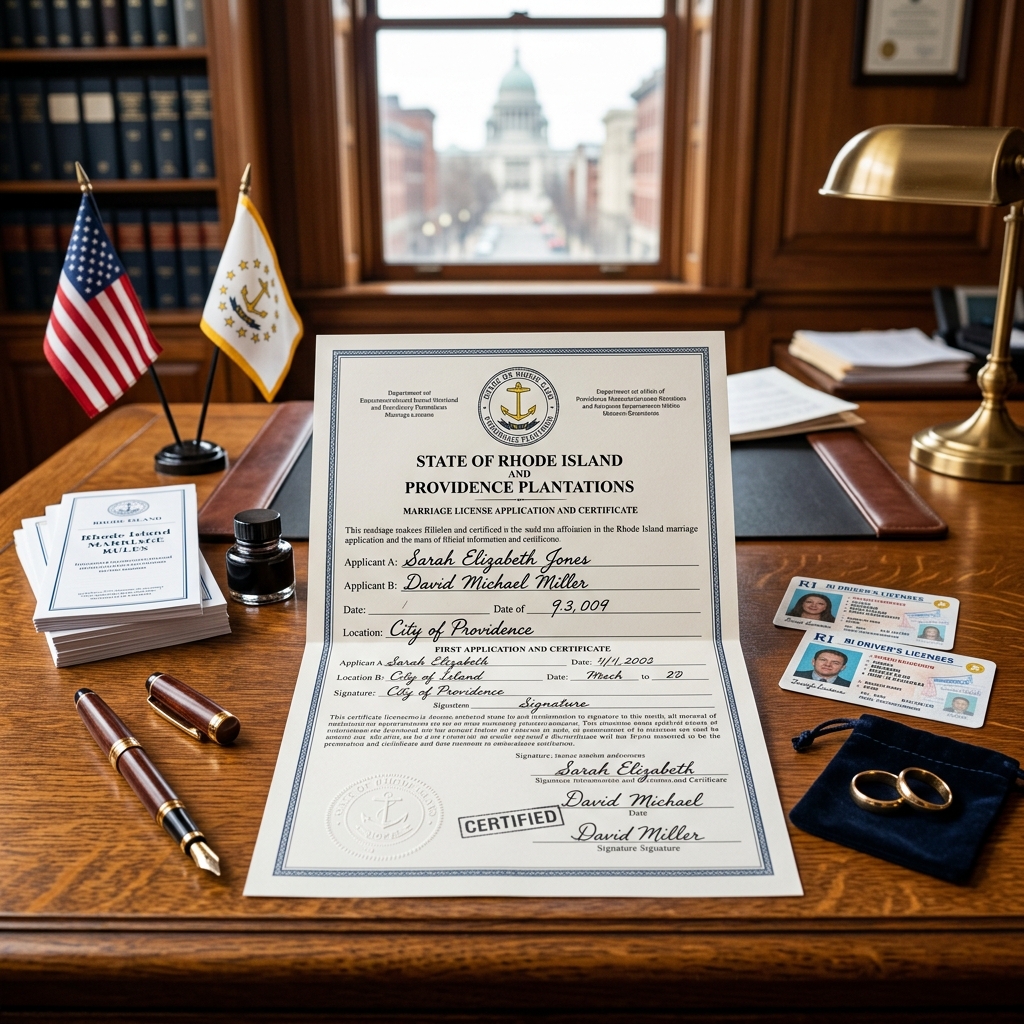
If you are planning to marry in Rhode Island, the state’s licensing process is straightforward, but it still depends on where you live and where the ceremony will take place. Couples generally need to appear in person, prove identity and birth facts, and show certified records if either person was previously married or in another legally recognized relationship.
Rhode Island does not require a waiting period or blood test before a marriage license is issued, and same-sex marriage is legal statewide. The practical issue for most couples is not whether they qualify to marry, but which clerk’s office should handle the license and which documents that office will accept.
Where a Couple Must Apply
The correct office depends on residency. If both people live in Rhode Island, they apply in the city or town hall where either person lives. If only one applicant lives in the state, the couple applies where the Rhode Island resident lives. If neither applicant lives in Rhode Island, the license is obtained from the city or town where the ceremony will happen.
This location rule matters because a Rhode Island marriage license is generally tied to the issuing municipality. Couples should not assume they can apply in any town hall simply because the state is small or the wedding venue is nearby.
Who Must Appear in Person
Rhode Island offices commonly require both applicants to appear together and sign the application in front of the clerk or an authorized assistant. The process is designed to verify the identities of both people and confirm that the information on the form is accurate.
In practice, this means a friend, relative, or wedding planner cannot usually complete the filing for the couple. Many city and town offices also handle applications on a first-come, first-served basis or by appointment, so checking local office hours in advance can prevent delays.
Basic Documents Most Offices Expect
Although individual towns may ask for slightly different supporting records, the state guidance is consistent on the core items. Both people must provide photo identification and proof of birth facts, which is often satisfied by a certified birth certificate.
- Government-issued photo identification for each applicant.
- Proof of birth facts, usually a certified birth certificate.
- Certified divorce, dissolution, or death records if a previous marriage or civil union ended.
- Additional proof of residency if the local office requests it.
Some towns are very specific about what counts as acceptable proof. For example, certain local offices require a long-form birth certificate that lists parental information and reject hospital records, wallet copies, and short-form abstracts. Because local practice can vary, applicants should read the instructions for the exact clerk’s office where they will apply.
What Counts as Proof of Prior Marital Status
If either applicant was previously married, civilly united, or in another formal legal relationship, the prior relationship must be shown to have ended before a new license is issued. That proof usually comes in the form of a certified final divorce decree, dissolution record, or death certificate.
The key word is certified. Offices commonly require an official copy with a raised seal or other authentication, not a plain photocopy. If the prior relationship ended in death, the clerk may require a certified death certificate for the former spouse or partner.
Age and Capacity Issues
Rhode Island’s marriage requirements can become more detailed when an applicant is under 18 or under legal guardianship. State pamphlet guidance indicates that a permit may be needed if either applicant is 16 or 17, and applicants under 16 cannot obtain a license without Family Court approval.
For adults, the main question is usually whether both people are legally free to marry and can produce the records the clerk requests. For younger applicants, court and parental involvement may become part of the process, making it important to confirm eligibility before scheduling the ceremony.
Blood Tests and Waiting Periods
Rhode Island no longer requires blood tests for marriage licenses, and the state also does not impose a waiting period. That means a qualified couple can often complete the license process without medical testing and without waiting several days after filing.
This does not mean the process is instant in every town. Offices still need time to review documents, and some may have limited appointment availability or specific business hours. But from a state-law standpoint, blood testing is not part of the current marriage-license process.
| Issue | Rhode Island Rule |
|---|---|
| Blood test | Not required |
| Waiting period | Not required |
| In-person appearance | Usually required for both applicants |
| Certified birth record | Commonly required |
| Prior divorce or death record | Required if a previous relationship ended |
Fees, Validity, and Local Office Differences
Rhode Island’s marriage-license fee is commonly listed as $24 by local offices, though applicants should confirm the current amount with the issuing clerk because procedures can change. Some municipalities may accept only cash, while others may allow other forms of payment or charge processing fees.
Local offices also differ on practical details such as whether appointments are required, which identification they prefer, and whether proof of current address is necessary. For example, some cities request proof of residency along with photo ID, while others focus more heavily on birth certificates and certified relationship records.
Couples should also ask how long the license remains valid and whether the ceremony must occur within the issuing municipality’s rules. Several city and town offices note that the license is valid for a limited period, often three months, but the exact handling should always be confirmed locally.
How to Prepare Before Visiting the Clerk
A careful checklist can reduce the chance of a rejected application. The most common delays come from missing certified records, incomplete identification, or arriving at the wrong office.
- Confirm the correct city or town clerk based on where you live or where the ceremony will be held.
- Bring both applicants together unless the local office specifically says otherwise.
- Gather certified birth certificates and a government-issued photo ID for each person.
- Collect certified divorce decrees, dissolution records, or death certificates if either person was previously married or in a civil union.
- Check office hours, appointment policies, and payment rules before going in person.
Applicants born outside the United States may also need translated documents or additional authentication, depending on the local office’s standards. Because those requests can vary, international applicants should contact the clerk in advance and avoid assuming a foreign record will be accepted without explanation or translation.
Common Mistakes Couples Should Avoid
One common mistake is bringing a standard photocopy of a birth certificate instead of a certified record. Another is assuming a divorce judgment is enough without a certified final decree. A third is applying at the wrong town hall because the couple misread the residency rule.
Couples also sometimes overlook the fact that offices may not accept the same documents. A passport might work as photo identification, but a town may still want a birth certificate with parental information. Reading the local instructions before visiting can save a second trip.
Frequently Asked Questions
Do Rhode Island couples need a blood test to marry?
No. Rhode Island does not require blood tests for a marriage license.
Is there a waiting period after applying?
No state waiting period is required, although the clerk still has to review the application and documents.
Can two out-of-state residents marry in Rhode Island?
Yes. If neither person lives in Rhode Island, the license is generally obtained where the ceremony will be performed.
What if one person was divorced before?
The clerk will usually require a certified final divorce decree or other certified proof that the prior marriage or legal relationship ended.
Can a birth certificate copy be used?
Many offices require a certified copy, and some explicitly reject photocopies, hospital records, or short-form abstracts.
Why Local Verification Still Matters
Even though the state rules are clear on the biggest issues, local clerks still control the intake process, document review, and office procedures. That is why two Rhode Island towns may describe the same marriage-license requirement in slightly different ways while still following the same underlying law.
For couples, the safest approach is simple: identify the right clerk, bring certified records, and verify the office’s current instructions before showing up. Doing that reduces the risk of delay and helps the couple move from paperwork to ceremony with fewer surprises.
References
- Marriage Licenses – Rhode Island Department of Health — Rhode Island Department of Health. 2026-07-10. https://health.ri.gov/vital-records/marriage-licenses
- General Marriage Requirements in the State of Rhode Island — City of Richmond, Rhode Island. 2026-07-10. https://www.richmondri.gov/DocumentCenter/View/220/Marriage-Requirements-Pamphlet-PDF?bidId=
- Marriage License in Providence — City of Providence. 2026-07-10. https://www.providenceri.gov/vital-statistics/requirements-marriage-license/
- Marriage Licenses — Town of Westerly. 2026-07-10. https://westerlyri.gov/401/Marriage-Licenses
- Marriage License — Town of Bristol. 2026-07-10. https://www.bristolri.gov/218/Marriage-License
- Marriage Licenses — City of Newport. 2026-07-10. https://www.newportri.gov/living-in-newport/city-hall/marriage-licences
- Marriage Licenses | Portsmouth, RI — Town of Portsmouth. 2026-07-10. https://www.portsmouthri.gov/161/Marriage-Licenses
Similar Articles








Read full bio of medha deb


