
Retaliatory Arrests and Your First Amendment Rights
How the First Amendment shields you from retaliatory arrests by officials.
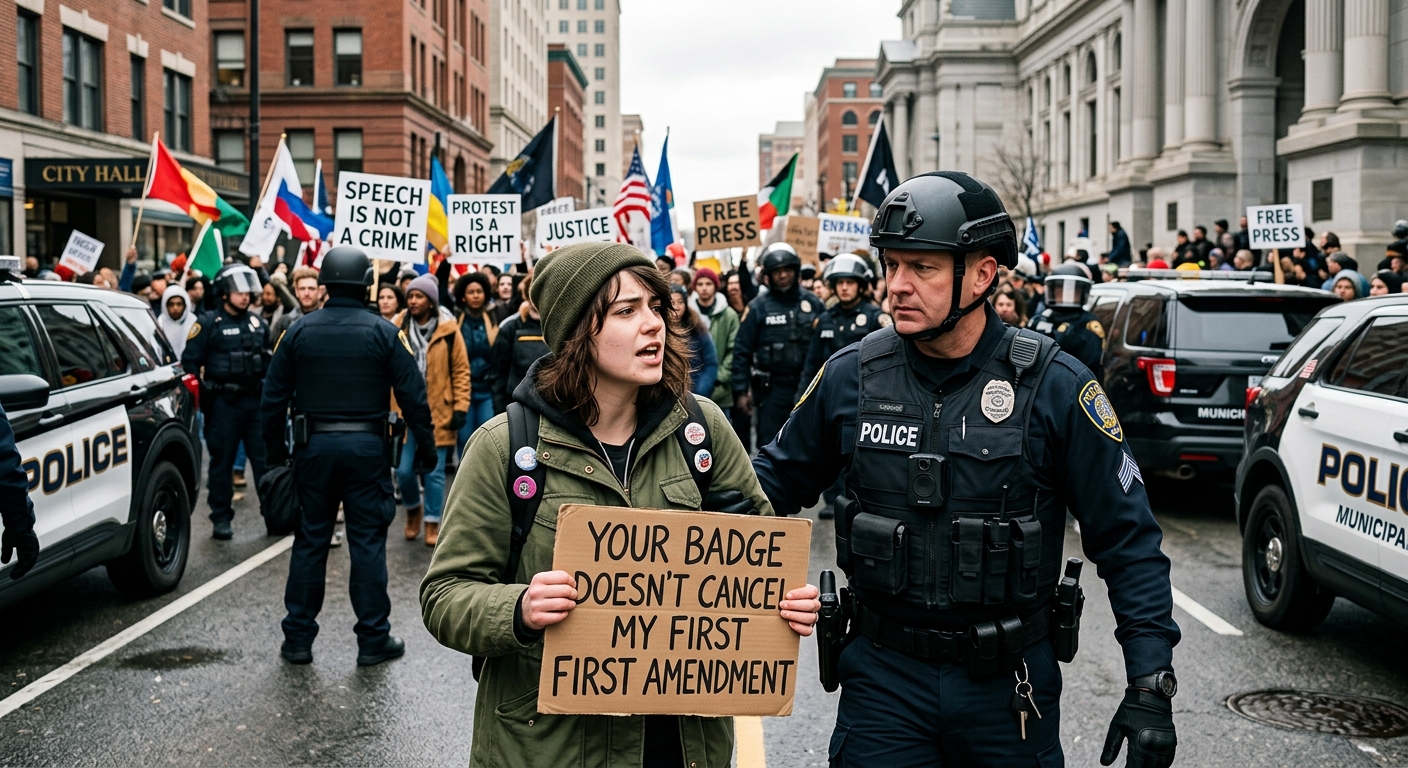
In any functioning democratic society, the ability of citizens to openly criticize their government without fear of reprisal is not merely a privilege is a fundamental right. The First Amendment of the United States Constitution is designed specifically to protect this dynamic, ensuring that power remains in the hands of the people and that those elected or appointed to public office are held accountable. However, a troubling pattern has emerged in municipalities across the country: the use of retaliatory arrests to silence political opponents, whistleblowers, and vocal community members.
A retaliatory arrest occurs when law enforcement officers, often acting at the behest of disgruntled local officials, arrest an individual not because they pose a genuine threat to public safety, but to punish them for exercising their constitutional right to free expression. By weaponizing the criminal justice system against critics, public officials cross a dangerous line, transforming law enforcement into a tool of political intimidation.
Understanding the legal boundaries of free speech, the right to petition the government, and the complex legal frameworks surrounding retaliatory arrests is essential for every citizen. The legal battles fought at the highest levels of the judiciary reveal how hard-won these protections are, and why they must be vigorously defended against overreach.
The Constitutional Right to Criticize Power
At the heart of the American constitutional framework is the First Amendment, which unequivocally states that Congress shall make no law abridging the freedom of speech, or of the press, or the right of the people peaceably to assemble, and to petition the government for a redress of grievances. While many citizens are familiar with the concept of free speech, the “Petition Clause” is equally critical when discussing interactions with local government officials.
The right to petition the government permits individuals to communicate directly with their representatives, demanding changes in policy, calling for investigations, or even organizing campaigns to remove ineffective leaders from office. This historical protection ensures a level of direct participation in the democratic process that goes beyond simply casting a ballot on election day. Whether it involves submitting a formal document, speaking during the public comment period of a city council meeting, or gathering signatures on a sidewalk, petitioning is a protected civic duty.
Unfortunately, public officials do not always welcome criticism. When municipal leaders feel threatened by petitions or public dissent, the friction between a citizens right to complain and an officials authority can spark profound legal conflicts. Under the First Amendment, the government is strictly prohibited from taking adverse, retaliatory actions such as initiating criminal prosecutions or authorizing arrests solely because an individual spoke out against them.
Weaponizing Obscure Laws Against Citizens
One of the most insidious tactics used to circumvent First Amendment protections is the selective enforcement of obscure or rarely utilized laws. The reality of modern legal codes is that they are incredibly dense, filled with thousands of minor infractions, regulatory violations, and vaguely worded statutes. It is often said that almost anyone can be found guilty of a minor violation if followed closely enough for a sufficient period of time.
In cases of retaliatory arrests, authorities often exploit these obscure statutes to manufacture a pretext for an arrest. For example, a political critic organizing a protest might be cited for minor traffic infractions, jaywalking, or “disorderly conduct.” An activist who momentarily misplaces a document might be charged with “tampering with government records.” In these scenarios, the underlying crime is usually a hyper-technical violation that police officers would typically ignore in the course of their daily duties.
This tactic provides a thin veneer of legality to an inherently corrupt action. The official can point to the statute and claim they are simply enforcing the law, completely ignoring the retaliatory motive behind the enforcement. This selective enforcement creates a massive hurdle for citizens seeking to hold officials accountable, as courts have historically struggled to balance the objective presence of a legal violation against the subjective, retaliatory motive of the arresting officer.
Understanding the Legal Shield: Probable Cause and Retaliation
Navigating the legal aftermath of a retaliatory arrest requires confronting a significant legal doctrine: the concept of probable cause and its intersection with civil rights claims. When a citizen attempts to sue the government for a retaliatory arrest under federal civil rights laws, they must navigate complex Supreme Court precedents that define exactly what constitutes a valid legal claim.
For decades, legal scholars debated whether the existence of probable cause for an arrest should automatically defeat a plaintiff’s claim of First Amendment retaliation. In the landmark 2019 decision Nieves v. Bartlett, the United States Supreme Court provided a definitive, albeit controversial, answer. The Court ruled that, in the vast majority of cases, if law enforcement had probable cause to make an arrestmeaning there was objective evidence that a crime, no matter how minor, had been committedthe retaliatory arrest claim would be dismissed.
The rationale behind the Nieves ruling was largely protective of law enforcement. The Court worried that without a strict probable cause standard, officers would face endless frivolous lawsuits requiring them to defend their subjective state of mind during split-second arrest decisions. However, the Court recognized the inherent danger of this ruling: it could theoretically give police free rein to arrest vocal critics for extremely minor offenses.
To mitigate this risk, the Supreme Court carved out a “narrow exception.” The probable cause bar does not apply if the plaintiff can present objective evidence showing that they were arrested when otherwise similarly situated individuals, who did not engage in protected speech, were left alone. This exception was designed to protect citizens from the exact scenario where obscure laws are weaponized exclusively against political opponents.
Recent Supreme Court Victories for Free Speech
The practical application of the Nieves exception became the focal point of a major Supreme Court showdown in 2024, in the case of Gonzalez v. Trevino. The case centered on a dramatic conflict in a small Texas town, serving as a textbook example of how local politics can devolve into weaponized legal action.
In this case, an elderly city councilwoman spearheaded a petition to remove a local city manager. Following a contentious city council meeting, the councilwoman accidentally gathered the citizen petition into her personal binder. Shortly afterward, local authorities aligned with her political rivals arrested her, charging her under a severe and obscure state law meant to prosecute those who fraudulently tamper with official government records. She spent time in jail and faced significant public humiliation.
When she filed a lawsuit alleging a retaliatory arrest, the lower appellate courts threw out her case. They applied a painfully strict interpretation of the Nieves exception, demanding that she provide perfectly identical “comparator evidence”meaning she had to find examples of other people who had specifically accidentally placed government petitions in their personal binders but were not arrested. Because she could not produce such impossibly specific examples, her case was dismissed.
The Supreme Court, however, intervened and reversed this overly rigid interpretation. In a crucial victory for First Amendment advocates, the Court ruled that plaintiffs do not need to provide virtually identical examples of unarrested individuals. Instead, broader objective evidencesuch as county data proving that this severe tampering statute had never been used in similar non-fraudulent, accidental contextsis sufficient to keep a retaliatory arrest claim alive. This ruling breathed new life into the protections for political critics, ensuring that the government cannot hide behind ultra-specific evidentiary demands when punishing dissent.
The Chilling Effect on Civic Engagement
The importance of these legal protections extends far beyond the individuals directly involved in high-profile lawsuits. When public officials are permitted to use the police as a personal enforcement squad against their detractors, it generates a profound “chilling effect” across the entire community.
A chilling effect occurs when citizens preemptively self-censor or withdraw from civic participation because they fear unjust repercussions. If a community witnesses a local grandmother being hauled off to jail simply because she circulated a petition, the message sent to the rest of the populace is loud and clear: stay quiet, or you will be next. This fear deters individuals from speaking at town halls, organizing grassroots movements, submitting public records requests, or running for local office.
Democracy relies on the free flow of ideas, including harsh criticism of those in power. Protecting the right to complain about public officials is not just about defending the specific speech in question; it is about preserving the structural integrity of local democratic institutions. Without robust protections against retaliatory arrests, local governments can easily slip into authoritarian fiefdoms where dissent is practically outlawed.
Key Distinctions: Protected Speech vs. Legal Violations
Understanding where the First Amendment ends and legitimate law enforcement begins can be complex. The table below outlines scenarios that highlight the difference between a valid exercise of free speech and actions that cross into retaliatory arrests.
| Scenario | Typical Law Enforcement Action | Retaliatory Red Flag (Potential Violation) |
|---|---|---|
| Speaking loudly and critically during a city council meeting. | Allowing the speaker to finish their time peacefully. | Arresting the speaker for “disorderly conduct” based on tone. |
| Accidentally holding onto a public document briefly. | Asking the citizen to return the document to the clerk. | Deploying officers to arrest the individual for “felony tampering.” |
| Jaywalking while carrying a protest sign against local officials. | Ignoring the minor infraction, as is customary for pedestrians. | Singling out the protester and making a formal custodial arrest. |
Frequently Asked Questions (FAQs)
What exactly is a retaliatory arrest?
A retaliatory arrest happens when a law enforcement officer or public official directs the arrest of an individual as a punishment for exercising their First Amendment rights, such as criticizing the government, protesting, or petitioning. Even if the person committed a minor infraction, the arrest is deemed retaliatory if the true motivation was to silence their protected speech.
Does the First Amendment protect all forms of criticism against the government?
The First Amendment provides incredibly broad protections for speech, especially political speech and criticism of public officials. However, it does not protect “true threats” of violence, incitement to imminent lawless action, or severe defamation. As long as the criticism is peaceful and non-threatening, it is strictly protected under the Constitution.
What is the “probable cause” exception in these civil rights cases?
In general, if police have probable cause to believe you committed a crime (like a minor traffic violation), a lawsuit claiming the arrest was retaliatory will likely fail under the standard set by Nieves v. Bartlett. However, there is an exception: if you can prove objectively that police rarely or never arrest other people for that same minor infraction unless they are engaged in protected speech, your lawsuit can proceed.
What is the right to petition the government?
The Petition Clause of the First Amendment guarantees your right to make requests to the government without punishment. This includes gathering signatures for a ballot initiative, demanding the resignation of an official, filing lawsuits, and submitting complaints to government agencies. It is a fundamental mechanism for holding leaders accountable between election cycles and ensuring the government serves the people.
References
- 22-1025 Gonzalez v. Trevino (06/20/2024)
- First Amendment
- Amdt1.7.2.5 Retaliatory Prosecution and Arrest
- Gonzalez v. Trevino | Supreme Court Bulletin
Similar Articles








Read full bio of Sneha Tete


