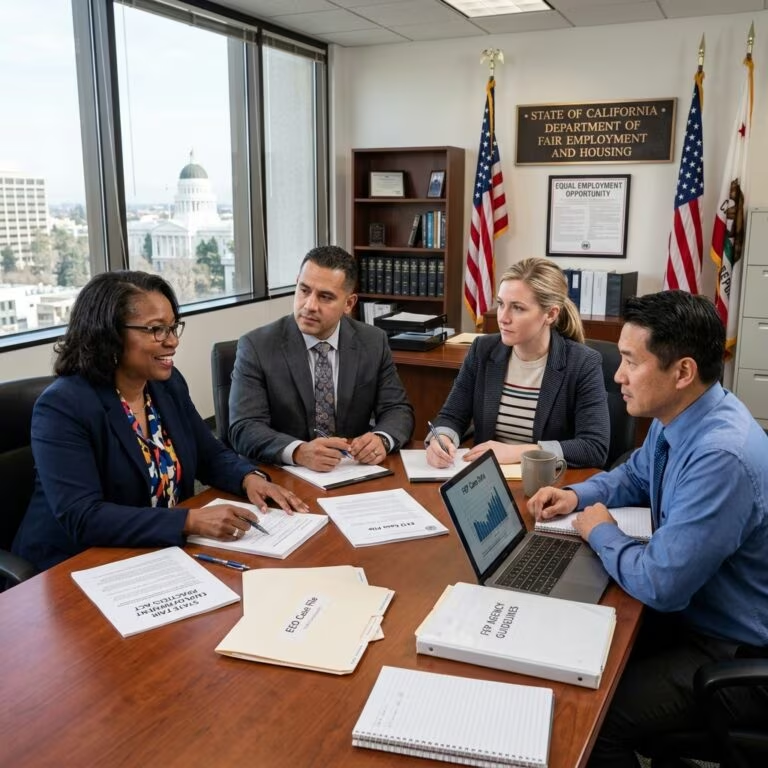
Workplace harassment and discrimination complaints are more than internal HR issues. They raise legal obligations under federal and state civil-rights laws and directly affect morale, retention, and organizational reputation.[10] When employers respond promptly, fairly, and consistently, they not only reduce liability but also reinforce a culture of respect and trust.
This guide walks employers, managers, and HR professionals through a structured, practical approach to receiving, investigating, and resolving harassment and discrimination complaints. It focuses on clear processes, employee protection, legal risk reduction, and long-term prevention.
1. Why a Structured Complaint Process Matters
Anti-discrimination and anti-harassment laws, such as Title VII of the Civil Rights Act, require employers to take reasonable steps to prevent and promptly correct unlawful conduct.[10] A well-designed response protocol demonstrates that the organization takes these obligations seriously and can significantly affect liability if a claim reaches the Equal Employment Opportunity Commission (EEOC) or a court.
- Legal compliance: Prompt and thorough responses to complaints are a key factor in EEOC evaluations and in many court decisions assessing employer liability.[10]
- Workplace safety: Employees who feel unsafe or unprotected are less likely to report problems early, allowing issues to escalate and spread.
- Culture and retention: Mishandled complaints often lead to turnover, reputational harm, and reduced engagement.
Even a single allegation should be treated as an opportunity to identify risks and improve workplace culture, regardless of whether legal violations are ultimately found.
2. Core Principles for Handling Complaints
Before focusing on step-by-step procedures, it is essential to anchor your process in a set of guiding principles that apply to all harassment and discrimination complaints:
- Promptness: Act quickly after learning of a complaint; delays can appear negligent and may allow misconduct to continue.
- Impartiality: Ensure that those handling the matter do not have a conflict of interest and are trained in investigations.
- Confidentiality: Share details only with those who need to know in order to investigate and respond appropriately.
- Protection from retaliation: Clearly prohibit adverse treatment of anyone reporting or participating in the investigation, and monitor for retaliation.
- Consistency: Apply the same process, standards, and potential corrective actions across similar cases to avoid perceptions of bias.
- Documentation: Keep fact-based, detailed records of every major decision and step in the process.
3. Building an Accessible Reporting System
An effective response starts with an accessible and clearly communicated reporting structure. Employees cannot use a process they do not understand or trust.
3.1 Clear Policy Language
Written policies should define prohibited harassment and discrimination in plain, understandable terms and reference protected characteristics covered by law, such as race, sex, religion, disability, and age.[10] Policies should explicitly state that:
- Harassment and discrimination are prohibited in any work-related context, including remote communications and work-related events.
- Employees are encouraged, and in many cases required, to report suspected misconduct.
- Retaliation for reporting or participating in an investigation is strictly prohibited.
3.2 Multiple Reporting Channels
Relying on a single contact (for example, a direct supervisor) can be problematic if that person is the alleged harasser or perceived as unsupportive. Best practice is to offer multiple avenues for reporting, such as:
- Human resources or people operations representatives
- A designated ethics or compliance hotline
- Alternative managers or department heads
- An online or anonymous reporting tool, where legally and practically feasible
Providing options helps alleviate fears of retaliation and increases the likelihood that employees will report incidents early.
3.3 Employee Education and Training
Complaints are more likely to be reported appropriately when employees and managers understand both the behavior that must be reported and the mechanics of the reporting process. Regular training should:
- Explain what constitutes harassment and discrimination under organizational policy and relevant law.[10]
- Describe how to make a complaint, including informal and formal options.
- Reinforce confidentiality and anti-retaliation protections.
- Encourage bystanders to report or support colleagues who report misconduct.
4. First Response: Receiving a Complaint
The first minutes and days after a complaint is raised set the tone for the entire process. Managers and HR staff should be trained to respond calmly, respectfully, and systematically.
4.1 Take Every Complaint Seriously
Whether the report is verbal, written, anonymous, or informal, it should be treated as credible and worthy of assessment. The initial responder should:
- Listen without interrupting or arguing.
- Avoid making promises about specific outcomes.
- Thank the employee for coming forward and acknowledge that reporting can be difficult.
- Explain the next steps in general terms (e.g., that the concern will be evaluated and, where appropriate, investigated).
4.2 Gather Basic Information at Intake
Initial intake is not a full investigation but should capture enough information to decide what kind of response is required. Key questions often include:
- Who was involved in the incident(s)?
- What happened, and what words or actions were used?
- When and where did the incidents occur?
- Were there any witnesses or documents (emails, messages, recordings)?
- Has this behavior happened before, and was it reported previously?
- What impact has the conduct had on the complainant (work, health, safety) and what immediate needs do they have?
If the complaint is made orally, it should be written down, reviewed with the complainant, and corrected as needed before being finalized for the file.
4.3 Evaluate Immediate Safety and Interim Measures
After a complaint is received, organizations must decide whether temporary steps are necessary to protect the complainant or the workplace while the investigation proceeds. Options include:
- Adjusting reporting lines or schedules
- Separating the complainant and the accused employee
- Temporarily reassigning one or both parties
- Placing one party on paid administrative leave, where appropriate and consistent with policy
These measures should be as minimally disruptive as possible and should not penalize the person who reported the concern.
5. Conducting a Fair and Thorough Investigation
A well-executed investigation is fundamental to resolving complaints fairly and protecting the organization from claims that it ignored or mishandled alleged misconduct.
5.1 Choosing the Investigator
The investigator should be neutral, trained, and perceived as credible by the parties. Depending on the situation, the role may be filled by:
- HR professionals with specific investigation training
- In-house legal counsel (with attention to privilege considerations)
- An outside attorney or specialized investigator, particularly where senior leaders are involved or internal neutrality is in doubt
Organizations should avoid assigning direct supervisors or individuals with personal ties to the parties whenever possible.
5.2 Planning the Investigation
Before interviews begin, the investigator should prepare a plan addressing:
- The specific allegations to be examined
- Relevant policies and legal standards
- Which witnesses must be interviewed and in what order
- What documents, communications, or physical evidence may exist
- Reasonable timelines for key steps, recognizing the need for promptness
The plan should remain flexible, as new information may require additional interviews or evidence collection.
5.3 Interviewing the Complainant
Early in the investigation, the complainant should be interviewed in greater depth than at intake. Effective interviews:
- Review the allegations and clarify key details.
- Ask open-ended questions to avoid suggesting answers.
- Explore whether there were previous incidents or patterns of behavior.
- Identify witnesses and any additional evidence.
- Reiterate anti-retaliation protections and how to report any retaliatory conduct.
5.4 Interviewing the Accused Employee
The person accused of misconduct must have an opportunity to respond to the allegations before any findings are made. During this interview, the investigator should:
- Explain the general nature of the complaint without revealing unnecessary details.
- Present the specific allegations and allow the accused to respond fully.
- Request any supporting evidence or witness names the accused wishes to provide.
- Remind the accused of the prohibition on retaliation against the complainant or witnesses.
5.5 Interviewing Witnesses and Reviewing Evidence
Witnesses often provide context and corroboration. They should be informed that:
- They are being interviewed as part of a confidential investigation.
- They should answer truthfully and completely.
- Retaliation for participating is prohibited and should be reported.
Concurrently, the investigator should seek out relevant documents and records, such as:
- Emails, messages, or other communications
- Personnel files or performance evaluations
- Attendance records or security logs
- Prior complaints involving similar conduct or individuals (if allowed by policy and law)
5.6 Assessing Credibility and Making Findings
After collecting information, the investigator must decide whether the evidence shows that policy or law was violated. This typically involves:
- Comparing competing accounts against documents, witness statements, and patterns.
- Weighing the consistency and plausibility of each account.
- Documenting the reasoning behind credibility determinations and conclusions.
The standard used in most workplace investigations is a “preponderance of the evidence”—that is, whether it is more likely than not that the alleged conduct occurred.
6. Documentation: Creating a Reliable Record
Detailed and contemporaneous documentation is essential. It provides a record for internal decision-making and for demonstrating to agencies like the EEOC that the organization responded appropriately.
6.1 What to Document
At minimum, the file should include:
- Initial complaint details and intake notes
- Written summaries or transcripts of all interviews
- Copies of relevant documents, communications, and records
- Notes on interim protective measures and the reasons for them
- Investigation findings and the rationale for credibility assessments
- Chosen corrective actions and any follow-up steps
Records should be factual and avoid speculation. Where allegations cannot be substantiated, the file should state that clearly.
6.2 Storage and Confidentiality
Investigation records and complaint files should be stored securely, often separate from standard personnel files, with access limited to those who need it for legitimate business or legal reasons. Employers should also comply with any applicable record-retention requirements under federal or state law.
7. Taking Action: Remedies and Discipline
If the investigation concludes that harassment or discrimination occurred, the organization must act promptly to stop the behavior and prevent its recurrence.
7.1 Range of Corrective Measures
Appropriate responses depend on the severity, frequency, and impact of the conduct, as well as the accused employee’s history and role. Options include:
- Verbal or written warnings
- Mandatory training or coaching
- Reassignment or transfer
- Demotion or pay reduction
- “Last chance” agreements
- Termination of employment in serious or repeated cases
Organizations should strive for proportionality and align actions with how similar cases have been handled in the past to avoid claims of unfair treatment.
7.2 Communicating Outcomes
Both the complainant and the accused should be informed when the investigation is complete and receive an appropriate summary of the outcome. While privacy considerations limit what can be shared, communications should generally:
- Confirm that the investigation is concluded.
- State whether the complaint was substantiated in whole or in part.
- Assure the complainant that appropriate steps are being taken to address the situation.
- Remind both parties of anti-retaliation expectations and how to report any concerns.
8. Preventing Retaliation and Monitoring After Resolution
Retaliation is one of the most frequently cited issues in discrimination charges filed with the EEOC.[10] Even when an employer handles the initial complaint well, mishandled follow-through can create new liability.
8.1 Clear Anti-Retaliation Messaging
At multiple points in the process, including intake, interviews, and outcome communications, the organization should clearly emphasize that:
- Retaliation against complainants, witnesses, or others who assist in the process is prohibited by policy and law.
- Retaliation includes subtle behaviors such as exclusion, undesirable assignments, or unjustified negative feedback.
- Any suspected retaliation should be reported immediately and will be investigated.
8.2 Post-Resolution Check-Ins
After corrective actions are implemented, HR or management should periodically check in with the complainant and, where appropriate, others in the work group to ensure:
- The offending behavior has stopped.
- No new issues or retaliation have emerged.
- Work relationships remain functional enough for operations.
These follow-up steps signal ongoing commitment and may reveal cultural issues that were not fully addressed by the initial response.
9. Using Complaints to Improve Culture and Compliance
Every complaint—substantiated or not—provides valuable data about workplace dynamics. Employers can use these insights to refine policies, strengthen training, and address systemic issues.
9.1 Pattern and Trend Analysis
HR and leadership should regularly review complaint data (while protecting confidentiality) to identify patterns, such as:
- Repeated issues in a particular department or location
- Similar types of misconduct (e.g., offensive jokes, exclusion from opportunities)
- Breakdowns in reporting channels or supervisory responses
Identified trends can guide targeted interventions, such as focused training or changes in management practices.
9.2 Policy and Training Updates
Based on lessons learned from investigations, organizations should continuously improve:
- Policies: Clarify ambiguous definitions, expand examples, or add explicit references to new communication technologies.
- Training content: Use anonymized scenarios that reflect real issues that have arisen.
- Manager guidance: Provide leaders with scripts or checklists for responding to complaints and concerns.
9.3 When to Seek External Legal or Professional Help
Some allegations are complex or high-risk enough that an organization should involve external counsel or expert investigators. This is particularly important when:
- Senior leadership is implicated.
- There are multiple complainants or a long history of allegations.
- The organization lacks internal investigation expertise.
- A government agency (such as the EEOC or a state civil rights agency) is already involved.
| Aspect | Internal Investigator | External Investigator |
|---|---|---|
| Cost | Lower direct cost | Higher direct cost |
| Perceived neutrality | May be questioned in leadership or high-profile cases | Often perceived as more independent and impartial |
| Expertise | Depends on training and experience of HR or legal staff | Typically specializes in investigations and employment law |
| Speed | Faster to initiate if resources are available | May require scheduling and onboarding time |
10. Frequently Asked Questions (FAQs)
10.1 Do employers have to investigate every complaint?
Employers must assess every complaint and, where there is an allegation of potential policy or legal violation, conduct a timely and adequate investigation. Even anonymous or informal concerns cannot be ignored, though the scope of inquiry may vary depending on the details available.
10.2 How quickly should an investigation begin?
Investigations should begin as soon as reasonably possible after the employer learns of the complaint. Agencies and courts often view delays as evidence that the employer did not take the matter seriously, particularly if the alleged behavior continued during the delay.
10.3 Can an employer keep everything completely confidential?
While employers must safeguard confidentiality to the greatest extent possible, some sharing of information is necessary to investigate and respond appropriately. Employers should limit disclosure to individuals who need information to perform their roles in the process.
10.4 What if the investigation finds insufficient evidence?
If an investigation cannot substantiate a complaint, the employer should still document the steps taken and explain the outcome to the parties in a respectful way. It may still be appropriate to consider broader measures, such as refresher training or culture improvements, especially if concerns about the environment were raised.
10.5 When should an employee contact an outside agency?
Employees who believe they have experienced discrimination or harassment can file charges with the EEOC or similar state agencies, generally within defined deadlines that vary by jurisdiction. Employers should not obstruct this process and may wish to consult legal counsel if notified of an external charge.
References
- Harassment — U.S. Equal Employment Opportunity Commission. 2023-05-18. https://www.eeoc.gov/harassment
- Discrimination, harassment, and retaliation — USAGov (U.S. General Services Administration). 2024-02-01. https://www.usa.gov/job-discrimination-harassment
- Handling Harassment Complaints & Investigations — Vermont Commission on Women / Workplaces for All. 2022-09-15. https://workplacesforall.vermont.gov/employers/preventing-harassment/handling-harassment-complaints-investigations
- DFEH Workplace Harassment Guide — California Civil Rights Department. 2017-06-01. https://calcivilrights.ca.gov/wp-content/uploads/sites/32/2017/06/DFEH-Workplace-Harassment-Guide.pdf
- Harassment FAQs (Youth) — U.S. Equal Employment Opportunity Commission. 2023-04-10. https://www.eeoc.gov/youth/harassment-faqs