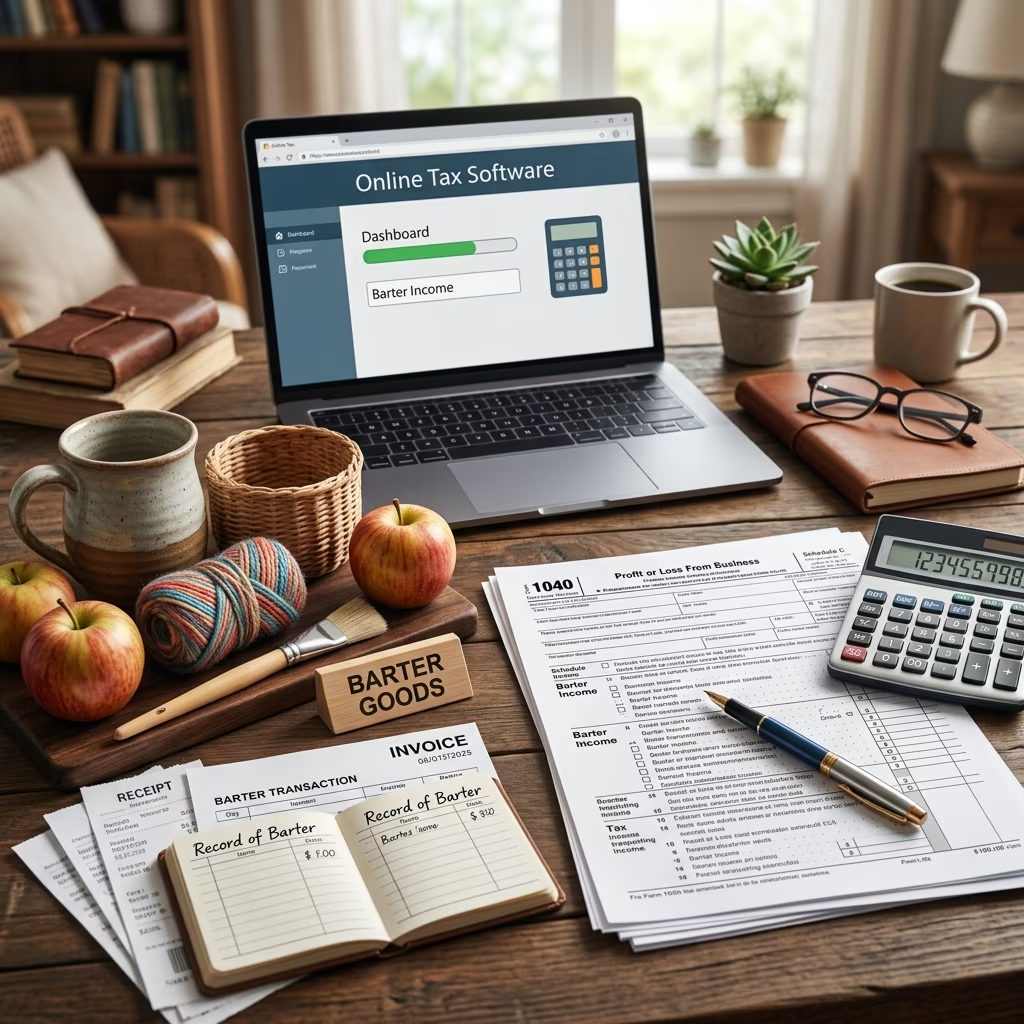
Bartering may feel like a simple, cash-free way to get what you need, but for tax purposes, the value of what you receive is usually treated as **taxable income**. The Internal Revenue Service (IRS) and many state tax agencies view barter transactions much like regular sales for income and, in some cases, employment and sales tax.
This guide explains when bartering creates taxable income, how to determine its value, which IRS forms you may need, and practical steps to keep your records and reporting accurate.
What Counts as Bartering for Tax Purposes?
Bartering is broadly defined as exchanging goods or services without using money as the medium of exchange. That can happen informally between two people or through organized networks.
- Direct trades between individuals: For example, you design a logo for a friend in exchange for landscaping work.
- Business-to-business exchanges: Two companies swap advertising space and professional services.
- Barter exchanges and clubs: Organized platforms or networks that use credits or “trade dollars” to record and facilitate multiple participants’ transactions.
In all of these cases, the IRS generally treats the fair market value of what you receive as income, regardless of whether any actual cash changes hands.
Why Barter Transactions Are Taxable
The IRS treats barter transactions as taxable because they are economically equivalent to receiving money and then spending it. If you would have had taxable income from a cash payment for the same work or goods, receiving non-cash compensation does not change the tax result.
According to IRS guidance, both parties in a barter must report the fair market value (FMV) of the products or services they receive as income on their tax return. In many states, barter transactions can also trigger state-level business and occupation or sales tax when goods or taxable services are exchanged.
Determining the Fair Market Value of Barter Income
Fair market value is generally the price at which a willing buyer and seller would agree to trade the property or services, with neither being under pressure to act. In barter situations, this is often the amount participants themselves assign to the exchange.
Practical methods to determine value
- Use your usual prices: If you customarily charge $500 for a website design, and you barter one design for $500 worth of accounting services, each party typically reports $500 of income.
- Refer to market rates: Where you do not have a standard price, look to comparable services or products in your local market.
- Written agreements: If the parties agree in writing on a value beforehand, tax authorities will generally accept that amount unless evidence suggests it is unrealistic.
Documenting how you reached the valuation is important. Keep copies of invoices, emails, or platform statements that show agreed values.
How Barter Income Is Reported on Federal Tax Returns
The way you report barter income depends on whether it relates to a trade or business, rental or farming activity, or is purely personal. The IRS treats barter income as taxable in the year the transaction occurs, or when barter credits are added to your account in an organized exchange.
Common reporting scenarios
| Type of Activity | Where Barter Income Is Reported | Notes |
|---|---|---|
| Business or self-employment | Form 1040, Schedule C (or business return) | Income is usually subject to income and self-employment tax. |
| Partnership, corporation, S corporation | Form 1065, 1120, or 1120-S | Report as part of gross income from operations. |
| Rental or royalty activity | Schedule E | Barter income connected to property rentals or royalties. |
| Farming activity | Schedule F | Value of goods or services received for farm products or labor. |
| Personal, non-business activity | Form 1040, “Other Income” line | Taxable even if you are not engaged in a trade or business. |
When barter income is connected to a business, you generally report it alongside your other business receipts, and you may also deduct expenses incurred in providing your side of the bargain, subject to normal rules.
Barter Exchanges and IRS Form 1099-B
If you use a formal barter exchange or club, the exchange often acts like a broker. It keeps records of your transactions and issues you an annual **Form 1099-B, Proceeds From Broker and Barter Exchange Transactions**, which is also sent to the IRS.
Key points about Form 1099-B
- Reporting obligation: Barter exchanges are required to report the value of transactions and provide 1099-B forms to participants, with copies filed with the IRS.
- What the form shows: The form lists the cash, property, services, and credits you received or that were credited to your account during the year.
- Where you report: Business barter income from 1099-B is typically entered on Schedule C or your applicable business return, while non-business barter income is reported as other income.
Failing to file required barter exchange reports, or ignoring 1099-B information, can result in IRS penalties. Federal law includes specific penalties for willful failure to file information returns with both the IRS and payees.
Tax Types That May Apply to Barter Income
Because barter income is treated as if you were paid in cash, you may owe several types of tax on it.
- Federal income tax: Barter income is included in your gross income and taxed under normal rules.
- Self-employment tax: If barter income arises from self-employment, you may owe self-employment tax on the net profit.
- Employment taxes: When employers compensate employees in-kind, payroll and withholding rules can apply.
- Excise or state business taxes: Certain transactions may carry specialized federal or state taxes.
- Sales or use tax: States may treat barter involving taxable goods or services as subject to sales or use tax.
Understanding both federal and state/local obligations is important, especially if you routinely use bartering in your business model.
Recordkeeping for Barter Transactions
Accurate records are critical for substantiating the amount of barter income you report and any deductions you claim. Poor documentation can lead to disputes over valuation and taxable amounts.
Essential records to keep
- Descriptions of traded items or services: Include what you provided and what you received.
- Date of the transaction: Barter income is taxable in the year the exchange occurs or credits are added.
- Agreed value: Document the fair market value assigned and how it was determined.
- Invoices and receipts: Keep normal business documents, even for non-cash deals.
- Statements from barter exchanges: Save annual summaries and Form 1099-B copies.
These records support your income reporting and help demonstrate that your valuations are reasonable if your return is reviewed.
Common Barter Scenarios and Their Tax Treatment
To understand how rules apply in practice, consider typical scenarios. Although each case has unique facts, the general treatment follows IRS guidance.
- Professional services swap: A graphic designer trades branding services with a lawyer for legal advice. Each reports the value of services received as income on their respective business returns and can potentially deduct costs related to their own services.
- Barter through an online exchange: A consultant joins a barter platform and earns credits redeemable for other services. The consultant must treat the value of credits as income when credited, not just when used, and receives Form 1099-B reflecting those amounts.
- Personal barter: A person trades household repairs for guitar lessons. Even though neither is running a formal business, each generally has taxable income equal to the value of what they received, reported as other income.
- Farm products for supplies: A farm provides produce to a supplier in exchange for fencing materials. The farmer reports the value of supplies received as farm income, while the supplier reports the value of produce received as business income.
These examples highlight that the absence of cash does not eliminate tax obligations; what matters is the economic value of what you gain.
Risks of Not Reporting Barter Income
Some taxpayers assume that barter transactions are informal and invisible to tax authorities. That assumption can be costly. Barter exchanges regularly send information returns to both participants and the IRS, and omissions can be flagged by matching systems.
Potential consequences
- Under-reporting penalties: Failing to report income can lead to accuracy-related penalties, interest, and additional tax due.
- Information return penalties: Businesses that are required to file information returns (such as 1099-B) but do not may face specific penalties, which can be higher when the failure is willful.
- Audit risk: Unreported barter income visible on third-party forms increases the chance of IRS scrutiny.
Consistent reporting of barter income in line with available documentation is the best way to reduce compliance risk.
Best Practices for Handling Barter Income
If bartering is part of your economic life, integrating tax considerations into every deal can make compliance easier.
- Discuss value upfront: Agree on realistic fair market values with the other party and put them in writing.
- Treat barter like cash: Record barter income and related expenses in your accounting system as you would any sale or purchase.
- Review forms from exchanges: When you receive Form 1099-B or similar statements, verify that amounts match your records before filing.
- Seek professional advice: Complex or frequent barter activity may warrant guidance from a tax professional familiar with these rules.
FAQs About Bartering and Taxes
Is all bartering taxable?
Most barter transactions are taxable because they result in you receiving something of value, similar to getting paid in cash. Both business and non-business barter can create income that needs to be reported. However, specific situations—such as small, occasional trades—may have nuances, so individual advice is prudent.
Do I have to report barter income if I didn’t get a Form 1099-B?
Yes. Your obligation to report income does not depend on receiving a form. If you receive goods, services, or barter credits with measurable value, you generally must include that amount in your income, whether or not a 1099-B or similar document is issued.
How does bartering affect my self-employment tax?
For self-employed individuals, barter income is treated as part of gross receipts from the business. After deducting allowable expenses, your net income is subject to self-employment tax in addition to income tax.
Can I deduct expenses related to barter transactions?
If the barter transaction is connected to your business, you may generally deduct ordinary and necessary business expenses incurred in providing your side of the exchange, subject to standard limitations. This can include materials, labor costs, and overhead.
Are barter transactions subject to state taxes?
Many states treat barter as taxable for business and occupation or sales tax when goods or taxable services are involved. For example, Washington state recognizes barter transactions as income for B&O and retail sales tax purposes. Check your state’s guidance or consult a local tax professional.
References
- Do I Have To Report Bartering Income on My Taxes? — Super Lawyers. 2023-08-10. https://www.superlawyers.com/resources/tax/personal-taxes/do-i-have-to-report-bartering-income-on-my-taxes/
- IRS Cautions: Bartering Transactions Are Taxable Transactions — Wolters Kluwer. 2023-03-01. https://www.wolterskluwer.com/en/expert-insights/irs-cautions-bartering-transactions-are-taxable-transactions
- IRS Tax Tip 2015-52: Bartering Income — Internal Revenue Service. 2015-08-18. https://content.govdelivery.com/accounts/USIRS/bulletins/fbbed9
- Bartering transactions are taxable — Washington Department of Revenue. 2022-06-01. https://dor.wa.gov/forms-publications/publications-subject/tax-topics/bartering-transactions-are-taxable
- Form 1099-B – Bartering Income — TaxAct Support. 2023-11-01. https://www.taxact.com/support/13933/form-1099-b-bartering-income
- Form 1099-B – Bartering Income — TaxSlayer Pro Support. 2023-10-01. https://support.taxslayerpro.com/hc/en-us/articles/360009301273-Form-1099-B-Bartering-Income
- Bartering is a taxable transaction even if no cash is exchanged — CPA Business Review. 2022-09-15. https://www.cpabr.com/alert-bartering-taxable-transaction