
Recording Police in Chicago: Law, Rights and Limits
How Illinois law, federal courts, and the First Amendment shape your right to record police officers in public spaces.
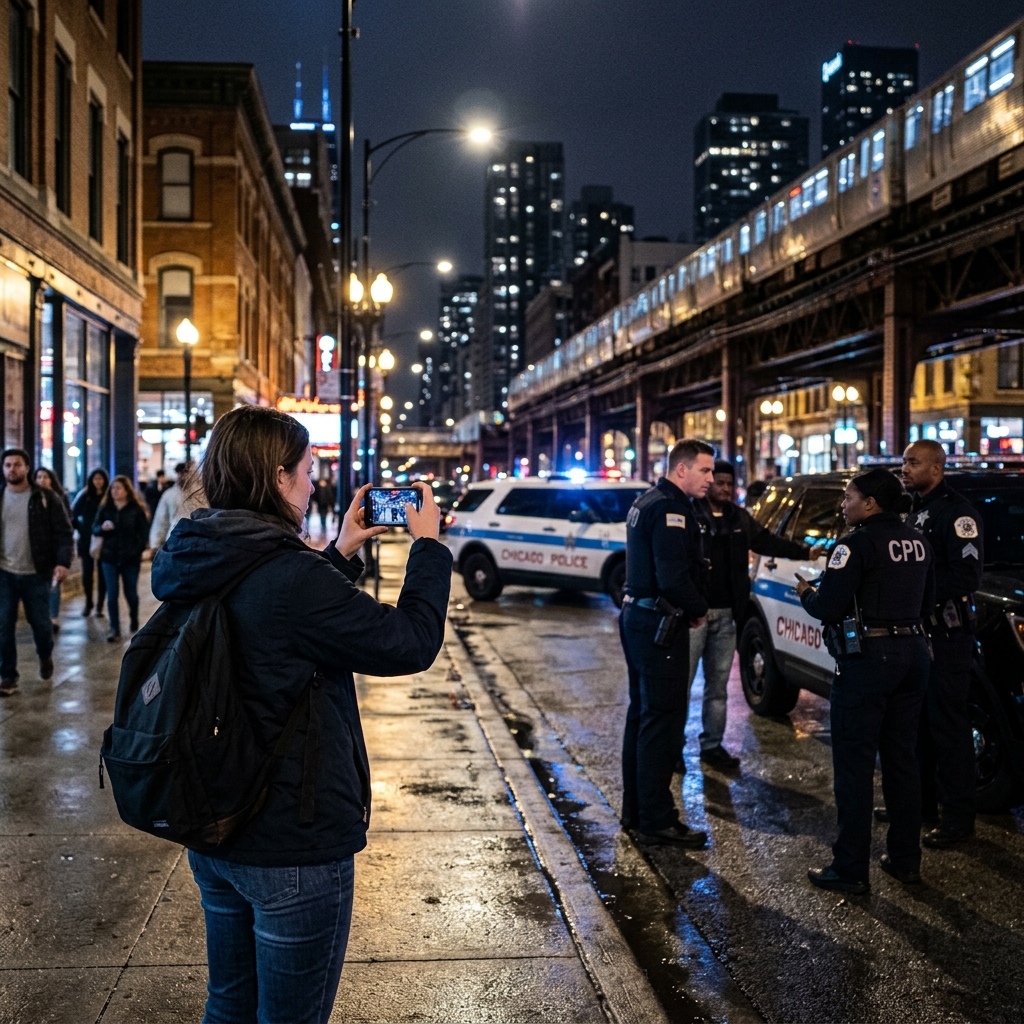
The question of whether you may legally record police officers in Chicago has been at the center of major constitutional litigation. Federal courts have recognized a strong First Amendment interest in documenting police activity, while Illinois has historically enforced strict eavesdropping rules that once criminalized many forms of audio recording. At the national level, the U.S. Supreme Court has repeatedly declined to resolve the issue in a broad, definitive ruling, leaving lower-court decisions in place.
This article explains how Illinois’ eavesdropping law evolved, what federal courts have said about the right to record police, and what practical rules now govern citizens using phones or cameras around law enforcement officers in Chicago.
From Strict Eavesdropping Rules to Constitutional Showdown
For years, Illinois had one of the most restrictive eavesdropping statutes in the United States. The law made it a crime to record a conversation without the consent of all parties whenever the conversation was considered “private,” and it treated audio recording as a felony in many circumstances. These rules were enforced even against people who attempted to record on-duty police officers in public places.
Several features of the earlier statute caused tension with constitutional rights:
- All-party consent requirement for audio recording of private conversations, regardless of whether the recorder was a participant.
- Broad definition of eavesdropping devices, covering almost any device capable of recording audio.
- Potential felony charges for recording certain conversations without consent, including interactions with law enforcement.
Civil liberties advocates argued that applying these rules to people who record police officers in public violated the First Amendment. Federal litigation followed, challenging Illinois’ enforcement against those who sought to document police interactions as part of transparency and accountability efforts.
ACLU v. Alvarez and the Right to Document Police
One pivotal case involved the American Civil Liberties Union of Illinois (ACLU), which wanted to record public interactions between Chicago-area police officers and civilians as part of a program monitoring police conduct. The ACLU asked federal courts to block prosecutions under the Illinois eavesdropping statute when its staff recorded police officers speaking at an audible volume in public spaces.
The U.S. Court of Appeals for the Seventh Circuit ruled in favor of the ACLU, concluding that enforcement of the statute in that context was likely unconstitutional. The court emphasized several points:
- Recording police officers performing official duties in public is closely tied to gathering information about government operations.
- The First Amendment protects not only pure speech, but also the creation of information needed for speech and press activity.
- Public officials generally have reduced expectations of privacy when acting in an official capacity in public places.
In parallel, other federal circuits recognized a similar right. The First Circuit, for example, held in Glik v. Cunniffe that recording police officials engaged in their public duties is a clearly established First Amendment right. Later cases have described a “commensurate right to record” police officers conducting official activity in public areas, linking it to the public’s right of access to information.
Supreme Court Declines to Revive Chicago’s Recording Limits
Despite the importance of the issue, the U.S. Supreme Court has repeatedly declined to issue a nationwide ruling on recording police officers. In a notable instance, the Court refused to hear a case challenging limits on taping police in public spaces, effectively leaving intact a lower-court decision that found such restrictions unconstitutional.
By denying review, the Supreme Court did not reject the lower court’s reasoning; it simply chose not to address the issue at that time. The practical consequences included:
- The lower-court ruling remained binding within its jurisdiction, protecting recording of police in public.
- No broad Supreme Court precedent was created, leaving the question to be shaped by circuit-level decisions.
- States, including Illinois, continued revising their statutes and enforcement practices in response to constitutional challenges.
As a result, people in Chicago now rely primarily on federal appellate decisions and revised state law, rather than a single nationwide Supreme Court rule, to understand their rights to record police.
Modern Illinois Eavesdropping Law: Key Concepts
Illinois has since updated its eavesdropping law, aligning it more closely with constitutional principles while still protecting privacy. The current framework focuses on two main questions in determining whether a recording is legal:
- Is the conversation “private”? A private conversation is one where at least one party has a reasonable expectation that it will remain confidential.
- Is the recording “surreptitious”? A recording is surreptitious if it is made by stealth, deception, or concealment.
Under this approach, Illinois generally criminalizes secret recording of private conversations without consent. But the law also includes explicit exemptions and recognizes that many conversations, particularly those occurring loudly in public, are not private.
Important implications for recording police include:
- If a police officer is speaking at an audible volume in a public space where there is no reasonable expectation of privacy, the conversation is typically not considered private.
- Openly recording such interactions is usually lawful, especially when done without stealth or deception.
- Surreptitious recording may still be treated differently, depending on whether the officer or others have a reasonable expectation of privacy.
When Recording Police in Illinois Is Generally Allowed
Drawing on court decisions and statutory exemptions, several scenarios commonly allow citizens to record police officers in Illinois lawfully:
- Public interactions on streets and sidewalks
Recording a traffic stop, pedestrian stop, or other interaction that takes place in plain view on a public street or sidewalk is generally permissible, as long as you are lawfully present and not interfering. - Police activity in parks and public meeting areas
Documenting crowd control, patrols, or other official duties in parks or publicly accessible municipal spaces typically falls within protected recording activity. - Open public meetings
Illinois law expressly allows recording meetings that must be open under the Open Meetings Act, subject to reasonable rules. - Emergency communications
Listening to or recording emergency communications made in the normal course of operations of law enforcement or other emergency service providers is specifically permitted.
In these situations, the combination of the First Amendment and Illinois law usually supports the right to record, provided that safety and privacy laws are respected.
Limits: Privacy, Interference, and Restricted Areas
Even though courts have recognized a substantial right to record police, that right is not unlimited. Both constitutional doctrine and state law impose boundaries to protect privacy and ensure that law enforcement can perform their duties.
| Limit | What It Means | Practical Example |
|---|---|---|
| Privacy expectations | Recordings of truly private conversations with a reasonable expectation of confidentiality may be illegal if made secretly without consent. | Secretly recording a quiet conversation between an officer and a witness in a closed office could violate eavesdropping law. |
| Interference with police work | Recording cannot materially obstruct or interfere with law enforcement activity. | Standing too close to an arrest scene or ignoring lawful safety instructions while filming may lead to lawful restrictions or arrest. |
| Unlawful presence | The right to record generally applies only when the recorder is lawfully present at the location. | Recording from a restricted area or private property where you are trespassing can be prohibited and subject to removal or arrest. |
| Surreptitious recording | Secret recording of private conversations remains regulated, even when a government employee is involved. | Hiding a device to capture private dialogue during a closed meeting may violate Illinois eavesdropping provisions. |
These limits reflect the balance courts seek between transparency and privacy. The right to record police is strong when officers act in public, but it does not override safety-based orders, restricted-access rules, or privacy protections for sensitive conversations.
Practical Guidelines for Recording Police in Chicago
People who want to record police in Chicago can reduce legal risk and enhance the usefulness of their recordings by following basic best practices drawn from legal guidance and civil rights resources.
- Stay lawfully present
Remain in areas where you are legally allowed, such as public sidewalks or parks. Avoid crossing police lines or entering restricted zones. - Keep a safe distance
Maintain enough space to avoid interfering with officers’ movements or operations. Courts and guidance recommend keeping back from active scenes and respecting physical barriers. - Record openly whenever possible
Holding your phone or camera visibly and announcing that you are recording can reduce claims of surreptitious recording and clarify your intent. - Follow lawful orders tied to safety
If officers issue clear, lawful instructions rooted in safety or legal restrictions, complying with those orders helps preserve both your safety and the legality of your recording. - Preserve evidence carefully
Store recordings securely and avoid altering them. In some contexts, police misconduct records must be preserved rather than destroyed, reflecting a broader commitment to transparency.[10]
While Illinois law and federal precedents generally support recording in public, each situation can involve unique facts. Consulting a qualified attorney is advisable if a recording leads to arrest, device seizure, or prosecution.
Frequently Asked Questions
Is it legal to record a Chicago police officer during a traffic stop?
In most cases, yes. Recording an officer conducting official duties during a traffic stop on a public street is generally protected, as long as you are not interfering and you remain lawfully present. You should keep a safe distance and obey reasonable safety-related instructions.
Can police ask me to stop recording?
Officers can request that you stop recording, but a request does not automatically make continued recording illegal. Limits arise if recording materially interferes with police activity, violates privacy rules, or occurs in a location where you have no legal right to be. Lawful, non-disruptive recording in public is usually protected.
Do I need consent to record police conversations?
You generally do not need consent to record police officers speaking audibly in public while performing official duties, because those interactions are rarely considered private conversations with a reasonable expectation of confidentiality. Secretly recording truly private conversations, however, can be unlawful.
What is the difference between video only and audio recording?
Illinois’ eavesdropping law particularly regulates audio recording of private conversations, though video recording may also raise privacy concerns if combined with audio. Recording police in public often involves both audio and video, which courts have treated as part of the broader right to gather information about government activity.
Can my recordings be used in court?
Lawfully obtained recordings of police interactions may be used as evidence in civil or criminal proceedings, subject to rules of admissibility and relevance. Courts and civil rights advocates view recordings as important tools for documenting potential misconduct and enforcing accountability.
References
- Setting the record straight: a legal challenge to the Illinois eavesdropping statute — Reporters Committee for Freedom of the Press. 2012-06-01. https://www.rcfp.org/journals/news-media-and-law-summer-2012/setting-record-straight-leg/
- Supreme Court Refuses To Hear Case On Taping Police Officers — NPR. 2012-11-26. https://www.npr.org/sections/thetwo-way/2012/11/26/165927712/supreme-court-refuses-to-hear-case-on-taping-police-officers
- Amicus Brief in Support of Petitioner (Supreme Court of the United States, No. 21-57) — Rutherford Institute. 2021-08-13. https://www.supremecourt.gov/DocketPDF/21/21-57/187473/20210813143511599_21-57%20Amicus%20Rutherford%20Supp.%20Petitioner.pdf
- Applying Illinois’ eavesdropping law to government practice — Illinois State Bar Association Government Lawyers Section. 2018-09-01. https://www.isba.org/committees/governmentlawyers/newsletter/2018/09/applyingillinoiseavesdroppinglawtogovernmentpracti
- Recorded & Taped Conversation Legality in Chicago — Sexner & Associates LLC. 2021-01-01. https://sexner.com/your-rights/recorded-conversations/
- Recording Police In Illinois | Your Legal Rights Explained — Legal information site (Illinois DUI Lawyers). 2023-01-01. https://chicagoduilawyers.com/record-police/
- Do You Have the Right To Record Interactions With Police? — FindLaw. 2023-06-01. https://www.findlaw.com/civilrights/enforcing-your-civil-rights/do-you-have-the-right-to-record-interactions-with-police.html
- Illinois Supreme Court Rules Chicago Must Preserve Police Misconduct Records — WTTW News (YouTube description reference). 2016-05-19. https://www.youtube.com/watch?v=8hca2A68-8Q
Similar Articles








Read full bio of Sneha Tete




