
Recording Police in Public: Your First Amendment Rights
Understanding when, where, and how you can legally record police officers in public while protecting both your rights and your safety.
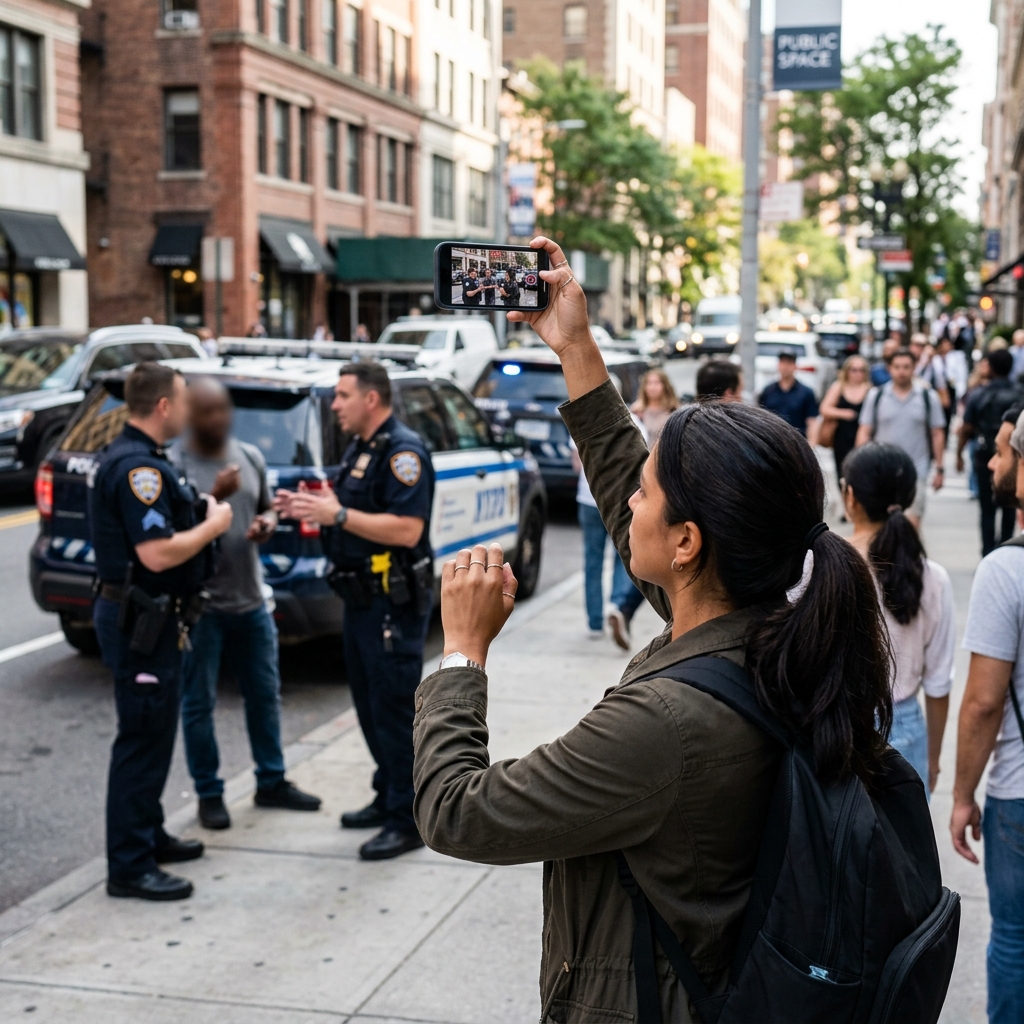
The spread of smartphones has turned millions of people into potential witnesses any time they see a police interaction. Videos of arrests, traffic stops, or protest responses can shape public debates, influence criminal cases, and trigger disciplinary action. At the same time, people who pull out a camera around officers often worry: Is it actually legal to record the police?
Across the United States, a strong and growing line of federal appellate decisions recognizes that citizens have a First Amendment right to record police officers performing their duties in public places, subject to reasonable limits on time, place, and manner. This right is not unlimited, and it is applied differently in some jurisdictions, but the core principle is increasingly well established.
Why Recording the Police Is a Constitutional Issue
The question of filming police is not just about technology or courtesy; it is about the scope of the First Amendment. Courts have recognized that the right to free speech and a free press includes a right to gather information about public officials, including police officers, in order to share that information with others.
Federal appellate courts have emphasized several constitutional interests that recording serves:
- Access to information: Recording is a modern way to collect facts about what government officials do in public spaces.
- Freedom of the press: The First Amendment protects both professional journalists and ordinary citizens acting as a “citizen press” when they document government activity.
- Public debate and accountability: Video evidence can expose misconduct, corroborate proper behavior, and inform public discussion about policing practices.
One federal appeals court explained that gathering information about government officials in a form that can readily be disseminated — such as video — serves a “cardinal” First Amendment interest.
The Emerging Federal Consensus: A Right to Record
Although the U.S. Supreme Court has not yet issued a definitive ruling specifically on recording police, multiple federal courts of appeals have held that the First Amendment protects this activity when it occurs in public spaces and does not interfere with police work.
Across several circuits, courts have recognized that citizens may photograph, film, or make audio recordings of officers performing official duties in public places, including streets, sidewalks, parks, and similar venues. Many of these cases involve people who were threatened, detained, or arrested after attempting to film an arrest or traffic stop.
Legal scholars describe this as a qualified right: it is fundamental but subject to reasonable restrictions, usually framed as “time, place, and manner” limits similar to those applied to other forms of First Amendment activity.
What Courts Generally Allow: The Core of the Right
While each case turns on its facts, decisions from multiple circuits point toward a common core of protected activity.
Typical Situations Where Recording Is Protected
- Recording in public places where you have a lawful right to be, such as sidewalks, parks, and public streets.
- Openly using a phone or camera to capture video or photos of an arrest, traffic stop, or crowd control activity from a reasonable distance.
- Recording for any purpose, whether for news reporting, personal documentation, sharing on social media, or potential legal action, so long as the recording itself does not obstruct police operations.
- Documenting audio and video, not just images. Courts have treated photographing, filming, and audio recording as similar forms of gathering information.
One appellate court described peaceful recording of an arrest in a public space that does not interfere with officers’ performance of their duties as “not reasonably subject to limitation.” Another court called the right to film government officials, including law enforcement, in public spaces a “basic, vital, and well-established liberty” under the First Amendment.
Examples of Protected Purposes
Courts and commentators highlight several legitimate aims for recording police, all covered by the same First Amendment protection:
- Monitoring potential misconduct or excessive force.
- Gathering evidence for criminal or civil proceedings.
- Creating material for journalistic reporting or documentaries.
- Informing community organizing and policy advocacy.
Reasonable Limits: Time, Place, and Manner Restrictions
Courts emphasize that the right to record is not absolute. As with many First Amendment activities, the government may impose reasonable, content-neutral restrictions on time, place, and manner, so long as they serve a significant interest (such as safety) and leave open alternative avenues for recording.
Common constraints recognized or discussed in case law include:
- Non-interference: You cannot physically obstruct officers, interfere with an arrest, or ignore lawful orders intended to preserve safety or evidence.
- Proximity: Officers may require people to step back to a safe distance or remain behind a barrier, as long as they do not selectively target recording itself.
- Scene security: Police can control access to active crime scenes or hazardous areas; the First Amendment does not guarantee a right to cross police lines.
- Privacy and wiretap laws: Some states have rules about recording audio in private settings or where people have a reasonable expectation of privacy, though many states and courts treat recording on-duty officers in public as outside those restrictions.
Importantly, courts have cautioned that officers are expected to endure the burdens that come with public oversight. In other words, inconvenience or discomfort alone does not justify restricting peaceful recording in public spaces.
How the Department of Justice Views Recording the Police
The U.S. Department of Justice (DOJ) has formally recognized the First Amendment interest in recording police officers. In guidance and statements related to police departments under federal oversight, the DOJ has affirmed that members of the public have a constitutional right to document officers performing their duties in public, subject to narrow time, place, and manner constraints.
According to the DOJ, law enforcement agencies should:
- Train officers that recording is presumptively protected by the First Amendment.
- Prohibit officers from retaliating against people who are recording, such as by arresting, detaining, or confiscating devices solely because of the recording.
- Ensure policies require warrants or valid legal authority for access to recorded material, except in narrow exigent circumstances.
This federal position reinforces what many courts of appeals have already held: recording public police activity is constitutionally protected and should be treated as part of routine civic oversight, not as suspicious behavior.
Different Circuits, Different Timelines
Although federal appellate courts widely agree on the existence of a First Amendment right to record police, they have not always agreed on when that right became “clearly established” for purposes such as qualified immunity. In some cases, courts have held that even though the right exists, officers could not be held personally liable for earlier incidents because the law was unsettled at the time.
Legal scholars describe an evolving landscape:
- In several circuits, courts now treat the right as clearly established going forward, meaning officers are expected to know that citizens may record them in public.
- Some earlier incidents — for example, from the early 2010s — have been analyzed under a more uncertain legal standard, leading to qualified immunity for officers even as courts declared the right for future cases.
- More recently, additional circuits have joined this consensus, including rulings addressing not just recording, but also livestreaming police activity during traffic stops or other encounters.
Because the Supreme Court has not yet definitively ruled on the issue, advocates and scholars continue to call for a nationwide standard that would apply uniformly in all federal circuits.
Practical Tips for Recording Police Safely and Lawfully
Knowing that you likely have a constitutional right to record is only part of the picture. It is equally important to exercise that right in a way that protects your safety and strengthens any potential legal claim.
| Good Practice | Why It Matters |
|---|---|
| Stay at a reasonable distance | Reduces the risk of being accused of interfering or obstructing an investigation. |
| Keep your hands visible | Helps prevent misunderstandings about your intentions or the object in your hand. |
| Announce calmly that you are recording | Clarifies your purpose and can deter misconduct, while demonstrating transparency. |
| Avoid physical involvement in the incident | Supports your argument that you were simply observing and documenting. |
| Secure backups of your video | Cloud storage or sharing protects evidence from accidental loss or deletion. |
Do’s When Recording Police
- Remain calm and polite, even if officers are confrontational. Your demeanor can influence how the situation unfolds.
- Comply with lawful orders that address safety or scene management, such as moving behind a line, as long as they do not specifically target the act of recording.
- Record context, including surrounding environment, voices, and any announcements, which may be relevant later.
- Note details such as badge numbers, patrol car identifiers, date, time, and location, either verbally on the recording or in separate notes.
Don’ts When Recording Police
- Do not physically interfere with an arrest, search, or traffic stop, even if you disagree with it.
- Do not enter restricted areas or cross police barriers just to get a closer shot.
- Do not lie about whether you are recording if asked directly; courts generally protect open recording, and dishonesty can fuel escalation.
- Do not destroy or alter footage if you expect it may be used in an investigation or legal proceeding.
Common Risks and How Courts Respond
Despite the growing legal recognition of the right to record, people still face risks when filming police, including detention, confiscation of devices, or arrest under broad charges like disorderly conduct or obstruction. Lawsuits over these incidents are a major reason courts have clarified the right in the first place.
When these cases reach court, judges often examine:
- Whether the person was peacefully recording from a lawful location.
- Whether officers can show that restrictions were based on genuine safety or operational needs, rather than simply annoyance at being recorded.
- Whether the law in that jurisdiction made the right to record clearly established at the time of the incident.
- Whether officers engaged in retaliation or viewpoint discrimination, such as targeting critical observers while tolerating others.
Even when individuals prevail on the constitutional question, doctrines such as qualified immunity sometimes shield officers from personal liability for damages, particularly for older incidents that occurred before the relevant appellate decisions. Scholars therefore argue that clearer, nationwide rules are needed to ensure consistent protection.
State Laws and Local Policies
The First Amendment provides the constitutional baseline, but state statutes and local policies can shape how the right to record operates in practice. For example:
- Some states have adopted laws expressly recognizing the right to record police in public, sometimes with specific distance requirements.
- Others have revised wiretapping or eavesdropping statutes to avoid criminalizing recording of on-duty officers in places where there is no reasonable expectation of privacy.
- Local police departments increasingly adopt policies directing officers not to interfere with lawful recording and to treat it as protected activity.
Legal scholars have proposed codifying the right to record through legislation to reduce uncertainty and prevent inconsistent enforcement or chilling effects on speech. Codification could also help align state and local practice with the federal appellate consensus.
Frequently Asked Questions About Recording Police
Can I record police officers during a traffic stop where I am the driver?
Many courts and commentators treat recording your own traffic stop as protected First Amendment activity, provided it does not interfere with the officer’s duties or involve unsafe behavior. You should keep your hands visible, avoid sudden movements, and comply with commands unrelated to the recording itself. Some departments explicitly allow drivers to use dashboard or phone cameras during stops.
What if an officer orders me to stop recording?
If the order is based solely on the fact that you are recording, it may conflict with the First Amendment as understood in many circuits. However, if the officer can articulate a legitimate safety or operational reason — such as ordering everyone back from a hazardous scene — courts may consider that a permissible time, place, or manner restriction. When confronted with such an order, many civil liberties organizations recommend calmly asking, “Am I being detained?” and, if not, deciding whether to comply or step back while continuing to record from a safer distance.
Can the police take or search my phone because it contains recordings of them?
General Fourth Amendment principles apply: officers usually need a warrant or a recognized exception to search the contents of a phone. Federal guidance and civil liberties groups state that officers should not delete or destroy recordings, and that seizing devices solely to prevent recording or publication raises serious constitutional concerns. If you are ordered to hand over your phone, you may calmly ask under what legal authority the officer is acting, but you should avoid physical resistance.
Is livestreaming police activity treated differently from recording to upload later?
Recent cases have begun to address livestreaming specifically. At least one federal appellate decision held that livestreaming police during a traffic stop is protected by the First Amendment, though the court allowed that narrow restrictions might be justified if the government can show concrete safety concerns. The basic principle is that livestreaming is another form of disseminating information; restrictions must still be reasonable and content-neutral.
Does my right to record apply if I am on private property?
The strongest protection applies in traditional public forums like streets and parks. When you are on private property — such as a store or an apartment building — the property owner’s rules and state trespass laws come into play. However, if the police are present and you have a legal right to be on the property (for example, as a tenant or invited guest), many of the same First Amendment principles still apply, especially if the recording is focused on on-duty officers rather than private individuals.
Why the Right to Record Matters for Democracy
Recording police activity is now deeply woven into modern democratic life. Courts, scholars, and the Department of Justice all recognize that allowing people to document how laws are enforced promotes transparency, accountability, and public trust.
From a constitutional perspective, the right to record police officers in public serves several vital functions:
- It reinforces the principle that government officials are accountable to the public.
- It enables both professional media and ordinary residents to participate in newsgathering and public debate.
- It provides evidence that can support civil rights lawsuits and criminal investigations.
- It helps ensure that narratives about police encounters are informed by objective visual and audio records, not just conflicting personal accounts.
As technology continues to evolve — from smartphones to body cameras to livestream platforms — courts and lawmakers will keep refining the boundaries of this right. For now, federal appellate decisions, DOJ guidance, and academic analysis point in the same direction: peaceful recording of police in public places is a protected form of First Amendment activity, subject only to carefully tailored restrictions.
References
- Filming the Police — The First Amendment Encyclopedia, Middle Tennessee State University. 2023-03-01. https://firstamendment.mtsu.edu/article/filming-the-police/
- Brief of Amicus Curiae The Rutherford Institute in Support of Petitioner — Supreme Court of the United States, Docket No. 21-57. 2021-08-13. https://www.supremecourt.gov/DocketPDF/21/21-57/187473/21-57%20Amicus%20Rutherford%20Supp.%20Petitioner.pdf
- Codifying the Right to Record Police — Columbia Human Rights Law Review, Julia Rose. 2023-02-01. https://hrlr.law.columbia.edu/files/2025/09/Rose_Codifying-the-Right-to-Record-Police_55.3.pdf
- Lights, Camera, Action… As Long As You Live in the Proper Circuit: The First Amendment Right to Record Police — SMU Science and Technology Law Review. 2020-01-01. https://scholar.smu.edu/cgi/viewcontent.cgi?article=1341&context=scitech
- You Have the Right to Record Police Actions — American Civil Liberties Union of Maryland. 2012-05-17. https://www.aclu-md.org/news/you-have-right-record-police-actions/
- First Circuit Affirms Right to Record the Police — Cato Institute, Cato at Liberty Blog. 2011-08-30. https://www.cato.org/blog/first-circuit-affirms-right-record-police
- The First Amendment Right to Record Images of Police in Public Places — Texas A&M Law Review. 2018-01-01. https://scholarship.law.tamu.edu/cgi/viewcontent.cgi?article=1066&context=lawreview
Similar Articles








Read full bio of Sneha Tete




