
Recording On-Duty Police: Your First Amendment Rights
Understand when, where, and how you may lawfully record police officers and why courts say this right is vital to public accountability.
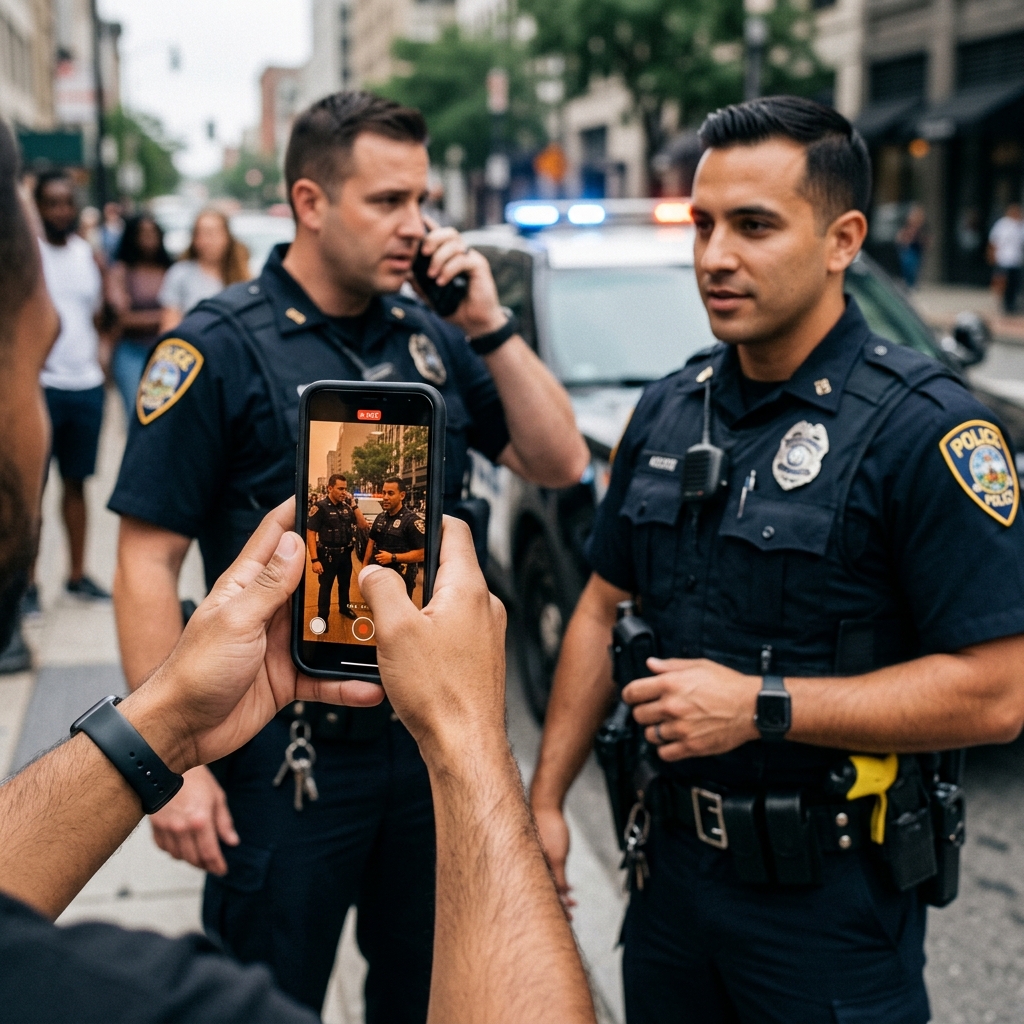
Across the United States, federal courts increasingly recognize that citizens have a First Amendment right to record police officers performing their duties in public spaces. This right has become a crucial tool for accountability, transparency, and public debate about law enforcement practices.
This article explains the legal foundations of that right, highlights key court decisions including the Seventh Circuit’s landmark ruling involving Illinois’s controversial eavesdropping law, and offers practical guidance for exercising this freedom responsibly.
Why Recording the Police Matters
Recordings of police activity—whether video or audio—have transformed public understanding of law enforcement conduct. Courts and commentators have noted that documenting official actions provides information essential to democratic oversight and public discussion of government affairs.
- Accountability: Recordings can reveal misconduct or confirm that officers acted appropriately.
- Evidence: Video and audio can become critical evidence in criminal, civil, or disciplinary proceedings.
- Public awareness: Records of police-citizen interactions shape policy debates and legislative reforms.
- Press freedom: Journalists and everyday observers rely on recordings to report on public safety and policing.
Federal appellate courts have explicitly acknowledged that gathering information about what public officials do in public is closely tied to the core purposes of the First Amendment.
The Constitutional Basis: First Amendment Protection
The First Amendment protects freedom of speech and of the press. Courts have repeatedly held that this protection extends beyond the right to speak and publish; it includes the right to gather information about government activity. Recording police is viewed as a first step in creating speech or press content.
Several federal circuits—including the First, Fifth, Seventh, Ninth, Tenth, and Eleventh—have recognized a constitutional right to record law enforcement officers in public.
| Court | Key Case (Illustrative) | Core Holding |
|---|---|---|
| First Circuit | Glik v. Cunniffe (2011) | Citizen had a clearly established right to film officers in a public park. |
| Seventh Circuit | ACLU of Illinois v. Alvarez (2012) | Applying Illinois’s broad eavesdropping law to open recording of police likely violates the First Amendment. |
| Tenth Circuit | Irizarry v. Yehia (2021) | Right to record police in public was clearly established by mid-2019; officer denied qualified immunity. |
Legal scholars have observed that federal courts now largely agree that recording police conduct is protected by the First Amendment, subject to reasonable restrictions on time, place, and manner.
Illinois’s Eavesdropping Law and the Seventh Circuit’s Response
One of the most influential decisions on recording the police arose from a challenge to Illinois’s eavesdropping statute, a law that once criminalized most non-consensual audio recording—even of public conversations.
How the Law Worked
Originally enacted in 1961, Illinois’s law banned audio recording of “oral communication” without consent of all parties, regardless of whether the conversation was private or occurred in a public setting. Violations involving law enforcement officers could be charged as serious felonies, carrying potential prison sentences of four to fifteen years.
- Silent video recording, note-taking, or photography during conversations were permitted.
- Audio recording, even in plain view, could trigger felony charges if done without consent.
- Police themselves had carve-outs allowing them to record without the same constraints.
The American Civil Liberties Union (ACLU) of Illinois argued that the statute created a troubling double standard: officers could record citizens, but citizens risking felony charges for recording officers at work.
The ACLU’s Challenge: ACLU v. Alvarez
In ACLU of Illinois v. Alvarez, the organization sought to openly record on-duty Chicago police officers in public locations as part of a program to monitor and document law enforcement conduct. Because the program would involve audio recording without officer consent, the ACLU risked prosecution under the Illinois statute.
The ACLU claimed the law violated the First Amendment by broadly restricting the creation of audio recordings of public officials performing public duties in public spaces.
The Seventh Circuit’s Ruling
The U.S. Court of Appeals for the Seventh Circuit concluded that enforcing Illinois’s eavesdropping law against citizens who openly record on-duty police officers in public likely violates the First Amendment.
- The court emphasized that recording is an integral step in creating speech and press content, and restrictions on recording therefore burden expressive rights.
- It rejected claims that officers have a privacy interest in their public performance of official duties.
- It found that the law restricts far more speech than necessary to protect legitimate privacy interests.
- The court ordered a preliminary injunction preventing the state’s attorney from prosecuting the ACLU and its employees for openly audio recording police in public.
This decision significantly advanced the legal recognition of the right to record law enforcement, particularly in Illinois and other states within the Seventh Circuit.
How Other Courts Have Treated the Right to Record
The Seventh Circuit’s ruling aligns with a growing national consensus. Several federal appellate courts have recognized that photographing and videotaping law enforcement personnel in public places is constitutionally protected.
An amicus brief filed in the U.S. Supreme Court summarized this trend, noting that every circuit court of appeals to consider the issue has recognized some First Amendment protection for recording police activity in public.
At the same time, scholars point out that the right is not absolute. It is generally subject to reasonable restrictions designed to protect safety, privacy in appropriate contexts, and the integrity of ongoing operations.
Reasonable Limits: Time, Place, and Manner
Federal courts typically frame the right to record as qualified and subject to reasonable time, place, and manner restrictions. These limits are meant to balance free expression with legitimate government interests, such as safety and effective law enforcement.
- Safety concerns: Officers may impose reasonable restrictions if a person’s recording interferes with an arrest or investigation, or places participants at risk.
- Physical proximity: Standing so close that you obstruct an officer’s movement or line of sight can be restricted.
- Secure or non-public areas: Police may lawfully limit recording in areas not open to the general public or where other privacy or security laws apply.
- Neutral regulations: Rules that apply equally to all activities (not just recording) in certain places may still govern where and how you can film.
In decisions like Irizarry v. Yehia, courts have underscored that peaceful recording from a reasonable distance in public spaces falls within protected activity, while interference with police operations does not.
Practical Guidance: How to Record Police Lawfully and Safely
Understanding the general legal framework is only part of the picture. People who choose to record police should also follow practical steps to reduce risk, protect themselves, and increase the usefulness of their recordings.
Key Best Practices
- Stay at a safe distance: Keep far enough away that you do not obstruct officers or create safety hazards.
- Remain calm and non-confrontational: Avoid escalating tensions; calmly assert that you are exercising your right to record.
- Record openly when possible: Courts often focus on open, non-surreptitious recording of police in public.
- Do not interfere: Do not touch officers, block access, or interrupt official commands. Recording is not a license to impede law enforcement.
- Protect your data: Use cloud backups or live streaming when feasible so footage is preserved even if a device is seized or damaged.
- Document context: Capture date, time, location, and relevant surroundings to assist later interpretation of the footage.
Respecting Other Legal Boundaries
While courts have protected recording of police in public, other laws may still apply:
- Private spaces: Recording inside private homes, businesses, or restricted government facilities may be subject to separate rules.
- State-specific recording statutes: Some jurisdictions still have consent requirements for certain types of audio recording; these statutes may be enforced in contexts other than public police encounters.
- Harassment or stalking laws: Persistent targeting of individuals outside legitimate documentation of police activity could raise other legal issues.
Consulting local statutes or seeking legal advice can help clarify how general recording rules apply in your state.
Impact on Policy, Policing, and Public Debate
The recognition of a First Amendment right to record police has contributed to broader changes in law and policy. Scholars note that documenting police conduct has spurred conversations about codifying the right and establishing explicit statutory protections.
- Legislative reform: Some states have revised or repealed overly broad eavesdropping or wiretapping laws to ensure they do not criminalize open recording of public officials.
- Police training: Departments increasingly incorporate guidance on how officers should respond to being recorded.
- Body-worn cameras: Official recording tools used by departments exist alongside citizen recordings, sometimes reinforcing or challenging official narratives.
- Civil litigation: When officers retaliate against individuals for recording, courts may evaluate potential First Amendment claims, as in recent appellate decisions.
These developments underscore that the right to record is not only about individual encounters; it influences the broader relationship between communities and law enforcement.
Frequently Asked Questions (FAQs)
1. Is it always legal to record police officers in public?
Federal appellate courts have consistently held that citizens have a First Amendment right to record police officers performing official duties in public spaces, subject to reasonable restrictions on time, place, and manner. However, specific state statutes and circumstances (such as interference with operations) can affect how that right applies.
2. Do I need the officer’s consent to record?
Many courts have protected non-consensual, open recording of police officers in public because officers do not have a cognizable privacy expectation while performing official duties in public. Some states still have consent laws regarding audio recording, so it is important to understand local rules, but broad bans on recording public officials have faced serious constitutional challenges.
3. Can the police order me to stop recording?
Officers may impose reasonable limits if your recording threatens safety or materially interferes with their work, but they generally cannot lawfully prohibit peaceful recording from a reasonable distance solely because you are documenting their actions. Specific situations can be complex, and disputes sometimes become part of later court cases.
4. Can police confiscate or delete my recordings?
Courts have emphasized the importance of preserving recordings for public oversight and legal processes. While officers may, under certain circumstances, temporarily secure devices as evidence pursuant to lawful procedures, they typically do not have authority to delete recordings or seize devices without proper legal justification. Challenging unlawful deletion or confiscation often requires legal assistance.
5. Does this right also apply to journalists?
Yes. Journalists and members of the public generally enjoy the same First Amendment protections for recording police in public. Courts have emphasized that recording serves press functions even when performed by non-traditional or citizen journalists.
Summary: Exercising Your Right Responsibly
Modern technology has made it simple for anyone to record police encounters. Federal courts now widely recognize this practice as falling within the First Amendment’s protection of information gathering and public debate. The Illinois case before the Seventh Circuit, where an expansive eavesdropping law was curtailed as applied to open recording of police, illustrates how older statutes are being reshaped to fit contemporary constitutional standards.
Citizens who choose to record should remain mindful of safety, avoid interfering with law enforcement operations, and stay informed about local laws. Used responsibly, recordings can play a vital role in documenting events, informing the public, and supporting a transparent and accountable system of policing.
References
- Seventh Circuit Upholds First Amendment Right to Film Police — Stanford Center for Internet and Society. 2012-05-08. https://cyberlaw.stanford.edu/blog/2012/05/seventh-circuit-upholds-first-amendment-right-film-police/
- Amicus Curiae Brief of Rutherford Institute in Support of Petitioner — Supreme Court of the United States. 2021-08-13. https://www.supremecourt.gov/DocketPDF/21/21-57/187473/20210813143511599_21-57%20Amicus%20Rutherford%20Supp.%20Petitioner.pdf
- Tenth Circuit Recognizes Constitutional Right To Record the Police — Holland & Hart LLP. 2021-09-01. https://www.hollandhart.com/tenth-circuit-recognizes-constitutional-right-to-record-the-police
- 7th Circuit Blocks Eavesdropping Law — Courthouse News Service. 2012-05-08. https://www.courthousenews.com/7th-circuit-blocks-eavesdropping-law/
- Victory for First Amendment Right to Audio Record Police — ACLU of Illinois. 2012-05-08. https://www.aclu-il.org/press-releases/victory-first-amendment-right-audio-record-police
- ACLU of Illinois v. Alvarez, 679 F.3d 583 (7th Cir. 2012) — Harvard Law Review. 2013-02-01. https://harvardlawreview.org/wp-content/uploads/2013/02/vol126_ACLU_illinois_v_alvarez.pdf
- Filming the Police — The First Amendment Encyclopedia, Middle Tennessee State University. 2017-01-01. https://firstamendment.mtsu.edu/article/filming-the-police/
Similar Articles








Read full bio of Sneha Tete




