
Reasonable Suspicion in DUI Traffic Stops
Learn how reasonable suspicion limits police power in DUI stops and protects your Fourth Amendment rights on the road.
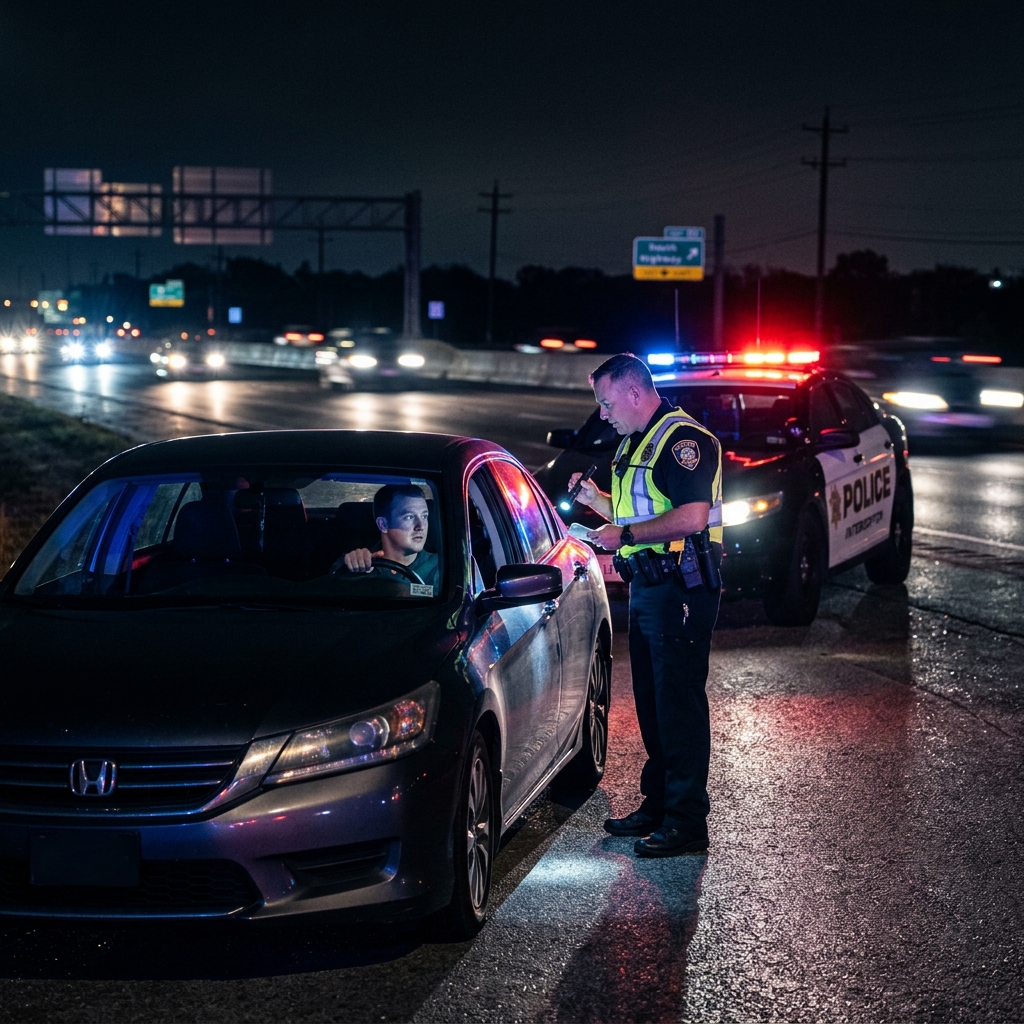
When a driver sees flashing lights in the mirror, the first legal question is whether the officer had reasonable suspicion
What Does “Reasonable Suspicion” Mean?
Reasonable suspicion is a constitutional threshold that allows an officer to briefly stop and detain someone when there are specific, objective facts suggesting criminal activity or a traffic violation. It is rooted in the Fourth Amendment, which prohibits unreasonable searches and seizures by the government. The United States Supreme Court first clearly articulated this standard in the landmark case Terry v. Ohio, recognizing that officers may conduct limited investigative stops based on more than a mere hunch, but less than full probable cause.
| Legal Concept | Description | Intrusiveness Level |
|---|---|---|
| Reasonable Suspicion | Specific, articulable facts and objective observations suggesting a law violation or criminal activity. | Allows a brief stop and limited investigation (e.g., traffic stop, questions). |
| Probable Cause | Facts and evidence that would lead a reasonable person to believe a crime has been committed. | Required for arrest, search of a vehicle (with limited exceptions), and more intrusive police actions. |
Courts evaluate reasonable suspicion using several core principles:
- Specific and articulable facts: The officer must be able to describe the behaviors or circumstances that raised suspicion, not just rely on intuition.
- Objective standard: The question is what a reasonable officer would conclude under the same circumstances, not what this particular officer personally felt.
- Totality of the circumstances: Judges look at all of the surrounding context—time of day, driving behavior, location, and interaction with the driver—rather than isolating one detail.
- Limited scope and duration: The stop should be brief and no more intrusive than necessary to confirm or dispel the officer’s initial suspicions.
How Reasonable Suspicion Applies to DUI Stops
In DUI enforcement, reasonable suspicion normally arises in two distinct stages: the initial traffic stop and the decision to begin a focused DUI investigation after contact with the driver.
Stage 1: Justifying the Initial Traffic Stop
Before an officer can pull over a vehicle, there must be some identifiable basis to suspect a traffic violation or other unlawful conduct. Reasonable suspicion does not require that the officer already believes the driver is intoxicated; any apparent violation of traffic laws can support a stop.
Examples of driving behavior commonly cited to justify a stop include:
- Crossing or straddling lane lines or drifting between lanes
- Driving significantly above or below the speed limit without explanation
- Making illegal turns, ignoring signals, or running red lights or stop signs
- Frequent or abrupt braking without clear reason
- Failing to use headlights when required, or other equipment violations
- Stopping in the roadway for no apparent reason
In many jurisdictions, officers may also consider contextual factors—such as proximity to a nightlife district, very late hours, or prior experience with similar driving patterns—as part of the overall circumstances. Each factor alone may be weak, but together they can form sufficient reasonable suspicion to justify the stop.
Stage 2: Reasonable Suspicion to Investigate for DUI
Once an officer legitimately stops a vehicle, further observations during the encounter are used to decide whether to expand the stop into a DUI investigation. At this point the question becomes: are there enough indicators of impairment to reasonably suspect drunk or drugged driving?
Common cues that officers rely on to establish reasonable suspicion of DUI include:
- Physical signs: Slurred speech, difficulty following instructions, unsteady movements, or trouble producing documents
- Eye indicators: Glassy, red, bloodshot, or droopy eyes
- Odor of alcohol or drugs from the driver or inside the vehicle
- Admission of drinking or drug use, even if the driver claims only a small amount
- Continued erratic driving observed just before the stop, such as weaving or sudden lane changes
If these or similar observations are present, an officer will typically ask further questions, request field sobriety tests, or use a preliminary breath test device, all aimed at determining whether probable cause for arrest exists.
Reasonable Suspicion vs. Probable Cause in DUI Cases
Reasonable suspicion and probable cause are closely related but serve different roles in DUI law. Mixing them up can lead to confusion about what officers are legally allowed to do at each point in the encounter.
Key Differences
- Purpose:
Reasonable suspicion allows the officer to start investigating; probable cause is required to make an arrest or conduct more invasive searches. - Evidence level:
Reasonable suspicion may rely on limited observations and partial information; probable cause usually demands stronger, corroborated facts such as test results or clearly failed sobriety tests. - Legal consequences:
An encounter based only on reasonable suspicion should remain brief and noncustodial; once probable cause exists, the officer can handcuff, formally arrest, and transport the driver.
In practice, a DUI investigation often progresses step-by-step:
- Traffic stop based on reasonable suspicion of a traffic or equipment violation.
- DUI investigation initiated when additional signs of impairment appear during contact.
- Probable cause established through field tests, preliminary breath tests, and continued observations.
- Arrest and, in many jurisdictions, an evidentiary breath or blood test after booking.
Constitutional Foundations: The Fourth Amendment
The requirement that officers have reasonable suspicion before stopping a motorist comes directly from the Fourth Amendment, which protects people from unreasonable searches and seizures. A traffic stop is considered a seizure because it restricts a person’s freedom of movement. For that reason, courts demand at least some objective justification for the stop.
From a constitutional perspective, reasonable suspicion strikes a balance between two interests:
- Public safety: Allowing officers to act quickly on observable warning signs to prevent harm on the road
- Individual liberty: Preventing random, discriminatory, or purely speculative stops of drivers
Supreme Court case law emphasizes that reasonable suspicion must be more than an unparticularized suspicion or idle curiosity; it requires some minimal level of objective justification. For motorists, this means that an officer who cannot point to specific facts supporting the stop may have violated the Fourth Amendment, and any evidence obtained could potentially be suppressed in court.
Common Indicators Officers Use in DUI Stops
Law enforcement agencies and professional organizations often train officers to recognize a set of typical cues that may signal impaired driving. While the exact list varies, many signs appear repeatedly in court decisions and training materials.
Driving Behavior Before the Stop
- Weaving or drifting between lanes
- Slow or inconsistent speeds, especially far below the posted limit
- Late braking, frequent tapping of the brakes, or stopping at green lights
- Wide turns or turning from the wrong lane
- Failure to maintain a steady course in light or moderate traffic
Physical and Verbal Cues During Contact
- Difficulty locating documents like a license or registration
- Strong smell of alcohol or marijuana from the driver or vehicle
- Confused or delayed responses to simple questions
- Problems with balance or coordination when exiting the vehicle
- Slurred, thick, or extremely rapid speech
These observations by themselves do not prove guilt, but they can be enough to justify further investigation, such as field sobriety tests. Courts then evaluate whether the combination of all evidence ultimately reaches the level of probable cause.
Exceptions: Sobriety Checkpoints and Other Special Situations
One important exception to the reasonable suspicion requirement in DUI cases involves safety checkpoints. In states that allow properly conducted sobriety checkpoints, officers may stop vehicles without individualized suspicion, provided constitutional safeguards are met. Courts generally require that checkpoints follow neutral criteria (such as stopping every third car), be authorized by policy, and minimize the intrusion on motorists.
Outside the checkpoint context, however, officers still need reasonable suspicion of a violation or criminal activity to stop a vehicle. Random, suspicionless stops away from an established checkpoint typically violate the Fourth Amendment.
Challenging the Legality of a DUI Stop
If a DUI case began with an improper traffic stop, the defense may move to suppress the evidence under the exclusionary rule. The argument is that any evidence obtained after an unconstitutional seizure—such as breath test results or admissions—should not be used against the defendant.
Common legal challenges focus on:
- Lack of articulable facts: The officer cannot explain clearly why they believed a violation occurred.
- Mistaken belief without reasonable basis: The officer misread conditions, and the mistake was not objectively reasonable under the circumstances.
- Prolonged detention without developing additional reasonable suspicion or probable cause.
Courts sometimes uphold stops even when some perceived violations later turn out to be incorrect, as long as the overall circumstances still support reasonable suspicion of intoxication or another offense. For defendants, this makes it important to examine the entire chronology of the stop, not just one detail, when planning a legal challenge.
Practical Tips for Drivers During a Suspected DUI Stop
While this article is not legal advice, certain general practices can help drivers navigate a DUI stop in a way that protects their rights and reduces unnecessary conflict:
- Remain calm and pull over safely as soon as you can after seeing emergency lights.
- Keep your hands visible, usually on the steering wheel, and wait for instructions.
- Provide required documents (license, registration, proof of insurance) when requested.
- Avoid arguing roadside about whether the stop is lawful; that issue is better addressed later with a lawyer in court.
- Know that in many jurisdictions you have a right to decline certain voluntary tests, but doing so can have separate legal or administrative consequences, depending on local law.
If you ultimately face DUI charges, consulting a qualified criminal defense or DUI attorney quickly can be critical. Lawyers can analyze whether reasonable suspicion and probable cause existed, identify possible constitutional violations, and advise you on the best strategy moving forward.
FAQs About Reasonable Suspicion and DUI Stops
Is a minor traffic violation enough for a DUI stop?
Yes. A single, observable traffic violation—such as speeding or failing to signal—can provide reasonable suspicion to stop a vehicle, even if the officer initially has no specific suspicion of drunk driving. Signs of intoxication may then emerge during the stop itself.
Can an officer stop me just because it is late at night near bars?
Time and location alone usually are not enough, but they can contribute to reasonable suspicion when combined with observed driving irregularities. For example, weaving near a bar district at closing time may legitimately raise more suspicion than the same behavior at midday.
What happens if the officer did not have reasonable suspicion?
If a court finds that the officer lacked reasonable suspicion for the initial stop, evidence obtained after that stop—such as field sobriety results or chemical tests—may be suppressed, which can significantly weaken or sometimes effectively end the prosecution’s case.
Do I have to answer questions about drinking?
Drivers generally must provide identification and basic documents, but they are not required to incriminate themselves. Many people choose to keep answers brief and avoid detailed discussions of drinking. However, the specific consequences of refusing to answer questions can vary by jurisdiction, so consulting a lawyer about local practice is advisable.
Can I be arrested based only on reasonable suspicion?
No. Reasonable suspicion permits a brief investigation, not an arrest. To lawfully arrest someone for DUI, the officer must develop probable cause based on the total evidence gathered during the stop, such as test results and performance on field sobriety exercises.
References
- What is Reasonable Suspicion for a DUI Stop? — FindLaw. 2023-08-01. https://www.findlaw.com/dui/arrests/what-is-reasonable-suspicion-for-a-dui-stop.html
- Reasonable Suspicion and DUI Stops — Hofland & Tomsheck. 2022-05-10. https://www.lvnvdui.com/reasonable-suspicion-and-dui-stops
- Handling a DUI or DWI Stop & Legal Implications — Justia. 2022-11-15. https://www.justia.com/criminal/drunk-driving-dui-dwi/handling-a-dui-stop/
- What “probable cause” do police need for DUI in California? — Shouse Law Group. 2023-04-20. https://www.shouselaw.com/ca/dui/defenses/lack-of-probable-cause/
- Reasonable Suspicion and the Investigative Traffic Stop — Texas Municipal Police Association. 2021-09-30. https://tmpa.org/tmpa/tmpa-news/Articles/Reasonable_Suspicion_and_the_Investigative_Traffic_Stop.aspx
- Understanding DWI Investigations — American Bar Association. 2020-06-01. https://www.americanbar.org/groups/judicial/resources/highway-justice/understanding-dwi-investigations/
Similar Articles








Read full bio of medha deb




