The arrest of long-time St. Louis civil rights activist Percy Green II at a public school board meeting and the subsequent finding that the arresting officer had qualified immunity offers a revealing window into how American courts balance police authority, protest rights, and government accountability.
This article uses Green’s case as a lens to examine the doctrine of qualified immunity, the legal standards that governed his claims, and what his experience tells us about the practical realities facing activists who confront public officials in contentious settings.
Background: Who Is Percy Green II?
Percy Green II is widely known in St. Louis and beyond as a Black activist, social worker, and long-standing advocate for racial and economic justice. He was active in the local chapter of the Congress of Racial Equality (CORE) and helped found ACTION, the Action Committee to Improve Opportunities for Negroes, a direct-action organization focused on challenging discriminatory hiring and economic exclusion.
Green’s activism has spanned decades of protests, including dramatic public actions such as scaling the unfinished Gateway Arch in 1964 to demand that Black workers be hired for the arch project and downtown jobs.[10] He also served as the plaintiff in McDonnell Douglas Corp. v. Green, a landmark U.S. Supreme Court employment discrimination case that set enduring standards for proving workplace bias under Title VII of the Civil Rights Act.
- Role: Civil rights activist and social worker based in St. Louis.
- Organizations: CORE; founding member of ACTION, a direct-action protest group.
- Key case: Plaintiff in McDonnell Douglas Corp. v. Green, a seminal employment discrimination decision.
- Activism: Over half a century of efforts to secure Black inclusion in jobs, public institutions, and regional decision-making.
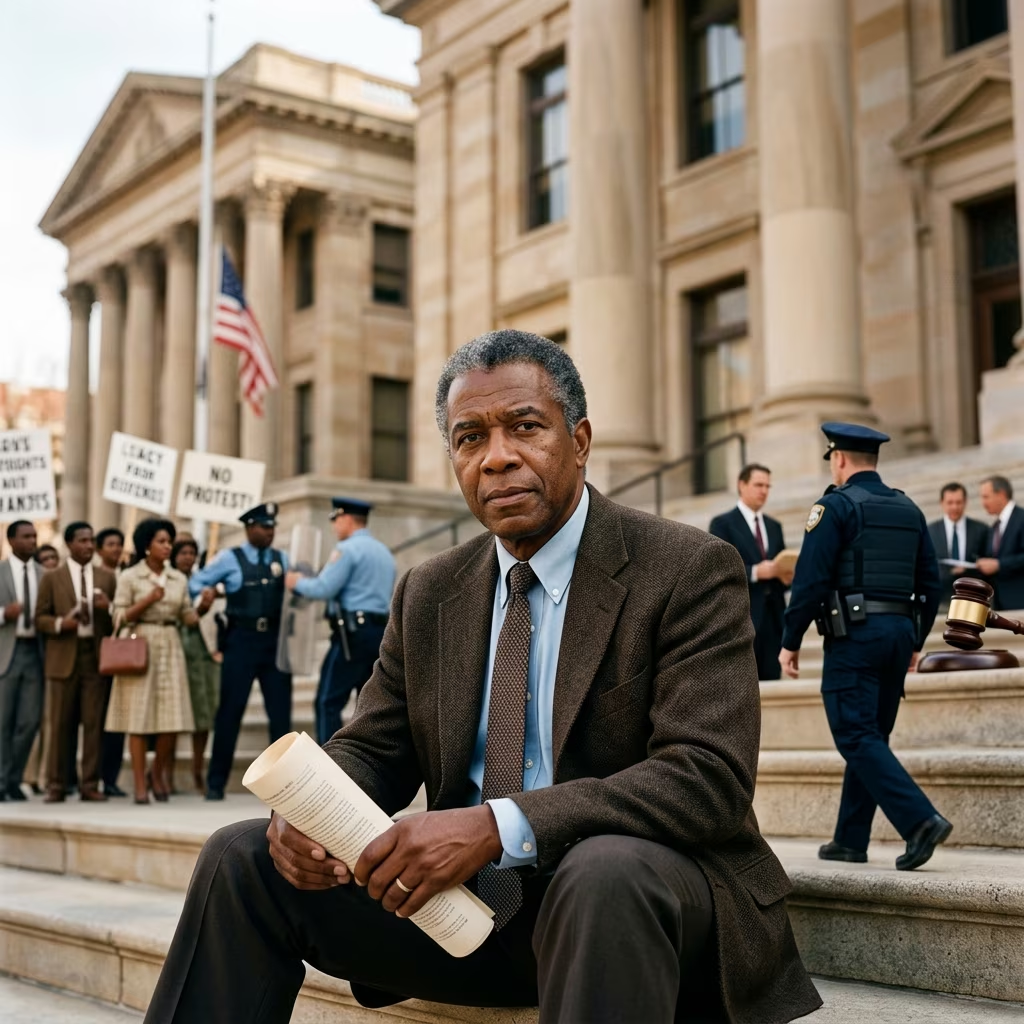
Against that backdrop, Green’s confrontation with security officers at a public school board meeting in St. Louis in 2003 was one more chapter in a long history of civil resistance—but this time, the central legal issue became whether the officer who arrested him was protected by qualified immunity.
The School Board Meeting Arrest: Core Facts
In November 2003, Green attended a St. Louis City School Board meeting, a public setting where residents could observe and challenge decisions affecting local schools. According to federal court records, Green’s conduct at the meeting led to a confrontation with school security officers, including Charles McCrary and Kestner Miller, who were employed by the Board of Education.
The incident escalated, and Green was arrested and later charged with offenses including peace disturbance and resisting arrest after being transported to the St. Louis Police Department. Green responded with an extensive civil lawsuit asserting that his arrest violated his constitutional and statutory rights and amounted to retaliation for his long history of civil rights activity and protest against racial discrimination.
In the federal case Green filed, he named more than two dozen defendants and asserted a wide array of claims under federal civil rights laws and Missouri common law, focusing on the circumstances of his arrest and the motives of those who authorized or executed it. The court was ultimately asked to decide not only whether his rights had been violated, but also whether the individual officers could be held personally liable or were shielded by qualified immunity.
Key Allegations Raised by Green
- That security personnel and other officials arrested him improperly at a public meeting.
- That the arrest was motivated by his prior civil rights activism and race, rather than legitimate law enforcement concerns.
- That the arrest and related actions were intended to discourage him from exercising his constitutional rights in the future.
- That the charges of peace disturbance and resisting arrest were inconsistent with his actual conduct and used as a pretext to suppress dissent.
These claims set the stage for a broader legal battle about free expression in public forums, equal protection, and whether officials who manage public meetings can rely on qualified immunity when they remove or arrest disruptive critics.
Understanding Qualified Immunity
Qualified immunity is a judicially created doctrine that protects government officials, including police officers, from personal liability for damages under federal law unless they violate rights that were “clearly established” at the time of their actions. The doctrine applies largely to suits brought under 42 U.S.C. § 1983, the primary statute for federal civil rights claims against state and local officials.
The U.S. Supreme Court has repeatedly described qualified immunity as necessary to shield officials from the burdens of litigation and the risk of liability when they must make quick decisions in uncertain legal environments. At the same time, the doctrine is controversial because it can make it difficult for victims of rights violations to obtain compensation or accountability, especially when courts deem the law unsettled or the facts ambiguous.
Core Features of Qualified Immunity
| Feature | Explanation |
|---|---|
| Scope | Applies to government officials sued in their individual capacities for money damages under federal civil rights laws. |
| Standard | Plaintiff must show that the official violated a constitutional or statutory right and that the right was clearly established at the time. |
| “Clearly Established” Requirement | Courts ask whether a reasonable official would have known the conduct was unlawful, often by looking to prior cases with similar facts. |
| Function | Protects officials from liability and sometimes from trial when the law was not clear or when reasonable officers could disagree about legality. |
| Limit | Does not protect officials who knowingly or obviously violate well-established constitutional rights. |
In Green’s case, the crucial question was whether the officer’s decision to arrest him at a heated public meeting violated a clearly established constitutional right in a way that a reasonable officer should have recognized as unlawful.
How Courts Applied Qualified Immunity in Green’s Lawsuit
The federal court examining Green’s claims reviewed the incident, his allegations, and the applicable constitutional standards before concluding that the officer was entitled to qualified immunity for the arrest. That determination did not mean that Green’s account was necessarily wrong or that his rights were perfectly respected; rather, the court decided that the officer’s conduct did not violate a clearly established right under existing precedents.
Courts often approach qualified immunity in two steps: first asking whether the facts, viewed favorably to the plaintiff, show a violation of a constitutional right, then asking whether that right was clearly established at the time. In practice, especially in protest cases, judges sometimes focus heavily on the second step, pointing to prior decisions that give officers broad discretion to manage crowd control and meeting disruptions.
Legal Factors Considered
- Nature of the forum: A public school board meeting is a public setting, but officials may regulate disruptive behavior to ensure the meeting can proceed.
- Officer perspective: Courts often consider what a reasonable officer on the scene would have perceived, including noise levels, crowd reaction, and perceived safety concerns.
- Existing case law: Prior rulings about removing disruptive speakers from public meetings play a major role in determining whether rights were clearly established.
- Resistance to arrest: Alleged resistance or noncompliance may influence how courts assess the reasonableness of the officer’s response.
The result in Green’s case underscored that even activists with long records of lawful protest and major wins in higher courts can face serious obstacles when challenging on-the-ground decisions by security personnel and police.
Protest Rights vs. Public-Order Powers
Green’s arrest illustrates a recurring tension in U.S. constitutional law: the balance between the First Amendment rights of protest, speech, and petition, and the government’s obligation to maintain order in public proceedings. Courts have long recognized that public bodies can adopt reasonable rules to ensure meetings can function, but those rules cannot be used as a disguise for viewpoint discrimination or retaliation against critics.
Activists like Green, who frequently challenge powerful institutions, often operate in environments where lines between “disruption” and “protected dissent” are contested. In such contexts, qualified immunity can tilt the balance toward officials by giving them legal protection for decisions made under pressure, even when those decisions arguably burden speech rights.
Common Risk Points in Public Meetings
- Strict time limits on comments, enforced unevenly against vocal critics.
- Rules against “disorderly” behavior, interpreted broadly to include loud but nonviolent protest.
- Use of security officers or police to remove individuals after tense exchanges.
- Subsequent charges such as peace disturbance or resisting arrest, which may hinge on conflicting narratives of what occurred.
In Green’s case, his civil rights history and outspoken participation at the school board meeting formed the context for his arrest, but the legal outcome turned largely on how qualified immunity shields officers from retrospective judicial scrutiny when the law is not sharply defined.
Implications for Activists and Communities
The finding of qualified immunity in Green’s case has broader implications for activists, especially those who challenge racism, inequality, and government policy in contentious venues. It illustrates both the resilience required to engage in decades of protest and the institutional defenses—legal and procedural—that confront those who seek accountability.
Practical Lessons for Protesters
- Know the rules of the forum: Understanding time limits, speaking procedures, and decorum rules at public meetings can reduce vulnerabilities that officials may later characterize as disruptive.
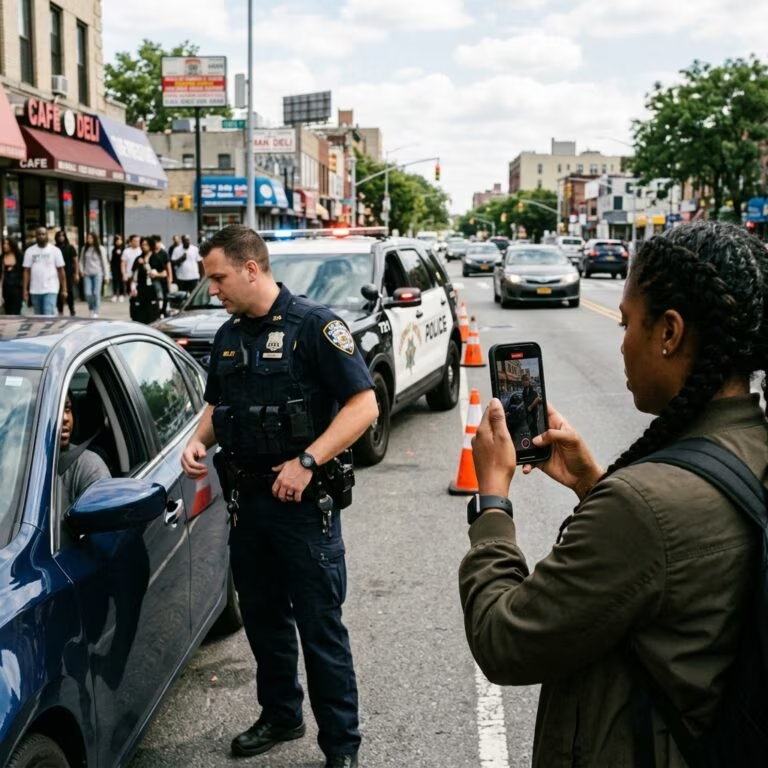
- Document events: Where possible, recording interactions, preserving witness accounts, and retaining written materials can be crucial when disputes arise about what happened.
- Expect legal complexity: Even when rights appear violated, qualified immunity can make litigation outcomes unpredictable, especially in novel or contested contexts.
- Consider broader strategies: Activists may combine legal action with media outreach, community organizing, and policy advocacy to address systemic problems beyond individual cases.
For communities, Green’s history—spanning employment discrimination litigation, high-profile protests, and repeated arrests—shows how persistent activism can reshape legal standards and public awareness, even if individual cases, like his school board arrest, do not result in liability against officials.
Debate and Reform Efforts Around Qualified Immunity
Green’s experience feeds into a broader national debate over whether qualified immunity strikes the right balance between protecting officials and ensuring redress for rights violations. Critics argue that the “clearly established” requirement is applied too rigidly, allowing officials to escape liability unless a prior case has nearly identical facts. Supporters contend that without strong immunity protections, officials would be deterred from performing their duties effectively.
In recent years, legislative proposals and judicial opinions have questioned whether the doctrine should be narrowed or abolished, particularly in cases involving police use of force and protest policing. While Green’s arrest preceded many of these reform discussions, the court’s reliance on qualified immunity in his case fits a pattern in which civil rights plaintiffs often confront formidable hurdles when suing individual officers.
Key Points in the Reform Conversation
- Whether courts should focus first on deciding if rights were violated, to clarify constitutional law, before turning to immunity.
- Whether statutes like § 1983 should be amended to limit or redefine qualified immunity.
- How immunity affects incentives for training, supervision, and discipline within law enforcement agencies.
- How the doctrine shapes the experiences of Black activists and communities disproportionately impacted by police intervention.
Though Green achieved a major Supreme Court victory in employment law, his later encounter with qualified immunity in the context of protest shows how different legal terrains—labor discrimination and street-level policing—can produce starkly different outcomes even for the same individual.
Frequently Asked Questions (FAQs)
1. Did Percy Green II win his civil rights case over the school board meeting arrest?
In the federal litigation arising from his 2003 arrest at a St. Louis school board meeting, the court concluded that the officer responsible for arresting Green was protected by qualified immunity. That determination meant Green did not obtain damages from that officer based on the arrest, even though he challenged the legality and motive behind the incident.
2. What charges were associated with Green’s arrest?
After being taken to the St. Louis Police Department, Green was charged with peace disturbance and resisting arrest in connection with the events at the school board meeting. Those charges formed part of the factual backdrop for his civil rights lawsuit.
3. How does Percy Green’s Supreme Court case relate to his later arrest?
Green’s earlier Supreme Court case, McDonnell Douglas Corp. v. Green, dealt with employment discrimination and established a widely used framework for proving discriminatory intent in hiring and firing decisions. His later arrest and qualified immunity dispute involved different legal doctrines—free speech, public meeting rules, and police liability—illustrating how one activist can confront multiple facets of civil rights law over time.
4. What is the main challenge qualified immunity poses for civil rights plaintiffs?
The central challenge is the requirement that plaintiffs show not only that their rights were violated, but also that those rights were clearly established in a way a reasonable official should have understood. When courts find that existing case law does not closely match the situation, they often grant immunity, which can block damages claims even where conduct appears troubling.
5. Why is Percy Green II considered an important figure in civil rights history?
Green played a central role in shaping both local and national civil rights struggles. His activism in St. Louis, his leadership in ACTION, and his Supreme Court case on employment discrimination have made him an enduring symbol of direct-action protest and legal resistance against structural racism.
References
- Case: 4:06-cv-01667-RWS, Percy Green II v. St. Louis Board of Education et al. — U.S. District Court, Eastern District of Missouri. 2008-11-05. https://www.govinfo.gov/content/pkg/USCOURTS-moed-4_06-cv-01667/pdf/USCOURTS-moed-4_06-cv-01667-2.pdf
- Percy Green II Biography — Forward Through Ferguson. 2015-10-08. https://forwardthroughferguson.org/stories/10yearslater-unflinchingprogress-percy-green/
- Sixty Years of Civil Rights Activism by the Iconic Percy Green — Gateway Journalism Review. 2022-02-01. https://gatewayjr.org/in-conversation-sixty-years-of-civil-rights-activism-by-the-iconic-percy-green/
- Percy Green II — Peace Economy Project Board Profile. 2020-06-01. https://peaceeconomyproject.org/wordpress/about/board/percy-green-ii/
- Percy Green II: Champion of Economic Development and Black Equality — St. Louis Economic Development Partnership. 2020-08-10. https://stlpartnership.com/percy-green-ii-champion-of-economic-development-and-black-equality/