
Professional License Portability for Military Families
How federal rules help servicemembers and spouses keep working after a military move.
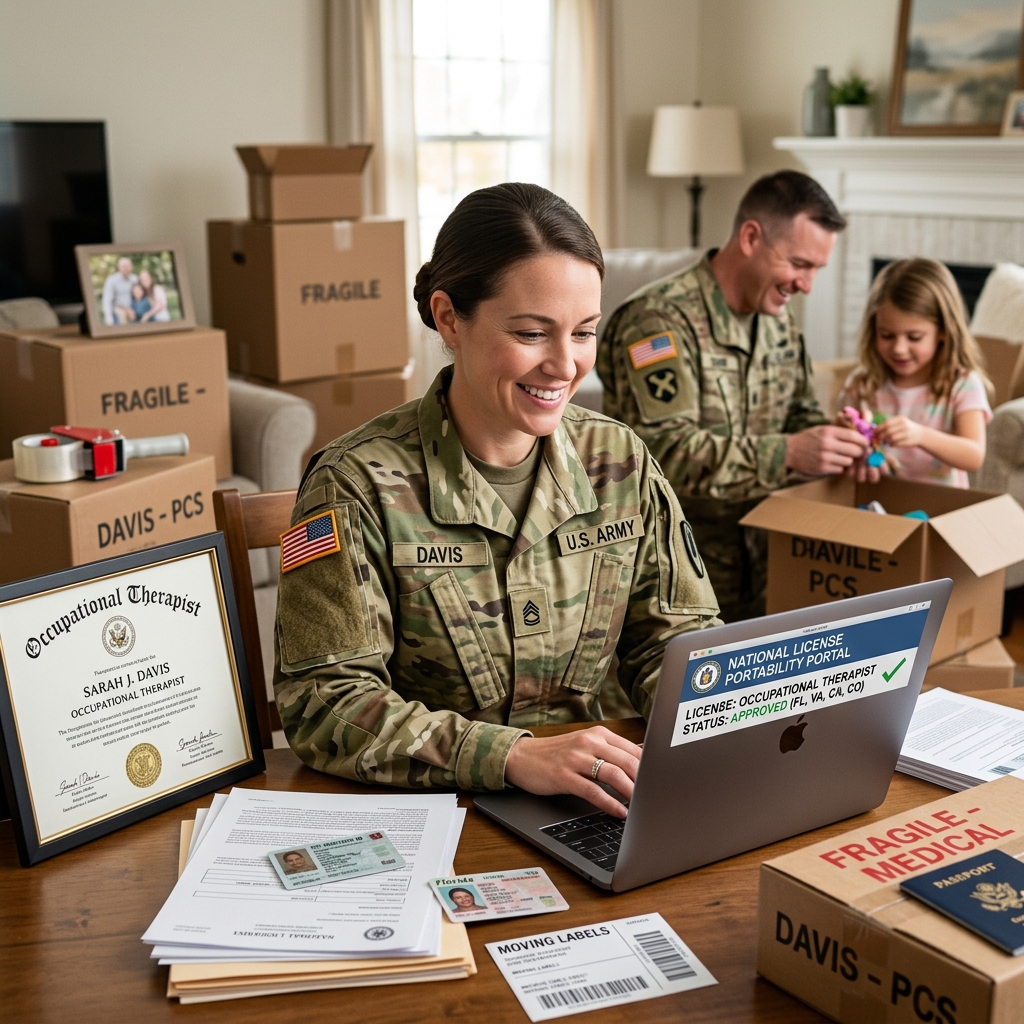
When a military family moves, a career should not have to start over. Federal law now gives servicemembers and their spouses a clearer path to keep using a covered professional license or certificate after relocation, as long as specific conditions are met. The goal is simple: reduce the disruption caused by military orders and make it easier for qualified people to continue working in their profession in a new state.
This article explains how professional license portability works, who can use it, what documents are usually required, how state licensing authorities fit into the process, and what changed under the updated federal rules. It also covers practical questions that families often ask when they are preparing for a move.
What professional license portability means
Professional license portability is a federal protection that allows certain licenses and certificates to remain valid for use in a new state after a military move. Under the current rule, a servicemember or spouse with a covered license may be able to practice in the new state without going through the full traditional licensing process again, provided the statutory requirements are met.
The policy is designed for professions that require state authorization, such as licensed health, technical, educational, and other regulated occupations. The updated federal law also includes law licenses among the covered credentials, expanding the range of professions that can benefit from portability.
Who can qualify
Two groups may benefit from this protection: active servicemembers and their spouses. The law applies when relocation happens because of military orders, not because of a voluntary move unrelated to service. The license must be a covered professional license or certificate, and the applicant must submit the required application materials to the licensing authority in the new state.
For a license to be treated as valid in the new location, the general framework requires three basic elements:
- The person must hold a covered license or certificate.
- The move must happen because of military orders.
- The person must apply to the licensing authority in the new state.
Once these conditions are satisfied, the covered credential may be treated as valid for the scope of practice allowed in the new state while the person is living there under military orders.
How the federal rule changed
The most recent update broadened the portability benefit and removed some older limits. One major change is that all professional licenses and certificates, including law licenses, are now eligible. Another significant change is that the law no longer requires the license to have been actively used for a specific period before the move.
The practical effect is important for families with frequent relocations. Earlier versions of portability rules were narrower and sometimes excluded professions that did not fit neatly into the prior language. The revised framework is more inclusive and easier to apply across a wider range of occupations.
What applicants usually need to submit
The licensing authority in the new state may ask for a small set of documents to verify eligibility and good standing. The federal statute identifies the core items that belong in the application package.
- Proof of military orders.
- If the applicant is a spouse, a copy of the marriage certificate.
- A notarized affidavit confirming identity, the truth of the application, understanding of the new state’s scope of practice, agreement to comply with that scope, and good standing in other jurisdictions where the applicant has held a license.
In some situations, a written statement from the servicemember’s commanding officer may satisfy the requirement for proof of military orders. That can be useful when formal orders are not immediately available but the service-related change in duty status has been documented by the command.
How the process works in practice
Although the federal law creates the portability right, the application is still handled by the licensing authority in the new state. That means the person relocating usually needs to contact the agency responsible for the profession and follow its instructions carefully. Some states may offer online forms, while others may require mailed or in-person submission.
The review process is meant to be quicker than a full relicensing process. If the licensing authority cannot complete its required action within 30 days after receiving a proper application, the statute allows the authority to issue a temporary license with the same rights, privileges, and responsibilities as a permanent license.
This temporary option matters for professions where delays can prevent a family from earning income soon after arrival. It helps reduce the gap between arrival in a new state and the ability to return to work.
Relationship to state licensing rules
State authorities still play an important role, even though federal law provides the portability protection. The applicant must still meet the new state’s scope-of-practice requirements, and the state may require the person to affirm that they understand those rules. The federal law does not erase professional standards; instead, it prevents unnecessary duplication when the person already holds a valid license and has moved because of military service.
Some licenses are also governed by interstate compacts or other state-specific arrangements. In those cases, the portability rule may not apply in the same way if a compact already controls the profession and the relevant state is part of that same compact arrangement. The basic idea is that the federal rule fills gaps where other portability systems do not already govern the license.
Why the rule matters for military families
Military families often move frequently, and those moves can interrupt employment in licensed professions. That disruption can be costly, especially for spouses whose careers depend on state authorization. License portability is intended to reduce that burden and make geographic relocation less damaging to long-term career growth.
The rule supports several practical outcomes:
- It shortens the time needed to return to work after a move.
- It reduces duplicative paperwork and testing.
- It helps families preserve income during relocations.
- It makes licensed professions more compatible with military life.
By making state-by-state transitions less difficult, the law recognizes that career continuity is part of family stability.
Common misunderstandings
One common misunderstanding is that portability means a person never has to interact with the new state’s licensing system. That is not correct. The applicant still has to file the proper paperwork and satisfy the applicable conditions in the new jurisdiction.
Another misunderstanding is that the rule covers every move. It does not. The relocation must be tied to military orders, and the applicant must be a servicemember or spouse with a qualifying license. The law is targeted rather than universal.
A third misconception is that the rule removes all state oversight. In fact, the new state can still regulate the scope of practice, discipline, and professional standards. Portability eases access; it does not eliminate professional accountability.
What to do before and after a move
Families that are preparing for a relocation can save time by organizing documents early. A well-prepared file can reduce delays once the move is underway and can make the state application easier to complete.
- Keep a current copy of the license or certificate.
- Save military orders and command letters in an accessible format.
- Collect marriage documentation if a spouse is applying.
- Confirm that the license is in good standing in every jurisdiction where the applicant is or was licensed.
- Review the destination state’s licensing instructions before arrival.
After the move, the applicant should submit the paperwork promptly and follow up if the state asks for clarification. Because each profession is regulated differently, it is important to rely on the licensing authority that governs the destination state rather than on general assumptions about the process.
Comparison of the main requirements
| Requirement | What it means |
|---|---|
| Covered license | The applicant must hold a professional license or certificate that falls within the federal portability rule. |
| Military move | The relocation must result from military orders, not a personal move unrelated to service. |
| State application | The applicant must file with the licensing authority in the new state. |
| Supporting documents | Orders, marriage certificate if needed, and a notarized affidavit are central documents. |
| Good standing | The applicant must remain in good standing where the license was issued and in other relevant jurisdictions. |
What applicants should expect from the new state
Different states may organize the process differently, but the destination state generally checks whether the applicant meets the federal criteria and whether the profession’s local scope of practice can accommodate the license. Some boards may ask for written confirmation, while others may issue recognition quickly after reviewing the documents.
Applicants should be prepared for the possibility that a state may ask for supplemental information, especially when the profession has specialized practice rules or additional registration requirements. Even in those cases, the federal rule still serves as a strong baseline protection against unnecessary delay.
Frequently asked questions
Does this apply only to active-duty servicemembers?
No. The protection also applies to spouses, as long as the family move is driven by military orders and the other eligibility requirements are met.
Is a temporary license possible?
Yes. If the state cannot complete the required action within 30 days after receiving a proper application, it may issue a temporary license with the same practical authority as a permanent one.
Do applicants still need to follow state professional rules?
Yes. The new state may still enforce its own scope-of-practice standards, discipline rules, and professional requirements.
Are law licenses included?
Yes. Under the updated federal rule, law licenses are included among the covered professional credentials.
Is prior active use of the license required?
No. The updated rule no longer requires the license to have been actively used for a set period before the move.
What if the license is part of an interstate compact?
In some cases, a compact may govern portability instead of the federal rule. The specific profession and the destination state matter, so applicants should confirm which system applies.
How to think about portability as a career tool
Professional license portability is more than an administrative shortcut. It is a workforce policy that acknowledges the realities of military life and the economic impact of relocation. By reducing the friction of moving a regulated career across state lines, the law helps preserve skills, income, and professional identity.
For servicemembers and spouses, that can mean arriving in a new place with a much better chance of getting back to work quickly. For employers and communities, it means access to experienced professionals who may otherwise have been sidelined by paperwork or lengthy relicensing delays.
References
- Professional License Portability – Department of Justice — U.S. Department of Justice. 2024-12-23. https://www.justice.gov/servicemembers/professional-license-portability
- 50 U.S.C. § 4025a: Portability of professional licenses of servicemembers and their spouses — U.S. House Office of the Law Revision Counsel. 2024-12-23. https://uscode.house.gov/view.xhtml?req=granuleid:USC-prelim-title50-section4025a&num=0&edition=prelim
- Justice Department Issues Updated Letters and Fact Sheet About Professional License Portability — U.S. Department of Justice, Office of Public Affairs. 2024-12-23. https://www.justice.gov/opa/pr/justice-department-issues-updated-letters-and-fact-sheet-about-professional-license
- Federal Professional License Portability and State Registration — California Department of Consumer Affairs. 2026-07-10. https://www.dca.ca.gov/military/federal.html
- Portability of Professional Licenses and Certificates for Servicemembers and Their Spouses — U.S. Air Force. 2023-01-05. https://www.af.mil/Portals/1/documents/2023SAF/One_pager_SCRA_license_portability.pdf
Similar Articles








Read full bio of medha deb




