
Profane Facebook Posts and Protected Union Speech
How U.S. labor law treats vulgar social media posts tied to organizing, and what employers and workers should know.
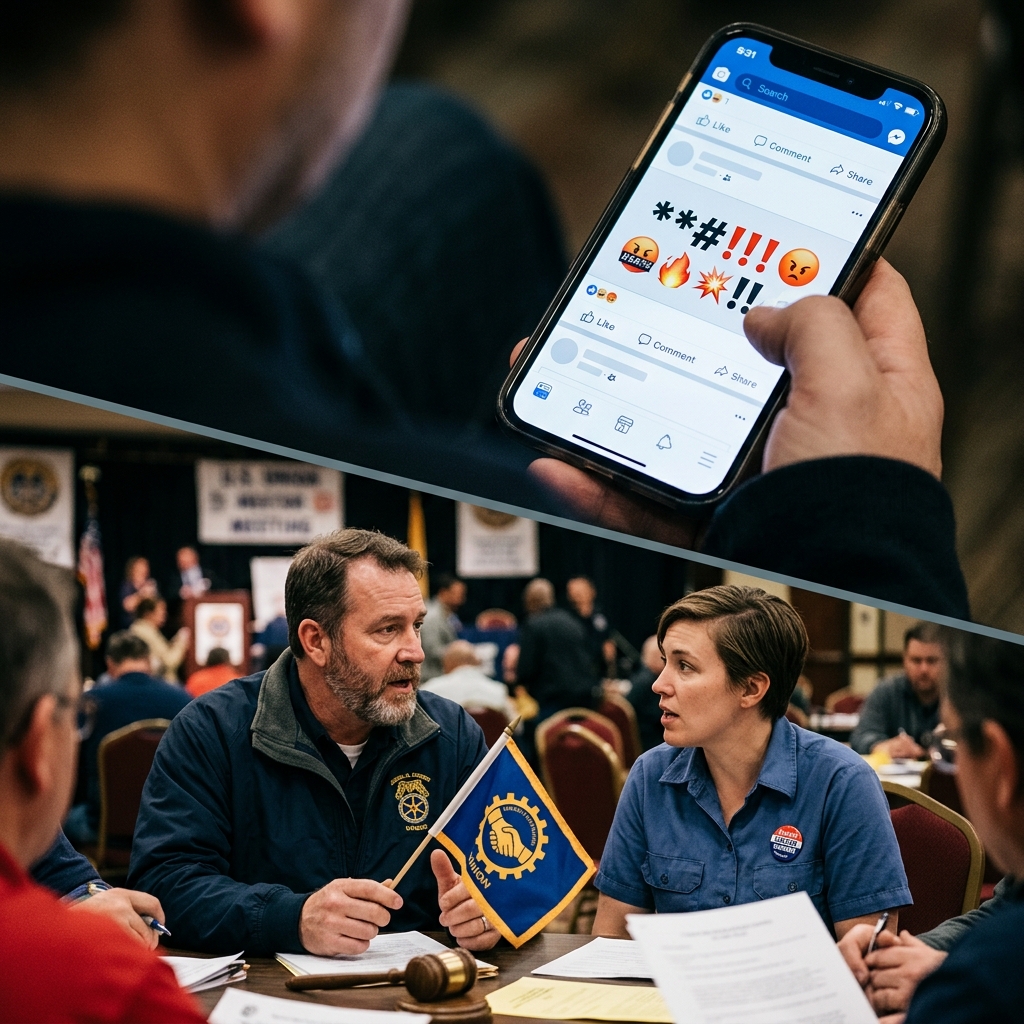
Modern workplace disputes increasingly play out on social media rather than in break rooms or union halls. A striking example involves an employee who posted a profanity-laced tirade about a supervisor on Facebook shortly before a union election, and was fired—only to have his termination later ruled unlawful because the post was treated as protected union speech under federal labor law.
This article explains why a vulgar online post could be protected, how the National Labor Relations Act (NLRA) applies to social media, and what both workers and employers should understand about the limits of protected concerted activity.
Union Speech and Social Media: The Legal Foundation
The central statute in this area is the National Labor Relations Act, enacted in 1935 to safeguard employees’ rights to organize, bargain collectively, and engage in concerted activities for mutual aid or protection. Section 7 of the NLRA protects this activity, while Section 8 prohibits employers from interfering with, restraining, or coercing employees who exercise those rights.
Historically, these protections applied to in-person activity—meetings, picketing, leafleting, and discussions among coworkers. The National Labor Relations Board (NLRB), the federal agency that enforces the NLRA, has clarified that these rights also extend to online spaces:
- Social media posts can qualify as protected concerted activity when workers discuss workplace conditions or organizing.
- Protection is not limited to unionized workplaces; non-union employees also have Section 7 rights.
- Individual statements may be protected if they seek to initiate or encourage group action, or express group concerns.
Thus, an employee’s Facebook post about pay, safety, scheduling, or unionization can fall squarely under federal labor protections, even when the employer views the post as disloyal or disruptive.
What Counts as Protected Concerted Activity?
The term protected concerted activity is broader than formal union activity. According to the NLRB, workers are protected when they act together, or attempt to act together, to improve working conditions, pay, or benefits.
Core elements of protected concerted activity
| Element | What it means | Example involving social media |
|---|---|---|
| Concerted | Involves more than one employee or clearly seeks to involve others in action. | Posting “We need to talk about these mandatory overtime shifts—who else is fed up?” and tagging coworkers. |
| Work-related | Addresses wages, hours, or other terms and conditions of employment. | Complaining that schedules are unsafe or that supervisors ignore harassment complaints. |
| Mutual aid or protection | Aims to improve conditions for a group, not just a personal gripe. | Calling on coworkers to support a union election or to sign a petition about safety gear. |
In the profanity-laced Facebook case that inspired this article, the NLRB and a federal appeals court focused on these elements and concluded that, despite offensive language, the post was directly tied to a union election and criticized alleged mistreatment affecting multiple employees.
Where the Line Is Drawn: Limits on Social Media Protection
Protection under the NLRA is not absolute. The NLRB’s own guidance warns that some online speech falls outside Section 7 and can be lawfully disciplined. Several key limits are particularly important for social media activity:
- Egregiously offensive comments — Posts that are extremely vulgar, threatening, or include slurs may lose protection, especially when they are not clearly connected to organizing or collective concerns.
- Knowingly false statements — Deliberately spreading false accusations about the employer or its products, with no relation to a labor dispute, can be unprotected.
- Purely personal gripes — Complaints that do not seek group action, do not involve coworkers, and do not reflect shared concerns are generally not concerted activity.
- Disparaging products or services without a labor link — Publicly attacking the employer’s goods or services without tying complaints to a labor controversy may fall outside NLRA protections.
The case that reached the “outer bounds” of protected union speech illustrates how close a worker can come to losing protection while still being shielded by the law. The employee launched a profane attack on a supervisor, but also urged coworkers to support a union vote and complained about treatment affecting others. That combination—vulgarity plus clear union-related content—was enough to keep the post within the NLRA’s protective umbrella.
How Courts and the NLRB Evaluate Profane Posts
When a termination over a social media post is challenged, the NLRB and, on appeal, federal courts examine the facts closely. In the union Facebook case, the Second Circuit Court of Appeals affirmed the Board’s ruling that the employer unlawfully discharged the worker.
According to commentary on the decision, the court applied a multi-factor approach to assess whether the post was so outrageous that it lost protection.
Typical factors considered
- Context and provocation — Whether the employee’s comments were impulsive, made in response to perceived mistreatment or anti-union conduct, or part of a long-running conflict.
- Timing — Whether disciplinary action coincided suspiciously with union organizing, such as just before a union election.
- Prior discipline for similar conduct — Whether the employer historically disciplined or ignored similar profanity or misconduct, or whether the worker was singled out during union activity.
- Degree of vulgarity — Whether the language, though offensive, falls within a realm commonly tolerated in the workplace, or crosses into threats or harassment.
- Connection to union or concerted activity — Whether the post references organizing, collective grievances, or an upcoming vote.
In the case at issue, the post contained serious profanity directed at a supervisor. However, the worker also explicitly encouraged coworkers to vote in favor of union representation, and the employer had not previously disciplined employees for similar language. These facts, combined with the suspicious timing—two days before a union election—led the NLRB and the court to view the termination as retaliatory union busting.
Employer Rights and Responsibilities in the Digital Age
Employers retain significant latitude to regulate workplace behavior and, in many situations, social media use. At the same time, they must avoid policies or disciplinary actions that unlawfully interfere with protected concerted activity or union rights.
Legitimate bases for discipline
Federal law generally allows employers to discipline or terminate employees for:
- Violations of neutral social media policies that are consistently enforced.
- Harassment, threats, or discriminatory slurs directed at coworkers or customers.
- Disclosure of confidential information or trade secrets.
- Defamation or knowing false statements not tied to labor disputes.
However, discipline that coincides with union activity or targets posts discussing workplace conditions can trigger scrutiny. Under the NLRA, employers engaging in “union busting” activities—such as firing workers for organizing—may face administrative complaints, orders to reinstate employees with back pay, and other remedies.
Policy drafting tips for employers
To reduce legal risk while maintaining standards of conduct, employers should consider:
- Clear, narrow language — Avoid overly broad rules that could be read to forbid any negative discussion of work online.
- Explicit preservation of legal rights — Include statements that the policy does not restrict employees’ rights under the NLRA to discuss wages, hours, and working conditions.
- Consistent enforcement — Apply rules evenly across workers and circumstances, not only when union organizing emerges.
- Training for supervisors — Ensure managers understand that punishing union-related speech can be unlawful, even when the language is uncomfortable.
Legal counsel familiar with labor law can help employers tailor social media policies that respect protected activity while addressing legitimate concerns about reputation, confidentiality, and workplace civility.
Practical Guidance for Workers Posting About Work
For employees, the key takeaway is not that anything goes online, but that posts about working conditions and organizing can carry legal protections even when management objects. Still, the boundaries matter.
Best practices before posting
- Focus on issues, not just insults — Connect your comments to pay, scheduling, safety, discipline, or other terms of employment, rather than only venting personal anger.
- Involve coworkers — Reference shared concerns or encourage others to join in, sign a petition, attend a meeting, or vote in a union election.
- Avoid threats and discriminatory language — Even when frustrated, steer clear of violence, slurs, or harassment, which can jeopardize protection.
- Stick to truthful statements — Do not knowingly spread false allegations about your employer or its products outside the context of a labor dispute.
- Understand company policies — Read the employer’s social media and confidentiality rules so you know what conduct is clearly forbidden.
While the case that inspired this article shows that profane language may still be protected when tied to organizing, workers should not treat that as a license for unrestricted online attacks. The decision was described as at the “outer bounds” of protection, meaning similar posts could, in different circumstances, be unprotected.
Frequently Asked Questions (FAQ)
1. Can I be fired for cursing about my boss on Facebook?
Yes, in many situations. The NLRA does not protect all profanity or insults. If your post is a purely personal gripe, includes threats or discriminatory slurs, or has no connection to collective concerns or union activity, your employer may lawfully discipline you. Protection is more likely when your comments address shared issues and seek group action.
2. What made the profane union Facebook post protected in the reported case?
In the case discussed by FindLaw and other legal commentators, the worker’s post, although vulgar, criticized alleged mistreatment affecting multiple employees and urged coworkers to vote in favor of union representation shortly before an election. The NLRB and the Second Circuit weighed the profanity against the post’s union-related content, the employer’s lack of prior discipline for similar language, and the timing near the vote, and concluded the termination was unlawful retaliation.
3. Does the NLRA protect social media posts if my workplace is non-union?
Yes. Section 7 protections apply whether or not a union is present. Workers have the right to band together to improve their working conditions, and this includes online discussions about wages, hours, and workplace issues. A union does not need to exist for concerted activity to be protected.
4. Are all negative comments about my employer protected?
No. The NLRB specifically notes that statements can lose protection if they are egregiously offensive, knowingly false, or disparage products or services without any connection to a labor dispute. Criticism tied to organizing or collective concerns is treated differently from general attacks that have no labor context.
5. How should employers respond when a worker posts something offensive but union-related?
Employers should proceed cautiously and, ideally, consult labor counsel. They should assess whether the post discusses working conditions or organizing, whether similar conduct has been tolerated in the past, and whether discipline could be viewed as anti-union retaliation. Immediate termination in the midst of a union election, based on conduct not previously punished, can be risky under the NLRA.
Key Takeaways
- Federal labor law protects not only formal union activity but also many forms of concerted online speech about workplace conditions.
- Profane social media posts can be protected if they are closely linked to organizing or collective grievances, though such cases may sit at the outer limit of what the law allows.
- Employers must balance their interest in workplace civility and reputation with statutory obligations not to retaliate against union or concerted activity.
- Employees should understand that protection is more likely when their posts are truthful, involve coworkers, and focus on shared work-related concerns, rather than purely personal attacks.
References
- Worker’s Profane Post on Facebook is Protected Union Speech — FindLaw Legal Blog (Courtside). 2016-03-08. https://www.findlaw.com/legalblogs/courtside/workers-profane-post-on-facebook-is-protected-union-speech/
- Social Media — National Labor Relations Board (NLRB). 2024-01-10 (last updated). https://www.nlrb.gov/about-nlrb/rights-we-protect/the-law/employees/social-media-0
- My Employee Said What on Facebook?! Employer Rights in the Digital Age — Carver, Darden, Koretzky, Tessier, Finn, Blossman & Areaux LLC. 2015-07-23. https://www.carverdarden.com/blog/my-employee-said-what-on-facebook-employer-rights-in-the-digital-age
- Is a Profanity-Filled Facebook Post Protected Speech? — RPNA Law. 2015-05-22. https://rpnalaw.com/2015/05/22/is-a-profanity-filled-facebook-post-protected-speech/
- Worker’s Profane Facebook Post Protected by Law — Courthouse News Service. 2015-05-21. https://www.courthousenews.com/workers-profane-facebook-post-protected-law/
Similar Articles








Read full bio of Sneha Tete




