
Probable Cause, Warrants, and Your Rights in Kansas
Learn how probable cause, search warrants, and key exceptions affect criminal cases and your constitutional rights in Kansas.
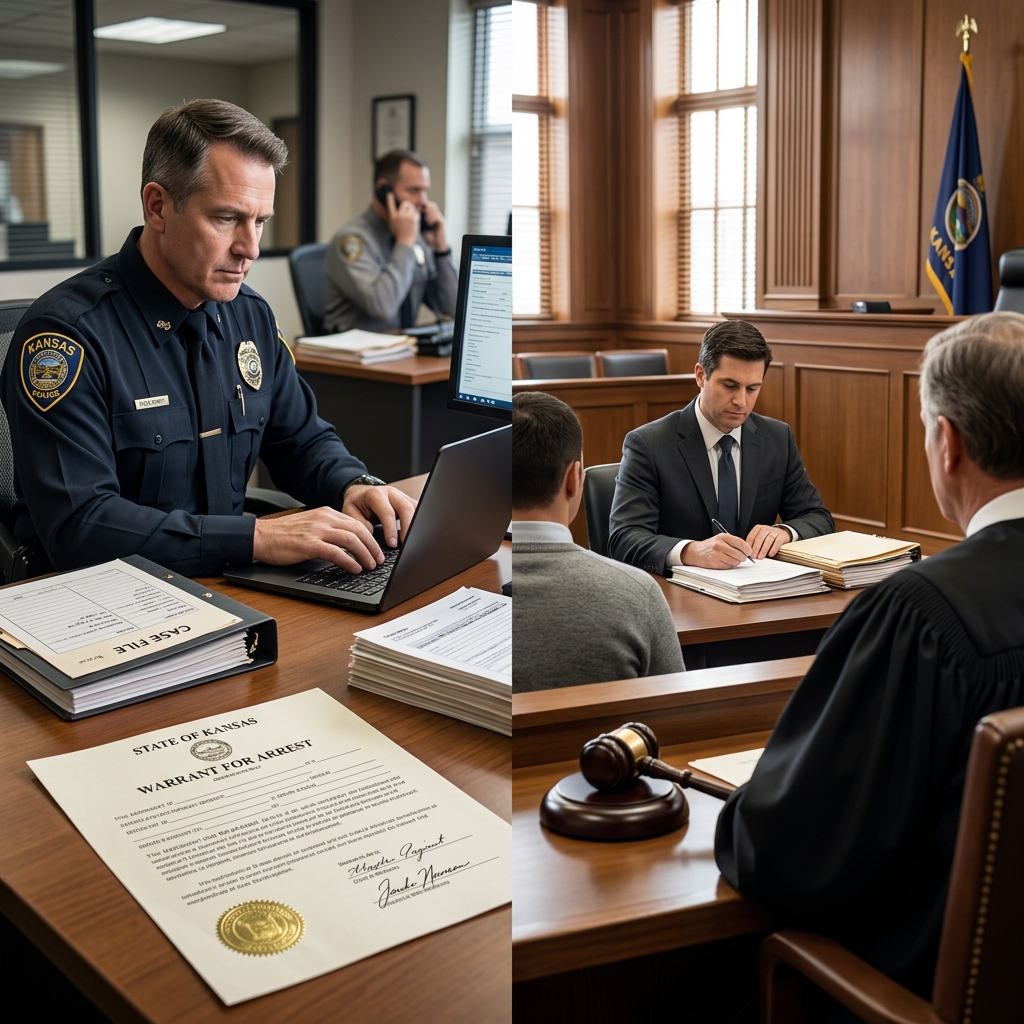
The way police obtain evidence in a criminal case is often just as important as the evidence itself. In Kansas, your rights against unreasonable searches and seizures are protected by the Fourth Amendment to the U.S. Constitution and by state law. These protections revolve around a few core concepts: probable cause, search warrants, and limited exceptions that allow officers to act without a warrant.
This guide explains how probable cause works, when police need a warrant, what happens during a warrantless search, and how an attorney may challenge illegally obtained evidence through a motion to suppress. Although this article focuses on Kansas law, many of the principles are grounded in federal constitutional protections that apply nationwide.
Foundations: The Fourth Amendment and Kansas Law
The Fourth Amendment provides that people have the right to be secure in their persons, houses, papers, and effects against unreasonable searches and seizures. In practical terms, this means the government must usually justify a search or seizure with either a valid warrant or a recognized legal exception.
Kansas law supplements those federal protections by defining the procedures for obtaining warrants and setting standards for what counts as probable cause. For example, the Kansas statute governing search warrants requires a sworn statement from a law enforcement officer demonstrating facts sufficient to establish probable cause that a crime “has been, is being or is about to be committed” and describing in detail the place to be searched and items to be seized.
- Federal baseline: The Fourth Amendment sets the overall constitutional limits on searches and seizures.
- State rules: Kansas statutes and court decisions detail how officers must seek warrants and what evidence can be used at trial.
- Local practice: Judges and attorneys apply these rules case by case, and small factual differences can change legal outcomes significantly.
What Probable Cause Really Means
Probable cause is the legal standard that justifies most searches, seizures, and arrests. It is more than a hunch but less than proof beyond a reasonable doubt. In everyday language, probable cause is a reasonable belief, based on facts, that a crime has been committed and that evidence will be found in the place to be searched.
Key Features of Probable Cause
- Fact-based: Officers must rely on concrete facts and observations, not mere suspicion or intuition.
- Objective standard: The question is whether a reasonable officer, given the same information, would believe a crime is involved.
- Location-specific: Probable cause must connect suspected criminal activity to a particular person, place, vehicle, or item.
- Time-sensitive: Probable cause can fade as circumstances change; stale information may not support a warrant.
Probable Cause vs. Other Legal Standards
| Legal Standard | Typical Use | Level of Certainty |
|---|---|---|
| Reasonable suspicion | Stops and brief frisks (e.g., Terry stops) | Lower than probable cause; specific, articulable facts suggest criminal activity |
| Probable cause | Search warrants, arrests, many vehicle searches | Moderate certainty; reasonable belief based on facts and circumstances |
| Beyond a reasonable doubt | Criminal conviction at trial | Highest standard; firmly convincing evidence, far above probable cause |
How Search Warrants Work in Kansas
In many situations, police in Kansas must obtain a search warrant before entering private property or seizing evidence. A warrant is a written court order, signed by a judge, that authorizes officers to search a specific place for specific items connected to a suspected crime.
The Warrant Application Process
Kansas law sets out detailed requirements for obtaining a warrant. The process usually includes the following steps:
- Affidavit or sworn statement: An officer submits a written statement under oath describing facts that support probable cause. These facts must link criminal activity to the location or person to be searched.
- Judicial review: A neutral judge or magistrate evaluates the affidavit to determine whether the legal threshold for probable cause is met.
- Particularity requirement: The warrant must clearly identify the place to be searched and the items to be seized, preventing overly broad or general searches.
- Issuance and execution: If probable cause exists, the judge signs the warrant, and officers must execute it within a limited timeframe, often within a few days.
Limits on What a Warrant Authorizes
Even with a warrant, police cannot search freely or seize anything they wish. The warrant’s language creates boundaries that officers must respect:
- Scope of location: Officers may search only the places identified in the warrant. A warrant for a home, for example, does not automatically authorize searching a neighbor’s property.
- Scope of items: The search must focus on the specific types of evidence listed. Searching for a large stolen item usually does not justify looking inside tiny containers where the item could not reasonably fit.
- Time limits: Warrants generally expire if not executed within a set period. After that, officers must seek a new warrant based on updated facts.
When Police Can Search Without a Warrant
Although warrants are the norm, the law recognizes several exceptions that permit warrantless searches when getting a warrant would be impractical or unnecessary. In Kansas, common exceptions include consent, plain view, exigent circumstances, searches incident to arrest, and specific rules for vehicles and brief investigative stops.
1. Consent Searches
If you voluntarily agree to let officers search your property, they generally do not need a warrant, probable cause, or even reasonable suspicion. Consent must be given freely; coercion or threats can invalidate a consent search.
- Voluntary agreement: You have the right to say no. If you say yes, you may be waiving constitutional protections against the search.
- Scope of consent: Officers must stay within the boundaries of what you allowed—for example, consenting to a living room search does not automatically authorize searching bedrooms.
- Impact on evidence: Evidence found during a valid consent search is usually admissible in court, even without a warrant.
2. Plain View Doctrine
Officers may seize contraband or evidence that is clearly visible if they are lawfully present in the location. For instance, if an officer legally stops a vehicle and immediately observes illegal drugs on the seat, those items can often be seized under the plain view exception.
3. Exigent (Emergency) Circumstances
In urgent situations, police may act without first obtaining a warrant. Exigent circumstances include scenarios where there is a risk of physical harm, a threat to public safety, or a serious danger that evidence will be destroyed before a warrant can be obtained.
- Threat to life or safety: Officers may enter a home without a warrant to respond to a violent disturbance or assist someone in immediate danger.
- Imminent destruction of evidence: If officers reasonably believe key evidence will be destroyed or removed during the time needed to secure a warrant, a warrantless search may be allowed.
4. Search Incident to a Lawful Arrest
When someone is lawfully arrested, officers may conduct a limited search of the person and areas within their immediate control. In the vehicle context, courts have allowed searches of the passenger compartment and containers inside it when closely tied to the arrest and when it is reasonable to believe the vehicle contains evidence of the offense.
5. Vehicle Searches and Stops
Vehicle searches blend several doctrines: probable cause, consent, plain view, and search incident to arrest. Because vehicles are mobile and often in public spaces, courts apply a slightly different framework than they do for homes.
- Traffic stops: Officers may stop a vehicle based on reasonable suspicion or observed traffic violations and may conduct limited checks such as requesting a driver’s license.
- Probable cause to search: If officers develop probable cause during a stop—for example, detecting the odor of illegal substances—they may be permitted to search parts of the vehicle without a warrant.
- Search incident to arrest: After arresting a recent occupant, officers may search areas within the person’s immediate control and, in some circumstances, parts of the vehicle associated with the arrest.
Digital Devices and Modern Evidence
Modern criminal investigations often involve smartphones, computers, and cloud-based accounts. Courts recognize that digital devices can contain extensive personal information, so searches of these devices are usually held to strict standards.
- Warrant preference: In most situations, officers need a warrant to search the contents of a phone or access cloud data, even if the phone was seized during a lawful arrest.
- Limited exceptions: As with physical searches, narrow exceptions may apply where there is pressing danger or consent, but courts tend to scrutinize digital searches closely.
If There Was No Probable Cause or Warrant: Will You Automatically Go Free?
A common misunderstanding is that any violation of search and seizure rules automatically leads to dismissal of criminal charges. The reality is more nuanced. When a search is illegal, the primary remedy is often a motion to suppress, which asks the court to exclude specific evidence from being used at trial.
Motion to Suppress Illegally Obtained Evidence
In Kansas, defendants can challenge evidence they believe was obtained in violation of the Constitution or state law. This is typically done through a formal written motion filed by a defense attorney before trial.
- Legal basis: The motion argues that police lacked probable cause, failed to obtain a required warrant, exceeded the scope of the warrant, or misused an exception to the warrant requirement.
- Hearing: Courts may hold an evidentiary hearing where both sides present testimony and legal arguments on whether the search or seizure was lawful.
- Suppression of evidence: If the judge agrees that the evidence was obtained illegally, the court may order that the evidence be excluded from trial, meaning the prosecution cannot rely on it to prove guilt.
Impact on the Outcome of the Case
Even if key evidence is suppressed, dismissal is not automatic. The prosecution must still decide whether it has enough legally obtained evidence to proceed.
- Case dismissal: If the suppressed evidence was central—for example, the only proof of possession of contraband—the prosecution may not be able to prove the case beyond a reasonable doubt and could dismiss the charges.
- Modified charges or strategy: Sometimes the state may continue the case using remaining evidence or reduce the charges.
- Plea negotiations: Successful suppression can change the balance of the case and sometimes lead to more favorable plea discussions.
Practical Steps If You Suspect an Improper Search
If you believe officers searched or seized property without proper legal justification, it is important to protect your rights early. Courts and attorneys rely heavily on details, so preserving information about what happened can be critical.
Immediate Actions
- Stay calm and avoid resistance: Physically resisting officers can lead to new charges and safety risks. You can assert your rights verbally by clearly stating that you do not consent to a search.
- Ask for a lawyer: If you are detained or arrested, you have the right to remain silent and to request an attorney. Exercising these rights can prevent statements from being used against you later.
Document What Happened
- Write down details: As soon as possible, record the date, time, location, officer names (if known), and a step-by-step description of the encounter.
- Identify witnesses: Note anyone who saw or heard the interaction; their testimony may support your version of events.
- Preserve documents: Keep copies of any search warrants, citations, or paperwork you received from law enforcement.
Consult a Criminal Defense Attorney
Because search and seizure law is complex, speaking with a qualified criminal defense lawyer is often the most important step. An attorney can review whether probable cause existed, whether a warrant was properly obtained, and whether any exception was legitimately applied. They can then decide whether to file a motion to suppress or pursue other remedies.
Frequently Asked Questions
Do police always need a warrant to search my home?
No. A warrant is the default requirement, but officers may search without a warrant if a valid exception applies, such as your voluntary consent, evidence in plain view, exigent circumstances, or a search incident to a lawful arrest. The legality of a specific search depends on the facts and how those exceptions are applied.
What happens if the warrant did not truly have probable cause behind it?
If a warrant was issued without sufficient factual support for probable cause, a defense attorney can ask the court to review the affidavit and challenge the warrant. When the judge concludes that probable cause was lacking, evidence seized under the warrant may be suppressed and excluded at trial.
Is consent really enough to justify a search?
Yes, valid consent can make a search lawful even without probable cause or a warrant. However, consent must be voluntary, and you have the right to refuse. If officers misrepresent your rights or use heavy pressure, consent may be challenged later in court.
If evidence is suppressed, are my charges automatically dismissed?
Not automatically. Suppression means the prosecution cannot use that specific evidence, but the case may continue if other independent evidence exists. Charges are more likely to be dismissed when the suppressed evidence is the primary basis for the prosecution’s case.
Should I talk to the police to explain my side of the story?
Speaking to law enforcement without an attorney can carry serious risks. Even innocent explanations may be misunderstood or used against you. Legal guidance helps you decide what to say, if anything, and how to protect your constitutional rights.
References
- Kansas Statutes Annotated 22-2502 (Search warrants) — Kansas Office of Revisor of Statutes. Accessed 2024-10-01. https://ksrevisor.gov/statutes/chapters/ch22/022_025_0002.html
- How Does a Police Officer Get a Search Warrant in Kansas? — Roth Davies, LLC. Accessed 2024-10-01. https://www.rothdavies.com/criminal-defense/frequently-asked-questions-about-criminal-defense/search-warrants/how-does-a-police-officer-get-a-search-warrant-in-kansas
- Kansas Criminal Defense: Probable Cause and Warrants — Super Lawyers. Accessed 2024-10-01. https://www.superlawyers.com/resources/criminal-defense/kansas/if-there-wasnt-probable-cause-or-a-warrant-will-i-go-free/
- Understanding Search and Seizure Laws & Rights in Kansas — Chahine Legal LLC. Accessed 2024-10-01. https://chahinelegalllc.com/blog/understanding-search-and-seizure-laws-in-kansas/
- Search of Vehicle Incident to Arrest in Kansas & Missouri — DUIKC (McLane Law Firm). Accessed 2024-10-01. https://www.duikc.com/search-of-vehicle-incident-to-arrest-in-kansas-missouri
- Kansas City, MO Criminal Defense FAQs — Howard L. Lotven, P.C. Accessed 2024-10-01. https://www.lotvenlawfirm.com/practice-areas/criminal-defense/criminal-defense-faqs/
- When Encountering Law Enforcement in Kansas — ACLU of Kansas. Accessed 2024-10-01. https://www.aclukansas.org/know-your-rights/when-encountering-law-enforcement-in-kansas/
Similar Articles








Read full bio of medha deb




