
Private Disability Insurance vs. SSDI: A Practical Guide
Understand how private disability insurance and Social Security Disability Insurance work, differ, and can be used together to protect your income.
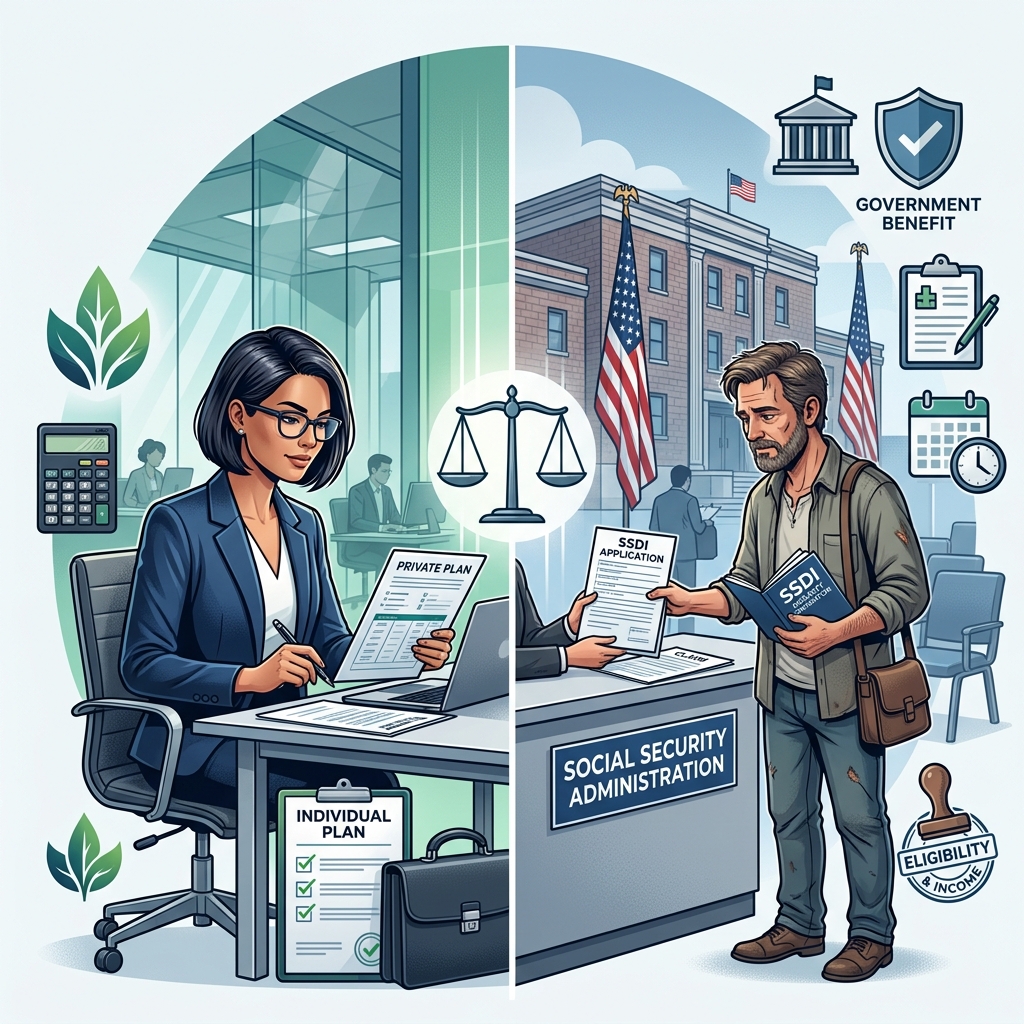
When an illness or injury keeps you from working, your ability to pay for housing, food, medical care, and other necessities can change overnight. Two major sources of financial support in that situation are private disability insurance and Social Security Disability Insurance (SSDI), a federal program administered by the Social Security Administration (SSA). Understanding how these systems work, how they differ, and how they can complement each other is essential for long-term income protection.
This guide explains the core features of each type of benefit, compares them side by side, and highlights practical strategies for using them together.
Big Picture: Government vs. Private Disability Protection
Both private disability insurance and SSDI aim to replace income when a serious disability prevents you from working. However, they are built on very different foundations.
- SSDI is a federal insurance program funded through payroll (FICA) taxes and governed by the Social Security Act.
- Private disability insurance is coverage you buy yourself or receive through an employer or professional association. It is issued and administered by commercial insurers under state insurance laws and, for most employer plans, the federal ERISA statute.
Because the systems are independent, you may be able to receive benefits from both at the same time, although some private policies offset the amount they pay based on your SSDI benefit.
Eligibility: Who Qualifies and Under What Conditions?
SSDI Eligibility Requirements
SSDI is not a needs-based program; it is an entitlement for workers who have paid enough into the Social Security system and meet SSA’s strict definition of disability.
- Work history: You generally need a sufficient number of work credits earned by paying Social Security taxes, which depends on your age at the time disability begins. Many workers between ages 31 and 65 must have worked five out of the last ten years.
- Disability standard: SSA considers you disabled only if you cannot perform any substantial gainful activity because of a severe physical or mental impairment expected to last at least 12 months or result in death.
- Timing: Benefits typically start only after several months of disability and can take months to be approved after application.
Assets and non-work income generally do not affect SSDI eligibility or payment amounts; it is not a welfare program.
Private Disability Insurance Eligibility
Eligibility for private disability benefits depends on the contract language in your policy, which can vary widely between insurers.
- Coverage source: Policies may be individually purchased, employer-sponsored, or offered through professional associations.
- Waiting periods: Many plans provide coverage immediately upon enrollment or after a short waiting period, although pre-existing conditions are often excluded for a time.
- Disability definitions: Policies often use an occupation-based standard—such as inability to perform the material duties of your own occupation—sometimes shifting to an “any occupation” standard after a specified period.
- Partial disability: Unlike SSDI, which requires total disability for eligibility, private policies frequently pay benefits for partial disability or reduced earning capacity.
Because private policies can be customized, they may be easier to qualify for than SSDI, particularly if you can still do some work but not at your prior level or in your prior role.
Benefit Amounts: How Much Income Can You Expect?
How SSDI Calculates Benefits
SSDI benefit amounts are calculated using a weighted formula based on your average indexed lifetime earnings covered by Social Security. Your monthly benefit is unique to your earnings record, but general figures illustrate typical ranges:
- The average SSDI payment
- The maximum SSDI benefit
- For most workers, SSDI replaces less than half of pre-disability income.
SSDI payments are made monthly and can continue, with some conditions, until you reach retirement age, at which point benefits convert to retirement benefits.
How Private Disability Policies Pay Benefits
Private disability insurance is designed to replace a portion of your pre-disability income, typically expressed as a percentage.
- Many long-term disability (LTD) policies replace around 50–70% of your prior earnings, depending on coverage selected.
- Short-term disability coverage may provide a similar percentage for a limited time, often bridging the gap until LTD or SSDI benefits begin.
- Benefits are generally paid monthly but may be supplemented by additional features such as cost-of-living adjustments or residual benefits for partial disability, depending on the policy.
Because private benefits are tied directly to your income and coverage choices, the monthly amount can be significantly higher than SSDI, particularly for higher earners or professionals.
Duration of Benefits and Long-Term Security
| Feature | SSDI | Private Disability Insurance |
|---|---|---|
| Start of benefits | After disability has lasted several months and application is approved; decision can take up to six months or more. | Short-term policies may start after a few days; long-term policies often begin after 3–6 months. |
| Maximum duration | Generally until retirement age, as long as disability criteria remain satisfied. | Defined by the policy; can be 2–5 years, to age 65, or another specified limit. |
| Partial disability coverage | No—requires inability to perform substantial gainful activity. | Often yes; many policies pay for partial or residual disability. |
SSDI offers long-term security if you qualify, but the strict disability standard and approval process can leave a gap early in a disability. Private coverage can provide shorter waiting periods and bridge gaps before SSDI or other benefits begin.
Taxation, Health Coverage, and Other Side Benefits
Tax Treatment of Benefits
- SSDI: Benefits may be subject to federal income tax depending on your overall income level.
- Private disability benefits: Taxation depends on who paid the premiums and whether they were paid with pre-tax or after-tax dollars. If you pay premiums with after-tax income, benefits are often tax-free; if the employer pays or you use pre-tax dollars, benefits are generally taxable.
Health Insurance and Related Protections
- Medicare: SSDI beneficiaries typically become entitled to Medicare after receiving disability benefits for 24 months, offering critical health coverage in addition to cash payments.
- Private policies: These policies usually focus on income replacement rather than medical coverage. Health insurance remains a separate product, though some disability policies may include limited rehabilitation or vocational support benefits depending on the insurer.
When evaluating your overall safety net, it is important to consider how SSDI’s connection to Medicare interacts with your existing health insurance options.
Using SSDI and Private Disability Insurance Together
Many workers rely on a combination of public and private benefits. The interaction between SSDI and private disability insurance requires close attention to both federal rules and policy language.
Can You Receive Both Types of Benefits?
In many cases, yes. Federal rules generally allow SSDI payments alongside private insurance benefits, without reducing SSDI eligibility or amounts because of private coverage.
- The SSA notes that private pension and insurance sources usually do not affect SSDI benefits.
- Public disability payments such as workers’ compensation can reduce SSDI through statutory offsets, subject to specific exceptions.
- On the private side, some insurers subtract your SSDI payment from your policy’s benefit, so that the combined amount equals a target percentage of your pre-disability income.
It is also possible for private insurers to require you to apply for SSDI and appeal denials, because SSDI can reduce the insurer’s liability through offsets.
Practical Planning Tips
- Review policy offset clauses: Carefully read your disability policy to see how SSDI will affect your monthly benefit from the insurer.
- Apply for SSDI promptly: Because SSDI decisions can take several months, timely application helps avoid gaps and maximize coordination with private benefits.
- Consider both income and health coverage: SSDI’s link to Medicare can be as important as the cash benefit for long-term planning.
- Seek professional guidance: Complex cases involving multiple sources of benefits or contested disability claims may warrant advice from a lawyer or experienced benefits advocate.
Advantages and Limitations of Each Option
Strengths of SSDI
- Provides long-term income support, often to retirement age, for workers who meet strict disability criteria.
- Offers access to Medicare after a qualifying period, which can be critical for medical and prescription coverage.
- Does not depend on financial need or asset limits; based solely on work history and disability status.
On the downside, SSDI has a narrow definition of disability, can be difficult to qualify for, and often replaces less than half of your prior income.
Strengths of Private Disability Insurance
- Can replace a larger share of your income—commonly 50–70% of pre-disability earnings—especially valuable for higher-paid workers.
- Policies often allow coverage for partial disability or reduced earning capacity.
- Short-term benefits may begin quickly, reducing the financial gap at the start of a disability.
- Coverage terms can be tailored through individual policies or employer plan design.
However, private coverage may have limited benefit durations, exclusions for pre-existing conditions, and offsets tied to SSDI or other sources of income.
Frequently Asked Questions (FAQs)
Do I need private disability insurance if I already have SSDI coverage through Social Security?
Many workers benefit from having both. SSDI can provide long-term support and access to Medicare, but the monthly benefit may be much lower than your pre-disability income. Private insurance can fill that gap and may cover partial disability that does not qualify for SSDI.
Will receiving SSDI reduce my private disability benefits?
It depends on your policy. Federal rules generally allow you to receive both without reducing SSDI, but many private policies include offset provisions that subtract SSDI payments from your benefit so that your total income remains at a specified percentage of prior earnings.
How long does it take to get SSDI compared with private benefits?
SSDI decisions often take up to six months or longer from application, and benefits start only after a waiting period following disability onset. Short-term private policies may pay benefits within days or weeks, and long-term policies typically begin after a 3–6 month elimination period.
Can partial disability qualify me for SSDI?
No. SSDI requires that you be unable to engage in substantial gainful activity due to a severe impairment expected to last at least 12 months or result in death. Private policies, by contrast, often provide benefits when you can still work but only in a limited capacity.
Are SSDI and private disability insurance taxable?
SSDI benefits may be taxable depending on your total income. Private disability benefits can be taxable or tax-free depending on how premiums were paid—employer-paid or pre-tax premiums generally lead to taxable benefits, whereas individually purchased policies paid with after-tax dollars usually produce tax-free benefits.
Key Takeaways for Protecting Your Income
- Think of SSDI as a foundational, government-backed safety net tied to your work history and disability status.
- View private disability insurance as a flexible tool designed to replace a larger portion of your income and to cover partial disability.
- Read your policy carefully to understand definitions of disability, benefit percentages, duration limits, waiting periods, and offset clauses.
- Consider both systems when planning for risk; combining SSDI and private coverage can provide stronger protection than relying on either alone.
References
- Overview of Our Disability Programs — Social Security Administration. 2024-06-01. https://www.ssa.gov/redbook/eng/overview-disability.htm
- Social Security Disability Insurance vs Supplemental Security Income — Special Needs Alliance. 2023-08-15. https://www.specialneedsalliance.org/the-voice/comparing-social-security-disability-insurance-ssdi-and-supplemental-security-income-ssi-2/
- SSI vs SSDI: 3 Major Differences — Special Needs Answers. 2025-01-10. https://specialneedsanswers.com/three-big-differences-between-ssi-and-ssdi-14866
- How Does Long Term Disability Differ from Social Security? — DeBofsky Law. 2024-02-20. https://www.debofsky.com/articles/difference-between-ltd-ssd/
- Long Term Disability Insurance vs. Social Security Disability Insurance — Guardian Life. 2023-11-30. https://www.guardianlife.com/disability-insurance/long-term/vs-social-security
- Comparison of Federal vs. State vs. Private Disability Benefits — Patient Advocate Foundation. 2023-05-01. https://www.patientadvocate.org/explore-our-resources/preserving-income-federal-benefits/comparison-of-federal-vs-state-vs-private-disability-benefits/
- SSDI Eligibility and Private Disability Insurance — Phillip M. Hendry Law. 2024-07-01. https://www.philliphendrylaw.com/faqs/ssdi-and-private-disability-insurance.cfm
Similar Articles








Read full bio of Sneha Tete




