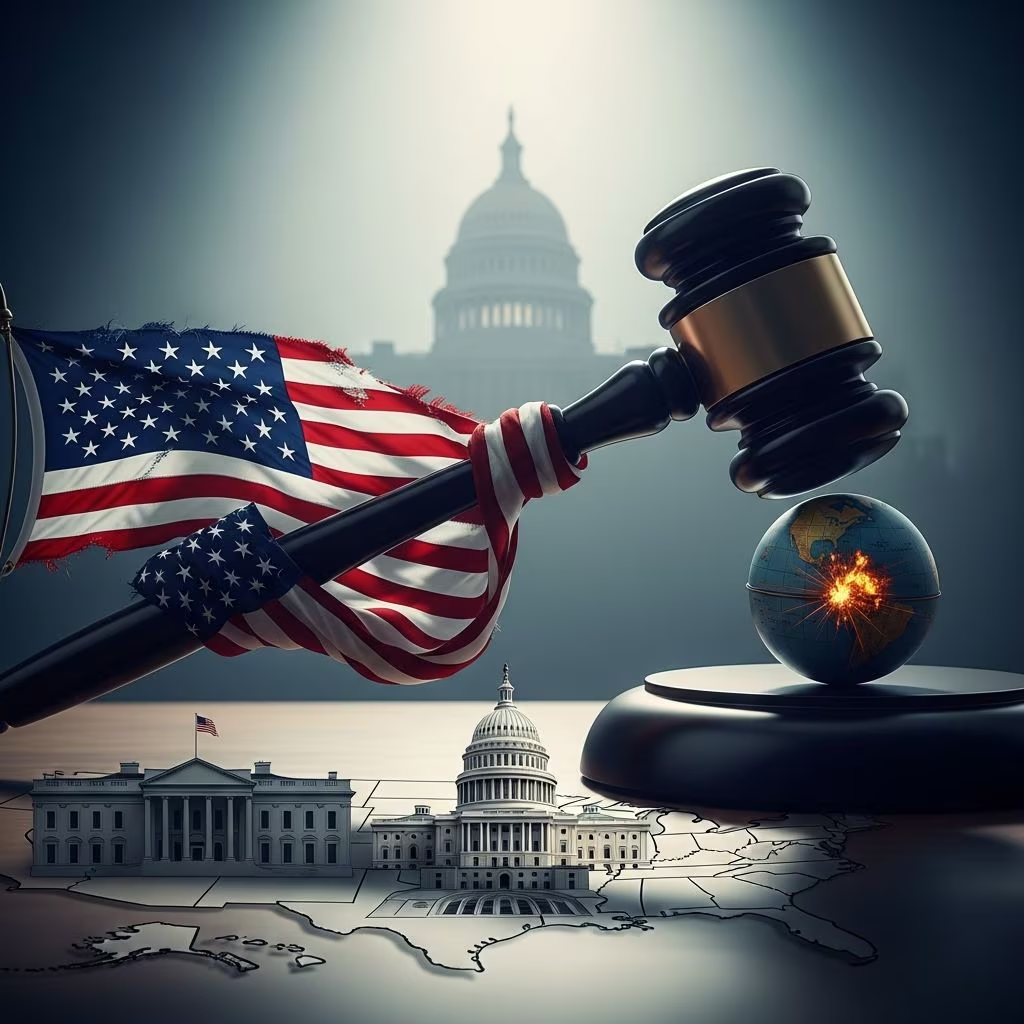
The question of whether the president can attack another country without congressional approval lies at the center of the United States Constitution, modern security threats, and decades of political practice. The short legal answer is: the president has limited authority to use force alone, but Congress holds the exclusive power to formally authorize war.
This article explains how the Constitution divides war powers, when presidents have acted without Congress, what the War Powers Resolution requires, and what that means for future conflicts.
Constitutional Basics: Who Holds War Powers?
The framers of the Constitution deliberately split responsibility for war between Congress and the president, aiming to prevent unilateral decisions that could drag the nation into costly conflicts.
| Institution | Key War-Related Powers | Constitutional Basis |
|---|---|---|
| Congress |
| Article I, Section 8 |
| President |
| Article II, Section 2 |
Most constitutional scholars agree that only Congress can declare war and that this is an exclusive legislative power. Disagreement arises around the gray area between a formal declaration of war and smaller or shorter military actions directed by the president.
Three Core Questions Behind Presidential Uses of Force
Any time a president considers military action without new, specific congressional authorization, three legal questions typically arise:
- Is the action defensive or offensive? Defensive actions to repel attacks are more widely accepted as part of the president’s inherent authority.
- How large and long-lasting is the operation? The more sustained and extensive the conflict, the stronger the argument that Congress must authorize it.
- Is there an existing statute that already authorizes force? Broad Authorizations for Use of Military Force (AUMFs) may provide legal cover even without a new vote.
Congress’s Power to Declare War
Article I, Section 8 of the Constitution gives Congress the power to “declare War,” widely understood as the authority to initiate significant hostilities.
Over time, Congress has used different tools to authorize military action:
- Formal declarations of war (rare in modern practice)
- Authorizations for Use of Military Force (AUMFs) tailored to specific enemies or regions
- Appropriations and other statutes that can be read to support some military operations
After the attacks of September 11, 2001, for example, Congress passed a broad AUMF enabling the president to use force against those responsible for the attacks and associated groups. That single authorization has since been invoked as the legal basis for operations in multiple countries far beyond Afghanistan.
Presidential Commander-in-Chief Authority
The president’s role as Commander in Chief gives control over how wars are fought—but not unlimited authority to start wars.
Scholars and courts generally accept three main areas where the president has independent room to act:
- Repelling sudden attacks against the United States, including protection of U.S. forces and sometimes citizens abroad.
- Short-term or limited operations that are argued not to rise to the level of “war” in the constitutional sense (for example, brief airstrikes or rescue missions), though this is heavily disputed.
- Deployments without immediate hostilities, such as moving forces to a region as a deterrent, before any actual combat begins.
The Supreme Court has been cautious about defining the outer boundaries of this authority and often avoids direct rulings on when a president may initiate hostilities.
The War Powers Resolution of 1973
In response to presidentially driven conflicts, especially in Southeast Asia, Congress enacted the War Powers Resolution (WPR) over President Nixon’s veto in 1973. The statute aims to restore congressional control over decisions to place U.S. forces into hostilities.
Key Requirements of the War Powers Resolution
When the president sends U.S. armed forces into hostilities or situations where hostilities are clearly imminent, the WPR requires:
- Reporting within 48 hours to Congress, explaining the circumstances, legal basis, and estimated scope of involvement.
- A 60-day clock for hostilities, plus 30 additional days for safe withdrawal, unless Congress declares war or authorizes continued force.
- Congressional power to direct withdrawal through a concurrent resolution (though this mechanism has itself raised constitutional questions).
Presidents from both parties have often treated the WPR’s limits as politically, rather than legally, binding and frequently contest whether particular operations even trigger its requirements.
Examples of Presidential Military Action Without Declarations of War
Modern U.S. history is full of instances where presidents have used force without a formal declaration of war and sometimes without any new specific authorization. The National Constitution Center notes that operations in Korea, Vietnam, Libya, Grenada, Lebanon, and other countries proceeded without declarations of war.
While the underlying legal justifications differ, rationales generally fall into one or more of these categories:
- Existing congressional authorization (e.g., a prior AUMF or broadly worded statute)
- Collective self-defense or defense of U.S. personnel or allies
- Humanitarian or “limited” missions framed as short, targeted uses of force
- UN or treaty commitments sometimes cited as political, though not constitutional, justification for action
How Far Can the President Go Without Congress?
Experts often group presidential uses of force into several categories to evaluate whether congressional authorization is required.
| Type of Use of Force | Typical Legal View | Need for Congressional Approval? |
|---|---|---|
| Repelling sudden attacks on the U.S. | Core commander-in-chief authority | Generally no, at least for immediate defense |
| Limited, short-term strikes or rescues | Highly contested; often framed as not full “war” | Many presidents say no; many scholars say yes if serious or prolonged |
| Sustained military campaigns or regime change | Generally understood as “war” in constitutional sense | Yes, Congress should authorize |
| Operations under broad, existing AUMFs | Depend on how widely the AUMF is interpreted | Often treated as already authorized, though critics disagree |
Authorizations for Use of Military Force and Their Stretching
Instead of frequent formal declarations of war, Congress has often passed Authorizations for Use of Military Force (AUMFs) that presidents then interpret broadly.
Two AUMFs are particularly important:
- 2001 AUMF: Authorizes force against those responsible for the 9/11 attacks and associated forces. It has been used as a legal basis for counterterrorism in multiple countries over many years.
- 2002 Iraq AUMF: Initially aimed at the threat posed by Saddam Hussein’s regime in Iraq, later cited to support other military activities in the region.
According to policy groups and legal scholars, successive administrations have “overread” these authorizations, applying them to new enemies and theaters that Congress arguably never contemplated. This has effectively shifted significant war-making power toward the presidency.
Congressional Oversight and the Push to Rebalance War Powers
Legal organizations and bipartisan members of Congress have advocated for reforms to restore the original balance of constitutional war powers.
Common reform proposals include:
- Repealing or replacing outdated AUMFs (especially the 2001 and 2002 authorizations)
- Modernizing the War Powers Resolution to create clearer triggers and enforceable consequences for unauthorized hostilities
- Requiring regular re-authorization of ongoing conflicts through sunset clauses
- Improving transparency by mandating public reporting on legal justifications and geographic scope of operations
The Brennan Center for Justice, for example, supports repealing old AUMFs and strengthening the WPR so that decisions on war and peace remain democratic, transparent, and accountable.
Practical Takeaways: When Is Congressional Approval Required?
While no single formula resolves all disputes, the following general principles reflect mainstream constitutional interpretation and practice:
- Formal war or major, sustained conflict: Congress must authorize through a declaration or AUMF.
- Defensive response to an actual or imminent attack: The president may use force without prior approval, but continued operations still implicate Congress’s role.
- Limited or short-term operations: The president often claims authority to act alone, yet the War Powers Resolution requires prompt notification and sets time limits without congressional authorization.
- Operations under existing AUMFs: Legally grounded in statute, though controversial when stretched far from the original context.
In other words, the president cannot unilaterally launch and sustain a full-scale war, but does retain significant emergency and limited-use authority absent prior congressional approval.
Frequently Asked Questions (FAQs)
Q: Does the president need Congress to order any single airstrike?
Not always. Presidents have often ordered limited airstrikes without new authorization, arguing they fall within commander-in-chief powers and do not rise to the level of a constitutional “war.” Critics contend that if such strikes are part of a broader campaign, congressional approval is required.
Q: Can the president start a war if Congress stays silent?
Most scholars say that initiating a true war requires congressional authorization, regardless of silence. However, presidents sometimes interpret congressional inaction, funding votes, or informal support as implicit approval, which is controversial.
Q: What happens if the president violates the War Powers Resolution?
The WPR does not contain automatic criminal penalties. Instead, enforcement usually depends on Congress using its political tools: cutting off funds, passing binding legislation, or pursuing litigation. Courts often avoid ruling directly on these disputes, citing separation of powers concerns.
Q: Are UN or NATO obligations a substitute for congressional authorization?
No. International commitments may create political or diplomatic reasons to act, but they do not override the U.S. Constitution. Most experts agree that only Congress can authorize war for domestic law purposes, even if an operation is carried out under a UN or NATO mandate.
Q: Why are old AUMFs still important today?
Because the 2001 and 2002 AUMFs have been interpreted broadly, they continue to provide a legal foundation for many counterterrorism and regional operations. That is why debates over repealing or updating them are central to the larger struggle over presidential and congressional war powers.
References
- The President’s War Powers — Friends Committee on National Legislation. 2022-02-01. https://www.fcnl.org/warpowers
- War Powers — Brennan Center for Justice. 2023-06-15. https://www.brennancenter.org/war-powers
- War Powers — Legal Information Institute, Cornell Law School. 2021-08-10. https://www.law.cornell.edu/wex/war_powers
- Interpretation: Declare War Clause — National Constitution Center. 2020-09-17. https://constitutioncenter.org/the-constitution/articles/article-i/clauses/753
- War Powers Resolution of 1973 — Richard Nixon Presidential Library and Museum, National Archives. 2019-11-21. https://www.nixonlibrary.gov/news/war-powers-resolution-1973
- War Powers Resolution Reporting Project — Reiss Center on Law and Security, NYU School of Law. 2024-01-05. https://warpowers.lawandsecurity.org
- War Powers Resolution: Expedited Procedures in the House and Senate — Congressional Research Service. 2023-05-30. https://www.congress.gov/crs-product/R47603