
Practical GDPR Compliance Guide for Global Companies
A clear, practical roadmap to help non‑EU businesses understand, assess, and achieve meaningful GDPR compliance across their operations.
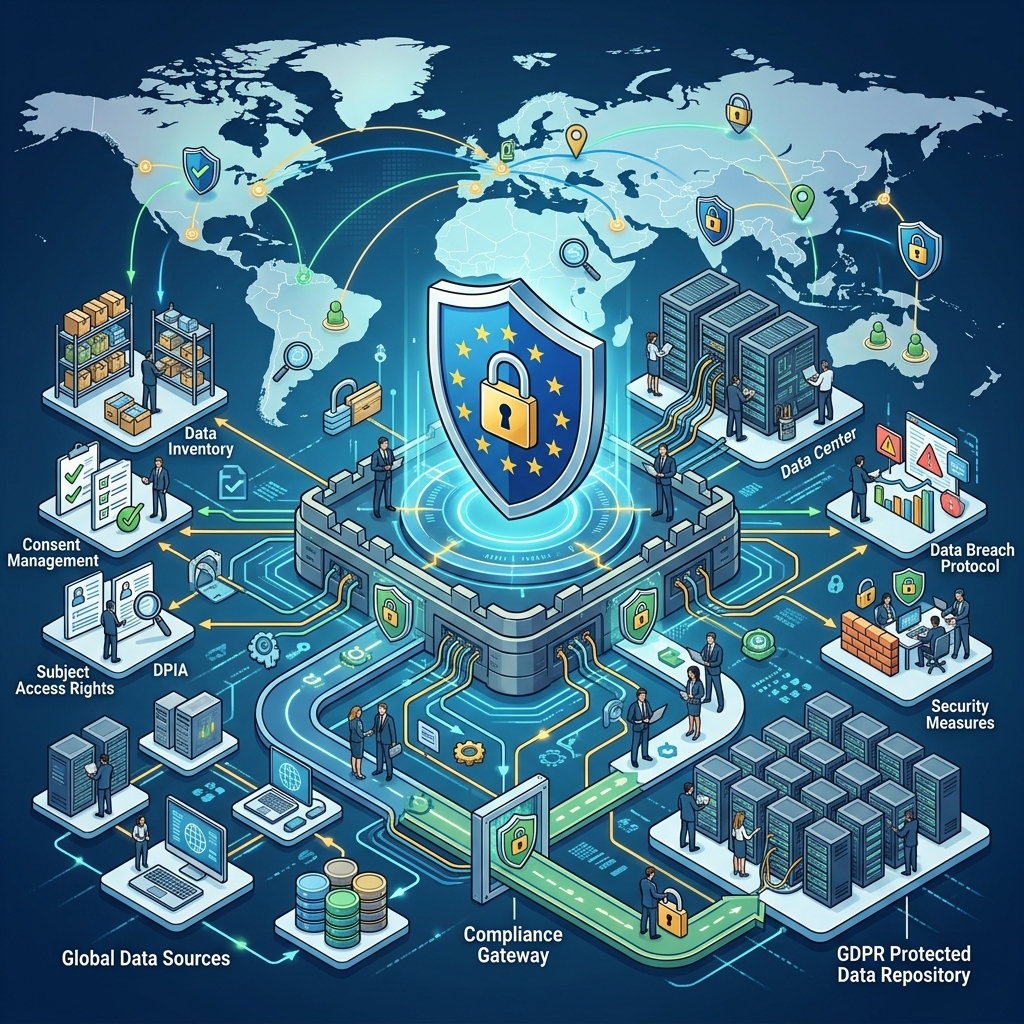
The General Data Protection Regulation (GDPR) is often perceived as a European law that only applies to businesses established in the EU. In reality, any organization worldwide that processes personal data of individuals in the European Union may be subject to the GDPR, regardless of where the company is headquartered. For global businesses, especially those based in the United States or other non‑EU jurisdictions, understanding when the GDPR applies and how to build a sustainable compliance program is essential to managing regulatory, reputational, and security risk.
This article offers a practical, non‑technical roadmap that mirrors the main themes of official guidance while presenting an original, accessible structure. It focuses on how companies can determine whether the GDPR applies, what core obligations they face, and how to implement a compliance framework that is workable in a real business environment.
Understanding When the GDPR Applies to Your Company
The GDPR protects the personal data of individuals in the EU and applies to organizations that either have an establishment in the EU or offer goods or services to people in the EU or monitor their behavior, such as through tracking technologies. For non‑EU companies, the starting point is to analyze whether their activities bring them within this scope.
Key questions to assess applicability
- Do you process personal data of individuals located in the EU? Personal data includes any information that can directly or indirectly identify a person, such as names, email addresses, customer IDs, IP addresses, or device identifiers.
- Are you intentionally targeting EU customers or users? Examples include offering a website in EU languages, accepting payment in EU currencies, or explicitly marketing to EU countries.
- Are you monitoring behavior of individuals in the EU? This could include behavioral advertising based on cookies, analytics that profile user habits, or location tracking.
- Do your business partners require GDPR compliance? Even if your exposure appears limited, contracts with EU‑based customers or vendors may impose GDPR obligations.
If the answer to any of these questions is yes, your organization should assume that the GDPR is relevant and move on to building a compliance strategy tailored to the scope and nature of your processing activities.
Building a GDPR Compliance Roadmap
Once you have confirmed (or strongly suspect) that the GDPR applies, the next challenge is turning broad legal requirements into concrete steps. Official guidance for non‑EU companies emphasizes the importance of understanding what data you process, how you use it, and why, before you attempt to adjust policies or technical controls.
Core stages of a typical compliance journey
- Scoping and information audit
- Mapping processing activities and purposes
- Establishing legal bases for processing
- Designing privacy notices and consent mechanisms
- Strengthening security and breach readiness
- Managing vendors and cross‑border transfers
- Appointing key roles and documenting accountability
Many global companies begin with high‑risk or high‑visibility processing activities, such as public‑facing websites, customer databases, and cloud services, and expand from there. This risk‑based prioritization helps you allocate resources to the areas most likely to attract regulatory scrutiny or complaints.
Step 1: Conduct a Structured Information Audit
A GDPR‑aligned information audit is the backbone of your compliance program. You cannot comply with principles such as data minimization, transparency, or purpose limitation if you lack a clear picture of what data you hold, where it resides, and who can access it.
What to capture in your data mapping exercise
- Categories of personal data (e.g., contact details, account credentials, transaction data, device identifiers).
- Sources of data such as website forms, apps, customer service interactions, marketing campaigns, or third‑party data feeds.
- Systems and locations where data is stored or processed, including on‑premises servers, cloud platforms, and third‑party tools.
- Recipients of personal data, such as payment processors, hosting providers, analytics services, or group companies.
- Retention periods associated with each category of personal data and justification for keeping the data for that length of time.
For many organizations, it is helpful to maintain a central register or inventory of processing activities. This not only supports GDPR record‑keeping duties but also becomes the reference point for reviewing new projects, assessing risks, and responding to data subject requests.
Including online tracking and cookies
Website cookies and similar technologies are sometimes overlooked in internal audits, yet they can involve extensive tracking of user behavior. Running your website through a cookie or tracker scanner helps surface third‑party scripts and tools that may process personal data for analytics, advertising, or functionality.
Step 2: Define Purposes and Legal Bases for Processing
The GDPR requires each processing activity to have a clearly defined purpose and at least one lawful basis for processing, such as consent, contract necessity, legal obligation, vital interests, public task, or legitimate interests. Non‑EU companies often rely heavily on contract necessity and legitimate interests, but they must document these bases appropriately.
Linking purposes and lawful bases
| Example Purpose | Typical Lawful Basis | Key Considerations |
|---|---|---|
| Processing orders and delivering services | Performance of a contract | Ensure data is necessary for the service and not reused for unrelated purposes. |
| Sending service‑related notifications | Legitimate interests or contract | Balance business needs with user expectations and offer opt‑out where appropriate. |
| Behavioral advertising and tracking | Consent | Require clear, informed consent and easy withdrawal mechanisms. |
| Legal or regulatory reporting | Legal obligation | Retain data only as long as necessary to meet specific statutory requirements. |
When relying on legitimate interests, organizations should record their assessment of why the processing is necessary and how the impact on individuals has been minimized. This documentation can be valuable if regulators question the basis in the future.
Step 3: Design Clear Privacy Notices and Consent Flows
Transparency is one of the core GDPR principles. Organizations must clearly explain who is processing personal data, why, the legal basis, who the data will be shared with, how long it will be stored, and what rights individuals have. This information is typically provided through privacy notices or policies that should be accessible and written in understandable language for the target audience.
Essential elements of a GDPR‑aligned privacy notice
- Identity and contact details of the organization (and any EU representative, if required).
- Categories of personal data collected and how they are obtained.
- Purposes of processing and corresponding legal bases.
- Recipients or categories of recipients, including third‑party service providers.
- Retention periods or criteria for determining how long data is stored.
- Summary of data subject rights, including access, rectification, erasure, restriction, objection, and portability.
- Information about international data transfers and safeguards used.
Managing consent responsibly
Where consent is used as a lawful basis, the GDPR requires that it be freely given, specific, informed, and unambiguous. Organizations should present consent requests separately from other terms, avoid bundling consent with product access, and allow individuals to withdraw consent at any time without penalty.
To demonstrate compliance, businesses should log consent decisions, including the time, method, and context of consent, and ensure that systems can respect revocations. This is particularly important for marketing communications and analytics or advertising cookies.
Step 4: Strengthen Security and Breach Preparedness
GDPR compliance is not only about documentation; it also requires appropriate technical and organizational measures to protect personal data. The regulation highlights concepts such as data protection by design and by default, and encourages measures like encryption, pseudonymization, and robust access controls.
Recommended security practices
- Encrypt data in transit and at rest where feasible to mitigate the impact of breaches.
- Pseudonymize personal data so that identifiers are stored separately from other attributes, reducing risk of direct identification.
- Implement role‑based access controls to limit personal data access to staff who genuinely need it.
- Regularly test and review security controls to evaluate their effectiveness and resilience over time.
- Maintain incident response procedures that cover detection, investigation, containment, and notification of breaches.
The GDPR sets strict timelines for notifying supervisory authorities and, in certain cases, affected individuals when a personal data breach occurs. Companies must be able to quickly identify which data was involved, assess risks, and determine whether notification thresholds are met.
Step 5: Manage Vendors and International Data Transfers
Few modern organizations process all personal data in‑house. Cloud providers, payment processors, analytics tools, and other vendors often act as processors or sub‑processors under the GDPR. Controllers must ensure these relationships are governed by contracts that contain specific data protection clauses and obligations.
Key elements in data processing agreements
- Subject matter, nature, and duration of the processing.
- Types of personal data and categories of data subjects affected.
- Instructions from the controller and limits on how the processor may use the data.
- Confidentiality obligations for personnel handling personal data.
- Security measures and assistance with breach notification and data subject requests.
- Conditions for engaging sub‑processors and requirements for transparency.
Where personal data is transferred outside the EU, companies must also comply with cross‑border transfer rules and ensure that appropriate safeguards, such as standard contractual clauses or other mechanisms recognized under EU law, are in place.
Step 6: Appoint Roles and Demonstrate Accountability
Depending on the scale and nature of processing, some organizations are required to appoint a Data Protection Officer (DPO), particularly where they engage in large‑scale, regular, and systematic monitoring or process special categories of data on a significant scale. Non‑EU organizations subject to the GDPR may also need to designate a representative in the EU to serve as a contact point for supervisory authorities and individuals.
Accountability in practice
- Maintaining up‑to‑date records of processing activities, grounded in your information audit.
- Documenting impact assessments for high‑risk processing, such as new profiling initiatives.
- Training employees regularly on data protection responsibilities and escalation paths.
- Embedding privacy considerations into project planning and procurement processes.
Demonstrable accountability can significantly influence how regulators view your organization in the event of an inquiry or incident. Having documented risk assessments, policies, and ongoing reviews shows that you treat data protection as a continuous obligation rather than a one‑off compliance exercise.
Practical Tips for Non‑EU Companies
Non‑EU organizations often face additional challenges because they must align GDPR requirements with local laws and industry practices. Nonetheless, several practical strategies can help make the compliance process more manageable.
- Start with high‑impact processes such as customer databases, marketing platforms, and core service environments before tackling peripheral systems.
- Use checklists and templates based on authoritative guidance to standardize assessments and documentation.
- Engage stakeholders early including IT, security, legal, marketing, and operations, to ensure that privacy controls are technically and commercially feasible.
- Align with broader security frameworks so that measures implemented for GDPR also strengthen cyber resilience and incident response.
- Review arrangements regularly as new tools, partners, and business models are introduced.
Frequently Asked Questions (FAQs)
1. Does the GDPR apply if my company has no offices in the EU?
Yes, the GDPR can apply to organizations with no physical presence in the EU if they offer goods or services to individuals in the EU or monitor their behavior, such as through tracking technologies or profiling.
2. How serious are the penalties for noncompliance?
The GDPR allows for significant administrative fines, with maximum penalties reaching up to 4% of a company’s annual worldwide turnover or EUR 20 million, whichever is higher, for certain serious violations.
3. What is the difference between a controller and a processor?
A controller decides why and how personal data is processed, while a processor processes data on behalf of the controller. Each has distinct obligations under the GDPR, and their relationship must be defined in a contract that meets regulatory requirements.
4. Do I always need consent to process personal data?
No. Consent is one of several lawful bases. Many business activities rely on performance of a contract, compliance with legal obligations, or legitimate interests. However, for activities such as certain types of marketing or tracking, consent may be the most appropriate or required basis.
5. How often should I review my GDPR compliance program?
GDPR compliance should be reviewed regularly, particularly when new systems, vendors, or business models are introduced. Annual or bi‑annual reviews, combined with targeted assessments for major projects, help maintain alignment with evolving technology and regulatory expectations.
References
- Data protection under GDPR — European Commission, Your Europe. 2023-05-01. https://europa.eu/youreurope/business/dealing-with-customers/data-protection/data-protection-gdpr/index_en.htm
- GDPR compliance checklist for US companies — GDPR.eu. 2023-04-10. https://gdpr.eu/compliance-checklist-us-companies/
- Everything you need to know about GDPR compliance — GDPR.eu. 2023-04-10. https://gdpr.eu/compliance/
- GDPR in the US: Compliance Simplified for Businesses — Termly. 2023-02-15. https://termly.io/resources/articles/gdpr-in-the-us/
- What Is GDPR Compliance? — Palo Alto Networks Cyberpedia. 2023-03-20. https://www.paloaltonetworks.com/cyberpedia/gdpr-compliance
- What US-Based Companies Need to Know About the GDPR, and … — Dickinson Wright. 2018-05-22. https://www.dickinson-wright.com/news-alerts/what-usbased-companies-need-to-know
Similar Articles








Read full bio of Sneha Tete


