
Post-Conviction DNA Testing: Law, Process, and Impact
How modern DNA testing helps correct wrongful convictions and reshapes post-conviction criminal procedure.
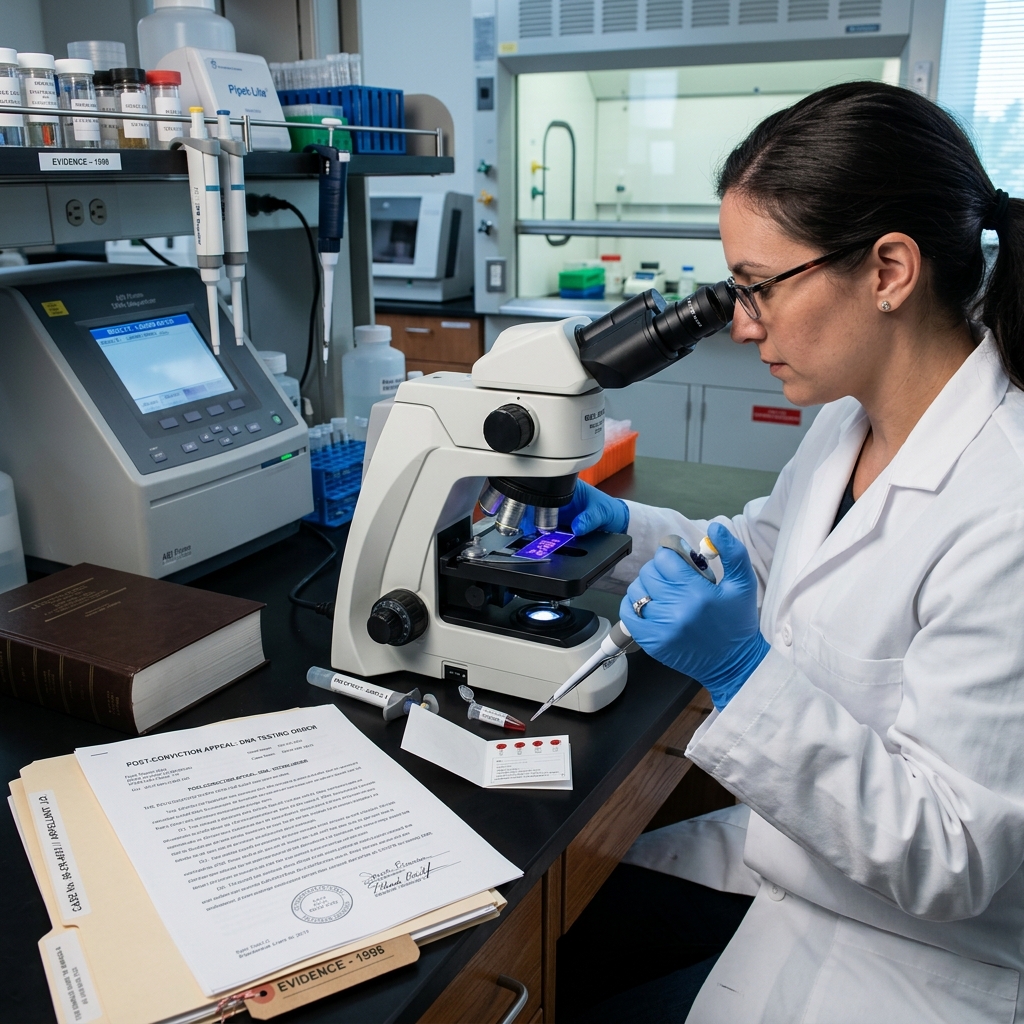
DNA evidence has transformed criminal justice, not only by helping courts convict the right people, but also by providing a powerful tool to revisit and correct past mistakes after a conviction has already been entered.
Post-conviction DNA testing gives incarcerated individuals a way to demonstrate that they were wrongly convicted, yet access to this testing is tightly controlled by statutes and court rules.
Why DNA Evidence Matters After Conviction
In most trials today, prosecutors and defense lawyers rely on DNA evidence to support their narrative of what happened and who was involved.
Once a jury returns a guilty verdict, the presumption of innocence disappears and the burden of proof shifts to the convicted person, which makes reopening a case difficult.
- Scientific reliability: Modern DNA analysis can link biological material to specific individuals with very high accuracy, or exclude them as possible sources.
- Retrospective power: Stored biological samples—such as blood, semen, or saliva—can be tested years after a conviction using more advanced techniques than were available at the time of trial.
- Impact on innocence claims: A single profile showing that DNA recovered from the crime scene does not belong to the inmate can be strong evidence of wrongful conviction, especially where identity was central to the case.
Because of this potential, legislatures and courts have created specific rules for when and how a convicted person can ask for DNA testing long after judgment.
Typical Situations That Lead to Post-Conviction DNA Requests
Post-conviction DNA testing is not appropriate in every case. It tends to focus on situations where biological evidence can genuinely change the outcome or undermine confidence in the verdict.
When Testing Was Not Available or Not Used
- No DNA methods at the time: Some convictions predate routine DNA testing, meaning the evidence was never examined using genetic methods.
- Limited or outdated technology: Earlier tests might have been less sensitive or less discriminating than current methods, so new testing could yield more probative results.
- Tactical decisions at trial: A defendant may have declined testing originally for strategic reasons, such as a fear the results would be incriminating. Many laws now restrict access if the evidence could have been tested but was not.
When Results Could Undermine the Conviction
Judges typically ask whether new DNA evidence, if obtained, could reasonably affect the verdict or sentence.
- Possible exoneration: DNA testing might show that the biological material at the center of the case—such as semen in a sexual assault—does not belong to the prisoner, strongly supporting innocence.
- Confidence in the verdict: Results may not conclusively prove innocence, but they can still justify overturning a conviction if they call the reliability of the original judgment into serious doubt.
- Identity at issue: Many statutes require that the identity of the perpetrator was disputed at trial; DNA is most helpful in cases where the central question was “who did it?” rather than “what happened?”.
Legal Framework: Federal and State Rules
Post-conviction DNA testing is governed by a mix of federal and state law. Each jurisdiction defines its own procedures and standards for granting access to evidence.
| Level of Law | Key Features | Typical Requirements |
|---|---|---|
| Federal law | 18 U.S.C. § 3600 allows federal inmates to seek post-conviction DNA testing under specified conditions. | Written motion, identity at issue, material evidence, reasonable probability of innocence, and provision of a comparison sample. |
| State statutes | Every state has some mechanism for post-conviction testing, but standards and procedures vary widely. | Eligibility limits, due diligence rules, filing deadlines, and standards on how strongly the new evidence must affect the verdict. |
| Constitutional law | The U.S. Supreme Court has declined to recognize a broad constitutional right to post-conviction DNA access, leaving most decisions to state legislatures and courts. | Inmates must rely primarily on statutory rights and procedural protections, rather than a freestanding constitutional entitlement. |
Federal Statute: 18 U.S.C. Section 3600
At the federal level, Congress enacted a detailed procedure for DNA testing through 18 U.S.C. section 3600.
- Written motion requirement: The inmate must submit a written motion to the court that imposed the conviction, specifying the evidence to be tested.
- Materiality and identity: The law requires that identity was at issue and that the proposed testing could produce new material evidence supporting a defense theory and raising a reasonable probability the inmate did not commit the offense.
- Timeliness rules: The statute creates a rebuttable presumption of timeliness for motions filed within certain time windows after conviction or enactment of the law.
- Effect of results: If DNA testing excludes the applicant as the source, courts can permit motions for a new trial or resentencing, even if such motions would otherwise be time-barred.
State-Level Variation
Although all states provide some form of post-conviction DNA access, the details differ significantly from one jurisdiction to another.
- Eligibility by offense: Some states limit access to certain serious felonies, such as homicide or sexual assault.
- Due diligence requirements: Courts may deny testing when the defendant could have sought DNA analysis earlier but failed to do so, especially if the evidence was discoverable at the time of trial.
- Time limits: Many statutes impose filing deadlines, sometimes only a few years after conviction, which may expire before technological advances make testing plausible.
- Evidentiary standards: In some jurisdictions, the applicant must show that new testing would probably change the verdict; in others, it is enough that the results could reasonably affect the outcome.
Core Requirements to Qualify for Post-Conviction DNA Testing
Despite differences among jurisdictions, several common requirements shape whether an inmate will be granted DNA testing after conviction.
Presence and Condition of Biological Evidence
- Existence of samples: The conviction must involve biological evidence such as blood, semen, or saliva that is relevant to the case.
- Preservation of evidence: The sample must still exist and be suitable for testing. In practice, evidence is often lost, degraded, or destroyed after trial, which can make post-conviction analysis impossible.
- Chain of custody: Courts generally require reliable documentation showing how the evidence was handled to ensure that the sample being tested is the same material introduced at trial.
Legal and Procedural Conditions
- Credible claim of innocence: Many statutes expect the applicant to assert actual innocence, supported by a plausible explanation of how DNA results would show that they did not commit the offense.
- Potential impact on verdict: Judges decide whether the proposed testing is likely to produce results that could, alone or with other evidence, alter the outcome of the original trial.
- Compliance with deadlines: Applicants must usually act within specified time limits once new evidence or technology becomes available, unless statutes provide exceptions for particularly compelling claims.
- No bad faith use of the process: Courts may deny testing if they conclude that a prisoner is using DNA requests as a delay tactic or where there is clear evidence the claim of innocence is false.
How the Post-Conviction DNA Testing Process Works
Although procedures vary, most post-conviction DNA requests follow a set of recognizable steps.
1. Identifying a Potential Case
- Reviewing trial records: Defense lawyers or innocence organizations examine transcripts, police reports, and lab notes to determine whether biological evidence exists that could be tested.
- Locating evidence: Investigators must find where the evidence is stored—often in police property rooms, court archives, or forensic laboratories—and verify its condition.
2. Filing a Motion or Petition
- Written request to the court: The applicant files a motion explaining what evidence should be tested, why DNA analysis is appropriate, and how the results could affect the conviction.
- Statutory grounds: The motion must show that the case meets the specific criteria in the relevant statute, such as identity being at issue and evidence being previously untested.
3. Judicial Review and Orders
- Assessment of statutory factors: Judges evaluate whether all conditions are satisfied and whether proposed testing could yield probative results rather than speculation.
- Order for testing: If the motion is granted, the court issues an order directing a laboratory to perform DNA analysis under defined protocols.
4. Interpreting and Using Test Results
- Conclusive exclusion: If results show that the inmate is not the source of key biological evidence, statutes often allow a motion for a new trial or resentencing, even where other deadlines would normally block relief.
- Inconclusive results: The law may permit additional testing or allow the court to deny relief if the evidence does not clearly support innocence or undermine the conviction.
- Secondary consequences: New results can influence parole decisions, plea negotiations, or broader reviews of systemic issues like forensic practices.
Limitations, Barriers, and Policy Concerns
Despite its promise, post-conviction DNA testing is not a universal remedy. Practical, legal, and financial barriers often prevent inmates from obtaining or benefiting from testing.
Evidence Preservation Problems
- Destruction of old evidence: For many older cases, police or laboratories discarded biological evidence once a conviction was secured, especially before DNA testing became routine.
- Degradation over time: Biological samples can degrade, making accurate DNA profiling difficult or impossible unless they were stored properly and processed promptly.
Restrictive Legal Standards
- High proof thresholds: Some states demand that testing will definitely exonerate the inmate, a standard that is difficult to satisfy before results are known.
- Short deadlines: Legislatures sometimes impose narrow windows for filing, which may close before new technologies develop or before inmates can locate evidence and legal assistance.
- No constitutional guarantee: Because courts have held that there is no general constitutional right to post-conviction DNA testing, inmates must rely primarily on statutory provisions that may be narrow or incomplete.
Institutional Resistance and Cost Issues
- Reluctance to reopen cases: Judges and prosecutors may resist testing because granting relief can question the integrity of past convictions and create workload pressures for courts and offices.
- Financial burdens: Many programs place the cost of testing on defendants or their legal teams, even though sophisticated analysis can be expensive.
- Need for funding: Federal initiatives, such as the Bureau of Justice Assistance programs, provide support to jurisdictions for case review and testing, but resources are limited and unevenly distributed.
Relief and Compensation After DNA-Based Exoneration
When post-conviction DNA testing leads to exoneration, the consequences extend beyond release from custody.
- Vacating convictions: Courts can set aside judgments, order new trials, or adjust sentences based on exculpatory DNA results.
- Government compensation: Federal law provides monetary compensation to wrongfully convicted individuals exonerated through DNA testing, up to a specified cap per year of incarceration.
- Policy reforms: DNA exonerations often spur reforms in evidence preservation, forensic practices, eyewitness identification procedures, and statewide standards for post-conviction review.
Frequently Asked Questions (FAQs)
Who can request post-conviction DNA testing?
Generally, people convicted of crimes involving biological evidence—especially serious felonies like sexual assault or homicide—may request testing if they meet the statutory criteria in their jurisdiction.
Is there a constitutional right to post-conviction DNA testing?
According to U.S. Supreme Court precedent, there is no freestanding constitutional right for inmates to access state-held DNA evidence for post-conviction testing. Access is instead defined by federal and state statutes, and procedural due process principles.
What happens if the DNA results are inconclusive?
If testing does not clearly include or exclude the inmate, courts may order additional testing if appropriate or may deny relief, depending on the statutory framework and the broader evidentiary record.
Does a negative DNA result automatically free an inmate?
No. Exclusionary results can be powerful evidence of innocence, but judges still weigh all other evidence. In some cases, DNA testing may lead to a new trial, while in others it may contribute to parole decisions or broader review without immediate release.
How quickly must an inmate apply for testing?
Deadlines vary. Federal law provides presumptions of timeliness for motions filed within specific timeframes, while many states impose their own limitations or allow late applications when new technology or evidence emerges.
References
- Post-Conviction Access to a State’s Forensic DNA Evidence for Probative Testing — Tennessee Journal of Law and Policy. 2010-01-01. https://ir.law.utk.edu/cgi/viewcontent.cgi?article=1162&context=tjlp
- Post-Conviction DNA Analysis — FindLaw. 2023-01-01. https://www.findlaw.com/criminal/criminal-procedure/post-conviction-dna-analysis.html
- Chapter 11: Using Post-Conviction DNA Testing to Attack Your Conviction — Columbia Jailhouse Lawyer’s Manual. 2021-02-01. https://jlm.law.columbia.edu/files/2021/02/18.-Chapter-11.pdf
- 18 U.S.C. Chapter 228A: Post-Conviction DNA Testing — U.S. Office of the Law Revision Counsel. 2024-01-01. https://uscode.house.gov/view.xhtml?path=/prelim@title18/part2/chapter228A&edition=prelim
- Defendants’ Access to Postconviction DNA Testing — National Institute of Justice. 2013-06-01. https://nij.ojp.gov/nij-hosted-online-training-courses/law-101-legal-guide-forensic-expert/depositions/uses-depositions/defendants-access-postconviction-dna-testing
- Postconviction Testing of DNA Evidence Program — Bureau of Justice Assistance. 2022-01-01. https://www.forensicstta.org/programs/postconviction-testing-of-dna-evidence-postconviction-program/
- DNA and the Fight for Freedom: How Post-Conviction Testing Is Changing the Justice System — The ISHI Report. 2025-02-01. https://promega.foleon.com/theishireport/the-ishi-report-february-2025/dna-and-the-fight-for-freedom-how-post-conviction-testing-is-changing-the-justice-system
Similar Articles








Read full bio of medha deb




