
Polygraphs and Lie Detectors in Criminal Cases
Explore how lie detector tests work, why courts question their reliability, and when polygraph evidence may matter in criminal investigations.
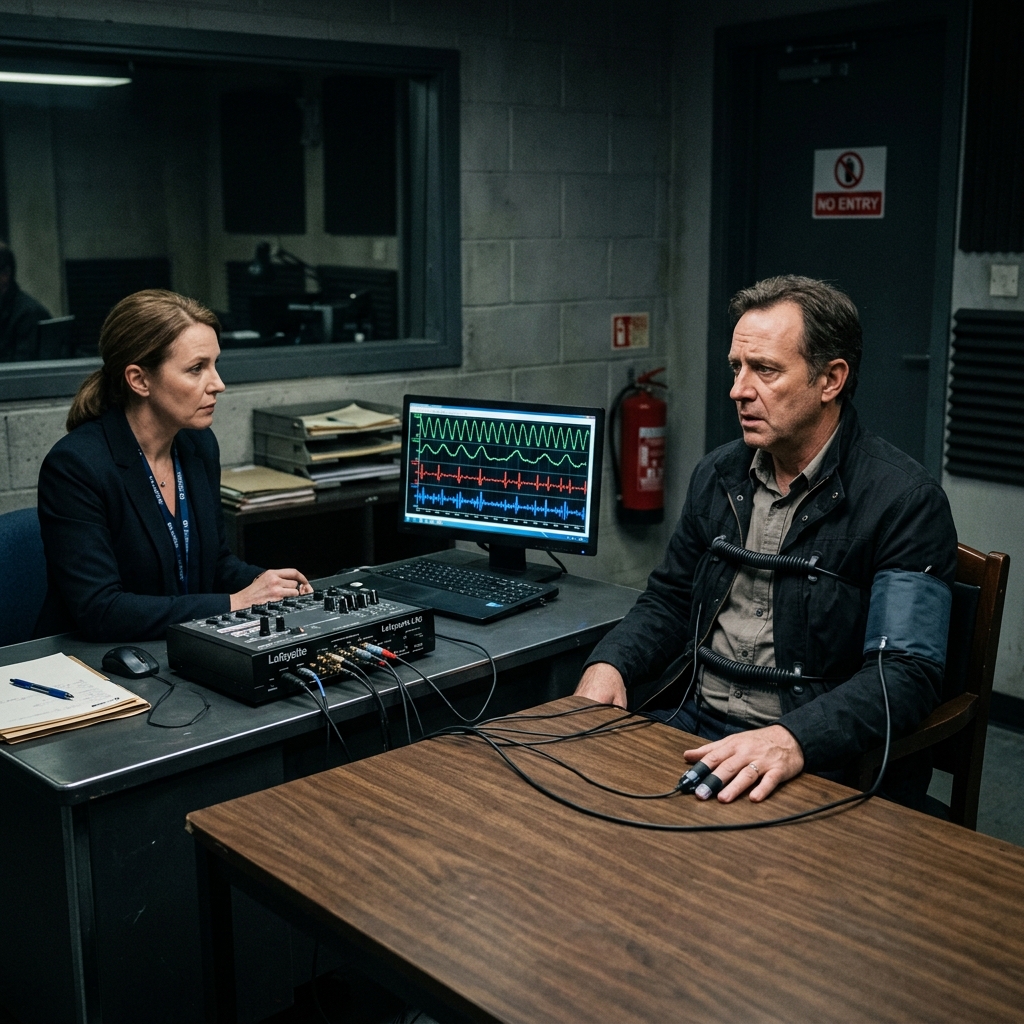
Polygraphs, commonly called lie detector tests, occupy a strange space in criminal law. They are familiar to the public from movies and television, widely used in some investigations and employment screening, yet rarely accepted as evidence in criminal trials. This article explains how polygraphs work, why their accuracy is disputed, and how courts and law enforcement actually treat polygraph results in practice.
Understanding What a Polygraph Really Measures
A polygraph does not detect lies directly. Instead, it records a person’s physiological responses while they answer questions, and an examiner interprets those responses as truthful or deceptive.
Typical measurements include:
- Heart rate and blood pressure – changes in cardiovascular activity
- Respiration – breathing rate and depth
- Skin conductivity – changes in sweating, often measured on the fingers
During a standard test, the examiner asks a series of questions, usually mixing neutral questions, background questions, and questions directly related to the incident being investigated. Many tests use a comparison question technique that contrasts responses to relevant questions with responses to control questions designed to provoke concern or mild anxiety.
If the person shows greater physiological arousal on relevant questions than on control questions, the examiner may conclude there is deception. If the pattern is reversed or unclear, the examiner may assess the person as truthful or label the result as inconclusive.
Core Limitations: Why Polygraphs Are Controversial
Despite their reputation, polygraphs have serious scientific and legal limitations. These limitations explain why courts are generally skeptical and why many legal systems sharply restrict their use.
No Unique Physiological Signature of Lying
Research in psychology and cognitive neuroscience highlights a fundamental problem: there is no known unique physiological pattern that corresponds specifically to lying. An honest person may feel anxious when answering truthfully, while a deceptive person may be calm and controlled. Many factors—fear, embarrassment, fatigue, confusion, previous trauma—can produce strong physiological reactions that have nothing to do with deception.
Accuracy Rates and Error Risks
Studies on polygraph accuracy show mixed results. Some proponents claim high accuracy when tests are carefully administered in specific incident investigations, often citing figures above 90%. Critics, including independent research bodies, have found significantly lower accuracy and highlight substantial error rates.
| Aspect | Proponents’ View | Independent Research View |
|---|---|---|
| General accuracy (specific incident) | Often claimed above 90% when properly conducted | Rates above chance, but clearly below perfection; significant errors |
| Screening use (e.g., employment/security) | Useful for identifying risk | Accuracy drops; insufficient for reliable screening in high-stakes settings |
| Risk of false positives | Downplayed | Innocent people can be misclassified as deceptive |
| Risk of false negatives | Downplayed | Deceptive individuals may pass as truthful, especially with countermeasures |
A major U.S. National Academies review concluded that polygraphs can distinguish truth from lies better than chance in some specific contexts but that their accuracy is far from reliable enough to support broad screening or decisive legal judgments. According to the American Psychological Association, cumulative research indicates that comparison-question techniques detect deception better than random guessing, yet they still generate substantial error rates, including both false positives and false negatives.
Problems with Real-World Validation
Scientists also point out that it is difficult to conduct rigorous validity studies on polygraphs in genuine criminal cases, because researchers rarely have absolute certainty about what the true facts are. Without a clear ground truth, it is hard to know whether the test correctly identified deception or truthfulness. This uncertainty contributes to ongoing debate over how much weight, if any, polygraph results should carry.
Countermeasures and Manipulation
Another concern is the possibility that subjects can learn techniques to deliberately alter their physiological responses—so-called countermeasures—such as controlled breathing patterns, muscle tension, or mental strategies designed to mask stress reactions. Even if these techniques are not universally effective, the possibility of manipulation further undermines confidence in the test.
How Courts Treat Polygraph Evidence
Because of these limitations, most courts have concluded that polygraph tests are not sufficiently reliable to be routinely presented to juries. In the United States, for example, appellate courts and the Supreme Court have repeatedly upheld decisions excluding polygraph evidence.
General Rule: Inadmissible as Evidence
In many jurisdictions, polygraph results are generally inadmissible in criminal trials. Judges often view them as expert opinions resting on contested science rather than objective measurements like DNA analysis or fingerprint comparison.
The U.S. Supreme Court has noted the absence of scientific consensus on polygraph reliability and has distinguished polygraph testimony from other forensic evidence, emphasizing that polygraph experts provide little more than another opinion on credibility. As a result, many courts follow rules that either exclude polygraph results entirely or allow them only under tightly controlled conditions.
Stipulation Exception: When Both Sides Agree
One common exception appears when both the prosecution and defense stipulate
- Parties may agree before the test that its results can be introduced.
- The agreement typically covers the conditions of the test and how results may be used.
- Courts may still impose procedural rules to ensure fairness, such as notice requirements and opportunities for each side to use its own expert.
Even where stipulation is allowed, lawyers often hesitate to rely on polygraphs. Agreeing to admit the results can be risky if the test does not go as expected, and judges retain discretion to exclude evidence that would mislead or confuse the jury.
Use in Impeachment or Corroboration
In some jurisdictions, polygraph results may be considered for limited purposes, such as impeaching a witness’s credibility or corroborating their testimony, rather than as direct proof of guilt or innocence. For example, a party might seek to show that a witness who claims to be truthful failed a polygraph, or that a witness passed a test in circumstances where credibility is a key issue.
Even in these cases, courts often require:
- Advance notice to the opposing party
- An opportunity for the other side to arrange a comparable test with its own expert
- Compliance with standard rules of evidence on expert testimony and reliability
Variation Across States and Countries
Legal treatment of polygraphs varies by jurisdiction. Some U.S. states prohibit their use entirely in criminal trials, while others permit limited use in certain contexts. A number of states allow admission only if both parties consent, and a few have more permissive rules for specific purposes.
Internationally, some countries permit government-administered polygraphs in national security investigations, but still restrict their role in court proceedings. This patchwork reflects ongoing disagreement about how much weight polygraph evidence deserves.
Polygraphs Outside the Courtroom
Even though polygraphs are rarely used as courtroom evidence, they remain common tools in non-judicial settings.
Criminal Investigations
Police and prosecutors may use polygraph tests during investigations to:
- Evaluate a suspect’s or witness’s statements
- Guide further questioning or investigative strategy
- Encourage cooperation by offering a test the person believes can demonstrate truthfulness
Importantly, investigators usually cannot force someone to take a polygraph. Individuals generally have the right to refuse testing without that refusal being treated as direct evidence of guilt in court. What a suspect says during the interview, however, may still be admissible separately from the test results.
Employment and Security Screening
Polygraph testing is also used in some employment contexts, particularly in government or law enforcement agencies involved in national security. In the United States, federal law prohibits most private-sector employers from using polygraphs, but there are exceptions for certain sensitive positions.
For security screening, agencies may use polygraphs to:
- Assess applicants for roles involving classified information
- Investigate potential security breaches
- Monitor employees working with high-risk data or operations
However, independent reviews have concluded that polygraph accuracy in broad screening is too limited to justify heavy reliance on results for critical personnel decisions.
Practical Considerations for Defendants and Witnesses
For people involved in criminal cases, polygraph requests can be confusing and high-pressure. Understanding the legal and practical implications is crucial.
Voluntary Nature of Testing
In most systems, agreeing to a polygraph test is voluntary. Suspects and witnesses can typically choose whether to participate. Before deciding, many people consult counsel to weigh potential benefits and risks.
Key points include:
- You generally have the right to decline a polygraph without that refusal being used as automatic proof of guilt.
- Statements you make during the interview portion of the test could still be used in court, even if the results are not.
- Once taken, a failed or disputed test may complicate negotiations with prosecutors, even if results are not admissible at trial.
Strategic Use by Defense Counsel
Defense attorneys sometimes consider polygraph testing as a strategy in specific situations, such as:
- Persuading prosecutors to drop charges or reduce counts if a client passes a credible test
- Supporting arguments for bail, probation conditions, or plea negotiations
- Preparing for potential stipulation-based admission where jurisdiction allows it
However, ethical and practical concerns mean many lawyers approach polygraphs cautiously. The unpredictability of results and the possibility of misclassification make them a tool to be used selectively rather than routinely.
Emerging Technologies and the Future of Lie Detection
Polygraphs are only one approach to lie detection. New technologies and methods—such as eye movement analysis, brain imaging, and advanced behavioral analytics—seek to offer more reliable ways to assess truthfulness.
For example, some systems measure changes in pupil dilation or subtle variations in eye behavior when people respond to questions, while others investigate neural activity patterns associated with memory and deception. Despite initial promise, courts and researchers remain cautious. As with traditional polygraphs, these technologies face challenges in demonstrating consistent, real-world reliability and avoiding unjustified inferences about guilt or innocence.
Legal systems are likely to continue treating lie detection technologies with skepticism unless and until robust, independent evidence shows clear, reproducible accuracy and manageable error rates.
Key Takeaways for Criminal Law
- Polygraphs measure physiological arousal, not lying itself.
- Scientific consensus is limited; there is no unique physiological marker for deception.
- Courtroom use is heavily restricted; in many jurisdictions, polygraph results are inadmissible unless both parties agree.
- Investigators and agencies still use polygraphs in non-judicial settings, including criminal investigations and security screening.
- Defendants and witnesses usually cannot be forced to take a polygraph and should seek legal advice before agreeing to a test.
Frequently Asked Questions About Polygraphs
Are polygraph results ever admissible in criminal trials?
In many jurisdictions, polygraph results are generally excluded from criminal trials because of concerns about reliability. However, some courts allow admission when both sides stipulate
Can the police force me to take a lie detector test?
Typically, police and prosecutors cannot compel you to undergo a polygraph test. Participation is usually voluntary, and you have the right to decline. Legal counsel can help you decide whether taking a test aligns with your interests in a particular case.
If I pass a polygraph, will charges be dropped?
Passing a polygraph does not guarantee that charges will be dropped. Prosecutors may consider the result as one piece of information, but they also look at other evidence, legal standards, and policy considerations. In some cases, a favorable test can support negotiations; in others, it carries little weight.
Why do some agencies still use polygraphs if courts don’t trust them?
Some agencies view polygraphs as useful investigative or screening tools, particularly in national security contexts, even though courts are skeptical about their reliability as formal evidence. For those agencies, polygraphs can prompt further inquiry or signal areas of concern, but they are generally not treated as definitive proof of truth or deception.
Are newer lie detection technologies more reliable than polygraphs?
Emerging methods, such as eye movement analysis and brain-based techniques, may offer improvements in some contexts, but they face similar challenges: proving consistent accuracy, minimizing error rates, and addressing ethical and legal concerns. For now, most courts treat these technologies as experimental and apply the same cautious approach they use for polygraph evidence.
References
- Lie detector test | Wex | US Law — Legal Information Institute, Cornell Law School. 2023-06-01. https://www.law.cornell.edu/wex/lie_detector_test
- Do “lie detectors” work? — American Psychological Association. 2004-11-01 (content referenced as a foundational scientific overview). https://www.apa.org/topics/cognitive-neuroscience/polygraph
- 262. Polygraphs—Introduction at Trial — U.S. Department of Justice, Criminal Resource Manual. 2018-01-01. https://www.justice.gov/archives/jm/criminal-resource-manual-262-polygraphs-introduction-trial
- The validity of polygraph testing: The consequences and future of using lie detectors in criminal cases — Yale Undergraduate Law Journal. 2021-05-01. https://www.yaleundergraduatelawjournal.com/onlinejournal/the-validity-of-polygraph-testing-the-consequences-and-future-of-using-lie-detectors-in-criminal-cases
- Polygraph — National Academies summary via cited research (content summarized from widely cited 2002 NRC review). 2002-10-01. https://nap.nationalacademies.org/resource/10420/polygraph.html
Similar Articles








Read full bio of medha deb




