
Police Safe Exchange Zones for Online Marketplace Deals
How police safe exchange zones help protect buyers, sellers, and families during in‑person online marketplace transactions.
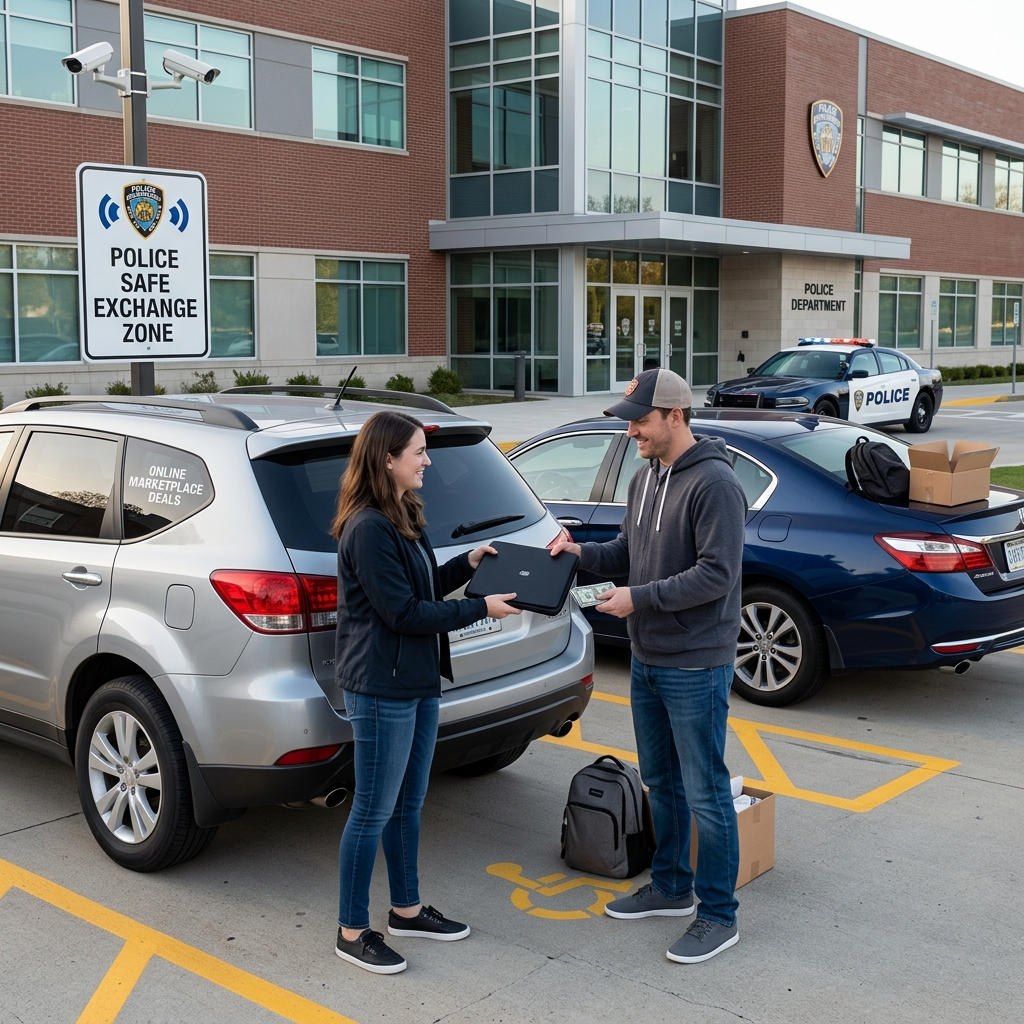
Online marketplaces have made it simple to buy, sell, or trade just about anything, but they have also created new safety risks when strangers meet in person to finalize a deal. In response, many law enforcement agencies now offer safe exchange zones—clearly marked areas at police facilities where people can complete transactions under surveillance and better lighting.
From Online Listings to Real-World Risks
Websites and apps such as Craigslist, Facebook Marketplace, OfferUp, and similar platforms connect millions of people every day. While most transactions end without incident, the potential for fraud, theft, or physical harm is significant enough that police departments across the United States have taken notice.
Traditional advice to “meet in a public place” is helpful but imperfect. Parking lots, cafes, or gas stations may still lack consistent surveillance or nearby assistance if a deal turns confrontational. Safe exchange zones aim to close that gap by providing a structured environment designed specifically for safer in-person meetings.
What Is a Safe Exchange Zone?
A safe exchange zone is a designated public area, typically at or near a police department, where individuals can meet to complete in-person transactions arranged online or conduct other sensitive exchanges, such as child custody transfers.
- Location: Commonly in police department parking lots or lobbies.
- Markings: Signs or pavement markings clearly identify the space.
- Lighting: Bright lighting improves visibility day and night.
- Surveillance: Many zones are monitored by video cameras around the clock.
- Cost: Use of the space is generally free to the public.
Police personnel normally do not participate in the transaction itself, but the presence of officers nearby and the visible security infrastructure can deter crime and encourage more cautious behavior by everyone involved.
Typical Features of Police Safe Exchange Zones
While exact setups vary by jurisdiction, safe exchange zones tend to share several core characteristics designed to promote safety, visibility, and accessibility.
| Feature | Purpose | Common Implementation |
|---|---|---|
| Designated spaces | Ensure users know exactly where to meet | Marked parking stalls or signed lobby areas |
| Lighting | Reduce concealment and improve visibility | Bright fixtures covering the zone at night |
| Video monitoring | Deter crime and provide evidence if needed | CCTV cameras watching the zone 24/7 in many locations |
| Access hours | Provide flexibility for different schedules | Often available 24 hours, especially parking lot zones |
| Proximity to law enforcement | Offer immediate help if something goes wrong | Located at or near police headquarters or municipal buildings |
Why Police Departments Created Safe Exchange Zones
Police agencies report numerous incidents where people meeting for online sales are robbed, assaulted, or defrauded. In some cases, offenders lure victims with low prices or high-value items, then use the meeting as an opportunity for crime.
By offering safe exchange zones, law enforcement agencies aim to:
- Reduce violent crime linked to online marketplace meetups.
- Prevent fraud by encouraging transactions in monitored spaces.
- Strengthen community trust through visible, practical safety programs.
- Provide a neutral venue for tense interactions, including child custody exchanges.
Safe exchange zones are often described as low-cost, high-impact community policing initiatives. A few signs, lights, cameras, and clearly communicated guidelines can significantly improve perceived and actual safety for residents.
Common Uses: Beyond Online Sales
Although safe exchange zones were initially promoted for websites like Craigslist, their use has broadened. People now rely on these areas for a range of sensitive meetings.
- Marketplace transactions: Buying or selling electronics, furniture, collectibles, vehicles accessories, or other goods arranged on Craigslist or similar sites.
- Peer-to-peer app sales: Transactions from apps like Facebook Marketplace, OfferUp, and other local listing services.
- Child custody exchanges: Separated or divorced parents exchanging children in a neutral, supervised setting.
- High-value item transfers: Meeting to transfer expensive goods, which may carry heightened risk if done privately.
Some agencies explicitly encourage or allow child custody exchanges in safe zones, recognizing the need for a neutral location where both parties may feel safer and more accountable.
How Safe Exchange Zones Work in Practice
Operational details differ among jurisdictions, but there are common patterns in how these zones are offered and used.
- No appointment needed in many locations: Some police lobbies or parking lots are accessible 24/7, allowing walk-in use of the safe zone.
- First-come, first-served: Users simply occupy the marked space when they arrive; there is rarely a reservation system.
- Police remain observers: Officers typically do not broker the deal or act as witnesses to the transaction, although they may intervene if a situation becomes unsafe.
- Guidelines for responsible use: Departments often urge citizens to use the zones only for legitimate exchanges and abide by any posted rules.
In some municipalities, indoor spaces—such as lobbies or meeting rooms in municipal buildings—can be used during business hours, with parking lot zones available at all other times.
Practical Safety Tips for Using a Safe Exchange Zone
Choosing a safe exchange zone is an important first step, but personal caution still matters. Police and safety experts commonly recommend combining location-based safeguards with basic situational awareness.
Planning the Meetup
- Propose the police department’s safe exchange zone as the meeting location from the outset.
- Schedule the exchange during daylight hours when possible, or use a well-lit 24/7 monitored area.
- Tell a friend or family member where you are going, and consider having them accompany you.
- Bring a fully charged mobile phone and keep it accessible throughout the meeting.
During the Transaction
- Meet in the exact marked area or lobby; do not move to nearby secluded spots.
- Keep valuables (cash, electronics) out of sight until you are ready to exchange.
- Verify the item carefully, including serial numbers for electronics or other goods that could be stolen.
- Ask for proof of identity if you have any concerns about legitimacy.
- Trust your instincts: if the other person refuses to meet at the zone or behaves suspiciously, end the interaction.
Protecting Your Privacy
- Avoid sharing unnecessary personal information such as home address, workplace, or daily routines.
- Use messaging features in the marketplace app instead of giving out your primary phone number or email, where possible.
- If the item is too large to bring to the police station (e.g., large furniture), consider whether the added risk of a home visit is worth it.
Legal and Liability Considerations
Safe exchange zones are typically offered as a public service rather than a contractual guarantee of protection. Police departments usually clarify that they provide the location, lighting, and surveillance, but they are not parties to any transaction and cannot ensure the quality or legality of items being sold.
Important legal points include:
- No endorsement of goods: Law enforcement agencies do not vouch for the condition, authenticity, or ownership of items.
- Limited involvement: Officers may step in if they witness criminal behavior, but they do not mediate disputes over price or defects.
- Potential evidence: Surveillance footage from cameras in the zone may be used in investigations if a crime occurs.
- Local policies: Rules for use and availability may vary, so checking your local department’s website or contacting them directly is wise.
Some departments will, on request, check serial numbers of items such as electronics or bicycles against stolen property databases, offering an added layer of protection for buyers.
How to Find a Safe Exchange Zone Near You
Not every community has a formal safe exchange zone, but many police departments have adopted or informally support the concept. To locate one in your area, consider the following steps.
- Visit your local police department’s official website to look for programs labeled “safe exchange zone,” “Craigslist safe zone,” or similar.
- Call the non-emergency police number to ask whether the lobby or parking lot may be used for exchanges.
- Check municipal websites for references to designated spaces at town halls or municipal complexes.
- Look for posted signs at police facilities marking specific spaces reserved for safe exchanges.
Community legal resources and local news outlets sometimes compile lists of safe exchange zone locations by county or region, which can be helpful if you travel or meet buyers and sellers from other towns.
Benefits for Families and Vulnerable Users
Safe exchange zones can be particularly valuable for people who may feel more vulnerable during in-person meetings: young adults, older individuals, people with disabilities, or anyone navigating contentious interpersonal situations.
For parents managing court-ordered child custody schedules, meeting in a police-monitored area can reduce the likelihood of confrontations and provide a record of regular, timely exchanges. Legal professionals sometimes recommend these spaces in high-conflict cases because they offer a neutral location that both parties can access without special arrangements.
Limitations of Safe Exchange Zones
Despite their advantages, safe exchange zones are not a cure-all. Some limitations to keep in mind include:
- Voluntary use: Sellers or buyers who intend harm may refuse to meet at a police location, pushing buyers to less secure places.
- Coverage gaps: Rural or under-resourced areas may lack formal zones or round-the-clock access.
- Scope of surveillance: Cameras may not capture every angle of the transaction, and indoor spaces may have different monitoring setups.
- Complex disputes: Disagreements over contracts, warranties, or misleading descriptions usually remain civil matters outside police involvement.
Understanding these limitations reinforces the need to combine safe locations with personal caution, especially for high-value or emotionally charged exchanges.
Frequently Asked Questions (FAQs)
1. Do I have to pay to use a police safe exchange zone?
In most cases, safe exchange zones offered by police departments are free to use. They are designed as a public safety service, and no appointment or fee is required.
2. Can officers help me inspect or appraise the item?
Police officers generally do not participate in the transaction itself and will not appraise the value of items. However, some departments may assist by checking serial numbers against stolen property databases when asked.
3. Are safe exchange zones only for Craigslist?
No. While many programs started with Craigslist in mind, they can be used for any legitimate online marketplace, including Facebook Marketplace, OfferUp, and other local listing services.
4. Can I use a safe zone for child custody exchanges?
Yes, many departments explicitly allow or encourage child custody exchanges in these zones or in their lobbies. It is advisable to confirm local policies with your police department and, if applicable, ensure your parenting plan or court order aligns with using the location.
5. What if the other person refuses to meet at a police station?
If a buyer or seller strongly resists using a safe exchange zone, consider it a warning sign. You may choose not to proceed with the transaction rather than risk your safety in an uncontrolled environment.
6. Do safe exchange zones guarantee my safety?
No location can guarantee complete safety, but meeting at a police facility with good lighting and surveillance significantly reduces risk compared with private residences or poorly monitored public spaces.
Key Takeaways for Safer Online Transactions
Safe exchange zones represent a practical partnership between law enforcement and the community. By offering accessible, monitored spaces for in-person deals, police departments help reduce the likelihood of theft, assault, and fraud associated with online marketplaces.
- Use police safe exchange zones whenever you arrange an in-person transaction with a stranger.
- Follow common-sense safety steps: tell someone where you are going, bring a phone, and trust your instincts.
- Remember that police provide the space—not a guarantee. Your caution still matters.
- Consider safe exchange zones not only for buying and selling but also for child custody transfers and other sensitive meetings.
As online marketplaces continue to shape how people buy and sell, safe exchange zones will likely remain an important tool in keeping community interactions safer, more transparent, and more accountable.
References
- Craigslist Safe Zone — Township of North Brunswick Police Department. 2016-01-01. https://northbrunswicknj.gov/programs_and_service/craigslist-safe-zone/
- Safety exchange zones — American Police Beat Magazine. 2022-06-01. https://apbweb.com/2022/06/safety-exchange-zones/
- Safe Exchange Zone — Town of McCandless Police Department. 2019-01-01. https://www.townofmccandless.org/248/Safe-Exchange-Zone
- Safe Exchange Zones in Lancaster & York Counties — Trinity Law. 2019-04-01. https://www.yourlawfirmforlife.com/safe-exchange-zones/
- Jupiter Police Department now a Craigslist Safe Exchange Zone — WPTV NewsChannel 5. 2016-01-01. https://www.youtube.com/watch?v=u00kEKvsf0w
Similar Articles








Read full bio of Sneha Tete


