Police Powers and Limits in High-Speed Chases
Understanding what officers may do in vehicle pursuits, when they must stop, and how chase tactics can create legal rights and liability.
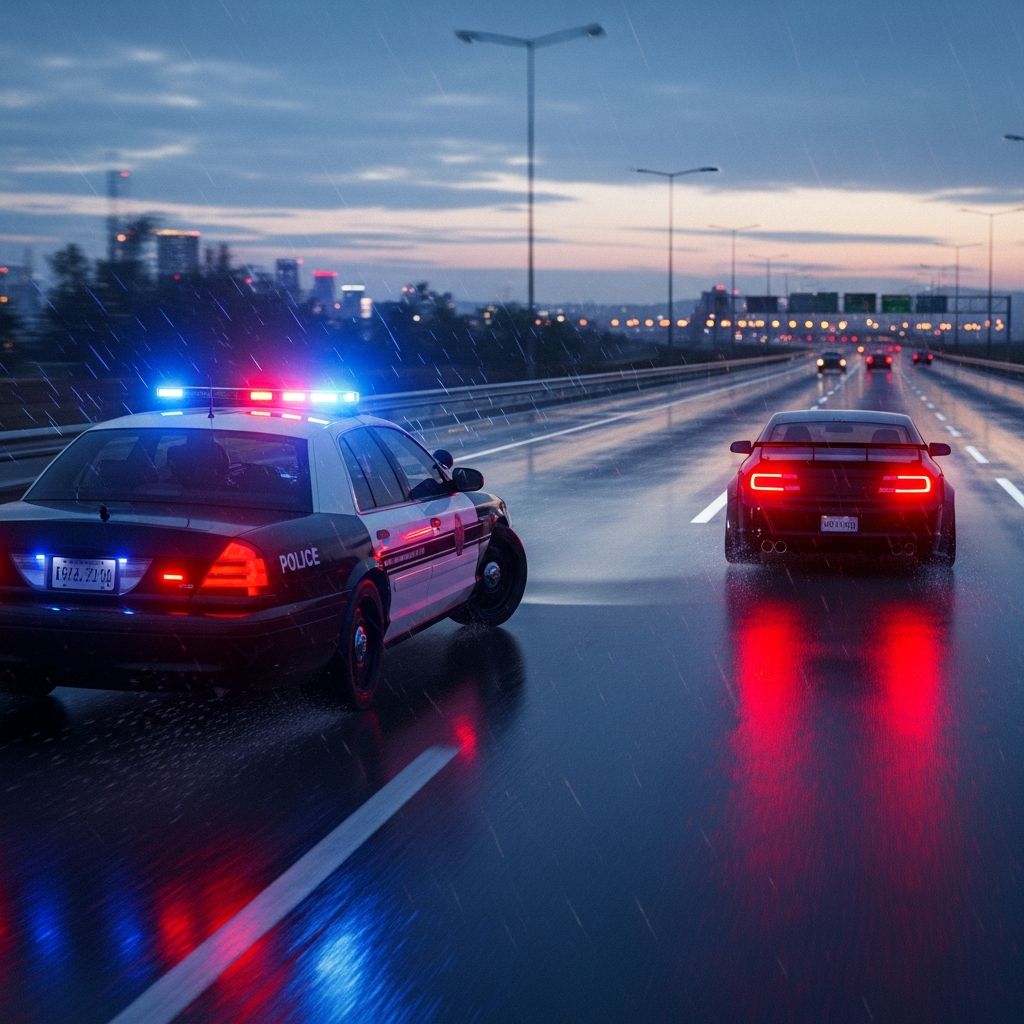
High-speed police chases are some of the most dangerous moments in everyday law enforcement. They can unfold in seconds, affect dozens of bystanders, and raise serious questions about safety, constitutional rights, and government liability. Understanding what officers may legally do during a chase, and when they must stop, is essential for anyone interested in criminal law, policing policy, or victim rights.
This article explains how vehicle pursuits are initiated, the tools police are allowed to use, the constitutional framework that governs deadly tactics, and the potential legal consequences when a chase goes wrong.
Why Police Pursuits Are So Legally Sensitive
High-speed chases are controversial because they combine two competing interests:
- Public safety – Every pursuit creates risk to pedestrians, other drivers, officers, and the fleeing suspect.
- Law enforcement goals – Officers have a duty to catch dangerous suspects and prevent further harm or escape.
Research funded by the U.S. Department of Justice has long emphasized that vehicular pursuits can resemble the use of deadly force because of the high risk of serious injury or death to everyone involved. As a result, courts often analyze chases using the same constitutional standards that apply to shootings and other extreme police tactics.
When Can Police Start a High-Speed Chase?
Officers typically cannot chase every driver who refuses to stop. Modern best practices and many written policies require a careful, real-time judgment before a pursuit begins.
Common factors departments instruct officers to consider include:
- The seriousness of the suspected crime (violent felony vs. minor traffic offense).
- The threat to the public if the suspect is not immediately caught.
- Current traffic conditions, road type, and visibility.
- Weather, time of day, and presence of pedestrians.
- Availability of alternatives (air support, license plate and video evidence, later arrest).
Many agencies explicitly discourage or forbid pursuits for low-level traffic violations when the risks of a chase would clearly outweigh the benefit of an immediate arrest.
Core Legal Framework: Constitutional Limits on Pursuits
Two key strands of constitutional law shape what police may do during a pursuit:
Fourth Amendment: Seizures and Use of Deadly Force
The U.S. Supreme Court has held that a person is “seized” under the Fourth Amendment when an officer intentionally uses force or a barrier to stop them. In the context of a chase:
- A roadblock or barrier deliberately positioned so a fleeing driver crashes into it is treated as a seizure requiring constitutional justification.
- Courts often compare some pursuit tactics to the use of deadly force. Under Tennessee v. Garner, deadly force is constitutionally limited to situations where the suspect poses a significant threat of death or serious physical injury, or where such force is necessary to prevent escape and the danger is severe.
Because a high-speed chase can itself create grave danger, some departments treat the decision to initiate or continue a pursuit as a decision about using potentially deadly force.
Due Process and Municipal Liability
Local governments can face civil rights lawsuits under 42 U.S.C. § 1983 when their own policies, customs, or failure to train officers cause constitutional violations.
The Supreme Court has recognized that inadequate training in areas where the need for instruction is obvious—like deadly force—can make a city liable when that failure results in rights violations. Because pursuits are so dangerous, federal guidance urges agencies to adopt clear written pursuit policies and training programs.
Common Tactics Police May Use During a Chase
Officers have several tools at their disposal once a chase begins. Whether each tactic is allowed depends on local policy, state law, and the level of danger involved.
| Pursuit Tactic | Purpose | Typical Restrictions |
|---|---|---|
| Lights and sirens | Warn drivers and assert emergency right-of-way | Usually mandatory when exceeding speed limits or ignoring traffic controls |
| Pursuit immobilization (PIT) maneuver | Force suspect vehicle to spin and stop | Often limited to low–moderate speeds and serious offenses due to injury risk |
| Spike strips / tire deflation devices | Disable tires to slow or stop vehicle | Requires coordination and consideration of traffic and pedestrian presence |
| Roadblocks | Physically block roadway to end pursuit | Treated as a seizure; improper use may violate Fourth Amendment |
| Air support | Track suspect from above, reduce pressure on ground units | Often used to justify slowing or terminating ground pursuit while still monitoring |
Traffic Law Exemptions for Emergency Vehicles
State statutes typically grant “authorized emergency vehicles” certain limited exemptions from ordinary traffic rules during pursuits—for example, allowing them to exceed speed limits or proceed through red lights—but usually only when using both lights and sirens and when doing so with “due regard” for safety.
When officers ignore these conditions, their conduct may be considered negligent under state tort law if a crash occurs.
Department Policies: From Full Discretion to No-Chase Rules
Because federal law sets broad constitutional boundaries but not detailed pursuit rules, much of the real decision-making happens at the agency level. Departments adopt written policies that translate legal standards into operational rules.
Traditional Approach: Officer Discretion With Oversight
Many agencies still allow pursuits but emphasize structured decision-making and supervision. Typical policy elements include:
- Clear criteria for initiating and continuing pursuits based on offense severity and risk.
- Supervisor involvement via radio to monitor and, if necessary, order termination.
- Limits on the number of vehicles that may directly engage in the chase.
- Requirements for radio communications about location, speed, direction, and reason for pursuit.
- Mandatory reports and post-incident review after every pursuit to evaluate compliance and outcomes.
No-Chase and Restricted-Chase Policies
In response to collisions, fatalities, and civil liability, many jurisdictions have adopted some form of no-chase policy or highly restrictive pursuit rules.
Such policies may:
- Prohibit high-speed pursuits entirely, or
- Limit pursuits to suspects in serious or violent felonies, or
- Restrict pursuits to specific environments (e.g., highways rather than dense urban streets).
No-chase policies are often paired with alternatives, such as relying on license plate readers, surveillance video, coordination with other agencies, and follow-up investigations to identify and arrest suspects later.
When Must Police End a High-Speed Chase?
Professional guidance from federal law enforcement support agencies stresses that supervisors should be empowered—often required—to terminate a pursuit when risks become unacceptable.
Policies commonly instruct officers and supervisors to call off a chase when some combination of the following occurs:
- The suspect has been identified sufficiently to allow later arrest without immediate pursuit.
- Traffic, weather, or road conditions create a high probability of collision.
- The pursuit enters an area with dense pedestrian or school traffic.
- Communications are lost or a supervisor is not available to monitor the chase.
- The underlying offense is relatively minor compared to the danger of continuing.
Some model policies state that if a supervisor cannot monitor and direct the pursuit, it should be terminated to avoid uncontrolled risk.
Public and Bystander Safety: What Civilians Should Do
Bystanders are often drawn to the drama of a chase, but attempting to “help” is almost always dangerous and legally risky. Cases show that civilians who interfere with a police pursuit—by blocking vehicles, following at high speeds, or trying to corner suspects—can themselves face criminal charges and civil liability.
Safe behavior for civilians includes:
- Yielding to approaching police vehicles with lights and sirens.
- Staying out of the roadway and avoiding sudden maneuvers that could confuse officers.
- Calling 911 with information if you witness a fleeing vehicle, rather than following it.
Law enforcement agencies frequently issue public reminders that civilians should not engage in pursuit-like behavior and should leave apprehension efforts to trained officers.
Injuries and Damage: When a Chase Creates Legal Liability
After a crash caused by a high-speed chase, several different legal frameworks may come into play. Potential claims can involve the fleeing driver, the police officer, the agency, or some combination of these parties.
State Tort Law and Negligence
Under state personal injury and wrongful death laws, injured people may pursue claims alleging that an officer or department acted negligently during a pursuit. Examples of potentially negligent conduct include:
- Initiating a high-speed chase over a minor offense when the danger to the public clearly outweighed the need to immediately apprehend the driver.
- Driving at excessive speeds without adequate justification or in disregard of written protocols.
- Ignoring traffic lights, stop signs, or other controls without using lights and sirens or without due regard for safety.
Some states, however, provide partial immunity or damages caps for government agencies, making these claims more complex and time-sensitive.
Civil Rights Claims Under 42 U.S.C. § 1983
When a pursuit tactic amounts to an unconstitutional seizure or violates clearly established rights, victims may bring federal civil rights actions under 42 U.S.C. § 1983 against officers and, in some cases, municipalities.
Common theories in pursuit-related § 1983 cases include:
- Use of excessive force in setting up a roadblock or using collision-based tactics not justified by the suspect’s threat level.
- Failure to adopt or enforce reasonable pursuit policies despite known dangers.
- Deliberate indifference in failing to provide proper training on high-speed pursuits.
Successful claims can result not only in compensation but also in court-ordered changes to agency policies and practices.
Internal Review, Training, and Policy Reform
Best-practice guidance encourages agencies to treat every pursuit as a significant event that must be documented, reviewed, and used to improve policy.
Effective internal systems typically include:
- Mandatory written reports after every pursuit, regardless of outcome.
- Supervisory review to determine whether policy was followed.
- Data collection and periodic analysis of pursuit frequency, injuries, property damage, and rule violations.
- Disciplinary action or retraining when officers disregard policy or safety requirements.
Federal publications for law enforcement executives urge chiefs and sheriffs to view pursuit policy not as a one-time document but as a living framework that must adapt to new technologies, legal decisions, and local crash data.
Frequently Asked Questions (FAQs)
Q: Can police always speed and run red lights during a chase?
A: No. State laws usually allow authorized emergency vehicles to exceed speed limits and pass through red lights only when using lights and sirens and only with due regard for the safety of others. If officers ignore these conditions and cause a crash, their actions may be considered negligent under state law.
Q: Is a roadblock during a chase automatically legal?
A: No. When officers intentionally position a roadblock so that a fleeing driver will collide with it, courts treat that as a seizure under the Fourth Amendment. The tactic must be justified under the same constitutional standards that govern other forms of potentially deadly force.
Q: What is a no-chase policy?
A: A no-chase policy is a departmental rule that either prohibits high-speed pursuits entirely or sharply limits when and where officers may engage in them, often restricting pursuits to suspects in violent or serious felonies. These policies aim to reduce injuries and fatalities for officers, suspects, and the public.
Q: If I am injured as a bystander in a police chase, can I sue?
A: Possibly. Depending on state law, you may have claims against the fleeing driver, the officer, or the department. Potential theories include negligence (for reckless driving or inappropriate initiation/continuation of the chase) and, in some cases, federal civil rights claims if constitutional standards were violated. State sovereign immunity rules, notice deadlines, and damages caps can significantly affect such cases.
Q: Are officers personally responsible for bad decisions during a pursuit?
A: Officers can be named individually in civil lawsuits, especially in federal civil rights actions. However, many claims also target the municipality, alleging that its policies, customs, or training failures contributed to the violation. Whether an officer is personally liable depends on immunity doctrines, the specific facts, and whether the law was clearly established at the time of the pursuit.
References
- Restrictive Policies for High-Speed Police Pursuits — National Institute of Justice, U.S. Department of Justice. 1990-03-01. https://www.ojp.gov/pdffiles1/Digitization/122025NCJRS.pdf
- Police Pursuit Lawsuits and Your Rights — Pullano & Siporin. 2023-06-01 (approx.). https://pullanolaw.com/police-pursuit-lawsuits-and-your-rights/
- Police Chase Car Accident Lawyers — Ben Crump Law. 2023-01-01 (approx.). https://bencrump.com/car-accident-lawyer/police-chase/
- Vehicular Pursuits: A Guide for Law Enforcement Executives — Office of Community Oriented Policing Services (COPS Office), U.S. Department of Justice. 2010-01-01. https://portal.cops.usdoj.gov/resourcecenter/content.ashx/cops-r1134-pub.pdf
- What Is a No-Chase Policy? — Jenner Law. 2022-08-01 (approx.). https://www.jennerlawfirm.com/faqs/what-is-a-no-chase-policy/
- Is It Illegal to Help the Police During a Car Chase? — The Law Offices of Mark Sherman. 2019-02-01. https://www.legaldefense.com/legal-blogs/2019/february/is-it-illegal-to-help-the-police-during-a-car-ch/
Similar Articles








Read full bio of Sneha Tete