
Police Misconduct Databases in the Courtroom
How modern police misconduct databases are reshaping courtroom strategy, officer accountability, and criminal justice outcomes.
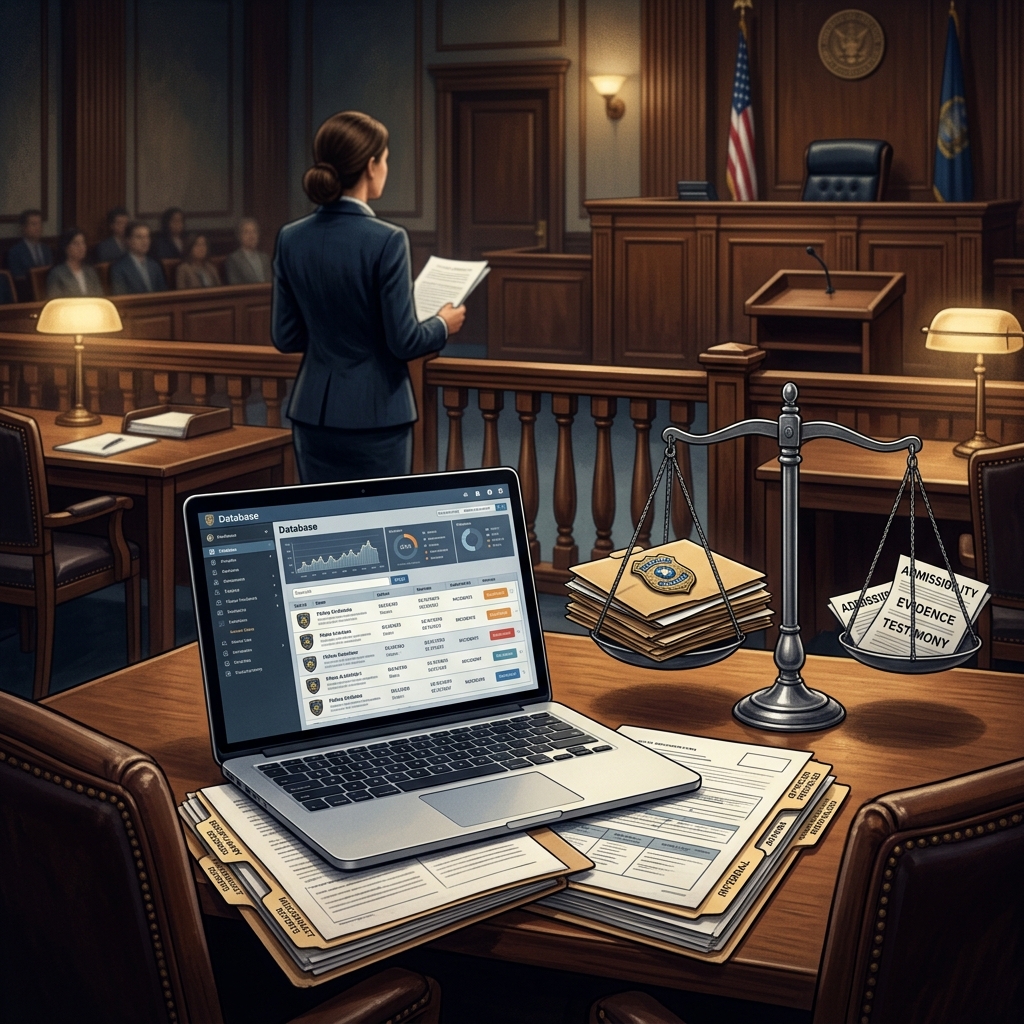
Databases that track police misconduct and use of force have moved from the realm of advocacy and research into the day-to-day practice of criminal and civil rights litigation. Defense attorneys, civil rights lawyers, prosecutors, and judges increasingly rely on structured information about officers’ past conduct to assess credibility, challenge evidence, and evaluate whether constitutional rights have been violated. At the same time, policymakers and communities view these databases as critical tools for improving transparency and accountability.
This article explains how police misconduct databases are built, the types of data they contain, and the ways lawyers use them in the courtroom. It also explores the legal issues that arise around these databases, including disclosure obligations, admissibility, and privacy concerns, as well as the broader impact on public trust and police reform.
From Personnel Files to Public Databases
Historically, information about police misconduct was scattered across internal affairs files, civil lawsuit records, and disciplinary decisions. Access was limited and often required time-intensive public records requests or litigation. Over the past decade, multiple projects have consolidated these records into searchable databases, making officer histories far easier to analyze and use.
Why Misconduct Data Is Being Systematically Collected
Several overlapping motivations have driven the creation of misconduct databases:
- Accountability and transparency: Public databases allow communities to see patterns in complaints, disciplinary actions, and use of force incidents across departments and individual officers.
- Improving case outcomes: Defense and civil rights lawyers use officer histories to challenge credibility and identify systemic issues that can support claims of constitutional violations.
- Screening and hiring: Agencies can identify “wandering officers”—those who move between departments after being fired or forced to resign—by consulting cross-jurisdiction employment and misconduct records.[10]
- Policy evaluation and research: Academic institutions and advocacy organizations analyze aggregated data to identify trends and propose reforms in training, oversight, and discipline.
Examples of Modern Misconduct Databases
Across the United States, different models of police misconduct databases illustrate how this information can be organized and used:
- Statewide accountability projects: The Louisiana Law Enforcement Accountability Database (LLEAD) compiles employment history, misconduct records, use of force reports, and settlement data from hundreds of agencies, giving a comprehensive picture of officer conduct over time.
- Large-scale public records databases: The Police Records Access Project in California makes millions of pages of misconduct and use-of-force records publicly searchable, covering hundreds of law enforcement agencies statewide.
- City-specific platforms: Databases like the NYPD Misconduct Complaint Database in New York City allow users to search thousands of officers who have been named in complaints, along with details about allegations and outcomes.
- Defense-oriented tools: Internal databases curated by legal aid organizations and public defenders often combine court findings, civil suits, disciplinary records, and community reports to support impeachment and case strategy.
- Prosecutorial disclosure lists: Many prosecutors maintain internal lists of officers whose credibility is in question, sometimes referred to as Brady lists or police disclosure lists, to manage their constitutional duty to disclose impeachment evidence.
What Information Police Misconduct Databases Contain
Although every database is structured differently, most aim to capture both formal findings of misconduct and related information that may bear on an officer’s reliability or risk profile.
Core Data Elements
Typical data points include:
- Officer identifiers: Name, badge number, rank, unit, and employment history across agencies.
- Complaint records: Allegations filed through internal affairs, civilian review boards, or external oversight bodies, including complaint type and disposition (sustained, not sustained, exonerated, or unresolved).
- Use of force incidents: Records of shootings, serious injuries, or other reportable force events, sometimes with accompanying investigative findings.
- Disciplinary actions: Formal discipline such as reprimands, suspensions, demotions, or terminations, often linked to specific incident identifiers.
- Civil litigation outcomes: Settlements and judgments in civil rights suits related to excessive force, false arrest, or unlawful searches, including monetary amounts when available.
- Judicial findings: Court decisions where judges explicitly find an officer’s testimony not credible, suppress evidence based on constitutional violations, or identify patterns of misconduct.
Supplementary and Predictive Data
Some experimental or internal prosecutorial databases go further, incorporating data points that may help identify officers at higher risk of misconduct:
- Early warning indicators: Clusters of complaints, repeated use-of-force incidents, or frequent involvement in suppression motions can trigger closer review.
- Training and certification information: Records of completed training, specialized certifications, and any lapses or revocations.
- Assignment histories: Units, neighborhoods, and roles that may correlate with particular types of allegations or enforcement practices.
While some commentators have suggested including highly personal data such as divorce, financial stress, or mental health records, such proposals raise significant privacy and discrimination concerns and are not common in public-facing databases.
Legal Foundations: Disclosure Duties and Constitutional Rights
The use of police misconduct databases in court is grounded in long-standing constitutional principles about fairness and access to impeachment evidence. Two doctrines are particularly important: Brady disclosure obligations and the Confrontation Clause.
Brady and Impeachment Evidence
Under the Supreme Court’s Brady line of cases, prosecutors must disclose evidence favorable to the accused when it is material to guilt or punishment, including information that can be used to impeach government witnesses. Misconduct databases help prosecutors identify:
- Officers with prior findings of dishonesty or false reporting;
- Patterns of excessive force that may undermine an officer’s narrative;
- Past allegations closely related to the facts at issue in the current case.
Internal disclosure lists allow prosecutors to systematize this process and ensure defense counsel receives relevant impeachment material in a timely way.
The Confrontation Clause and Cross-Examination
The Sixth Amendment Confrontation Clause protects a defendant’s right to cross-examine adverse witnesses, including police officers. When defense counsel has reliable misconduct data, they can more precisely target cross-examination to credibility issues and prior constitutional violations.
Table: Prosecutorial vs. Defense-Oriented Databases
| Feature | Prosecutor Disclosure Lists | Defense Misconduct Databases |
|---|---|---|
| Primary purpose | Fulfill Brady obligations and manage risky witnesses | Impeach officers, challenge evidence, support motions |
| Typical contents | Verified misconduct, credibility concerns, disciplinary records | Verified misconduct plus civil suits, complaints, community data |
| Access | Internal to prosecutors; disclosed case-by-case | Internal to defense organizations; may rely on public sources |
| Key legal drivers | Brady, Giglio, due process duties | Confrontation Clause, effective assistance of counsel |
Using Misconduct Data Strategically in Criminal Cases
Police misconduct databases are most powerful when integrated into case strategy rather than treated as standalone background information. Effective use begins long before trial and continues through post-conviction review.
Pretrial Investigation and Motion Practice
Defense and civil rights lawyers can use database information at multiple stages:
- Targeted subpoenas: Once an officer’s history is identified, counsel can seek underlying records and investigative files rather than issuing broad, unfocused requests.
- Motions to suppress: Past judicial findings that an officer violated the Fourth Amendment or provided unreliable testimony support challenges to searches, seizures, and statements in new cases.
- Bail arguments: Demonstrating that a case relies on an officer with a problematic record can support arguments for reduced or no bail, especially when credibility is central.
- Plea negotiations: Prosecutors may be more willing to reduce charges or offer favorable pleas when faced with documented credibility concerns about key law enforcement witnesses.
Trial Use: Impeachment and Narrative Building
At trial, the goal is not simply to suggest that an officer has made mistakes but to tie prior misconduct directly to the issues in the case. Effective approaches include:
- Credibility impeachment: Demonstrating prior incidents of dishonesty, falsified reports, or judicial findings of unreliability when the officer’s testimony is central to the prosecution’s narrative.
- Pattern evidence: Showing repeated excessive force or unlawful stops to challenge the plausibility of the officer’s account or the lawfulness of their conduct.
- Theory of the case integration: Connecting prior misconduct to a broader theory—for example, a pattern of targeting particular communities or disregarding department policy—rather than presenting allegations as isolated anecdotes.
Preserving Appellate Issues
When courts restrict access to misconduct evidence or limit cross-examination, counsel should make a clear record for appeal. This includes:
- Proffering the specific database information sought to be introduced;
- Explaining its relevance to credibility, constitutional claims, or theory of the case;
- Invoking constitutional rights such as the Confrontation Clause and due process to frame the exclusion as potentially prejudicial.
Civil Rights Litigation and Systemic Claims
Beyond individual criminal cases, misconduct databases have become central to civil rights litigation alleging patterns or practices of unconstitutional policing.
Monell and Pattern-or-Practice Claims
In suits against municipalities and police departments, plaintiffs must often prove that violations stem from policies, customs, or practices. Databases help by:
- Identifying clusters of similar complaints and incidents involving the same officers or units;
- Showing that the department knew or should have known about recurring problems through repeated complaints or settlements;
- Documenting inadequate discipline or training responses following serious misconduct incidents.
Settlement Analysis and Damages
Publicly accessible settlement data allow litigators to place new cases in context—for example, demonstrating that a department has paid substantial sums for similar allegations in the past, which can support arguments about the seriousness of violations and appropriate damage awards.
Challenges, Risks, and Ethical Considerations
Despite their promise, police misconduct databases raise complex issues around accuracy, fairness, and privacy.
Data Quality and Misinterpretation
Not every allegation or complaint reflects proven misconduct. Effective and ethical use requires attention to:
- Distinguishing allegations from sustained findings: Many databases clearly mark whether complaints were substantiated, but lawyers must be careful not to equate unproven allegations with established fact.
- Contextualizing statistics: High numbers of complaints may reflect an officer’s assignment (e.g., a high-activity unit) rather than disproportionate misconduct. Cross-referencing unit, role, and complaint type is essential.
- Validating sources: Combining public records, court decisions, and official discipline data helps create a more reliable picture than relying on a single dataset.
Privacy and Due Process Concerns
Public disclosure of officer misconduct records can implicate privacy and reputational interests, particularly when databases include unsustained complaints or allegations that never led to discipline:
- Departments and legislatures must balance transparency with protection against unfair public shaming for unproven claims.
- Officers may seek limitations on how older or minor misconduct records are used, especially in hiring and promotion decisions.
- Clear policies and statutory frameworks are needed to govern what records become public, for how long, and under what conditions.[10]
Institutional Resistance and Policy Debates
Agencies and unions sometimes oppose broad public databases, arguing that they invite misinterpretation and place officers at risk. Advocates respond that careful design, documentation, and explanation can mitigate these concerns while preserving the public’s right to know. Debates continue over:
- Whether national databases should be mandatory for all agencies;
- How to fund and maintain accurate, timely data collection;
- What role independent organizations and universities should play in hosting and analyzing data.
Practical Tips for Lawyers Using Misconduct Databases
For practitioners, integrating misconduct data into legal work is both an investigative task and a strategic decision. The following practical steps can help maximize value while minimizing ethical risk.
Checklist for Effective Use
- Start early: Search for relevant officers as soon as they appear in discovery, rather than waiting for trial.
- Cross-reference sources: Combine public databases, court records, and official discipline files to confirm key facts.
- Focus on material relevance: Tie any prior misconduct directly to credibility or constitutional issues in the current case.
- Document authentication: Be prepared to show how records were obtained and why they can be relied upon in court.
- Use expert support where needed: Data analysts or researchers can help interpret patterns and present them in accessible formats for judges and juries.
Ethical Use of Sensitive Information
Lawyers should adopt internal guidelines for working with misconduct databases, including:
- Verifying serious allegations before relying on them in court filings;
- Avoiding unnecessary disclosure of personal data not directly tied to case issues;
- Maintaining secure storage and access controls for internal databases, especially when they contain non-public records.
Frequently Asked Questions (FAQs)
Are police misconduct databases publicly accessible or private?
Both models exist. Some databases, such as statewide accountability projects and city complaint platforms, are fully public and searchable by anyone. Others are internal to prosecutors or defense organizations and used primarily to manage case strategy and disclosure obligations.
Can misconduct records always be used to impeach officers at trial?
No. Courts typically require that misconduct evidence be relevant and not unduly prejudicial. Prior incidents related to dishonesty, false reporting, or similar constitutional violations are more likely to be admissible than unrelated minor discipline. Lawyers must be prepared to explain the specific link between the past conduct and issues in the present case.
How do prosecutors decide which officers to include on disclosure lists?
Criteria vary by jurisdiction, but many prosecutors focus on sustained findings of dishonesty, judicial determinations of unreliability, or significant disciplinary actions. The aim is to capture information that could materially affect credibility, and therefore must be disclosed under Brady.
Do misconduct databases help prevent “wandering officers” from moving unnoticed between agencies?
Yes. Databases that track employment history and disciplinary records can alert hiring agencies to prior serious misconduct, reducing the risk that officers with problematic histories simply relocate to new departments without adequate scrutiny.[10]
What is the role of community and advocacy organizations?
Advocacy groups, legal nonprofits, and academic institutions often play a central role in building and maintaining public misconduct databases. They gather records through public records requests, litigation, and data analysis, then make the information accessible to communities, researchers, and lawyers.
References
- Tracking Police Misconduct: A Prosecutor’s Guide to Police Disclosure Lists — Institute for Innovation in Prosecution. 2021-07-01. https://pceinc.org/wp-content/uploads/2021/07/20210700-%E2%80%93-Tracking-Police-Misconduct-Guide-%E2%80%93-Institute-for-Innovation-in-Prosecution.pdf
- Collect Data: Data Sources for Police Misconduct — National Association of Criminal Defense Lawyers (NACDL). 2021-03-01. https://www.nacdl.org/Content/CollectDataSourcesforPoliceMisconduct
- Resource Spotlight: Data Projects Tracking Police Misconduct, Use of Force, and Officer Employment Histories — Prison Policy Initiative. 2026-01-26. https://www.prisonpolicy.org/blog/2026/01/26/police_misconduct/
- California Police Misconduct Records Now Available in Public Database — CalMatters. 2025-08-01. https://calmatters.org/justice/2025/08/police-misconduct-records-database/
- NYPD Misconduct Complaint Database — New York Civil Liberties Union (NYCLU). 2023-06-01. https://www.nyclu.org/data/nypd-misconduct-database
- Law Enforcement Perspectives on Public Access to Misconduct Records — Cardozo Law Review. 2020-10-01. https://www.cardozolawreview.com/law-enforcement-perspectives-on-public-access-to-misconduct-records/
- Trump Administration Deactivates the National Law Enforcement Accountability Database (NLEAD) — Congressional Research Service. 2019-01-18. https://www.congress.gov/crs-product/IN12515
Similar Articles








Read full bio of medha deb




