
Police Misconduct Claims and Rights in Illinois
A detailed guide to recognizing police misconduct in Illinois, filing complaints, and pursuing civil and criminal remedies to protect your rights.
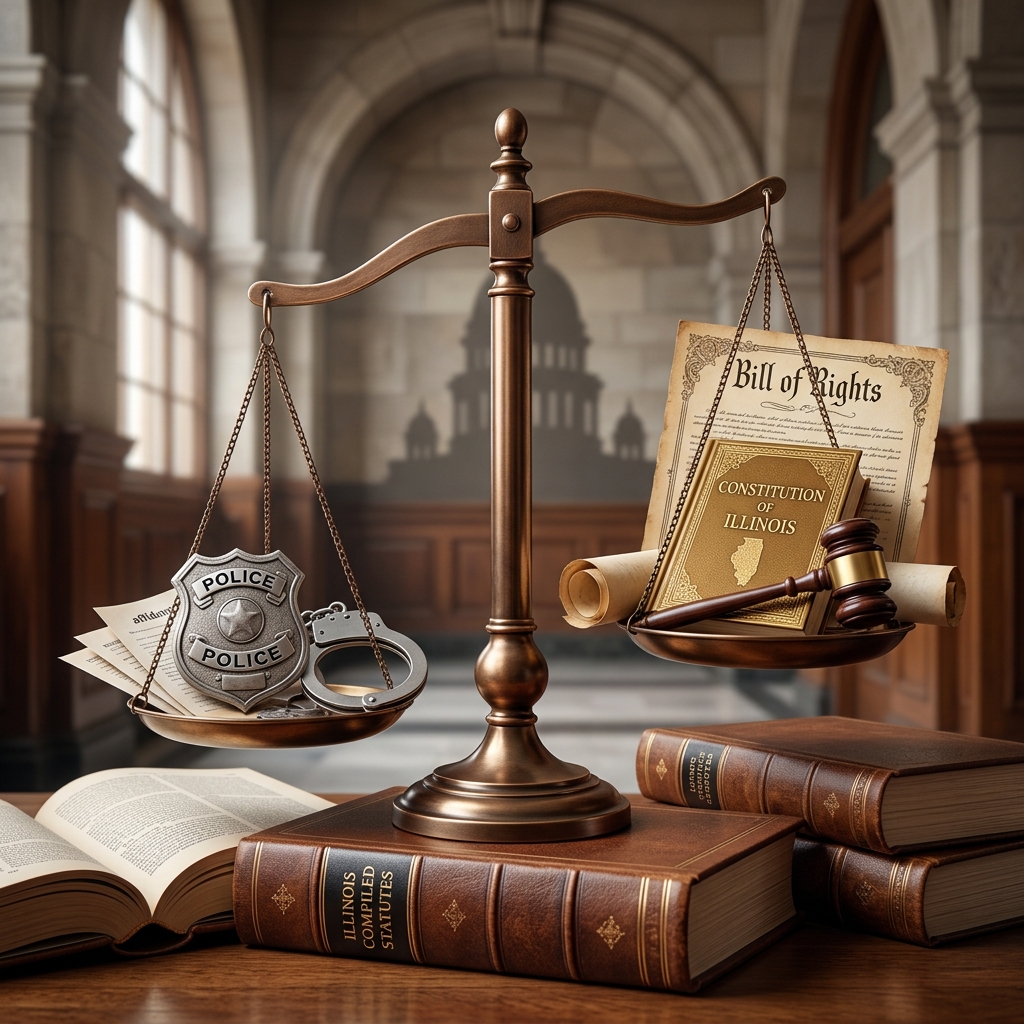
Police officers in Illinois hold significant authority, but that authority is limited by the Constitution, state statutes, and departmental rules. When officers cross those legal boundaries, their conduct may amount to police misconduct, and victims have several pathways to seek accountability and compensation.
This article explains how misconduct is defined under Illinois and federal law, the impact of recent reforms, how to file complaints, and the main legal tools available if your rights are violated.
Understanding What Counts as Police Misconduct in Illinois
Police misconduct broadly refers to an officer’s unlawful or abusive actions performed while exercising official authority. Illinois law treats this both as a criminal offense and as a basis for civil liability.
Statutory Definition of Official Misconduct
Illinois’ criminal code includes a specific offense called official misconduct, which applies to public officers and employees, including law enforcement personnel. Under this provision, a public officer may commit misconduct by:
- Intentionally or recklessly failing to perform a mandatory legal duty.
- Knowingly performing an act they are forbidden by law to perform.
- Acting beyond lawful authority to gain a personal advantage for themselves or others.
- Accepting an unauthorized fee or reward in connection with official duties.
The statute also singles out law enforcement employees who knowingly use or share information from their job to obstruct or prevent a criminal investigation, arrest, or prosecution. This form of misconduct is treated as a felony under recent reforms.
Common Types of Police Misconduct
In everyday practice, misconduct can take many forms. Examples recognized by Illinois legal aid and the U.S. Department of Justice include:
- Excessive or unreasonable use of force, including unnecessary deadly force.
- False arrest without probable cause, or fabricating evidence to justify an arrest.
- Discriminatory enforcement based on race, color, national origin, sex, or religion, especially in stops, searches, and arrests.
- Sexual misconduct or coercive sexual contact by officers.
- Tampering with body cameras or dash cameras, such as turning them off or destroying footage to hide wrongdoing.
- Failure to intervene when another officer uses excessive force or violates clear legal standards.
- Dishonesty, including lying under oath, falsifying reports, or making false statements in investigations.
Not every unpleasant encounter with an officer rises to the level of legal misconduct, but when conduct violates constitutional protections or specific statutes, you may have grounds for both administrative complaints and civil claims.
Recent Illinois Reforms: The SAFE-T Act and Beyond
Illinois has enacted significant reforms to increase oversight of law enforcement, most notably through Public Act 101-0652, commonly known as the SAFE-T Act. This law reshapes standards for use of force, complaint procedures, and record-keeping.
Changes to Use-of-Force Standards
The SAFE-T Act updates Illinois’ use-of-force laws and training requirements:
- Officers must consider the totality of the circumstances before using force, recognizing factors such as the severity of the crime, immediate threats, and availability of alternatives.
- Deadly force is more tightly regulated; an officer must reasonably believe the person poses an imminent threat of great bodily harm to another and that less severe options are not sufficient.
- Force likely to cause death or serious injury is not justified once there is no longer an imminent threat of great bodily harm.
These standards aim to reduce unnecessary violence and align local practices with constitutional norms and national best practices.
Oversight, Reporting, and Record Preservation
The SAFE-T Act expands oversight over police misconduct and mandates greater transparency:
- Agencies must report certain misconduct-related information to the Illinois Law Enforcement Training and Standards Board (ILETSB).
- The Illinois Attorney General is authorized to investigate allegations of unlawful patterns or practices by law enforcement agencies and seek civil remedies.
- Body camera footage and other materials related to misconduct complaints and investigations must be permanently retained and cannot be destroyed.
These changes aim to prevent departments from quietly disposing of evidence or shielding repeated misconduct from review.
Removing Barriers to Filing Complaints
Historically, some contracts and policies made it difficult for civilians to report misconduct. For example, collective bargaining agreements in major departments required signed affidavits for complaints and allowed officers to review evidence before giving statements, hindering investigations.
Recent reforms and policy changes have reduced these obstacles. Under updated Illinois standards:
- Anyone can file a complaint against a sworn officer without signing an affidavit or other legal forms.
- Complaints may be submitted anonymously, particularly to statewide oversight bodies.
- Officers under investigation no longer have to be given the name, rank, or unit of the complainant, which can reduce retaliation fears.
How to File a Complaint Against a Police Officer in Illinois
Victims and witnesses of police misconduct have multiple options for filing complaints. These processes are separate from civil lawsuits or criminal prosecutions, but they can support later legal actions and help trigger disciplinary measures.
Complaints to the Illinois Law Enforcement Training and Standards Board (ILETSB)
ILETSB oversees officer certification and training statewide. Individuals who believe an officer acted improperly can submit complaints directly to ILETSB.
Key points about ILETSB complaints include:
- You can file a complaint if you believe an officer committed a crime, used excessive force, tampered with cameras, lied under oath, or behaved dishonestly or unprofessionally.
- Complaints are submitted using the agency’s standardized form (often referred to as an officer complaint form), which can be sent electronically through ILETSB’s portal.
- You may file anonymously; a sworn affidavit is not required because a “sworn affidavit override” rule allows investigations to proceed without it.
- ILETSB can review misconduct, coordinate with agencies, and influence an officer’s certification status.
Internal Affairs and Local Department Complaints
Most municipal police departments and county sheriff’s offices have their own internal complaint procedures. These often involve filing with an internal affairs division or a civilian office of police oversight.
Typical features of local complaint processes include:
- Online or paper forms available on the department’s website.
- Acceptance of complaints about bias, rude conduct, or violations of departmental policy, even if no crime occurred.
- Internal investigations that can result in discipline, retraining, or policy changes.
If a local department refuses to accept your complaint, you still have the right to file directly with ILETSB, and you do not need to go through local channels first.
Complaints to State and Federal Civil Rights Agencies
When misconduct involves discrimination or civil rights violations, you may also submit complaints to broader civil rights enforcement bodies. The U.S. Department of Justice’s Civil Rights Division enforces several laws that prohibit discriminatory or abusive conduct by state and local officers.
Key DOJ-enforced provisions include:
- Federal criminal statutes that punish willful deprivation of rights under color of law (such as deliberate excessive force or sexual assault).
- Federal civil laws that bar patterns or practices of misconduct, allowing DOJ to seek injunctive relief and court-ordered reforms for agencies.
- Anti-discrimination laws that prohibit differential treatment based on race, color, national origin, sex, or religion by law enforcement agencies receiving federal funds.
Civil Lawsuits for Police Misconduct and Civil Rights Violations
Administrative complaints focus on discipline and policy changes. To recover damages for injuries or losses, victims often file civil lawsuits in state or federal court.
Section 1983: Federal Civil Rights Claims
One of the most important tools is 42 U.S.C. § 1983, commonly referred to as a Section 1983 claim. This federal statute allows individuals to sue state or local officers who, acting under color of law, violate constitutional or federal rights.
To prevail in a Section 1983 case, plaintiffs generally must show:
- The officer acted in their official capacity or used state-granted authority (under color of state law).
- The officer’s actions deprived the plaintiff of a right protected by the U.S. Constitution or federal law, such as the Fourth Amendment right against unreasonable searches and seizures.
- The officer’s misconduct caused actual injuries or losses.
- The plaintiff suffered measurable damages, such as physical injury, emotional distress, lost income, or legal expenses.
Evidence commonly used in these cases includes police reports, witness statements, video recordings, medical records, and expert testimony.
Potential Remedies in Civil Rights Lawsuits
Victims of police misconduct may seek multiple forms of relief, depending on the facts of the case and the applicable law:
- Compensatory damages for medical bills, lost wages, pain and suffering, and property damage.
- Punitive damages in some federal civil rights cases, designed to punish particularly egregious misconduct.
- Attorney’s fees and costs, when authorized by federal law, which can make it feasible to pursue complex litigation.
- Injunctive relief, such as court orders requiring policy changes, training reforms, or monitoring of departments, often sought by DOJ in pattern-or-practice cases.
Illinois-Based Claims and State Court Options
In addition to federal lawsuits, Illinois law allows claims based on state constitutional rights and tort principles, such as assault, battery, false imprisonment, or malicious prosecution. Advocacy initiatives have also proposed expanding state-level remedies for constitutional violations by officers.
Choosing between state and federal court, or using both, depends on strategic considerations, the nature of the rights at issue, and limitations on government liability and immunities. Consultation with an experienced civil rights attorney is critical for evaluating these options.
Evidence and Procedure in Police Misconduct Cases
Police misconduct litigation is complex and often contested. Understanding the basic stages of a civil rights case can help victims make informed decisions.
Core Evidence in Misconduct Claims
Strong evidence can make the difference between a successful claim and a dismissed case. Common types of proof include:
- Body camera and dash camera recordings, which Illinois now requires to be preserved in misconduct investigations.
- Witness statements from bystanders or other officers.
- Photographs of injuries and property damage.
- Medical records and expert evaluations documenting physical or psychological harm.
- Internal affairs files, complaint histories, and training materials, obtained during discovery.
Typical Stages of a Civil Rights Lawsuit
| Stage | Description |
|---|---|
| Initial consultation | Meeting with a civil rights attorney to review what happened, identify potential defendants, and assess the viability of claims. |
| Investigation | Gathering records, interviewing witnesses, preserving video evidence, and analyzing police procedures. |
| Filing the complaint | Preparing and submitting a written complaint in state or federal court describing the facts, legal theories, and damages sought. |
| Discovery | Exchange of documents, depositions, and written questions (interrogatories) between both sides to build the evidentiary record. |
| Pretrial motions | Requests to the judge to dismiss claims, narrow issues, or exclude certain evidence. |
| Mediation or settlement | Negotiations to resolve the case without trial, often with a mediator’s assistance. |
| Trial | Presentation of evidence to a judge or jury, who then decide liability and, if appropriate, damages. |
Criminal Versus Civil Proceedings
Police misconduct can lead to both criminal charges against officers and civil lawsuits by victims. These processes have different goals and standards of proof.
- Criminal cases seek to punish officers who intentionally violate rights or commit crimes such as assault or obstruction of justice. Prosecutors must prove guilt beyond a reasonable doubt, a high standard.
- Civil cases seek compensation and sometimes injunctive relief. Plaintiffs usually must prove their claims by a preponderance of the evidence, meaning it is more likely than not that the misconduct occurred.
An officer might face internal discipline, criminal prosecution, and civil litigation arising from the same incident. Each pathway offers different forms of accountability.
Practical Steps if You Experience Police Misconduct
If you believe you were subjected to unlawful police conduct in Illinois, taking prompt and careful steps can help protect your rights and strengthen any future claim.
- Seek medical attention immediately for any injuries and keep all records.
- Write down details as soon as possible, including the date, time, location, badge numbers, vehicle numbers, and names of any witnesses.
- Preserve evidence, such as photographs, video recordings, and communications related to the incident.
- File a complaint with the relevant local department, ILETSB, or civil rights agency, particularly if you want formal review or disciplinary action.
- Consult an attorney with experience in civil rights or police misconduct cases to evaluate possible state and federal claims.
Frequently Asked Questions About Illinois Police Misconduct
Do I have to reveal my identity to file a misconduct complaint?
Not necessarily. Illinois allows anonymous complaints, especially through statewide oversight mechanisms, and no signed affidavit is required for many types of reports. However, sharing contact information may help investigators follow up and clarify details.
Is excessive force always illegal?
Police may use reasonable force to make arrests or protect themselves and others. Force becomes unlawful when it is excessive relative to the circumstances, violates statutory standards (such as those in the SAFE-T Act), or infringes constitutional protections against unreasonable seizures.
Can I sue the police department, not just individual officers?
In certain cases, you can sue both officers and the agencies that employ them. Under federal law, some claims against municipalities require showing that a policy, custom, or failure to train caused the constitutional violation. Departments may also face injunctive relief in pattern-or-practice suits brought by the DOJ.
What if the department refuses to accept my complaint?
If a local department declines to take your complaint, you still have the right to file directly with ILETSB or with appropriate civil rights agencies. Administrative resistance does not eliminate your legal options.
Are there deadlines for filing civil rights lawsuits?
Yes. Civil claims, including Section 1983 actions, are subject to statutes of limitations, which limit how long you have to file after the incident. Because deadlines depend on the type of claim and forum, you should speak with a lawyer as soon as possible to avoid losing your rights.
References
- Illinois Statutes Chapter 720, Criminal Offenses § 5/33-3 (Official Misconduct) — State of Illinois / FindLaw. 2024-01-01. https://codes.findlaw.com/il/chapter-720-criminal-offenses/il-st-sect-720-5-33-3/
- POLICE MISCONDUCT AND USE OF FORCE (SAFE-T Act Summary) — Illinois Municipal League. 2021-02-22. https://www.iml.org/file.cfm?key=21583
- Filing a complaint against a police officer — Illinois Legal Aid Online. 2023-08-15. https://www.illinoislegalaid.org/legal-information/filing-complaint-against-officer
- Addressing Police Misconduct Laws Enforced By The Department Of Justice — U.S. Department of Justice, Civil Rights Division. 2021-05-10. https://www.justice.gov/crt/addressing-police-misconduct-laws-enforced-department-justice
- Civil Rights Violations and Police Misconduct — CTM Legal Group. 2022-09-01. https://www.ctmlegalgroup.com/civil-rights-violations-and-police-misconduct
- How Illinois’ collective bargaining rules protect police misconduct — Illinois Policy Institute. 2017-02-09. https://www.illinoispolicy.org/reports/how-illinois-collective-bargaining-rules-protect-police-misconduct/
- HB 1727: The Bad Apples in Law Enforcement Accountability Act — ACLU of Illinois. 2020-03-01. https://www.aclu-il.org/legislation/hb-1727-bad-apples-law-enforcement-accountability-act-01/
Similar Articles








Read full bio of medha deb




