Facial recognition has evolved from a niche laboratory tool into a routine part of modern policing in many parts of the world. Law enforcement agencies increasingly rely on this technology to generate investigative leads, identify suspects and missing persons, and monitor public spaces. At the same time, concerns about accuracy, bias, and privacy have triggered intense legal and policy debates.
This article explains how facial recognition works in criminal investigations, what benefits police seek from using it, why accuracy and bias are such contested issues, and how lawmakers and communities are responding. It is an original analysis inspired by existing legal and policy commentary, but written in new words, with new organization and examples.
What Facial Recognition Technology Does in Policing
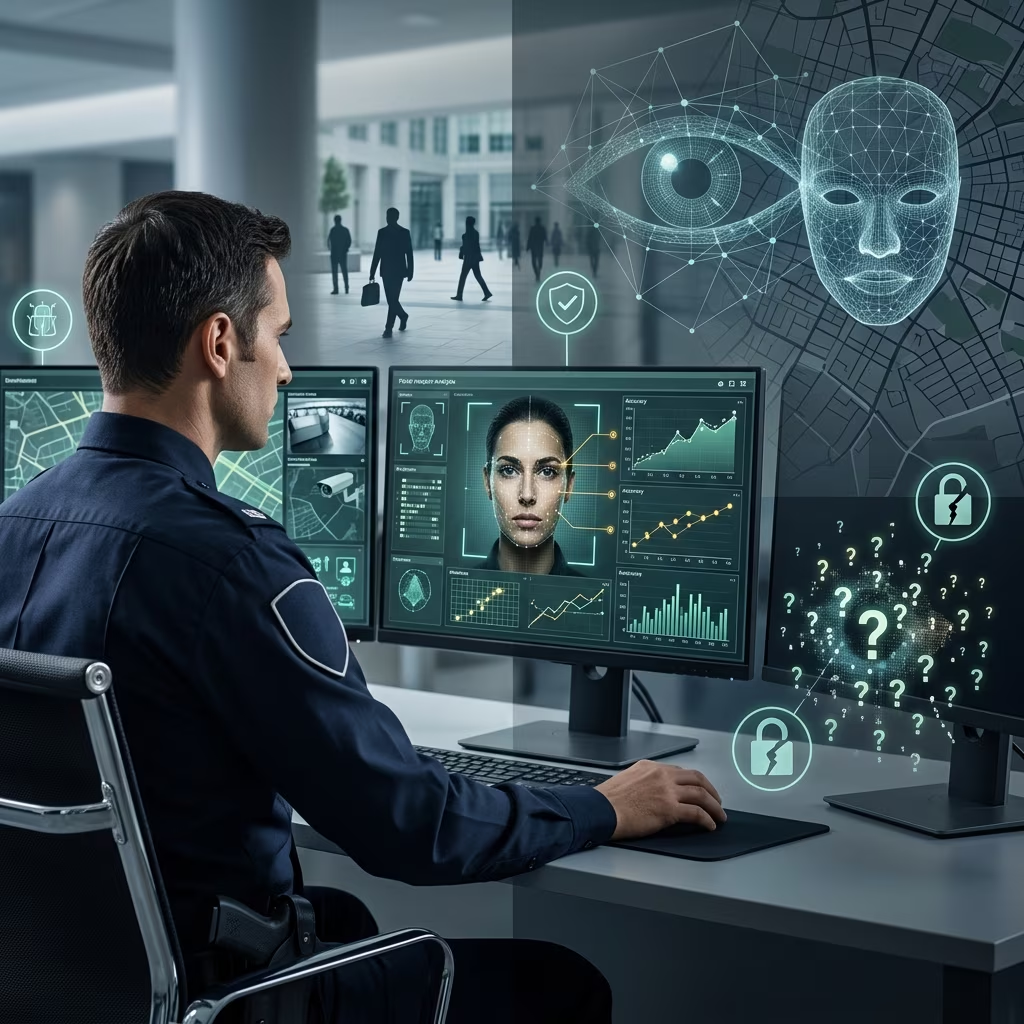
Facial recognition systems used by police are specialized software tools that compare an image of an unknown face against a database of known faces to estimate how likely it is that they belong to the same person. When used in law enforcement, the goal is usually to generate leads, not to deliver definitive proof of identity.
Core Functions in Criminal Investigations
- Face identification (1:n matching) – An unknown face (for example, from CCTV footage) is compared against a large gallery of stored images, such as mugshots, to see if the system suggests one or more possible matches.
- Face verification (1:1 matching) – A face is compared to a single reference image to confirm or challenge a claimed identity, such as verifying whether someone is the same person shown in an existing police record.
- Real-time or near real-time searching – Some systems can scan live video streams from public cameras to detect faces and check them against watchlists of wanted suspects, though this type of use is often heavily restricted or controversial.
- After-the-fact analysis – More commonly, police use facial recognition ex post, meaning they upload still images from past incidents to see if the software can suggest identities for investigation.
In practical terms, facial recognition is now woven into routine investigative workflows. For example, a department may upload a still image taken from a robbery video, run it through a facial recognition platform, and review the list of potential candidates whose booking photos are stored in a shared database.
How a Typical Police Facial Recognition System Works
Although implementations differ, many systems follow a broadly similar pipeline:
- Face detection – The software identifies and isolates faces within an image or video frame.
- Face alignment – Detected faces are aligned based on reference points (such as eyes, nose and mouth) to standardize angle and position.
- Feature extraction – The system converts facial features into a numerical representation, often called a digital template.
- Template comparison – The probe template (unknown face) is compared against templates from the database, generating similarity scores.
- Candidate list – The software returns a ranked list of possible matches, often with a confidence score, for human reviewers to assess.
Importantly, responsible agencies emphasize that these candidate lists are investigative tools, not automatic proof. Potential matches are supposed to trigger further checks, such as eyewitness interviews or independent document verification, before any arrest or charge is considered.
Why Police Agencies Embrace Facial Recognition
Proponents of facial recognition highlight its potential to make investigations faster and more efficient, especially when dealing with large volumes of digital evidence. As digital cameras, phones, and security systems proliferate, police agencies are flooded with images and video. Facial recognition promises to turn this data into useful leads.
Common Law Enforcement Use Cases
| Use Case | How Facial Recognition Helps |
|---|---|
| Identifying unknown suspects | Compares surveillance images against booking photos to suggest possible identities for follow-up investigation. |
| Finding missing or vulnerable persons | Checks images of missing people against footage from transportation hubs or public cameras to locate their movements. |
| Supporting complex investigations | Speeds up the process of sorting through large image archives in major cases, such as organized crime or terrorism-related investigations. |
| Verifying identity in custody | Helps confirm that a person being processed matches existing records, or helps identify someone who refuses to provide accurate information. |
Data from one U.S. police department illustrates how facial recognition appears in day‑to‑day work. In a reported period, the Arvada Police Department used facial recognition in 97 investigations out of more than 13,000 total incidents, leading to 44 positive matches and 53 cases with no match. This suggests that, at least in that agency, facial recognition is an occasional but valued tool rather than a constant presence.
Public Perceptions of Benefits
Research on public attitudes shows that many people recognize the potential upside of police facial recognition. A survey by the Pew Research Center found that large majorities of U.S. adults believe wide use of facial recognition would help police find more missing persons and solve crimes more quickly and efficiently. At the same time, respondents voiced serious concerns about loss of privacy and potential misuse.
How Accurate Is Police Facial Recognition?
Accuracy is central to debates about facial recognition. Supporters often point to vendor tests and laboratory benchmarks showing high overall accuracy under ideal conditions. Critics focus on how performance degrades in real-world environments and how errors are distributed across different demographic groups.
Factors That Affect Accuracy
- Image quality – Facial recognition works best with clear, frontal images in good lighting. Blurry, low-resolution surveillance footage sharply reduces accuracy.
- Database quality – If the gallery of known images is outdated or incomplete, even the best algorithm may fail to find a correct match.
- Algorithm design and training data – Systems trained on unbalanced datasets may perform better on some demographic groups than others, leading to bias.
- Human interpretation – Analysts or officers still make subjective judgments about whether to trust a candidate match. Cognitive bias can worsen errors if humans over‑rely on the software’s suggestions.
A detailed report by the Center on Privacy & Technology at Georgetown University concluded that, as currently used in U.S. criminal investigations, facial recognition is likely an unreliable source of identity evidence. The report emphasized that both human and machine factors compound each other: algorithmic errors can be amplified by confirmation bias, while facial images themselves carry demographic cues that can skew judgment.
Accuracy vs. Reliability in Real Investigations
Laboratory accuracy rates do not automatically translate into reliable courtroom evidence. In practice:
- Some agencies insist facial recognition is only an investigative lead, never the sole basis for probable cause.
- Yet researchers have documented situations where facial recognition search results were used directly to justify arrests, contrary to stated policies.
- Wrongful arrests linked to misidentifications have occurred, particularly involving people of color, demonstrating that mistakes can have serious consequences.
These real-world outcomes explain why some experts argue that face recognition, at least in its current form and use, does not yet meet the standards of a fully validated forensic science.
Bias, Civil Rights, and Wrongful Arrests
Concerns about bias and discrimination are among the most serious objections to police use of facial recognition. Even when overall accuracy appears high, differential error rates can place disproportionate burdens on specific communities.
Unequal Error Rates
Studies and official reviews have found that many facial recognition systems are more likely to misidentify women and people of color than white men. When combined with policing patterns that already focus heavily on certain neighborhoods, unequal error rates can worsen existing inequities.
- Disparate misidentification risk – If error rates are higher for particular groups, members of those groups face greater chances of being wrongly flagged as suspects.
- Compounded harms – Misidentification may lead to intrusive questioning, searches, or arrest, with downstream impacts on employment, reputation, and mental health.
- Difficulty challenging the evidence – Defendants often lack access to details about the software or search process, making it hard to challenge face recognition evidence in court.
Documented cases illustrate these risks. For example, legal observers have reported multiple wrongful arrests in recent years in which facial recognition was a key factor, including the widely discussed case of Robert Williams, who was arrested in Detroit after an erroneous facial recognition match. These incidents underscore that civil rights concerns are not hypothetical.
Privacy and Mass Surveillance Concerns
Beyond misidentification, critics worry that facial recognition enables unprecedented forms of surveillance. When combined with extensive camera networks and large biometric databases, the technology can allow continuous tracking of movements and associations in public spaces.
- Loss of anonymity in public – People can be identified at a distance without their knowledge, undermining the traditional assumption of anonymity in crowds.
- Chilling effects on protest and free expression – If authorities use facial recognition to identify participants at demonstrations, individuals may hesitate to exercise their rights, fearing long-term tracking or retaliation.
- Function creep – Systems introduced for serious crime or terrorism investigations may gradually be used for less serious matters, or for non-criminal monitoring, unless clear limits are enforced.
In one notable European case, the European Court of Human Rights found that authorities violated fundamental rights when they used facial recognition to analyze CCTV and social media images to identify a protester. The judgment reflects increased judicial scrutiny of how biometric technologies intersect with privacy and freedom of expression.
Legal and Policy Responses to Police Facial Recognition
Laws and policies governing police use of facial recognition are evolving rapidly, but they remain uneven. In some jurisdictions, detailed regulations and oversight mechanisms are emerging; in others, agencies rely mainly on internal policies or general constitutional principles.
Regulation and Governance in Practice
- Department-level policies – Some police departments adopt rules stating that facial recognition must not be the sole basis for probable cause, requires supervisory approval, and is limited to specific types of investigations.
- National and regional legislation – In the European Union, the Artificial Intelligence Act creates a new regulatory regime for high-risk AI systems, including many biometric identification tools used by law enforcement. The Act imposes conditions, transparency requirements, and restrictions on certain types of real-time remote biometric identification.
- Gaps in federal law – In the United States, there is currently no comprehensive federal statute specifically regulating police use of facial recognition. Oversight often depends on agency-specific guidelines and general constitutional law.
- Audits and official reviews – Bodies like the U.S. Government Accountability Office and U.S. Commission on Civil Rights have criticized agencies for deploying facial recognition without sufficient training, oversight, or transparency.
As of 2021, GAO reported that 42 federal agencies employing law enforcement officers had used facial recognition technology in some form. Subsequent civil rights oversight has highlighted the lack of systematic reporting and regular review of how these systems are used.
Grassroots and Local Policy Movements
Alongside formal regulation, local governments and civil society groups have pushed for bans or moratoriums on police facial recognition. Following critical reports on reliability and bias, activists argue that the technology should not be used until (or unless) clear safeguards and scientific validation are in place.
In some cities, councils have voted to restrict or prohibit use of facial recognition by municipal agencies. Elsewhere, community organizations are pressing for transparency, demanding public disclosure of which systems are in use, what databases they draw on, and how often they contribute to arrests or prosecutions.
Best Practices and Safeguards for Responsible Use
Given the mix of potential benefits and serious risks, many experts recommend strict guardrails around police deployment of facial recognition. While practices differ, several recurring principles emerge.
Technical and Procedural Safeguards
- Use as a lead, not a verdict – Treat facial recognition results strictly as investigative leads that must be corroborated through independent evidence before any arrest or charge.
- High-quality training and certification – Ensure that analysts and officers operating facial recognition systems receive specialized training on limitations, error rates, and cognitive bias.
- Documented workflows – Maintain detailed records showing when and how facial recognition searches are conducted, how candidates are reviewed, and what additional evidence supports final decisions.
- Regular accuracy and bias testing – Subject algorithms to independent, standardized tests to measure performance across diverse demographic groups, and adjust deployment based on the findings.
- Strict database governance – Clearly define which images may be included in law enforcement galleries, how long they may be retained, and when individuals may request removal.
Legal and Ethical Safeguards
- Clear legal thresholds – Set explicit rules for when facial recognition may be used (for example, only for serious offenses or specific investigative needs) and require higher authorization for particularly intrusive uses, such as real-time crowd scanning.
- Transparency and public reporting – Publish annual statistics on the number of searches, their investigative outcomes, and any known misidentifications or complaints.
- Right to challenge – Ensure that defendants can access information about facial recognition evidence used against them, including the system, settings, and candidate list, so that courts can meaningfully examine reliability.
- Independent oversight – Involve external bodies, such as data protection authorities or civil rights commissions, in monitoring police use of facial recognition and enforcing compliance with regulations.
Frequently Asked Questions
Is facial recognition always accurate when used by police?
No. Like any technology, facial recognition has error rates that vary with conditions such as image quality and algorithm design. Research indicates that, as currently used in U.S. criminal investigations, it is likely an unreliable source of identity evidence and should not be treated as definitive proof.
Are some groups more likely to be misidentified?
Yes. Studies and official reviews have found that facial recognition systems are more likely to misidentify women and people of color than white men, which raises serious concerns about discriminatory impacts and wrongful arrests.
Do police use facial recognition for mass surveillance?
Practices vary. Some agencies restrict facial recognition to specific investigations using still images, while others have explored or deployed real-time scanning of crowds. Laws like the EU AI Act and some local policies seek to limit or prohibit broad real-time remote biometric identification because of privacy and civil liberties concerns.
Is there any federal law in the U.S. that regulates police facial recognition?
Currently, there is no comprehensive U.S. federal statute specifically governing police use of facial recognition. Oversight relies on constitutional law, agency policies, and a patchwork of state and local measures.
How do communities feel about police using facial recognition?
Public opinion is mixed. Many people believe facial recognition can help find missing persons and solve crimes more efficiently, but substantial portions of the public worry that widespread use will reduce privacy and may lead to misuse or discrimination.
References
- Facial recognition technology in law enforcement: Regulating data-based biometric policing in the AI Act — ScienceDirect / K. Jaśkowski et al. 2024-08-01. https://www.sciencedirect.com/science/article/pii/S0267364924001572
- Facial Recognition Technology — Arvada Police Department (City of Arvada, CO). 2023-11-01. https://www.arvadaco.gov/917/Facial-Recognition-Technology
- Police and Facial Recognition Technology: How Innovation Can Fall Short of the Law — Columbia Science & Technology Law Review Blog. 2024-10-15. https://journals.library.columbia.edu/index.php/stlr/blog/view/655
- Public more likely to see facial recognition use by police as good rather than bad for society — Pew Research Center. 2022-03-17. https://www.pewresearch.org/internet/2022/03/17/public-more-likely-to-see-facial-recognition-use-by-police-as-good-rather-than-bad-for-society/
- A Forensic Without the Science: Face Recognition in U.S. Criminal Investigations — Georgetown Law Center on Privacy & Technology. 2022-10-01. https://www.law.georgetown.edu/privacy-technology-center/research/a-forensic-without-the-science-face-recognition-in-u-s-criminal-investigations/