
Police Brutality Claims and Section 1983
Understand how Section 1983 helps people pursue police misconduct claims and what remedies may be available.
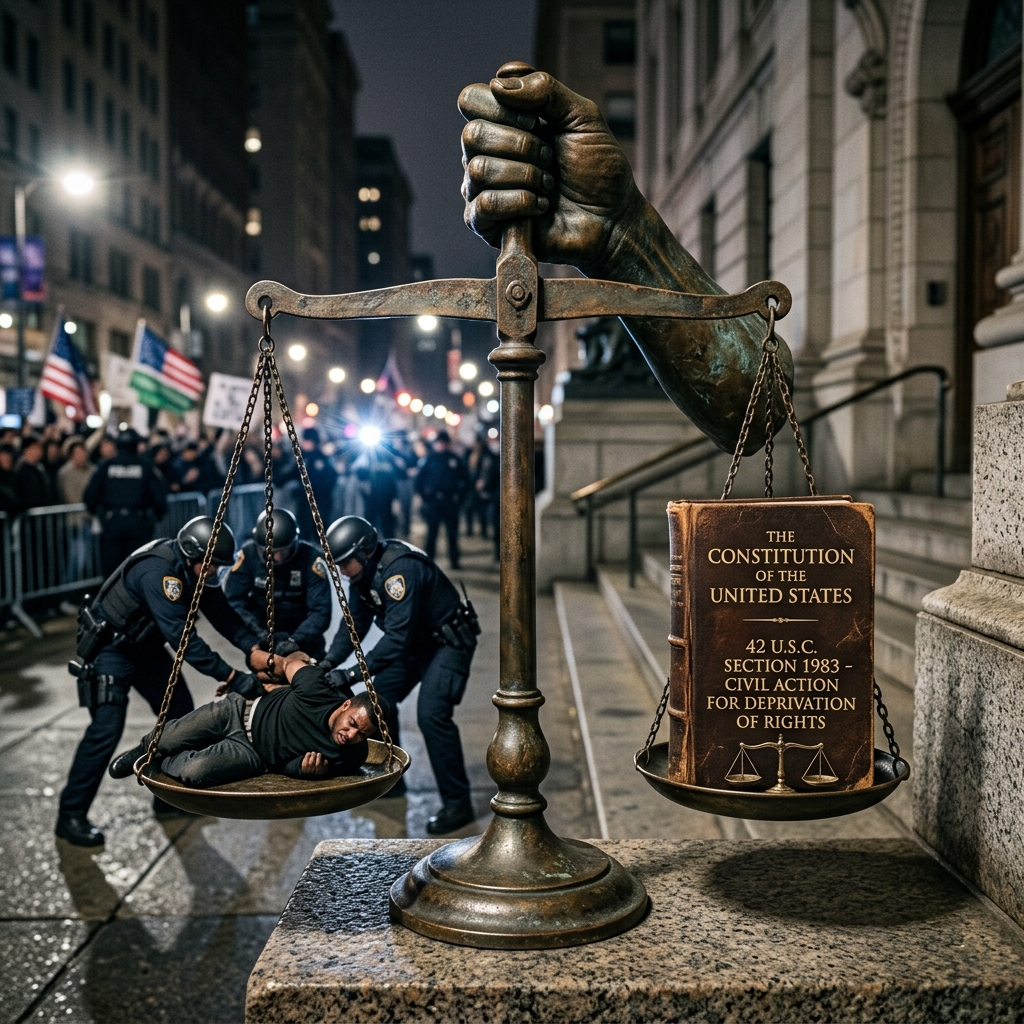
When police officers use unlawful force or otherwise violate constitutional rights, injured people may be able to bring a civil rights lawsuit under 42 U.S.C. § 1983. This federal law does not create the underlying right itself; instead, it provides a way to enforce rights already protected by the U.S. Constitution and federal law.
Section 1983 is one of the most important tools for responding to police misconduct because it can provide money damages, injunctive relief, and accountability for conduct that goes beyond mere bad judgment. In practice, these cases often involve allegations such as excessive force, unlawful arrest, denial of medical care, or other abuses committed under color of state law.
What Section 1983 Actually Does
Section 1983 is a federal civil rights statute that allows a person to sue state and local officials who, while acting with governmental authority, deprive someone of a constitutional right. The law is commonly used in police misconduct cases because officers regularly act under color of state law when they stop, arrest, search, detain, or use force against members of the public.
To bring a viable claim, a plaintiff generally must show two core elements: first, that the defendant acted under color of state law; and second, that the conduct deprived the plaintiff of a constitutional right. That framework is simple to state, but difficult cases often turn on details such as what happened during the encounter, whether the officer’s conduct was objectively unreasonable, and whether the right at issue was clearly established.
| Core Question | What the Plaintiff Must Show |
|---|---|
| Was the defendant acting as a government official? | The conduct occurred under color of state law. |
| Was a protected right violated? | The conduct deprived the plaintiff of a constitutional or federal right. |
| Was there injury? | The violation caused actual harm supporting damages or other relief. |
Who Can Be Sued in a Civil Rights Case
Section 1983 claims are usually brought against the individual officer or officers involved, but they may also reach certain public entities depending on the facts. A city, county, or other local government can sometimes be sued if the constitutional violation was caused by an official policy, practice, or deliberate failure to train or supervise.
There are limits, however. Courts have long held that a municipality is not automatically liable just because one of its employees committed misconduct. In other words, local governments are not liable under a simple employer-responsibility theory; the plaintiff must connect the injury to a policy or custom that actually caused the harm.
Claims against state governments are treated differently from claims against local governments, and the federal government is not sued under Section 1983 in the same way. When federal officers are involved, a different type of case, commonly called a Bivens action, may come into play instead.
Common Types of Police Misconduct Claims
Section 1983 can be used in a wide range of civil rights disputes, not just classic excessive-force cases. The most common allegations include the following:
- Excessive force during an arrest, stop, or detention.
- False arrest or detention without lawful basis.
- Unlawful search or seizure in violation of the Fourth Amendment.
- Denial of medical care in jail or custody.
- Failure to protect a person in custody from known risks.
- Wrongful death arising from unconstitutional police conduct.
The exact legal theory depends on the facts and on which constitutional right was allegedly violated. For example, a claim arising from an arrest may involve the Fourth Amendment, while a claim about jail conditions may involve due process or other constitutional protections.
Why These Cases Are Important
Section 1983 serves two major functions: compensation and deterrence. Compensation means a victim may recover money for the harm caused by the constitutional violation, including medical bills, lost income, pain and suffering, and emotional distress. Deterrence means civil liability can discourage future misconduct by officers and public agencies.
In some cases, a court may also order injunctive relief, which is a non-money remedy requiring a government agency to change its behavior. That might include policy revisions, retraining, or another corrective step designed to reduce the chance of future harm.
The Role of Qualified Immunity
One of the biggest obstacles in police misconduct litigation is qualified immunity, a defense that can protect individual officers from personal liability unless they violated a clearly established constitutional right. In practical terms, even where a plaintiff proves that conduct was wrong, a court may still dismiss the claim if prior law did not make the officer’s obligation sufficiently clear.
This defense is one reason Section 1983 cases are often heavily contested. Plaintiffs must do more than show that the encounter ended badly; they must show that the law was specific enough to place the constitutional line beyond debate in the circumstances of the case.
Municipal Liability and Policy Failures
When plaintiffs seek to hold a city or county responsible, the focus usually shifts from the individual officer’s conduct to the organization’s policies or customs. A municipality may face liability if an official decision, a persistent practice, or a deliberate failure to train officers caused the constitutional injury.
That means evidence matters. Internal complaints, training records, use-of-force policies, prior incidents, and supervision practices may all become relevant. A plaintiff often needs to show that the government entity made a deliberate choice, or tolerated a known problem, rather than merely employing a bad actor.
| Defendant Type | Typical Issue | Key Limitation |
|---|---|---|
| Individual officer | Use of force, arrest, search, detention | Qualified immunity may apply. |
| City or county | Policy, custom, training, supervision | No automatic liability for employee misconduct. |
| State government | Usually limited by sovereign immunity principles | Not generally treated as a Section 1983 “person” in the same way. |
What Remedies May Be Available
Money damages are the most familiar remedy in a Section 1983 case. Depending on the facts, a successful plaintiff may recover compensation for physical injury, treatment expenses, lost wages, emotional suffering, and related losses.
Some cases may also support punitive damages against individual defendants if the conduct was especially egregious, although those awards are not automatically available in every civil rights case. In addition, a plaintiff may seek orders that require the government to change a policy or stop a harmful practice.
Attorney’s fees can also be significant in civil rights litigation, which matters because these cases can be expensive to investigate and prove. That fee-shifting feature can help people with valid claims obtain counsel even when their individual financial losses are modest compared with the broader public importance of the case.
Deadlines and Filing Concerns
Timing is critical in police misconduct cases because Section 1983 claims borrow the applicable state personal-injury limitation period. In many places, that means the deadline may be relatively short, and waiting too long can permanently bar the case.
Even where federal and state claims are filed together, a plaintiff typically needs to act quickly because evidence can disappear, memories fade, and agency records may be harder to obtain over time. Early legal review can also help identify whether claims belong in federal court, state court, or both.
How Plaintiffs Build a Stronger Case
Successful Section 1983 cases are usually built on concrete proof rather than general allegations. Useful evidence may include body-camera video, witness statements, medical records, incident reports, photographs of injuries, jail logs, dispatch records, and prior complaints against the same agency.
Because these claims often involve constitutional standards, legal framing matters as much as factual proof. Plaintiffs and their attorneys usually need to identify the exact right violated, the specific government actor responsible, and the way the misconduct caused measurable harm.
Frequently Asked Questions
Can I sue if I was injured by police during an arrest?
Possibly. If the officer acted under color of state law and violated a constitutional right, Section 1983 may provide a path to compensation.
Do I sue the officer, the city, or both?
That depends on the facts. Individual officers may be sued for their conduct, and a city or county may be sued if a policy, custom, or training failure caused the violation.
What if the officer says the force was reasonable?
Reasonableness is often a central issue, especially in excessive-force claims. The outcome usually turns on the specific circumstances, including the threat level, the severity of the situation, and the amount of force used.
Can I recover money for emotional distress?
Yes, emotional distress may be part of compensatory damages in a successful Section 1983 case if the evidence supports that harm.
Are police misconduct claims always federal cases?
No. Many victims also have state-law claims, such as assault, battery, false imprisonment, or wrongful death, depending on the conduct and the state’s laws.
Why These Claims Often Require Careful Legal Analysis
Police brutality lawsuits sit at the intersection of constitutional law, civil procedure, and evidence. The legal standards can be demanding, and defendants often raise immunity defenses, causation arguments, or disputes about whether any constitutional right was actually violated.
Even so, Section 1983 remains a central remedy for people harmed by official misconduct. It gives injured individuals a way to pursue accountability when government power is used unlawfully, while also giving courts a mechanism to respond to systemic problems that may otherwise continue unchecked.
References
- Section 1983 claims generally — Helm Law Office, PC. 2024-01-01. https://www.helmlawoffice.com/police-misconduct/section-1983-claims-generally/
- Section 1983 Lawsuit: How Federal Civil Rights Claims Work — Arizona Civil Rights. 2024-01-01. https://azcivilrights.com/section-1983-lawsuit/
- Section 1983 (42 U.S.C. § 1983 – Civil Rights in the United States — University of Minnesota Law Library. 2024-01-01. https://libguides.law.umn.edu/c.php?g=125765&p=2893387
- Chapter 5 – U.S. Commission on Civil Rights — U.S. Commission on Civil Rights. 2024-01-01. https://www.usccr.gov/files/pubs/guard/ch5.htm
- Federal Civil Rights Claims — People’s Law Library. 2024-01-01. https://www.peoples-law.org/node/457/printable/print
- 1983 lawsuits: 3 shocking facts about police misconduct — James Law Group. 2024-01-01. https://www.jameslawgroup.net/1714/1983-lawsuit-3-shocking-facts/
Similar Articles








Read full bio of Sneha Tete




