
Plain‑Language Guide to Common Divorce Terms
Understand key divorce terminology in clear, everyday language so you can follow the process and make informed decisions.
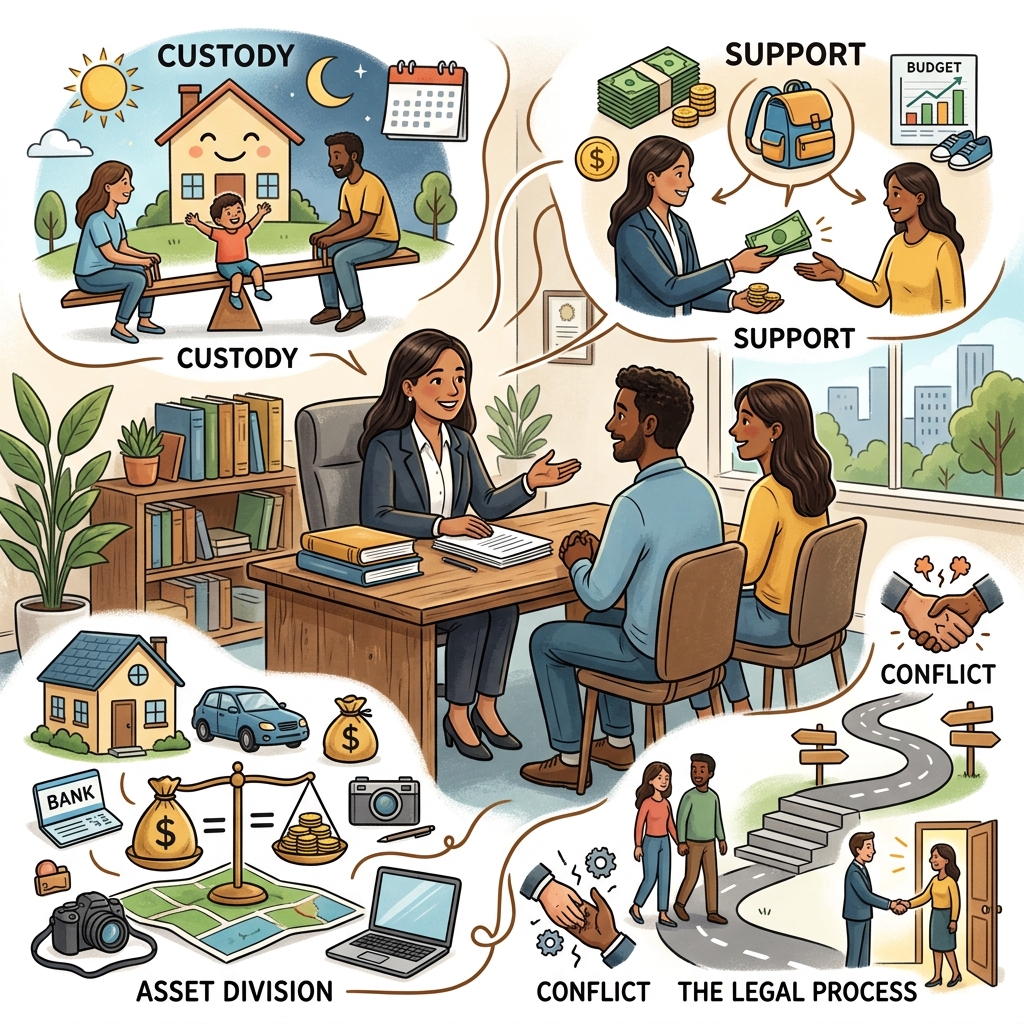
Divorce involves not only emotional and financial change, but also a flood of unfamiliar legal language. Understanding the words used in court papers, lawyer conversations, and judge orders helps you stay engaged in your case and make informed choices. This guide explains common divorce terms in plain English, with brief examples so you can see how they work in real life.
Because divorce law is largely state‑based, definitions can vary slightly depending on where you live. However, the concepts below are broadly used in many U.S. jurisdictions and align with established legal terminology used by courts and legal professionals.[10]
1. Big Picture Terms: Ending a Marriage
Several core terms describe the legal process of ending a marriage. These are often used interchangeably, but they can have specific meanings in statutes and court rules.
1.1 Divorce
Divorce is the court process that legally ends a valid marriage. Once a divorce is finalized, the spouses are no longer legally married and are free to remarry in the future.[10]
- One spouse typically begins the case by filing initial papers with the court.
- Issues such as property division, child custody, and support are resolved before the final order is entered.
1.2 Dissolution of Marriage
Dissolution of marriage is another legal term for divorce and is used in many state statutes and court forms.[10] Although the phrase sounds technical, it refers to the same basic process: legally ending the marital relationship.
- Some states use “divorce” in everyday language but “dissolution” in official legal documents.
- Forms may refer to the person filing as a petitioner in a dissolution action.
1.3 Annulment
Annulment is different from divorce. In an annulment, a court declares that the marriage was legally invalid from the start, treating it as if it never existed. Common reasons include a spouse being underage, already married to someone else, or unable to consent at the time of marriage.
- Annulment does not simply end a marriage; it erases it in the eyes of the law.
- The specific grounds for annulment are defined by state law and usually require proof.
2. Fault, No‑Fault, and Contested Divorces
Modern divorce law focuses less on blame than in the past, but fault still matters in some states. Understanding these terms clarifies why your case is being filed and how it may proceed.
2.1 No‑Fault Divorce
In a no‑fault divorce, the spouse seeking to end the marriage does not have to prove the other did anything wrong. The reason given is usually that the marriage has broken down beyond repair, sometimes called “irretrievable breakdown” or “irreconcilable differences”.[10]
- Most U.S. divorces today are filed as no‑fault actions.[10]
- No‑fault procedures can simplify the case and reduce the need for evidence about marital misconduct.
2.2 Fault‑Based Divorce
A fault divorce is filed on the basis that one spouse did something that legally justifies ending the marriage. Common fault grounds include adultery, abandonment, cruelty, or chronic substance abuse.
- Fault grounds must typically be proved through testimony or documents.
- In some states, fault may influence issues such as property division or spousal support.
2.3 Contested vs. Uncontested Divorce
A contested divorce is one in which the spouses do not agree on one or more key issues, such as custody, support, or division of property. An uncontested divorce occurs when the parties reach agreement on all major matters and primarily need the court to approve and formalize their settlement.
| Type of Case | Main Features | Typical Impact |
|---|---|---|
| Uncontested | Full agreement on issues; limited court hearings. | Often faster, lower cost, less conflict. |
| Contested | Disputes over one or more issues; may involve trial. | More time, higher expense, greater uncertainty. |
3. Who Is Involved? Roles in a Divorce Case
Understanding how the law labels participants in a divorce helps you read court documents and know what is expected of you.
3.1 Petitioner and Respondent
The petitioner (or sometimes “plaintiff”) is the spouse who starts the case by filing the initial divorce papers. The respondent (or “defendant”) is the other spouse who receives these papers and has a chance to reply.
- The petitioner sets out basic requests about property, custody, and support in the opening filing.
- The respondent may agree, disagree, or present alternative proposals.
3.2 Mediator, Arbitrator, and Judge
Several neutral professionals may be involved in resolving disputes:
- Mediator: A trained neutral who facilitates discussion to help spouses negotiate their own agreement, without imposing a decision.
- Arbitrator: A neutral decision‑maker who hears evidence and makes a binding or non‑binding ruling, usually in private arbitration rather than in open court.
- Judge: The public official who presides over court hearings, decides disputes that cannot be settled, and signs the final orders.
4. Ways to Resolve Disputes: ADR and Mediation
Not every divorce ends in a full trial before a judge. Many couples use structured processes to reach agreements outside of traditional courtroom litigation.
4.1 Alternative Dispute Resolution (ADR)
Alternative dispute resolution (ADR) refers to methods of settling legal conflicts without a conventional trial, including mediation, arbitration, and collaborative law. Courts and legal organizations increasingly encourage ADR to reduce cost and conflict.
- ADR can be voluntary or ordered by the court in certain cases.
- Agreements reached through ADR are often turned into formal court orders.
4.2 Mediation
Mediation is a common form of ADR used in divorce and custody cases. A mediator helps the parties clarify issues, explore options, and develop solutions that they both can accept. The mediator does not represent either party and does not decide the case.
- Mediation sessions are usually confidential and not part of the public court record.
- If an agreement is reached, it is often written into a settlement or parenting plan.
5. Money Issues: Alimony and Child Support
Financial support is central in many divorces, especially where one spouse earns significantly more than the other or where children are involved.
5.1 Alimony (Spousal Support)
Alimony, also called spousal support, is money paid by one spouse to the other during or after divorce to help with living expenses. Its purpose is often to reduce unfair economic effects of the breakup, especially for a lower‑earning spouse.[10]
- Courts may consider factors such as length of marriage, each spouse’s income and earning capacity, age, health, and the standard of living during the marriage.[10]
- Support can be temporary (for a set period) or longer‑term, depending on state law and case facts.
5.2 Child Support
Child support is an ongoing payment, usually from the non‑custodial parent to the custodial parent, to help cover the child’s basic needs such as housing, food, clothing, and education. Most states use guidelines or formulas based on parental income and number of children.
- Support orders are enforceable by the court and can be modified if circumstances significantly change.[10]
- Child support is typically separate from alimony and is focused solely on the child’s best interests.
6. Children: Custody, Visitation, and Parenting Plans
For parents, arrangements concerning children are often the most important part of a divorce case. Courts emphasize the child’s welfare above all else.
6.1 Legal and Physical Custody
Custody describes parents’ rights and responsibilities for their children. Many jurisdictions distinguish between two forms:
- Legal custody: The authority to make major decisions about the child’s life, such as schooling, healthcare, and religious upbringing.
- Physical custody: Where the child lives day‑to‑day and which parent provides primary physical care.
Custody can be sole (held primarily by one parent) or joint (shared in some fashion between both parents), depending on state law and the child’s needs.
6.2 Visitation (Parenting Time)
Visitation, often called parenting time, refers to the schedule for when the parent who does not have primary physical custody spends time with the child.
- Schedules can be fixed (specific dates and times), flexible (“reasonable” visitation by agreement), supervised (with a third person present), or in rare cases, restricted.
- Courts aim to create arrangements that serve the child’s emotional and developmental needs.
6.3 Parenting Plan
A parenting plan is a detailed document describing custody arrangements, visitation schedules, and how parents will make decisions and communicate about their children.
- Courts often require a parenting plan in contested custody matters.
- Plans can address holidays, transportation, communication rules, and ways to resolve future disagreements.
7. Property and Debts: What Belongs to Whom?
Dividing assets and liabilities is another major part of divorce. The rules depend heavily on whether a state follows community property or equitable distribution principles.
7.1 Marital Property
Marital property generally includes assets acquired during the marriage, regardless of whose name is on the title. It may include income, real estate, retirement accounts, and personal property.
- Property owned before the marriage or received as an individual gift or inheritance may be treated differently, often as separate property.
- Exact definitions are set by state law and can significantly affect how property is divided.
7.2 Community Property
Community property is a system used in some states in which most property and debts obtained during the marriage are considered jointly owned by both spouses and divided equally or nearly equally at divorce.
- Examples of community property states include California and Texas, but rules vary among them.
- Separate property (owned before marriage or received individually) is usually excluded from division.
7.3 Qualified Domestic Relations Order (QDRO)
A Qualified Domestic Relations Order (QDRO) is a specialized court order that allows retirement plans to be divided between spouses without triggering immediate taxes or penalties, when the plan is subject to federal law.
- QDROs are used for certain employer‑sponsored plans such as 401(k)s and pensions.
- The order must meet strict requirements under federal law and plan rules to be effective.
8. Court Documents and Orders
Several key documents mark stages in the divorce process and confirm what the court has decided.
8.1 Decree or Judgment
A divorce decree, sometimes called a judgment of dissolution, is the written order from the court that officially ends the marriage and sets out the final terms regarding property, support, and parenting.[10]
- The decree is often the primary document you will refer to in the future to understand your rights and obligations.
- Failing to follow the decree can result in enforcement actions or contempt proceedings.
8.2 Separation Agreement and Settlement
A separation agreement or settlement agreement is a written contract between spouses that spells out how they will divide property, handle support, and arrange parenting responsibilities.
- Agreements reached between the parties are often incorporated into the final decree.
- In many cases, thorough agreements reduce the need for contested hearings or trials.
8.3 Temporary Orders and Protective Orders
During a divorce, courts may issue temporary orders that control issues such as who stays in the home, who pays certain bills, and how children will be cared for until the case is resolved.[10]
Additionally, a protective order or restraining order may be issued to protect a spouse or child from harassment or abuse.
- Temporary orders are meant to stabilize the situation and can later be replaced by final terms in the decree.
- Violating a protective order can carry serious legal consequences, including criminal penalties.
9. Frequently Asked Questions (FAQs)
9.1 Is divorce the same as dissolution of marriage?
In most U.S. jurisdictions, “divorce” and “dissolution of marriage” refer to the same legal process, but the formal term used in statutes and court forms may be “dissolution”.[10] Everyday speech typically uses “divorce”.
9.2 Do I need to prove fault to get divorced?
Usually not. The majority of states allow no‑fault divorce, meaning you can end the marriage without proving wrongdoing by your spouse, based on irreconcilable differences or similar language.[10] Some states still permit fault grounds, but they are not typically required.
9.3 How is child support calculated?
States generally use child support guidelines, which are formulas based on factors such as parental income, number of children, and sometimes parenting time.[10] Courts can adjust the guideline amount in limited circumstances, but the goal is consistent, predictable support levels.
9.4 Can custody and visitation arrangements be changed later?
Yes. Custody and visitation orders can usually be modified if there is a significant change in circumstances and the proposed change is in the child’s best interests.[10] Examples include a parent’s relocation, changes in a child’s needs, or serious issues affecting the child’s safety.
9.5 What happens if one spouse ignores the decree?
If a spouse fails to follow the divorce decree—such as by not paying ordered support or refusing to transfer property—the other can ask the court to enforce the order, which may include wage garnishment, fines, or findings of contempt.[10]
References
- Glossary of Legal Terms — United States Courts. 2024-01-05. https://www.uscourts.gov/glossary
- Florida Courts Help: Legal Terms — Florida State Courts. 2023-08-10. https://www.flcourts.gov/Courts-System/florida-courts-help/get-started/legal-terms
- Divorce Glossary — FindLaw. 2022-11-15. https://www.findlaw.com/family/divorce/divorce-glossary.html
- Glossary of Legal Terms for Divorce Proceedings — Carlson & Work. 2023-03-20. https://www.renolawfirm.com/glossary-of-legal-terms-for-divorce-proceedings/
- Divorce Glossary — Simple Texas Divorce. 2022-09-30. https://www.simpletexasdivorce.com/divorce-information-center/divorce-glossary/
- Essential Legal Terms You Need to Know in Divorce Proceedings — M. Fell Family Law. 2023-05-12. https://www.mfellfamilylaw.com/essential-legal-terms-you-need-to-know-in-divorce-proceedings/
- The Definitive Glossary of Divorce Jargon — Freed Marcroft. 2023-02-01. https://freedmarcroft.com/from-a-to-z-the-definitive-glossary-of-divorce-jargon/
Similar Articles








Read full bio of Sneha Tete


