
Piracy and Privateering Under Federal Law
Learn how federal law defines piracy, privateering, and related crimes at sea.
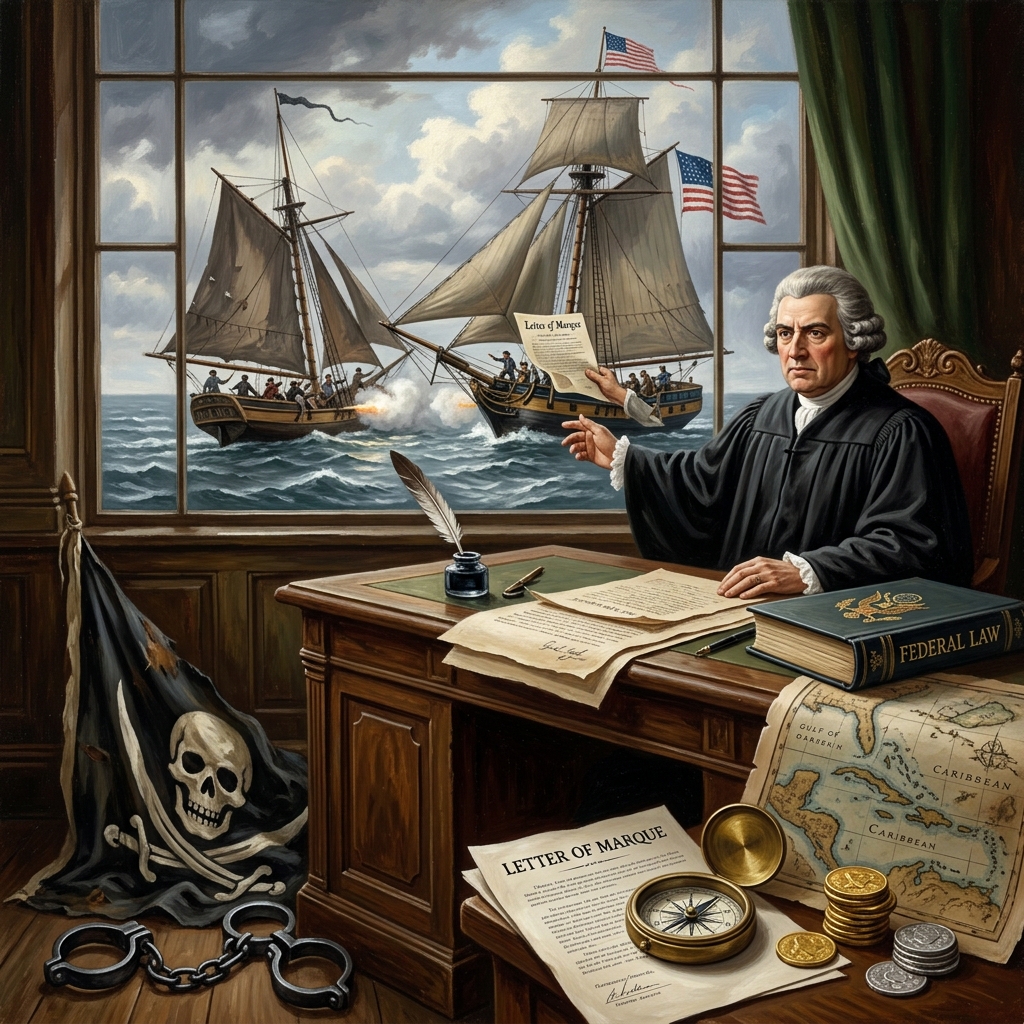
Maritime crime has long occupied a unique place in American law. While most criminal offenses are tied to conduct on land, piracy and privateering involve acts committed at sea and can trigger federal prosecution under a dedicated group of statutes. These laws reflect both the historical importance of ocean commerce and the continuing need to protect ships, cargo, crews, and international shipping routes.
Although the words pirate and privateer may sound like relics from another era, federal law still uses them in precise ways. The distinction matters because one refers to unlawful violence or theft at sea, while the other historically involved government authorization to attack enemy vessels. Modern U.S. law generally treats piracy as a serious federal offense and privateering as a term with narrow legal meaning inside Chapter 81 of Title 18.
Why maritime offenses still matter
The United States has extensive coastlines, busy ports, and a major stake in international shipping. Crimes committed on the high seas can threaten navigation, commerce, and human safety far beyond the location where they begin. For that reason, Congress has preserved a specific body of criminal law addressing piracy, vessel attacks, and conduct tied to private warlike activity.
Modern prosecutions under these laws may be uncommon compared with ordinary theft or assault charges, but the statutes remain important because they allow federal authorities to respond to conduct that crosses national boundaries. Maritime offenses also raise special questions about jurisdiction, proof, and the relationship between domestic law and international norms.
How federal law organizes piracy offenses
Federal piracy law appears in 18 U.S. Code Chapter 81, which groups together multiple offenses involving unlawful conduct at sea. The chapter addresses classic piracy, participation in piratical ventures, injuries to ships, theft from distressed vessels, and related conduct such as receiving pirate property. It also contains provisions that reach U.S. citizens and foreign nationals who engage in hostile acts on the water under particular circumstances.
This structure is important because piracy is not treated as one single act. Instead, the law separates different kinds of conduct so prosecutors can charge the offense that best fits the facts. Some sections punish direct violence, while others focus on supporting conduct, possession of stolen maritime property, or attempts to plunder a ship already in distress.
| Legal issue | General focus | Typical federal concern |
|---|---|---|
| Classic piracy | Violence or depredation at sea | High-seas attacks, robbery, or seizure of vessels |
| Privateering-related conduct | Hostile acts under color of foreign authority | Unlawful use of purported commissions or warlike authorization |
| Supporting offenses | Aiding, receiving, or concealing pirate property | Material assistance to piracy or possession of stolen maritime goods |
| Vessel-related crimes | Plunder, distress, deception, or conversion of ships | Danger to crews and loss of maritime property |
What counts as piracy
In broad terms, piracy is unlawful violence or theft carried out on the sea for private gain and without proper state authorization. International law also recognizes piracy as conduct occurring outside normal territorial jurisdiction, which helps explain why federal law pays special attention to the high seas. A core feature is that the conduct is private, not state-sanctioned, even if the offender tries to disguise it as authorized activity.
Under U.S. law, the most serious piracy provision punishes a person who commits piracy as defined by the law of nations and is later found in the United States. That offense can carry a sentence of life imprisonment. Other provisions reach U.S. citizens or foreign nationals who commit murders, robberies, or hostile acts at sea under false or unlawful claims of authority.
Privateering and the historical idea of a commission
Privateering was once a legal practice in which a government authorized private ships to attack enemy commerce during war. The captain or owner carried a commission, often called a letter of marque, which gave the vessel limited permission to engage in hostile acts against designated enemies. That authorization distinguished the privateer from the ordinary pirate.
Modern U.S. criminal law retains references to this concept because conduct done under a false or improper claim of authority can still amount to piracy. The law is especially concerned with people who act “under color” of a foreign commission or on the pretense of authority that does not legally justify the violence or seizure. In other words, simply claiming official permission does not make the conduct lawful.
Related offenses included in the chapter
Chapter 81 reaches more than direct attacks on ships. It also punishes conduct that helps piracy succeed or that exploits maritime victims after an attack. This broader design reflects the reality that piracy often depends on accomplices, transport, concealment, or later resale of stolen goods.
- Arming or serving on privateers: A person who arms a vessel for privateering purposes or serves aboard a privateer in prohibited circumstances can face federal punishment.
- Assault on a vessel commander: Attacking the commander of a ship can be treated as piracy-related conduct.
- Conversion or surrender of a vessel: Wrongfully taking control of a ship or forcing its surrender can trigger criminal liability.
- Corruption of seamen: Recruiting, persuading, or conspiring with sailors to betray their lawful duties can also be a federal offense.
- Plunder of distressed vessels: Stealing from a ship in distress is separately punishable because the victims are already in a vulnerable position.
- Receiving pirate property: Knowing possession of goods stolen by pirates can expose a person to prosecution even if that person did not personally board the vessel.
Penalties can be severe
One reason piracy remains a notable federal offense is the severity of the penalties. Some offenses in Chapter 81 carry a mandatory life sentence, while others authorize long prison terms that may still be substantial even when they are not mandatory. Congress has treated these crimes as especially dangerous because they involve force, fear, and disruption of maritime trade.
For example, piracy under the law of nations can lead to life imprisonment. Attacks intended to plunder a vessel, or certain acts that place a ship in peril through false lights or other deceptive conduct, may bring a sentence measured in years or even life. Receiving property known to have been stolen by pirates can also carry significant prison exposure. These penalties show that the legal system views maritime predation as more than ordinary theft.
Jurisdiction: why the federal government handles these cases
Piracy usually falls under federal rather than state authority because the conduct often occurs outside any one state’s borders. The federal government has the power to regulate offenses on the high seas and to prosecute conduct that affects U.S. interests in international waters. This is especially important when a vessel, crew member, or victim later enters the United States.
Jurisdiction can become complex when an offense involves foreign ships, foreign citizens, or conduct near territorial boundaries. In those situations, prosecutors may rely on statutes that apply to U.S. citizens, conduct on the high seas, or attacks against U.S. vessels and property. The legal question is not only what happened, but also where it happened and whose interests were targeted.
How prosecutors may build a piracy case
A prosecution for piracy or a related offense usually requires proof of both conduct and context. The government may need to show that the defendant acted at sea, that the conduct was violent or predatory, and that the action was done for private ends or under an unlawful claim of authority. In supporting-offense cases, prosecutors may also have to prove knowledge, such as awareness that property had been stolen by pirates.
Evidence in these cases may include witness statements from crew members, ship logs, communications, surveillance data, vessel tracking records, cargo documents, and recovered property. Because maritime crimes can involve multiple actors and ships, prosecutors often try to establish the full sequence of events rather than focusing only on the final boarding or theft.
Possible defense issues in maritime cases
Defendants facing piracy-related charges may raise a number of defenses depending on the facts. They may challenge whether the conduct occurred in a location covered by the statute, whether the vessel was truly on the high seas, or whether the alleged conduct amounted to piracy rather than a lesser offense. They may also contest proof of intent, especially where the government claims the defendant acted for private gain or knowingly received pirate property.
Another common issue is mistaken identity, especially in cases involving fast-moving ship encounters, night operations, or multiple vessels. In some cases, a defendant may argue that the alleged conduct was authorized by law or took place during a lawful military or law-enforcement operation, though such claims would need strong supporting evidence.
Difference between piracy and ordinary robbery
Although piracy can look like robbery, the law treats it differently because of the setting and the broader danger it creates. Ordinary robbery is usually a land-based offense involving force or intimidation to take property from a person or business. Piracy, by contrast, occurs in maritime settings and often involves danger to vessels, crews, cargo, and navigation itself.
That distinction matters because a pirate attack can threaten multiple victims at once and can disrupt international commerce. It also creates unique evidentiary and jurisdictional problems. For that reason, the law does not simply treat piracy as “robbery on water”; it treats it as a special category of criminal conduct with its own statutory framework.
Frequently asked questions
Is piracy still a crime in the United States?
Yes. Federal law still prohibits piracy and several related maritime offenses. The governing statutes remain in Chapter 81 of Title 18.
Can someone be charged even if they did not personally board the ship?
Yes. Chapter 81 includes offenses that reach people who aid piracy, possess pirate property, or participate in conduct connected to a piratical venture.
Why does privateering appear in federal law if it is mostly historical?
Privateering appears because the law distinguishes between lawful state authorization and unlawful claims of authority. The concept helps define when a person is acting under a false or improper commission.
Does piracy always require violence?
Violence is common, but not every covered offense requires direct physical force. Some statutes focus on plunder, possession, deception, or facilitation connected to piratical conduct.
Why the old language still matters today
Even though the vocabulary of pirates, privateers, and letters of marque comes from earlier centuries, the underlying legal ideas remain relevant. Modern shipping still depends on safe passage, and attacks at sea can create losses that extend across borders and economies. Chapter 81 preserves a legal toolkit for responding to those harms.
The chapter also serves a symbolic function. It makes clear that maritime violence, theft from vulnerable ships, and unlawful seizure of property are not just ordinary criminal acts. They are offenses that strike at commerce, safety, and international order.
References
- 18 U.S. Code Chapter 81, Piracy and Privateering — U.S. House of Representatives, Office of the Law Revision Counsel. 2026-07-09. https://uscode.house.gov/view.xhtml?path=/prelim@title18/part1/chapter81&edition=prelim
- 18 U.S. Code Chapter 81, Piracy and Privateering — Cornell Law School, Legal Information Institute. 2026-07-09. https://www.law.cornell.edu/uscode/text/18/part-I/chapter-81
- Convention on the Law of the Sea, Article 101 — United Nations. 1982-12-10. https://www.un.org/depts/los/convention_agreements/texts/unclos/unclos_e.pdf
- Pirates, Privateers, and Civil War Maritime Laws — Library of Congress, In Custodia Legis. 2020-05-28. https://blogs.loc.gov/law/2020/05/pirates-privateers-and-civil-war-maritime-laws/
- Piracy — Encyclopaedia Britannica. 2025-05-14. https://www.britannica.com/topic/piracy-international-law
Similar Articles








Read full bio of medha deb




