
Personal Injury Awards in Divorce: Community or Separate Property?
How courts treat personal injury settlements when a marriage ends, and what it means for community versus separate property.
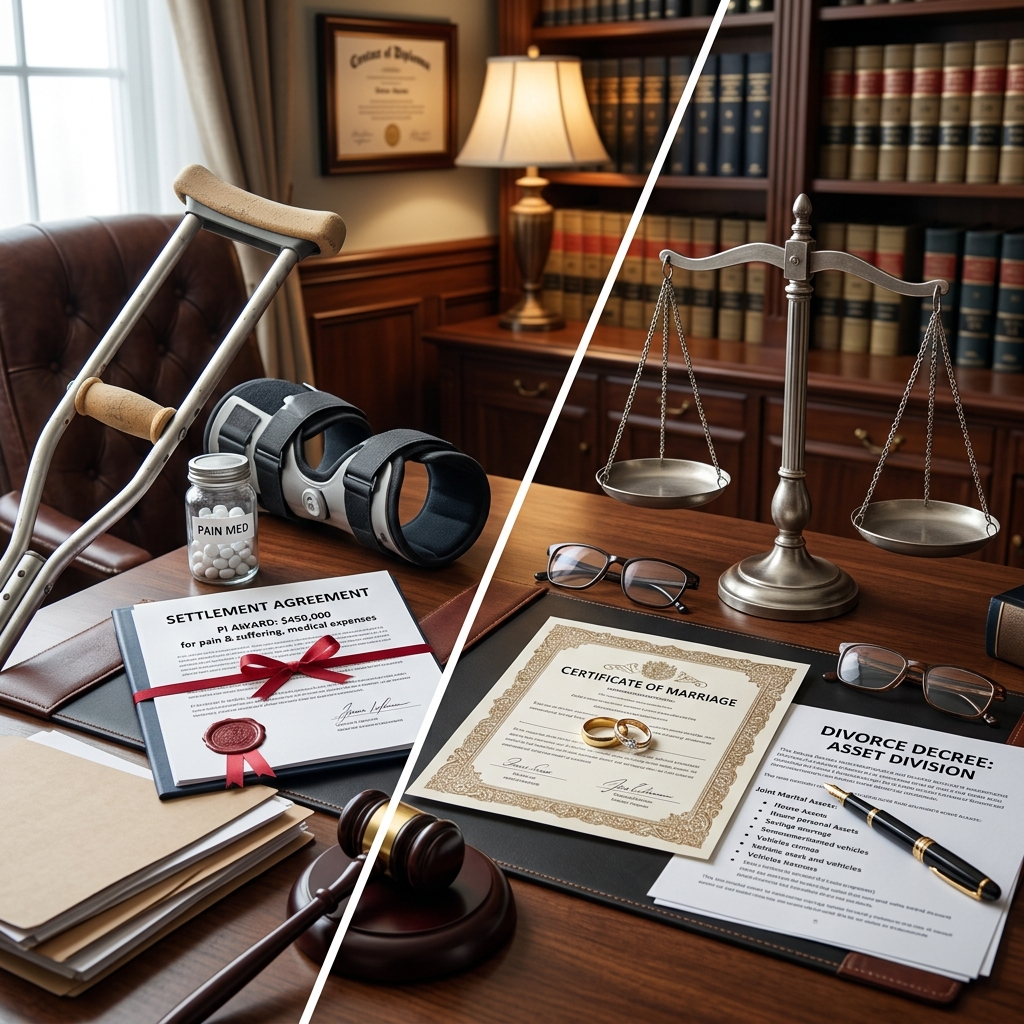
When a spouse receives money from a personal injury claim and later faces a divorce, one of the most complex questions is whether that money is shared marital or community property or separate property belonging only to the injured spouse. Courts rarely treat the entire award in a single way. Instead, they look at when the injury happened, what each part of the settlement is meant to compensate, and how the money was handled during the marriage.
This article explains the key concepts that determine how personal injury settlements and judgments are handled in divorce, with examples from both community property and equitable distribution states. It is an educational overview, not legal advice. Specific outcomes depend on the law of your state and the facts of your case.
Understanding Marital, Community, and Separate Property
Before looking at personal injury awards, it helps to understand how courts classify property in divorce.
Basic Property Categories
- Marital property (or community property in certain states) usually includes assets and debts acquired or earned during the marriage, regardless of whose name is on the title.
- Separate property generally covers what a spouse owned before the marriage, as well as assets acquired during the marriage by inheritance, gift to one spouse, or in some cases, certain personal injury damages.
- Mixed property arises when one asset contains both marital and separate components—for example, when a personal injury award includes both compensation for joint economic losses and personal pain and suffering.
Many states using equitable distribution distinguish marital from separate property and then divide marital property fairly, though not always equally. Community property states generally start from the presumption that most property earned during the marriage belongs equally to both spouses, subject to specific exceptions.
Why Personal Injury Awards Are Difficult to Classify
Personal injury settlements and judgments often bundle many different types of damages into a single payment. Courts must unpack those components to decide what belongs in the marital estate and what should remain with the injured spouse.
- Some parts reimburse costs paid with marital funds, like medical expenses.
- Other parts replace lost wages or earning capacity that would have supported the household.
- Non-economic damages focus on individual harm, such as pain, suffering, disfigurement, and loss of enjoyment of life.
This mix means a settlement is rarely entirely marital or entirely separate. Courts often divide it into portions that follow different rules.
Key Factors Courts Consider
Whether a personal injury award is treated as community or separate property depends on several recurring factors, even though specific rules vary by state.
1. Timing of the Injury and Settlement
When the cause of action arose is often the first question courts ask. Some statutes, such as California Family Code provisions, expressly tie classification to the timing of the injury.
- Injury before marriage: Awards for injuries that occurred before the spouses married are frequently treated as separate property. The money compensates harm that predates the marital partnership, and many states keep it with the injured spouse.
- Injury during marriage: If the injury occurs while the parties are married and living together, some states consider the claim or settlement initially part of the marital or community estate. Later, courts often allocate portions of those damages at divorce, frequently favoring the injured spouse for non-economic losses.
- Injury after separation or divorce: An injury that happens after a legal separation or after a divorce judgment typically leads to damages classified as separate property. They are not treated as marital assets because the marital economic partnership has ended.
In community property jurisdictions such as California, statutes can explicitly state that causes of action arising during marriage are community property, subject to exceptions when injuries occur after separation or are caused by the other spouse.
2. Purpose of Each Category of Damages
Another major factor is what each portion of the award is designed to cover. Courts often use the nature of the damages as a guide to whether they are personal to one spouse or shared.
| Type of damages | What they compensate | Typical treatment in divorce* |
|---|---|---|
| Medical expenses paid with marital funds | Reimbursement for bills paid by the couple during marriage | Often classified as marital or community property because both spouses bore the cost. |
| Past lost wages during marriage | Income the injured spouse would have earned to support the household | Frequently treated as marital or community property, as they replace marital earnings. |
| Future lost earning capacity after divorce | Income the injured spouse will lose after the marital partnership ends | Often leaned toward separate property, reflecting future personal economic loss. |
| Pain and suffering, disfigurement, mental anguish | Personal non-economic harm to the injured spouse | Commonly treated as separate property, because these damages are personal. |
| Property damage to marital assets | Repair or replacement of jointly owned items (e.g., car bought during marriage) | Usually marital property, as it compensates loss to marital assets. |
*Actual treatment depends on state law and judicial discretion.
3. Commingling and Use of Funds
Even when an award is initially separate, it may be converted into marital or community property if it is commingled with joint assets or used in ways that benefit the marital estate.
- Depositing separate settlement funds into a joint bank account can make it harder to trace and may support an argument that the money became marital property.
- Using the settlement to buy a family home, pay household bills, or fund a joint business can lead courts to treat part or all of the money as marital or community property.
- Conversely, keeping funds in a clearly separate account and documenting that they are set aside to cover the injured spouse’s ongoing medical care or personal needs can help preserve separate status.
Courts pay close attention to the paper trail: bank records, titles, and agreements can all influence whether a claim of separate property is successful.
How Different States Approach Personal Injury Settlements
While broad themes are similar, state law can significantly affect outcomes. Here is a high-level overview of common approaches, using a few states as examples.
Community Property Frameworks
In community property states, property acquired during marriage is generally presumed to belong equally to both spouses, with exceptions carved out by statute or case law.
- Presumption of community property: Some statutes start by classifying causes of action arising during marriage—and the resulting settlements—as community property.
- Statutory exceptions: Laws may state that damages for injuries occurring after legal separation, while spouses live separately, or caused by the other spouse are separate property belonging solely to the injured spouse.
- Allocation to the injured spouse at divorce: Even when personal injury damages are initially part of the community estate, courts may allocate the bulk of those damages to the injured spouse when dividing property, especially non-economic losses. In some systems, the injured spouse must receive at least a minimum share, such as fifty percent of community personal injury damages.
Other community property states similarly recognize that not all compensation tied to a marriage should be split evenly when it reflects individualized physical and emotional harm.
Equitable Distribution States
Equitable distribution jurisdictions classify assets as marital or separate and then divide marital assets in a manner deemed fair rather than automatically equal.
- Marital share of economic damages: Awards for medical expenses paid with marital funds, lost marital wages, and damage to marital property are often treated as marital property and divided between spouses.
- Separate share of personal damages: Non-economic damages, including pain and suffering, disfigurement, and mental anguish, are frequently viewed as belonging to the injured spouse alone.
- Mixed classification: Courts may explicitly find that a single settlement has both marital and separate portions, and apportion each accordingly.
- Burden of proof: The spouse claiming that an asset—including part of a personal injury award—is separate often bears the burden of proving that classification with credible evidence.
While details differ across states, this general pattern—economic losses as marital, personal non-economic losses as separate—is widely reflected in case law and statutory guidance.
Practical Steps to Preserve Separate Property Claims
People who receive personal injury settlements and later divorce often want to protect the portion that legitimately relates to their individual harm. While the law ultimately governs classification, certain practical actions can make that argument stronger.
- Keep funds in a separate account
Maintaining settlement money in an account in the injured spouse’s name only, rather than depositing it into a joint account, can reduce commingling and help trace the funds. - Maintain detailed documentation
Records showing how the settlement was broken down by category (for example, medical expenses, lost wages, pain and suffering) and how funds were spent can support arguments about what portion is marital versus separate. - Use agreements where appropriate
Prenuptial or postnuptial agreements can specify how personal injury compensation will be treated if the marriage ends, though enforceability depends on state law and proper drafting. - Avoid unnecessary commingling
Using separate funds for clearly personal expenses related to recovery, rather than general household spending, helps preserve the characterization of those funds as separate.
None of these steps guarantee a particular outcome, but they often make the legal issues more straightforward and reduce disputes over classification.
Common Misconceptions About Injury Settlements in Divorce
- “If the settlement was paid while we were married, it must be shared equally.”
In reality, many systems distinguish between marital economic losses and personal non-economic harm. Even in community property states, statutes or case law may strongly favor awarding personal damages to the injured spouse. - “Pain and suffering damages always belong entirely to the injured spouse everywhere.”
While pain and suffering is often treated as separate because of its personal nature, some courts may still consider marital contributions or commingling. State-specific law matters. - “Putting settlement money in a joint account won’t affect its legal status.”
Commingling can blur the line between separate and marital property, leading to disputes and, in some cases, conversion of separate funds into marital or community assets. - “Only the name on the check matters.”
Courts look beyond whose name appears on a settlement check. They examine purpose, timing, and how funds are used, rather than simply who received the payment.
FAQs: Personal Injury Awards and Divorce
Does my spouse automatically get half of my personal injury settlement in a divorce?
No. Courts usually break down the settlement by category. Portions that reimburse marital expenses or replace marital income may be classified as marital or community property, while non-economic damages for pain and suffering or future personal losses are often treated as the injured spouse’s separate property.
What if my injury happened before the marriage?
If the injury occurred before the marriage and the settlement or judgment was paid before the wedding, the funds are commonly considered separate property. However, using those funds for marital purposes—such as buying a joint home or paying shared debts—can create a marital interest in part of the asset.
Can separate personal injury funds become marital property?
Yes. Separate funds can become marital or community property through commingling or transmutation. For example, depositing a separate settlement into a joint account, or extensively using it for family expenses without clear documentation, can support treating it as marital property.
How do courts decide what portion of a settlement is marital versus separate?
Courts look at the settlement agreement, verdict forms, or other documentation to understand the breakdown of damages. They may hear testimony or review expert reports about what each portion compensates. Economic damages tied to marital earnings or expenses often fall into the marital category; non-economic damages reflecting personal physical and emotional harm are frequently set aside as separate.
Do I need legal advice about my specific settlement?
Yes. The way personal injury awards are treated in divorce can have significant financial consequences and varies by jurisdiction. Consulting a family law attorney—and, in some cases, a personal injury lawyer—can help you understand how your state’s statutes and case law apply to your situation.
References
- Is My Personal Injury Settlement Community Property in My Divorce? — Harold W. Weiser, LLC. 2023-05-10. https://haroldweiser.com/is-my-personal-injury-settlement-considered-community-property-in-my-divorce/
- Understanding California Family Code Sections 780, 781, and 2603: Personal Injury Damages in Divorce — The Geller Firm. 2022-11-01. https://www.gellerfirm.com/blog/understanding-california-family-code-sections-780-781-and-2603-personal-injury-damages-in-divorce
- Are Personal Injury Settlements Considered Marital Property? — Ernst Law Group. 2023-04-18. https://www.ernstlawgroup.com/personal-injury-faqs/are-personal-injury-settlements-considered-marital-property/
- California Personal Injury Settlements: Marital Property or Separate? — Tofer & Associates. 2022-09-20. https://toferlaw.com/california-personal-injury-settlements/
- Are Personal Injury Settlements Marital or Separate Property in New Jersey Divorce? — Newsome O’Donnell, LLC. 2021-08-05. https://www.divorcelawyers1.com/blog/are-personal-injury-settlements-marital-or-separate-property-in-new-jersey-divorce/
- Is a Personal Injury Settlement Marital Property in Ohio? — Williams, Kratcoski, Steck, & Malone. 2020-03-12. https://www.wksmlawoffice.com/medina-county-ohio-attorney/is-a-personal-injury-settlement-marital-property-in-ohio
- Is a Personal Injury Settlement Marital Property? — MartinWren, P.C. 2019-07-22. https://martinwrenlaw.com/faqs/are-personal-injury-settlements-marital-property/
- Is My Spouse Entitled to My Personal Injury Settlement in Divorce? — Gordon Delic & Associates. 2021-06-10. https://gordondelic.com/is-my-spouse-entitled-to-my-personal-injury-settlement-in-divorce/
- Are Personal Injury Settlements Considered Marital Property? — Provo Lawyers. 2020-11-03. https://provolawyers.com/are-personal-injury-settlements-considered-marital-property/
Similar Articles








Read full bio of Sneha Tete


