
Per Stirpes Vs Per Capita: How Wording Changes Who Inherits
Understand how per stirpes and per capita instructions in your will control who inherits when a beneficiary dies before you.
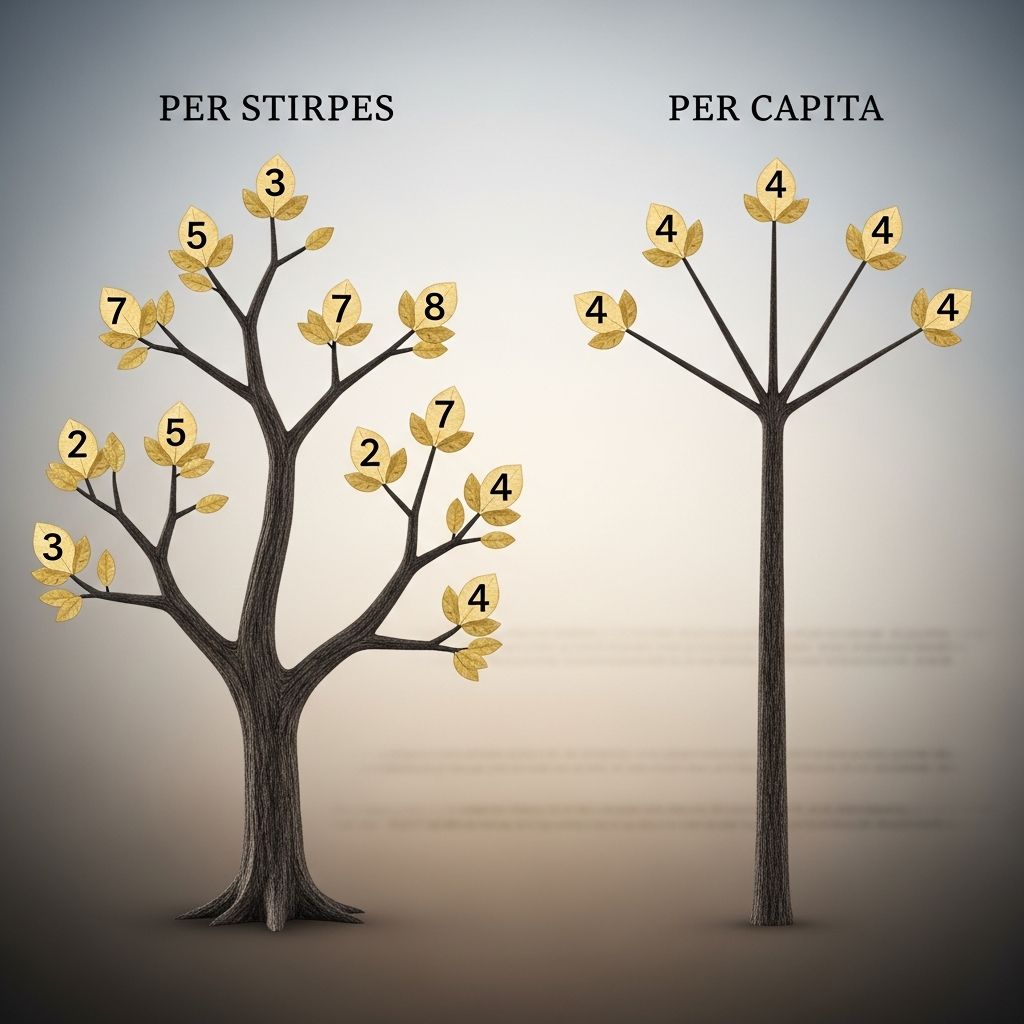
Per Stirpes vs Per Capita: How Wording in Your Will Changes Who Inherits
The phrases per stirpes and per capita look technical and old-fashioned, but they play a critical role in what happens to your property when a beneficiary dies before you. Both terms are used in wills, trusts, and beneficiary designations to decide who steps into the deceased beneficiary’s place and how shares are divided among your family members.
Understanding these concepts can help you avoid accidental disinheritance of grandchildren, unintended windfalls to a few relatives, and disputes among surviving family members. This guide explains each term in plain language and shows how they operate in common family situations.
Key Concepts: Beneficiaries, Branches, and Generations
Before diving into the Latin, it helps to clarify a few basic estate-planning ideas that appear in almost every will or trust.
- Beneficiary: A person or organization named to receive property when you die.
- Descendant: A person who is directly related down the bloodline, such as a child, grandchild, or great-grandchild.
- Branch of the family: All descendants who come from one child (for example, all of one child’s children and grandchildren).
- Generation level: People who are the same distance in the family tree from you (for example, all children are one generation, all grandchildren are another).
Per stirpes and per capita are simply two different ways of deciding whether to distribute inheritances by branch or by head among these descendants.
What Is Per Stirpes?
Per stirpes is a Latin phrase that translates to “by branch.” In estate planning, it means that if a beneficiary dies before you, that person’s share passes down to their own descendants, keeping the inheritance within that family line.
Lawyers sometimes describe a per stirpes system as distribution by right of representation, because each living descendant represents the place of their deceased parent in the inheritance.
Core features of per stirpes
- Focuses on branches: Each child of the person making the will (the testator) usually starts with an equal share.
- Children take their parent’s place: If one child dies first, that child’s descendants divide that child’s share among themselves.
- No descendants, no share: If a deceased beneficiary leaves no descendants, that branch typically receives nothing, and the share is reallocated among remaining branches, depending on the document and state law.
Why people choose per stirpes
- Protects grandchildren: Ensures that grandchildren are not inadvertently disinherited if their parent dies before the testator.
- Aligns with many people’s sense of fairness: Each branch of the family receives the same original share, even if one branch has more descendants than another.
- Automatically adapts: The system can adjust to new births and deaths in the family without constantly rewriting the will, because the language focuses on family branches rather than naming each person individually.
What Is Per Capita?
Per capita is Latin for “by head.” In an estate-planning context, per capita distribution divides an inheritance equally among all members of a specified group who are alive at the time of distribution.
Instead of tracking branches, per capita focuses only on how many living beneficiaries there are in a class, such as “my children” or “my descendants.”
Core features of per capita
- Equal shares for each living person in the class: Everyone at the named generation level (for example, all living children) receives the same amount.
- No automatic pass-down to grandchildren: Unless the will or trust states otherwise, the children of a deceased beneficiary do not automatically inherit their parent’s portion under a simple per capita clause.
- Share is redistributed among survivors: When a beneficiary in the specified class dies before the testator, that person’s share is usually reallocated among the remaining living class members.
Why people choose per capita
- Simplicity: The math is straightforward—count the living beneficiaries in the class and divide equally.
- Focus on surviving individuals: Ensures that only those who are alive at the testator’s death receive a share, which some people prefer when they wish to concentrate resources on a smaller group.
- Flexibility in defining the class: The testator may choose “to my children, per capita” or “to my descendants, per capita,” resulting in very different groups but the same basic principle of equal shares per living person.
Side-by-Side Comparison: Per Stirpes vs Per Capita
The following table highlights how these two approaches differ in practical terms.
| Feature | Per Stirpes | Per Capita |
|---|---|---|
| Literal meaning | “By branch” | “By head” |
| Primary focus | Family branches and lines of descent | Number of living beneficiaries in a defined class |
| If a child dies before the testator | The child’s descendants take that child’s share | The child’s share is usually divided among remaining living beneficiaries at the same level |
| Treatment of grandchildren | Grandchildren inherit only if their parent (the testator’s child) has died | Grandchildren may receive nothing if their parent survives, unless a broader class (like “descendants”) is used |
| Typical goal | Keep inheritances within each bloodline branch | Provide equal amounts per surviving beneficiary at the chosen generation |
| Common users | People who want grandchildren and later descendants protected | People who want to concentrate assets on a smaller group of living relatives |
Variations You May See in Modern Estate Plans
Estate planners and state statutes sometimes use variations of these concepts to fine-tune fairness among generations.
- Per stirpes at different generational levels: Some systems start the calculation at the first generation where someone is alive, which can result in more equal splits among grandchildren in large families.
- Per capita at each generation: A hybrid method, used in some states, that redistributes a deceased beneficiary’s share among their own descendants at the same generation level, rather than concentrating wealth in one branch.
- Custom wording: A will or trust can override default rules by carefully describing what should happen if a beneficiary dies first, including specific instructions for stepchildren or spouses.
Choosing Between Per Stirpes and Per Capita
Neither method is inherently better; the right choice depends on your family structure, values, and goals.
Questions to consider
- Do you want each branch of your family to receive the same overall share, even if some branches have more descendants?
- Do you prefer to divide assets among a fixed group of individuals and not automatically include their descendants?
- Are you concerned about accidentally disinheriting grandchildren if their parent dies before you?
- Is your family blended, with stepchildren or half-siblings, making clear definitions of “descendants” important?
When per stirpes often fits best
- You want your estate to trace through your bloodline so that if a child dies first, their children still benefit.
- You want each child’s branch of the family to receive the same overall slice of your estate, regardless of how many grandchildren each child has.
- You prefer not to update your will every time a grandchild is born, relying instead on the mechanism that descendants step into a parent’s place.
When per capita may be preferable
- You want to provide only for certain named beneficiaries (for example, just your surviving children) and not automatically for their descendants.
- Your estate is modest, and you want to avoid dividing it into very small shares across many grandchildren or great-grandchildren.
- You anticipate significant differences in how children will provide for their own families and do not want to equalize across branches.
Practical Tips for Using These Terms in Your Will
Because the words are short but powerful, a few drafting practices can reduce confusion and future conflict.
- Spell out your intent in plain language: Even when using per stirpes or per capita, consider adding an explanatory sentence so your wishes are obvious to non-lawyers.
- Identify the class clearly: State whether the gift is to “my children,” “my descendants,” “my grandchildren,” or another group, and consider including or excluding stepchildren in writing.
- Coordinate with beneficiary designations: Retirement accounts, life insurance, and payable-on-death designations may separately allow per stirpes or per capita choices. Align these with your will so the overall plan makes sense.
- Review state law differences: Some states default to particular definitions or modified systems (such as “per capita at each generation”), so a local attorney can explain how your language will be interpreted in your jurisdiction.
- Update after major life events: Death, birth, adoption, marriage, or divorce can all affect whether your current per stirpes or per capita choices still match your preferences.
Common Misunderstandings and Pitfalls
Many disputes in probate arise from small wording choices that were not fully understood when the documents were signed.
- Assuming grandchildren are always included: Under per capita to “my children,” grandchildren do not automatically receive anything unless their parent is also a named beneficiary or the class is defined more broadly.
- Ignoring blended families: If you have stepchildren or children from multiple relationships, relying solely on generic terms like “descendants” can lead to unexpected outcomes.
- Overlooking the effect of predeceased beneficiaries: Without clear instructions, a deceased beneficiary’s share may pass through state intestacy law, not where you thought it would go.
- Not coordinating with trusts: A revocable trust or other estate-planning vehicle may use its own distribution scheme. Inconsistency between documents can create confusion and litigation risk.
Frequently Asked Questions (FAQs)
Does per stirpes always start with my children?
Not necessarily. While many plans begin the per stirpes calculation with the testator’s children, some documents specify a different starting generation, such as grandchildren. State law and the exact language in your will or trust determine where the branches begin.
Can I use per stirpes for some gifts and per capita for others?
Yes. It is common to use different distribution methods for different parts of an estate. For example, you might give specific property to named individuals and use per stirpes for the residue of your estate. Clear drafting can mix these methods if your intentions are spelled out.
What happens if a beneficiary dies and has no children?
Under a typical per stirpes arrangement, a deceased beneficiary without descendants usually leaves no branch to inherit, so that share is redistributed among the remaining eligible beneficiaries according to the document and applicable state law.
Is one method more tax efficient?
The choice between per stirpes and per capita primarily affects who receives property, not how it is taxed. Estate and income tax consequences depend on the overall size of the estate, types of assets, and applicable federal and state tax rules, not just on these distribution labels. For complex estates, professional tax and legal advice is recommended.
Do these terms apply only to wills?
No. Per stirpes and per capita instructions appear in trusts, retirement accounts, life insurance policies, and other beneficiary designations. Many financial institutions allow you to select a per stirpes option directly on their forms, which then controls who inherits that specific asset if a primary beneficiary dies first.
References
- Uniform Probate Code — National Conference of Commissioners on Uniform State Laws. 2019-07-08. https://www.uniformlaws.org/committees/community-home?CommunityKey=FAAB51FC-73A3-4943-8FC8-9633CC7F6E1D
- Per stirpes vs. per capita in a will: What’s the difference? — FreeWill. 2023-05-10. https://www.freewill.com/learn/per-stirpes-vs-per-capita
- The Difference Between Per Capita and Per Stirpes Beneficiary Designations — Borshoff, Rogers & McGee, P.C. 2021-05-12. https://www.brmmlaw.com/blog/2021/may/the-difference-between-per-capita-and-per-stirpe/
- Per Stirpes vs Per Capita: What Do These Mean in a Will? — Laiderman Law Firm. 2022-03-18. https://www.laidermanlaw.com/understanding-how-assets-are-distributed-in-a-will/
- How Should I Distribute My Estate? Per Stirpes v. Per Capita — Charlotte Estate Planning. 2022-11-02. https://cltestateplanning.com/blog/how-should-i-distribute-my-estate-per-stirpes-v-per-capita/
- Per Stirpes vs Per Capita in a Will: Understanding the Distinction — PlannedGiving.com. 2023-01-06. https://www.plannedgiving.com/per-stirpes-vs-per-capita-in-a-will-understanding-the-distinction/
- Per Stirpes vs Per Capita – What’s the Difference? — Trust & Will. 2023-08-15. https://trustandwill.com/learn/difference-between-per-stirpes-and-per-capita
Similar Articles








Read full bio of medha deb


